NILS4 will be conducted in late 2025 to 2026 and reported upon in 2026.
There’s currently a national target in Australia about strengthening Aboriginal and Torres Strait Islander languages by 2031. This is Target 16 in a policy framework called Closing the Gap. Zoe and I talk about how language strength can be measured in different ways and how the team have chosen to ask about language strength in this survey in ways that show clearly that the questions are informed by the voices in the co-design process.
Then we discuss the parts of the survey which ask about how languages can be better supported, for example in terms of government funding, government infrastructure, access to ‘spaces for languages’ and access to language materials, or through community support. The latest draft of the survey also mentions legislation about languages as a possible form of support. This is great; the data should encourage policy makers not to intuit or impose solutions, but rather to listen to what language authorities are saying they need. What I especially noticed in this part of the survey was the question about racism affecting the strength of a language – or reducing racism as a form of supporting languages – so I ask Zoe to tell me what led the team to include it.
We go on to discuss the enormous efforts and progress underway, and the love which many Aboriginal and Torres Strait Islander communities around Australia have for language maintenance or renewal. People may get the impression that language renewal is all hardship and bad news because a focus on language ‘loss’, ‘death’, or oppression pervades so much of the academic and media commentary. But Zoe and I both recently met in person at a fabulous, Indigenous-led conference in Darwin called PULiiMA in which delegates from 196 Aboriginal or Torres Strait Islander languages participated. That’s just one indication of the enormous effort and progress around Australia, mainly initiated by language communities themselves rather than by governments. We talk about why, in this context, it’s important that this survey also has section about languages ‘flourishing’ and being learnt.
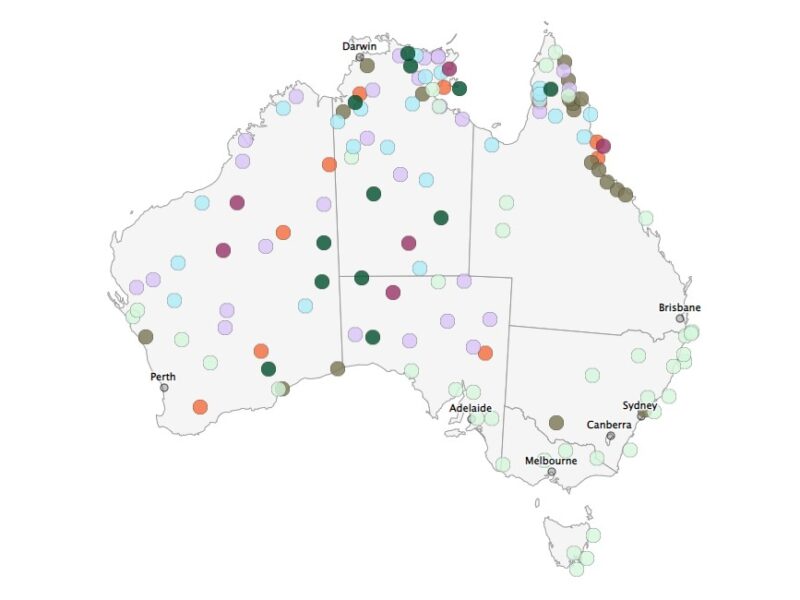
Language groups that participated in NILS3
We discuss the plans for reporting on the survey; incorporating the idea of ‘language ecologies’ was one of the biggest innovations in the National Indigenous Languages Report (2020) about the 3rd NILS and continues to inform NILS4. Finally, we talk about providing Language Respondents and communities access to the data after this survey is completed, in line with data sovereignty principles.
The survey should be available for Language Respondents to complete, on behalf of each language, in late 2025. AIATSIS will facilitate responses online, by phone, on paper and in person. If you would like to nominate a person or organisation to tell us about an Aboriginal or Torres Strait Islander language, please contact the team at [email protected]. Respondents will have the option of talking in greater depth about their language in case studies which AIATSIS will then include as a chapters in the report, as part of responding to calls in the co-design process to enable more access to qualitative data and data in respondents’ own words.
If you liked this episode, support us by subscribing to the Language on the Move Podcast on your podcast app of choice, leaving a 5-star review, and recommending the Language on the Move Podcast and our partner the New Books Network to your students, colleagues, and friends.
Transcript
Alex: Welcome to the Language on the Move Podcast, a channel on the New Books Network.
My name is Alex Grey, and I’m a research fellow and senior lecturer at the University of Technology in Sydney in Australia. This university stands on what has long been unceded land of the Gadi people, so I’ll just acknowledge, in the way that we do often these days in Australia, where we are. Ngyini ngalawa-ngun, mari budjari Gadi-nura-da and I’d really like to thank
Ngarigo woman, Professor Jaky Troy, who, in her professional work as a linguist, is an expert on the Sydney Language, and has helped develop that particular acknowledgement.
My guest today is Zoe Avery, a Worimi woman and a research officer at the Centre for Australian Languages. That centre is part of the Australian Institute for Aboriginal and Torres Strait Islander Studies, which we’ll call AIATSIS. Zoe, welcome to the show!
Zoe: Thank you! I’m really excited to be here and talking about my work that I’m doing at AIATSIS.
Alex: Yeah, so in this work at AIATSIS, you’re one of the people involved in preparing the upcoming National Indigenous Languages Survey. This will be the fourth National Indigenous Languages Survey in Australia. The first one came out now over 20 years ago, in 2005.
This time around, you and your team have made some really important changes to the survey design through the co-design process. Let’s talk about that. Can you tell us, please, what is the National Indigenous Languages Survey, what’s it used for, and how this fourth iteration was co-designed?
Zoe: Yeah, so, the National Indigenous Languages Surveys, or I’ll be calling it NILS throughout the podcast, they’re used to report the status and situation of Indigenous languages in Australia, as you mentioned. This is the fourth one. The first one was done all the way back in 2004 and, the third NILS was done about 6 years ago, in 2019. So it’s been a while, and it’s kind of just to show the progress of how, languages in Australia are being spoken and used, and I suppose the strength of the languages, which we’ll kind of go into a bit more detail. But the data is really important, because it can be used by the government to develop, appropriate language revitalisation programs or understand the areas that require the most support, but it can also be used by communities, which is really important as well.
And so, NILS4 has been a little bit different from the start compared to previous NILS, because the government has asked us to run this survey in order to measure Target 16 of Closing the Gap, which is that by 2031, languages, sorry, by 2031, there is a sustained increase in the number and strength of Aboriginal and Torres Strait Islander languages being spoken.
So, the scope for this project is much bigger than the past NILS, and AIATSIS has really prioritised Indigenous leadership in the design, and will be continuing to prioritise Indigenous voices in the rollout and reporting of the results of the survey.
So, because this is a national-level database, and we want to make sure as many languages as possible are represented, including previously under-recognized and under-reported languages, including sign languages, new languages, dialects. It’s really important that we have Indigenous voices, prioritized throughout this entire research process. And we want to make sure that the questions that are being asked in the survey are questions that the community want answers to, whether or not to advocate, to the government that these are the areas that need the most support, the most funding, or whether or not the community want that data for themselves to help develop, appropriate, culturally safe programs.
So what we did is we had this big co-design process, this year to design the survey. We had 16 co-design workshops with Indigenous language stakeholders across Australia, and this was, these workshops were facilitated by co-design specialists Yamagigu Consulting. We had, in total, about 150 people participate in the co-design process, and of these 150 people, about 107 of these were Indigenous. And so these Indigenous language stakeholders included elders, language centre staff members, teachers, interpreters, sign language users, language workers, government stakeholders, all sorts of different people that have a stake in Indigenous languages, for whatever reason. And we had 8 on-country workshops, which were held in cities around Australia, and 8 online workshops as well, which helps make it easier for, people that kind of came from different places, and weren’t able to come to an in-person workshop.
Alex: That’s a huge… sorry, just congratulations, that sounds like it’s been a huge undertaking. So many people, so many, so many workshops, well done.
Zoe: Yeah, it has been huge, and we’ve had so many different people from a variety of different language contexts, participate as well. So, the diversity of language experiences that were kind of showcased at these workshops was immense and has had a huge impact on drafting the survey, which is obviously the whole point of the workshops, but yeah … We took all the insights from the co-design workshops, we analysed them, thematically coded everything, and started incorporating everything into the survey. And then we went back to the people who participated in the co-design workshops and held these validation workshops so we could show them the draft of the survey, show them how we had planned on incorporating all of their insights, you know, that we weren’t just doing it for the sake of ticking a box to say, yes, we’ve had Indigenous engagement, but we were actually really wanting to have Indigenous input from the start, and right until the end of the project. And we had really good feedback from the validation workshops, and it is, you know, not just a massive task running these workshops, but also, making sure that everybody’s listened to, and sometimes they were kind of contrasting views about how things should be done, and yeah, we wanted to make sure that we had as much of a balance as possible.
We also consulted with the Languages Policy Partnership, which are kind of key workers in Indigenous languages policy and, advocacy. They’re kind of leaders in the Closing the Gap Target 16 that I was just talking about, so their input and advice has been really important to us, as have consultations with the Australian Bureau of Statistics and the Mayi Kuwayu Study of Aboriginal and Torres Strait Islander Wellbeing. So yeah, there’s been a lot of input, and we’re really excited that we’re at the point now where we’re finishing the survey! Dotting all the I’s, crossing all the T’s and getting ready to start rollout soon.
Alex: Yeah, well, I mean, one would hope good input, good output! You know, such a huge process of designing it. You should get really well-targeted, really informative, useful results.
And you’ve mentioned a few things there that I’ll just explain for listeners, because not all our listeners will be familiar with the Australian context. It’s coming through that there’s enormous diversity of Indigenous peoples and languages in Australia, so to explain a little bit, because we won’t go into this in much detail in this interview, Zoe’s mentioned new languages like, contact languages, Aboriginal Englishes, Creoles, like Yumplatok, which comes from the place called the Torres Strait. If you’re not familiar with Australia, that area is between Australia, the Australian mainland, and Papua New Guinea, in the northeast. And then there’s an enormous diversity of what are sometimes called traditional languages across Australia, both on the mainland and the Tiwi Islands as well. So we have a lot of Aboriginal language diversity, and then in addition, Torres Strait Islander languages, and then in addition, new or contact varieties.
Zoe: Sign languages.
Alex: And sign… of course, yes, and sign languages. Thank you, Zoe. And then you’ve mentioned Target 16. So we have in Australia a policy framework called Closing the Gap. For the first time ever, the current Closing the Gap framework includes a target on language strength.
But as the survey goes in to, language strength can be measured in different ways. So how have you chosen to ask about language strength in this survey, and why have you chosen these ways of asking?
Zoe: Yeah, so, along with, kind of, Target 16 of Closing the Gap, there’s an Outcome 16, which is that Aboriginal and Torres Strait Islander cultures and languages are strong, supported, and flourishing. So it’s important for us in the survey to, kind of, address those kind of buzzwords, strong, supported, and flourishing. But it is very clear, from co-design, that the widely used measures of language strength don’t necessarily always apply to Australian Indigenous languages. So these kind of widely used and recognised measures of how many speakers of a language are there, and is the language still being learned by children as a first language? These are not the only ways of measuring language strength, and we really wanted to make sure that we kind of redefined language strength in the survey based off Indigenous worldviews. So, language is independent [interdependent] with things like community, identity, country, ceremony, and self-determination.
How do we incorporate that into the survey? So we’re still going to be asking questions, like, how many speakers of the language are there? What age are the people who are speaking the language, but we’re also going to be asking questions on how many people understand the language, because people may not be able to speak a language due to disability, cultural protocol reasons, or due to revitalisation, for example. But they can still understand the language, and that can still be an indication of language strength. We’re also asking questions about how and where it’s used. So, do people use the language while practicing cultural activities, in ceremony, in storytelling, in writing, just to name a few? We know that Indigenous languages are so strongly entangled with culture and country, and it’s difficult to measure the strength of culture and country. But we can acknowledge the interdependencies of language, culture, and country, and by asking these kinds of questions, we can get some culturally appropriate and community-led ways of defining language strength.
Alex: And that’s just going to be so useful for, then, the raft of policies that one hopes will follow not just the survey, but follow the Target 16, and even once we get to 2031, will continue in the wake of, you know, supporting that revitalisation.
Zoe: Yeah, absolutely, and I think that, another thing that we heard from co-design, but just also from Indigenous people, in research and advocacy, that language is such a huge part of culture and identity, that by, you know, developing these programs and policies to help address, language strength, all the other Closing the Gap targets, like health and justice and education, those outcomes will all be improved as well.
Alex: Yeah, I guess that’s why, in the policy speak, language is part of one of the priority response areas for the Closing the Gap. And I noticed this round of the survey in particular is different from what I’ve seen in the earlier NILS in the way it asks questions, which also appears to reflect the co-design. So, for example, these questions about language strength, they start with the phrase, ‘we heard that’ and then a particular kind of way of thinking about strength. And then another way of thinking about strength might be presented in the next question: ‘We also heard that…’. So on, so on. So, is this so people trust the survey more, or are you conscious of phrasing the survey questions really differently compared to, say, the 2019 version of the survey?
Zoe: Yeah, absolutely we want people to trust the survey, and understand that we respect each individual response. Like, as much as it’s true, we’re a government agency, and we’ve been asked to do this to get data for Closing the Gap, we want language communities to also be able to use this data for their own self-determination, and we want to try and break down these barriers for communities and reduce the burden as much as possible. So, making sure that the survey was phrased in accessible language, and the questions were as consistent as possible.
But yeah, we wanted to make sure that we were implementing insights from co-design, but making it clear in the survey that we didn’t just kind of come up with these questions out of nowhere, that these were co-designed with community and represent the different priorities of different language organisations, workers, and communities across Australia. So, we want the community to know why we’re asking these questions. And also, why they should answer the questions. Because ultimately, that’s why we’re asking the survey questions, because we want people to answer the questions.
Alex: Yeah, yeah, and I think that also comes through in the next part of the survey as well, which is about how languages can be better supported, which again gives a lot of, sort of co-designed ideas of different ways of support that people can then talk to and expand on, so that what comes through in your data, hopefully, is really community-led ideas of what government support or community support would look like, rather than top-down approaches.
So, for example, the survey asks about forms of government funding, reform to government infrastructure, access to what the survey calls ‘spaces for languages’. I really like this idea as a sociolinguist, I really get that. Access to language materials through community support. The survey also mentions legislation about languages as a possible form of support. So this should encourage policymakers not to intuit or impose solutions, but rather to listen to the survey language respondents and what they say they need.
What I especially noticed in this part of the survey was the question about racism affecting the strength of language. Or, if you like, reducing racism as a way of supporting language renewal. I don’t think this question was asked in previous versions of the survey, right? Can you tell us what led your team to include this one?
Zoe: Yeah, so, this idea of a supported language, as I measured… as I explained before, is one of the measures in, Outcome 16 of Closing the Gap, and that we want policymakers to listen to what the language communities want and need in regards of support, because, you know, in Australia, there’s so much language diversity, it’s not a one-size-fits-all approach. Funding was something that all language communities had in common, whether it was language revitalisation they needed funding for, resources and language workers, but also languages that, one could say are in maintenance, so languages considered strong languages, that have a lot of speakers, they also need funding to make sure that their language, isn’t at risk of being lost, and that, it can stay a strong language.
So, there are other kinds of ways that a language can be supported, and if we’re talking about, kind of racism and discrimination as a way that a language isn’t supported. It was important for us to kind of ask that question, because in co-design it was clear that racism and discrimination are still massively impacting language revitalisation and strengthening efforts. The unfortunate reality of the situation of Australian languages, Indigenous languages, is that due to colonisation, Indigenous languages have been actively suppressed.
We want to make sure that respondents of the survey have the opportunity to, kind of, participate in this truth-telling. It is an optional question. We understand it can be somewhat distressing to talk about language loss and the impacts of racism and things like that, but if respondents feel comfortable to answer this question, it does give communities the opportunity to share their stories about how their language has been impacted by racism. So, yeah.
Alex: I really think that’s important, not just to inform future policy, but the act of responding itself, as you say, is a form of truth-telling, and the act of asking, and having an institute that will then combine all those responses and tell other people. That’s an act of what we might call truth-listening, which is really important in confronting the social setting of language use and renewal. This goes back then, I guess, to strength. It’s not just how many people learn a language, or how many children exist who grow up in households speaking a language. There has to be a social world in which that language is not discriminated against, and those people don’t feel discriminated against for wanting to learn that language or wanting to use it.
Now, people may get the impression that language renewal is all hardship and bad news because of a focus on ‘language loss’, in quotes, or language ‘death’, or oppression. This pervades so much of the academic and media commentary. But you and I, Zoe, we met recently in person at a fabulous Indigenous-led conference in Darwin called PULiiMA and there, there were delegates from 196 Aboriginal or Torres Strait Islander languages participating. So, that’s just one indication of the enormous effort and progress in this space around Australia, and mainly progress and effort initiated by language communities themselves, rather than governments.
So in that context, it’s important, I think, that this survey also has a section about languages flourishing, the positive focus. Languages are being learnt and taught and used and revived and loved. Tell us more about the design and purpose of the ‘flourishing’ sections of the survey.
Zoe: Yeah, I just want to say that how awesome PULiiMA was, and to see all the different communities all there, and there was so much language and love and support in the room, and everyone had a story to tell about how their language was flourishing, which was so awesome to hear. A flourishing language in terms of designing a survey and asking questions about, is a language flourishing, is a tricky thing to unpack, because in co-design, we kind of heard that a flourishing language can be put down to two things, and that’s visibility and growth of a language. And so growth of a language is something that you can understand, based off the questions that we’ve already asked, in kind of the strength of a language, how many speakers, is this number more or less compared to last time, the last survey? We’re also asking questions about, ‘has this number grown?’ in case it kind of sits within the same bracket as it did in the last survey.
And visibility is, kind of the other factor, which can be misleading sometimes as well. We’re asking questions about you know, is it being used in place names, public signage, films and media. Just to name a few. But a language that is highly visible in public maybe assumed to be strong, but isn’t strong where it matters, so, being used within families and communities. So, this section is a little bit smaller, because it kind of builds on the questions in previous sections.
It will be interesting to see, kind of, the idea of a flourishing language, and we do have the opportunity for people to kind of expand on their, responses in, kind of, long form answers, so people can explain, in their own words, in detail, if they choose to, kind of, how they see their language as being flourishing,
But, yeah, for a language to be strong and flourishing, it needs to be supported, and that’s something that was very clear in co-design, and people wanting things like language legislation, and funding, and how these things can be used to support the language strength, and to allow it to flourish. So in this section, we also have, kind of, an opportunity for people to give us their top 3 language goals. So whether that’s, they want to increase the number of speakers, or they want to improve community well-being. All sorts of different language goals and the opportunity for people to put their own language goals and the supports needed to achieve those language goals. So, the people who would benefit from the data from this survey, the government, policy makers, communities, they can see what community has actually said are their priorities for their language, and what they believe is the best way to address those language goals. So, encouraging self-determination, within this survey.
Alex: And following on from that point, I have a question in a second about, sort of, how you report the information, and also data sovereignty, how communities have access to, in a self-determined way, use this resource. But I just wanted to ask one more procedural question first. So, you shared a complete draft with me, and we’ve spoken about the redrafting process, so I know the survey’s close to ready, but where are you at the team at AIATIS is up to now – and now, actually, for those listening in the future, is October 2025. Do you have an idea of when it will be released for people to answer, and who will you be asking to answer this survey?
[brief muted interruption]Zoe: Yeah, so we’ve just hit a huge milestone in the research project where we’re in the middle of our ethics application. So, we’ve kind of finished drafting the survey, and it’s getting ready for review from the Ethics Committee at AIATSIS. And hopefully, if all goes well, we’ll be able to start rolling out the survey in November [2025].
So yes, it’s been a long time coming. This survey’s been in the works for many years. I’ve only personally been working on this project for a little under 12 months, but there have been many people before me working towards this milestone.
And the people that we want to be completing this survey are what we’re calling language respondents. So we don’t necessarily want every Indigenous person in Australia to talk about their language, but rather have one response per language by a language respondent who can kind of speak on the whole situation and status of their language, and can answer questions like how many speakers speak the language. So that could be anyone from an elder to a language centre staff member, maybe a teacher or staff member at a bilingual school. We’re not defining language respondent and who can be a language respondent because we understand that that’s different, depending on the language community, and if there are thousands of speakers of a language, or very few speakers of a language. We also understand that there could be multiple people within one language group that are considered language respondents, so we’re not limiting the survey to one response per language, but that’s kind of the underlying goal that we can get as many responses from the different languages in Australia, but at least one per language.
Alex: That makes sense. So, it’s sort of at least one per speaker group, or one per language community.
Zoe: Yeah.
Alex: Yep. Yeah. Yep. And then… so the questions I foreshadowed just before, one is about the reporting. So, I noticed last time around the National Indigenous Languages Report, which came out after the last survey – so the report came out in 2020 – that incorporated this really important idea of language ecologies, and that was one of the biggest innovations of that round of the survey. And that was, I think, directed at presenting the results in a way that better contextualized what support actually looks like on the ground, rather than this very abstracted notion of each language being very distinct and sort of just recorded in government metrics, but [rather] embedding it in a sense of lots of dynamic language practices, from people who use more than one variety.
So do you want to tell us a little bit more about how you’ve understood that language ecologies idea? Because I see that comes up in a question as well, this time around in the survey, and is it in the survey because you’re hoping to use that in the framing of the report as well?
Zoe: Yeah, so the third NILS, which produced the National Indigenous Languages Report in 2020, contributed massively to increasing awareness of language ecologies, and this idea that a language doesn’t exist within a bubble. It has contextual influences, particularly when it comes to multilingualism and other languages that incorporate, are incorporated into the community. So NILS4 aims to build on this work, in collecting interconnected data about what languages are being used. Who are they being used by? In what ways? Where are they being used at schools? At the shops, in the home. Different languages, as you mentioned before, different varieties of English, so that could be Aboriginal English, for example, or Standard Australian English. It could be other Indigenous, traditional Indigenous languages, so some communities are highly multilingual and can speak many different traditional languages. Some communities may use sign languages, whether that’s traditional sign languages or new sign languages, like Black Auslan. And kind of knowing how communities use not only the language that the survey is being responded to about, but also other languages, which will help with things like interpreting and translating services, education services, all sorts of different, things that, by understanding the language ecology better and the environment that the language exists in, yeah —
Alex: That makes sense, and there you’ve mentioned a few things that I didn’t really ask you about, but I’ll just flag they’re there in the survey too, translation and interpreting services, education, government services, and more broadly, workforce participation through a particular Aboriginal or Torres Strait Islander language. That’s important data to collect. But the last sort of pressing question I have for you in this podcast is not about language work but about data sovereignty. This is a really big issue in Australia, not just for this survey, but for all research, by and with Indigenous peoples, and particularly looking at older research that was done without the involvement of Indigenous people, where there’s been problems with who controls and accesses data. So, what happens to the data that AIATSIS collects through this survey?
Zoe: Yeah, so data sovereignty is obviously one of our priorities and communities fundamentally will own the data that they input into the survey. And there will be different ways that, this information will be shared or published, depending on what the respondent consents to. So, part of the survey includes this consent form, where they basically, can decide how their data will be used and shared. And so the kind of three primary ways that the data will be used is: it will be sent to the Productivity Commission for Closing the Gap data, as I mentioned before, we have been funded in order to produce data for Closing the Gap Target 16, and so the data that’s sent to the Productivity Commission will be all de-identified. And this will be all the, kind of, quantitative responses, so nothing that can kind of be identified will be sent to the Productivity Commission. And this kind of data is kind of the baseline of what people are consenting to by participating in the survey. If they don’t consent to this, then, they don’t have to do the survey, their response won’t be recorded.
And then the other kind of two ways that AIATSIS will be reporting on the data is through the NILS4 report that will be published next year [2026], and also this kind of interactive dashboard on our website. So people will be able to kind of look at some of the responses. And communities will have the option on whether this data is identified or de-identified, so some communities may wish to have their responses identifiable, and people will be able to search through and see kind of data that relates to their communities, or communities of interest, or they might choose to kind of remain anonymous and de-identified, and so these are going to be mostly quantitative responses as well.
However, we are interested in, kind of publishing these case studies in the NILS report, which will be opportunities for communities to tell their language journey in their own words. And so this is a co-opt, sorry, an opt-in co-authored chapter in the NILS report, that, yeah, language communities can not just have data, or their responses, but have the context provided, the story of their language and their data. And that was something that was really evident in co-design, that the qualitative data needs to exist alongside the quantitative data, and that’s a huge part of data sovereignty as well, like, how communities want to be able to share their data. So, we’re really excited about this kind of, co-authored case study chapter in the report, because community are excited about it as well. They want to be able to tell their story in, in their own words.
And so, that’s kind of how the data will be used and published, but, there are other ways that the community will be able to kind of access their data that they provide in the survey. So, that’s also really important to us, and we’re following the kind of definitions of Indigenous data sovereignty from the Maiam Nayri Wingara data sovereignty principles. So, making sure that, yeah, community have ownership of their data, and they can have access to it, are able to interpret it, analyse it. And this is kind of being done from the beginning of co-design all the way up to the reporting, and that, yeah, community have control over their data at all points of this process.
Alex: It sounded like just such a thoughtfully managed and thoughtfully designed survey, so thanks again, Zoe, for talking us through it, and all the best for a successful rollout. The next phase should be really interesting for you to actually get people reading and responding, and I’ll be looking out for the survey results when you publish them later in 2026. Is there anything else about the survey that you’d like to tell our listeners?
Zoe: I think that we’ve had a really, productive conversation about our survey. We’re really excited to start rolling it out, and we’re really excited for people to look out for the results as they start to be published and shared next year. So, yeah, if anybody has any questions, or would like more information, I encourage everyone to kind of check out our website and send us an email. But yeah, thank you for having me, and for letting me chat about this project. It’s been a huge part of my life for the past few months, and excited for the rest of the world to get to experience this data, which is hopefully going to have such a big impact on communities having this accurate, reliable, comprehensive national database, that can be used for, yeah, major strides in Indigenous languages in Australia.
Alex: Well, we’ll definitely put the AIATSIS website, which is AIATSIS.gov.au, in the show notes, and then when the particular survey is out for people to respond to, we’ll put that in the notes on the Language on the Move blog that embeds this interview as well. And then people will be able to, as I understand it, respond online to the survey, or over the phone, or in person, and in a written form as well. So, as that information is available, we’ll share that with this interview.
So, for now, thanks so much again, Zoe, for talking me through this survey, and thanks everyone for listening. If you enjoyed the show, please subscribe to our channel, leave a 5-star review on your podcast app of choice, and of course, please recommend the Language on the Move podcast and our partner, The New Books Network, to your students, your colleagues, your friends. Speak to you next time!
Zoe: Thank you.
]]>The conversation focuses on a study of adults with three languages ‘at play’ in their childhoods and lives today, exploring how visible racial differences from the mainstream, social power, emotions, and familial relationships continue to shape their use – or erasure – of their linguistic heritage.
Zozan’s book opens with a funny and touching account of how her own experiences as a person of “ambiguous ethnicity” shaped this research. We begin our interview on this topic. Zozan points out that the last Australian Census showed that 48.2% of the population has one or both parents born overseas. Yet, she argues, “our teachers and our education system are unprepared, perpetuating the power relations that reinforce injustice and inequality towards half of the population”.
Then we focus on what diversity feels like to her research participants and how “mixedness” or “hybridity” is not normalised, despite being common. We build on a point Zozan makes in her book, that throughout their daily lives the participants “have to position themselves because our [social and institutional] understanding of identity is narrow-mindedly focused on a single affiliation. […] While all participants are engaged in such strategic positioning, my findings emphasise that this can come at a great personal expense, something which is not sufficiently recognised by scholarly work in this field thus far.”
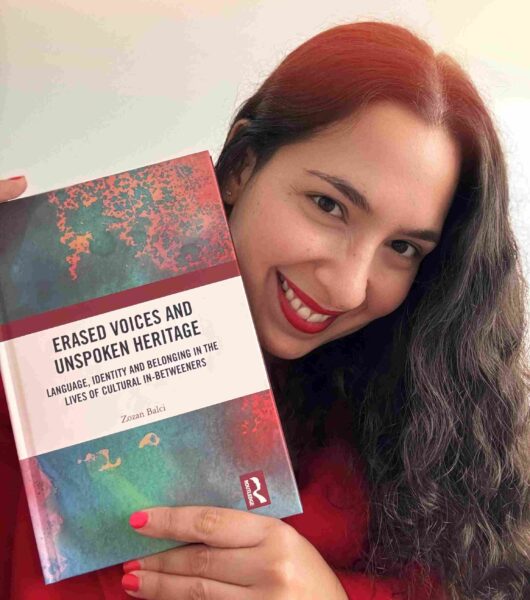
Dr Zozan Balci with her new book (Image credit: Zozan Balci)
We then delve into the emotions experienced and remembered by participants in relation to certain language practices in both childhood and more recent years, and the way these shape their habits of language choice and self-silencing. While negative emotional experiences have impacted on heritage language transmission and use, Zozan’s study shows how people who had distanced themselves from their heritage language – and its speakers – then changed: “it only [took] one loving person […] to reintroduce my participants to a long-lost interest in their heritage language”. We focus on this “message of hope” and then on another cause of hope, being the engaged results Zozan’s achieved when she redesigned a university classroom activity to un-teach a deficit mentality about heritage languages and identities.
Finally, we discuss Zozan and her team’s current “Say Our Name” project. This practically-oriented extension of Zozan’s research addresses one specific aspect of linguistic heritage and identity formation: the alienation experienced by people whose names are considered ‘tricky’ or ‘foreign’ in Anglo-centric contexts. The project has created practical guides now used by universities and corporations and the City of Sydney recently hosted a public premiere of the Say Our Names documentary. Soon, Zozan will be developing an iteration of the project with the University of Liverpool in the UK.
Follow Zozan Balci on LinkedIn. She’s also available for guest talks and happy to discuss via LinkedIn.
If you liked this episode, support us by subscribing to the Language on the Move Podcast on your podcast app of choice, leaving a 5-star review, and recommending the Language on the Move Podcast and our partner the New Books Network to your students, colleagues, and friends.
Transcript
ALEX: Welcome to the Language on the Move podcast, a channel on the New Books Network. I’m Alex Grey, and I’m a research fellow and senior lecturer at the University of Technology Sydney in Australia. My guest today is Dr. Zozan Balci, a colleague of mine at UTS. Zozan is an award-winning academic, a sociolinguist, and a social justice advocate. Zozan, welcome to the show.
ZOZAN: Hello, thank you for having me.
ALEX: A pleasure! Now, Zozan, you teach in the Social and Political Science program here at UTS, and I know you have a lot of teaching experience, but today we’ll focus on your sociolinguistics research. In particular, let’s talk about your new book. How exciting! It’s called Erased Voices and Unspoken Heritage: Language, identity, and belonging in the lives of cultural in-betweeners. You’ve just published it with Routledge.
The first chapter is called A Day in the Life of the Ethnically Ambiguous, and you begin by talking about your own, as you put it, “ambiguous ethnicity”. So let’s start there. Tell us about how your own life shaped this research, and then who participated in the study that you designed.
ZOZAN: Yeah, thank you so much, and yes, “ethnically ambiguous” is kind of like the joke that I always introduce myself with. So, I was born and raised in Germany to immigrant parents, so although I’m German, I look Mediterranean. And so people mistake me from being from all sorts of places. I’ve been mistaken for pretty much everything but German at this point. So, you know, I personally grew up, in my house, we spoke 3 languages, so we spoke German, Italian, and Turkish, which is essentially how my family is made up. And, you know, this has kind of resulted in a bit of a… I’m gonna call it a lifelong identity crisis, because, you know, that’s a lot of cultures in one home.
And it also has played out in language quite interestingly, and I just kind of wanted to see with my study if others struggle with the same sort of thing, other people who are in this kind of environment, and I found that they do. And so in the book. I tell the stories of four people, all who have two ancestries in addition to the country they are born in, so there’s three languages at least at play. And all are visible minorities, so they… they don’t look like the mainstream culture in their… in the country where they were born. And all struggle having so many different cultures and languages to navigate. And, you know, it’s quite interesting, in some of the cases, the parents are from vastly different parts of the world, so the kid actually looks nothing like one of their parents.
So, one example is my participant, Claire. She has a Japanese mother and a Ugandan father, and so she speaks of the struggle of looking nothing like a Japanese person, so in her words, all people ever see is that she’s black.
And so there is some really heartbreaking stories about, you know, how challenging that is, growing up in Australia when you look nothing like your mum, and…You know, it’s also hard to assert your Japanese heritage when people look at you and don’t accept that you are half Japanese, even though she strongly identifies with it, for example. So, there are a couple of participants like that.
One of my participants, Kai, is probably the one I personally relate to the most. His mother is Greek, and his father is Swedish, and he looks very Mediterranean like me. So, he talks a lot about, you know, the guilt towards his heritage community, also internalized racism, and that is something I could probably personally very much relate to. So these are the kinds of stories that are in this book.
ALEX: They’re wonderful stories because you frame them in such a clear way that connects them to research and connects them to bigger ideas than just the personal experience of each participant, but it becomes very moving. These participants clearly have a great rapport with you. When Claire talks about speaking Japanese and the impact being a visible minority and visibly not Japanese, it seems, to other people, has on her. That’s incredibly touching, but also the effect that has on her mum, and her mum’s desire to pass on heritage language to Claire.
But the opening few pages are also, I have to say, really funny and interesting. They drew me in, I wanted to keep reading. So I’ll just add that in there to encourage listeners to go out and seek more of your voice after this podcast by reading the book.
Now, in this book, your intention, in your own words, is to explain what diversity feels like, and to normalize mixedness. And you point out that this is really important, pressing, in a place like Australia, but many places where our listeners will be around the world are similar. In Australia, about half the population are what we might call second-generation migrants, with at least one parent born overseas. And so you go on to say, this book aims to have a genuine conversation about what diversity and inclusion look like.
So, tell us more about what hybridity is. This is a concept you use for the, if you like, the sort of
embodied personal diversity of people, and what it feels like for your participants, and whether hybrid identities are recognised and included.
ZOZAN: Yeah, you know, it’s actually quite interesting, because when people hear that you’re culturally quite mixed, they kind of misunderstand what it’s like. So, you know, your mind doesn’t work in nationalities or languages, right? So in the case of my study, where three cultures or languages, are at play, you know, those… these participants don’t consider that they have three identities. Like, that is not how a mind works.
So rather, you are a person who has mixed it all up. So you don’t just think in one language, unless you have to. Like, for example, right now, I’m speaking to you in English, because I have to, but, you know, when I’m just chopping my vegetables and thinking about my day, I don’t think in only English. It’s a mix, in a single sentence, I would mix. If I speak to someone who can understand another language that I speak, I would probably mix those two. Like, it’s just… but I don’t do this, like, oh, let me mix two languages. Like, I’m not consciously doing that. And the same goes for behaviours or practices.
So, the way I kind of, you know, an analogy that I think you can use here, maybe to make it easier to understand, is if you think of, you know, say you have your 3 cultures, and there are 3 liquids, and so you pour them all in a cup and make a cocktail, right? So you mix them all up. And…
ZOZAN: you know, it’s… It’s very hard, then, to tell the individual flavour of this new cocktail now, right? It’s all mixed. But, you know, that’s not something that people understand. They want… they want the three liquids, the original liquids, what is in there? And often, you know, they will tell you that you probably ruined the drink by mixing them.
Laughter
ALEX: We laugh, but your participants have really experienced words to that effect, sure.
ZOZAN: Absolutely, and so, you know, you are often forced into a position, so you are forced to pretend you’re a different drink, because it’s very hard to, you know, separate the liquids once they have been mixed, right? And, you know, now I’m also Australian, so a dash of a new liquid has been mixed into it, you know, making the whole drink more refreshing, I think.
But, you know, unfortunately, most people still have very rigid ideas about identity, including our parents, right? So my parents cannot relate to my experience at all. They are not mixed. My teachers didn’t get it at school, right? Only people like me get it. But it’s important that we all kind of start thinking a little bit about what we’re asking people to do, because, you know.
when I went to school, for example, I could only be German, so I had to leave my other languages and my behaviours at home, because, you know, of assimilation, right? You need to assimilate to everybody else.
And then in my house with my parents, you need to leave the German outside, so it’s considered disrespectful if I say I’m German, right? So my parents would hate to hear this podcast, for example. Because to them, it’s like renouncing your heritage, right? So it’s about… you need to preserve what we have given you. And so you are kind of this person who’s like, well…
I don’t see it the way… I’m not three things. This is all me, and it’s actually people trying to over-analyse what kind of nationality this behaviour is, or this language is. In your head, you’re not actually doing that. You’re just one person who is a cocktail.
ALEX: That makes a lot of sense when you explain it, but in the findings, it becomes really clear that that’s actually very hard for people to assert as an identity. As you say, with parents, with teachers, with the public at large. You call it strategic positioning, the way people have to downplay, or almost ignore, or not show their language, or not show their other aspects of their… their different heritages, and that that can come at great personal expense.
And you point out that, in fact, while a lot of the research literature may celebrate this mixedness or this hybridity, the fact that it comes at personal expense and is difficult is not really acknowledged very much.
Now in this work you’re also drawing on some really foundational theories of language and power. So it’s not just about feeling bad or feeling excluded. The way people are able to mix their heritage languages and other aspects of their heritage, and the way they’re not able to comes within a power play and that draws really on the work of Pierre Bourdieu. I won’t delve really deeply into his theory of habitus, but I’ll quote this explanation of yours, which I loved: “the habitus can be understood as a linguistic coping mechanism, which is very much shaped by the structures around us. We develop language habits, whether within the same language or in multiple languages, which secure our best position or future in a particular market.”
And then really innovatively, you link the formation of these habits to our emotional experiences, drawing on the work of another theorist, Margaret Wetherall. Please talk us through how these theories help explain the way your participants pretended, as children, not to speak their heritage languages. This is just one aspect of how these emotions have influenced their… their behaviours, but I think many of our listeners will have done the same thing as children themselves, or relate now to knowing children who do this.
ZOZAN: Yeah, absolutely, and I think, you know, you almost need to go back to basics. Like, we use language to communicate, and we communicate to connect with others. You know, it’s a social need, it’s a human need to connect, to belong to a group, because we are social animals. So that’s actually the purpose of language, right?
But we also associate language with a cultural group. So, if the cultural group is well-regarded, so is their language, and vice versa. So, for example, here in Australia, obviously, English is highly regarded. And Arabic is not, for example, right? So this is a direct link to how we perceive the people of these cultures, right? So we’re comparing the dominant mainstream Anglo-Saxon cultural group versus Arabic in an era of really strong Islamophobia, right? So language is both this tool for communication, and it’s also this… this… this symbol of… of power, really. And so if the way you try to connect, so the… whichever language, you use, but also how you present yourself, if that results in a negative experience in disconnect, in fact, or feelings of rejection or inclusion, we will absolutely try and avoid doing that again. So we will try to connect… we will always try to connect in a way that is more successful to achieve inclusion and connection, right? So this is kind of like the theory simplified.
And obviously, you feel these experiences in your body, right? You feel shame, or you feel rejection, you feel loneliness, whatever it may be. And equally, on the bright side, you can feel happiness, you can feel, you know, togetherness, whatever it is, inclusion. So, this is kind of the emotional aspect, right? You feel… because this is a human feeling, the connection and disconnect. So, I think that sometimes we take that a bit out of our study of language. And I think we just need to bring that back a little bit, because it actually explained…explains then, how this plays out with language, so language being a key aspect.
You know, if you are told off for speaking a certain language in a certain context, or you’re being made fun of for speaking it, or something bad happens to you when you speak it, maybe you’re singled out, because you can speak something that others can’t. You will resent that language, and you won’t want to speak it again, and you will habitually almost censor yourself from speaking it, because you don’t want to feel like that again, right? So that’s kind of… and you don’t necessarily consciously do that. This is very important. I don’t mean that, like, you know, a 5-year-old is able to notice that about themselves. But typically, the rejecting a language, by and large, happens the first time a child leaves the home, in the sense of going to kindergarten or preschool, or somewhere that is not within the immediate family, where there’s almost, like, you’re being introduced to the mainstream culture in some systemic way, and you are meeting the mainstream culture there as well. So, you are with children, especially if you have an immigrant background, or your parents do, you’re meeting lots of children who don’t. And so this is your first becoming aware of being different, and so, of course, if you look differently already, that’s… that’s difficult. But then also, if you speak differently, that makes it extra difficult.
And so, you know, one of the examples, from the book that I think was just, it actually, when he did say it in the interview, I did tear up, so I want to share this one. And so this was, Kai, so just as a refresher, he is half Greek, half Swedish, and he grew up here in Australia. And so, at the time that he grew up there was still a lot of, sort of, discrimination, towards Greek people. That has probably tempered down a little bit since, but at the time, it was very acute still, where he grew up. And so, in a school assembly, he must have been in primary school, so fairly young, in front of the entire school, he was asked, singled out, and say, “hey, Kai, you… you speak Greek, right? How do you say hello in Greek?”
And he said, “I don’t know”.
And so when I had this interview, we paused for a second, and I said, “but you knew. You knew how to say hello in Greek”. And he’s like, “yes, I knew”. And I said, “well, why… why do you think you said you didn’t know?” And he said, “well, because they didn’t know, so if I don’t know, then I can be like them”.
And I think that is very heartbreaking, right? Because, especially here in Australia, there’s this idea that, you know, if you speak another language, if you are multilingual, that is almost un-Australian. You’re supposed to be this monolingual English speaker, right? That’s the norm, that’s the mainstream. So if you divert from that, that’s different, but especially if you speak a language where the cultural group is not well regarded, right? That positions you as, firstly, different, but also lower.
ZOZAN: Right? And so we can understand, again, he probably didn’t realize, as a 7-year-old, or whenever this was, what he was doing, consciously, but you can see this pattern, right? That’s why I’m saying it’s more a feeling than it is rational thought. The way your language practices develop is based on how your body feels in response to you using, like, language.
ALEX: And the fact that it’s such an embodied feeling comes out in your participants, who are now in their 20s and 30s, remembering in detail a number of these instances from way back in their childhood. I mean, the example of Kai jumped out at me too, the school assembly, because in the context, it might have seemed to the teachers that they were trying to celebrate his difference, to sort of reward him for knowing extra languages, but that’s not how it came across to him, because he’d already started experiencing the negative disconnection that that language caused.
Now that’s one example of negative feelings, but your study shows quite a number of how people in your study developed very negative feelings and distanced themselves from their heritage languages, partly consciously, partly unconsciously, or perhaps as children, consciously, but not knowing what a drastic impact it would have in the future on their ability to ever pick that language up again.
But then you say, this changed, and this is in adulthood usually, changed through relationships with people who they love and admire: “It only took one loving person to reintroduce my participants to a long-lost interest in the heritage language. I believe this is a message of hope.”
Well, I believe you, Zozan, when you say that’s a message of hope, so tell us more about that hope.
ZOZAN: Yeah, I mean, and again, it’s about connection, right? So, this is really at the forefront of everything. So, you know, if there is a person that you can connect with, that will somehow encourage you to rediscover what you have lost, then it’s actually… it can be reversed. It doesn’t mean that, you know, now you’re completely like, “yay, let me start speaking my language again”, or whatever. It’s not necessarily that, but, you know, it tempers down some of that self-hatred that you perhaps have, that guilt, whatever it is, so that you can actually deal with this illusion.
ZOZAN: a little bit more rationally. And, you know, a lot of participants, also, kind of talked about how they’re psyching themselves up to actually visit the country where their parent is from, because slowly, they can, you know, get to that place where they are able to do that, where that… where, you know, the realization that actually there’s nothing wrong with my heritage, it’s just I have been socialized to think that, because the people I have been trying to connect with couldn’t connect with me on that.
And so in the book, there’s a couple of such examples. So in the example of Claire, she, she met a friend at school who also is Black, and has sort of introduced her to this world that she didn’t know, whether it’s, you know, beauty tips for actually women like her, which of course she said was a struggle with a Japanese mother who didn’t know what to do with her hair, and all of those things, so little things like that, but also just, you know, embracing some of these things that… that she couldn’t actually seem to, sort of grasp in her home or in school. We have Kai, whose grandmother, so he loves his grandmother, she hardly raised him, and she developed dementia, and she forgot how to speak English as a result, so she could only speak Greek, so she kind of remembered only that. And so he was like, “well, I want to speak to my grandma”. So now I have to actually up the Greek, because otherwise I cannot communicate with her, and that would be a huge shame”. So you know, that connection is much stronger than everything else. Like, “I want to stay connected to grandma”. In another instance, you know, we had, father and daughter having a bit of a difficult relationship, as is so common in our teenage years, you know, we struggle. But so her dad then taught her how to drive, and they spend all these long hours, driving together, and he, in fact, is a taxi driver, so he showed her all the, you know, the tricks and the, you know, the shortcuts. And, you know, all this time, almost forced time spent together, kind of reconnected them, and, you know, now she’s much more open to, “hey, can you… can you tell me how I… how I can say this in Hungarian?” Or, you know, feeling excited about maybe visiting Hungary, for example.
So these are the kinds of stories, and so this is really important, because connection can just undo some of that traumatic stuff that happens earlier. And you’re quite right, it typically happens as an adult. It’s almost when you kind of have fully formed, and you can look at it a bit more rationally, and actually realize, you know, all of these experiences, it’s not because something’s wrong with me, but rather there’s a lack of understanding, or there are prejudices around me. That doesn’t make it, you know, they are wrong, and I’m okay, kind of feeling, yeah.
ALEX: Yeah, yeah.
ALEX: And you point out that it’s really, at least in your study, really clear that it’s this relationship, or a change in a relationship, that comes first, and then prompts that return to the heritage language, or that renewed passion for spending some time speaking it, or learning it.
And there had been debate in the literature as to whether it’s, you know, that you learn the language first and that enables connections, and you say, well, at least in your study, it seems to be the other way around, so maybe we really need to think of building those relationships first to enable people to want to, or to feel comfortable embracing that heritage language.
I guess, to that end, to try and help people come to that position of, you know, “it’s not me who’s wrong, there’s this world of prejudices or exclusions that are a problem”, you give the wonderful example of you yourself changing your classroom behaviours in the university subjects you teach to try and unteach the idea that heritage languages and identities are deficits. And when you tried it, this wasn’t your study, but it’s, you know, something you were doing because your own study encouraged you to go in this direction, you got such engaged student participation as a result. Can you please tell our listeners about that?
ZOZAN: Yeah, absolutely, and so this was based on an experience I had in my schooling. So I, as I mentioned, I went to school in Germany, and it is very common in Germany still to study Latin as a foreign language throughout high school, and so I was one of those poor people who had to do that.
ALEX: So was I, and you can imagine it was not as… not as common here in Australia.
ZOZAN: I, I… oh, God. It was tough, …But obviously, I speak Italian, so to me, often it was much easier to write my notes in Italian, because it’s almost the same word, right?
ZOZAN: So it just helps me learn that easier. So just in my notebook by myself, I used to write, you know, the Latin word and then the Italian word next to it, because, you know, it obviously makes it easier. Now, my teacher then came around and looked at my notes and said, “well, you have to do this in German”, and I’m like, “well, these are just my personal notes, I can do whatever I want”. And he’s like, “no, that’s an unfair advantage, you have to do it in German’, right? So I’m like, okay, great, so it’s an… it’s a problem at all other times, and all of a sudden, it’s an unfair advantage, so I just… I was not allowed to use my language, even though that was the better way to teach me, right? Like, I mean, that was my individual need as a student, that would have helped me.
So, I know that, obviously, you know, I teach in Sydney, it’s a very diverse student cohort, we have people from all over the place, we have international students, we have students whose first language isn’t English. And I know that many of them, especially if they grew up here and they’ve had this background, this, you know, their parents from elsewhere, they might have had similar experiences to me, whether it’s, you know, either being shamed in some shape or form, or actively forbidden, right?
And so I thought, okay, let me try and see what we can do with that. And so in my class, I then kind of started off with, does anyone here speak or understand another language? And I think it’s very important to say, speak or understand, because that firstly opens up this idea that, oh, okay, maybe the language that I silenced myself in. Typically you can still very much understand it, so I can barely say anything in Turkish, but I understand it quite well. And so, that’s not because I’m not linguistically gifted, it’s because of what I’ve done with it, right? And so, they will then raise their hand, and you can kind of… “what language is that?” And, you know, interestingly, obviously, you will find you speak 10, 15 languages in a classroom of 30 people, because it’s typically quite diverse.
So then we looked at, in this particular example, we looked at a political issue that was, happening at the time. I actually don’t remember what it was now. But I said to them….
ALEX: Hong Kong. I think it was….
ZOZAN: The Hong Kong protests, maybe? This is a while ago. But you could do this with anything. Like, I mean, let’s say I want to do this on the, war in Ukraine, for example. You know, what is the reporting around that? So, importantly because the lesson was around political bias in news reporting, that’s why it’s important for this particular activity to pick a political issue, but you could pick something, obviously, much less confronting, if you want.
So I asked them to look at news reporting about this issue from the last week or so, and I said, if you can speak or read another language, or even listen to, say, a news report on video, have a look at what, around the world, the reporting on the same issue, how are different countries reporting on it, right? So we actually used these other languages. And it was so interesting, because obviously, once you have, you know, some people looking at, you know, obviously news from Australia, but then others news from around Europe, from around South America, from around Asia, you can absolutely see that the news reporting is different. The angles are different, what is being said, who is being biased, is different, right?
And so here we then, you know, this discussion was much richer than had I just said, okay, read news in English, or just from Australia, where, you know, we’re just gonna hear the same perspective. And so I’ve been trying as much as possible to always do that and allow my students to, you know, if you want to read a journal article for your paper from another from an author that didn’t write in English, please do, if that is helpful. You know what I mean? So, these are the kinds of things I try to bring into my classroom to kind of show them, “hey, this is an asset. You speaking another language is great. It opens another door to another culture, to another way of thinking and viewing the world. It’s not a bad thing. You should use it whenever you can.” And it has worked really well.
ALEX: Oh, I love it, and I love that it doesn’t put pressure on those people to then be perfect in their non-English language or languages either. The way you describe it in the book, the more people spoke, the more other students said, “oh, actually, I do understand a bit of this language”, or “oh yeah, I didn’t mention it before, but I also have these linguistic resources”, and everyone just feels more and more comfortable to bring everything to the table.
ALEX: The next question, I don’t know if we’ll edit it out or not, just depending on the time, but it does flow quite nicely from what you’ve just been discussing, so I’ll ask it, and you can answer it, and we’ll record it.
ALEX: So, Zozan, another way you’ve built on this project, which was originally your thesis, and then you’ve written in this wonderfully engaging book. You’ve then gone on since then to do a different related project that’s ended up with a documentary and a lot of practical applications. And I think listeners would love to hear about it. It’s a project called Say Our Names. You’re leading a team of researchers from various disciplines in this project, and it’s about challenging quote-unquote “tricky” or “foreign” names in Anglophone contexts. You’ve created some really practical guides for colleagues, which I’ve seen, and even directed a mini-documentary that showcases the lived experiences behind these names. It premiered a few months ago here in Sydney in collaboration with the City of Sydney Council. Can you tell us about this project in a nutshell, and what the public responses have been like now that your research is out there beyond the university?
ZOZAN: I know, the Say Our Names is a bit like the beast that cannot be contained for some reason, it’s really, blown up, but I think what made it so successful is because it is such an easy entryway into cultural competence, very much to, you know, speaking to the kinds of themes that are in the book. So as you know, my name, people find hard to pronounce. It really isn’t, but it is immediately foreign in most, in most places that I would go to. And I actually… my name is mispronounced so often that sometimes I don’t even know how to pronounce it correctly anymore. Like, I have to call my mum, reset my ear: “How do I say this again?”
And, you know, there’s obviously lots of people in Australia, around the world, who have this very same issue, right? So you have your name mispronounced, you have it not pronounced, because people are so scared to say it, it looks so wild to them, they just call you “you”, or just don’t refer to you at all. Or perhaps, they anglicize it, or they shorten it, and you know, it seems like a harmless thing to do, but actually, it’s sort of like, you know, it scratches the surface of a much bigger issue, right? So you have, again, this dominant culture, and so here in Australia, obviously, the English-speaking Anglo-Saxon culture with everybody else, right? And so English names we are totally fine with, but as soon as something is not English or not, you know, common European, it becomes a tricky thing, and it’s hard to say. And so you internalize that, as the person whose name that is, you internalize, my name is hard to say, my name is foreign.
And your name is the first thing you say to someone, right? You meet a new person, you say, “hi, my name is Zozan”. And… I mean…
ZOZAN: 90% of the time, either people will mispronounce it, or they will ask me more about it.
ZOZAN: And I tell this story, not in the documentary, but when I introduce the documentary. I tell the story about how I actually, a couple of years ago, this is quite, timely, I had podcast training, how to speak about my research in, for podcasts. The first task that we had to do in this training was explain our work, like, what kind of research are you, what is your research?
And I found… I got really stuck with that, like, I couldn’t put in writing what I do. And I’m a very chatty person, I normally have no trouble talking and, talking about myself, but for some reason, that seemed like an impossible task. I couldn’t… I had no idea how to say it. And I realized the reason why I don’t know how to say it is because I never, in a situation where people speak about their work, I never get past my name. People don’t want to hear about my name, sorry, my work, because they want to hear about my name.
So, you know, I say, hi, I’m Zozan at a networking event. And, “oh, what kind of name is it? Oh, where are you from? Oh, you know, what are your parents? Where are your parents from?” And you don’t actually get a chance to do what you came to do, which is, I would like to speak about my work, because I’d like an opportunity.
And so we realized this is quite important, and yes, of course, it’s adjacent to all of this work from the book. It’s, it’s, you know, your name is a lexical item as part of language, right? So we realized the need to… maybe this is an easy entry point to connect people. If we just show the importance of trying to get someone’s name right, how to ask, how to deal with your own discomfort of not knowing how to pronounce it and asking how to… to take off a little bit of the burden of the other person who’s continuously uncomfortable anyway, right?
And so, yeah, we, we, again, storytelling is my thing, so we, we had some focus groups, obviously where we could do a bit more, you know, what is your story, what is your experience, and also how would you like to be approached, right? This is very important. We don’t want to assume that, as researchers, you know, obviously I have my own ways and thoughts. But it was important, so we asked, and created this best practice guide that really came from community: “This is how people would like to be approached. This is what you can do”.
And then we also created this, little documentary. It’s… it’s really, really beautiful, I think, if I have to say so myself. But obviously it just shows the stories, it shows stories of what it… what the name means, because it is obviously part of your cultural heritage, how people have felt resentful towards their names, and ashamed of their names, in exactly the same way as people do with language in my book. So there were a lot of parallels.
And also what it means when people try to get it right, when there’s actually a person making an effort, because again, it’s about connection. Here’s someone who wants to connect with me, and who’s making the effort. So, of course, now I also want to make the effort, right? So it’s almost like this beautiful…
ZOZAN: Like, thank you for trying, and yes, I want to be your friend, let me help you. …
And so, yeah, and it went beyond UTS, it went citywide. I am… we have been receiving requests around Australia to come and screen it and hold a little panel. We’ve had panel discussions with people who are experts in this field. But also, I think what is important that we now brought in as well is Indigenous voices, because obviously there’s an erasure there of names and language that we also need to talk about in the Australian context. So, we’re doing a lot around that, and yeah, it’s been… it’s been the most practical application, I think, of my research so far.
ALEX: When I heard a panel talking about it, something I took away is just to be encouraged, you know, if you’re the person who’s asking, “how do you say your name?” You don’t have to get it right the first time, you don’t have to have just listened to it, and then you can immediately repeat it, because maybe it is an unusual name for you. You just have to be genuinely making an effort to learn, and to show that you want to connect, and that you want to get it right, and you want to ask the person how they want to be known. And that, I think, is just so important for people to keep in mind. It’s not a standard of immediate perfection, it’s a standard of attempting to genuinely respect and connect with people.
Before we wrap up, can you tell us what’s next for us, Zozan, and can we follow your work online, or even in person?
ZOZAN: Well, …
ZOZAN: Obviously, the book is available, you can buy it as an e-book, or obviously, if you’re really into hardback, you can do that too. Say Our Names is spreading far and wide. I’m taking it to Europe, at the end of the year. It will be, used in classrooms in the UK. I will be screening it at a conference in Paris, so there’s actually quite a bit of… because it’s obviously really relevant all around the world, right? We are more globalized, so very happy to do more screenings and introductions and panels. Obviously, a book tour is in the works … let’s see how we go with that, but, certainly around Sydney, and then perhaps also overseas. So I’m trying to spread the word, and, you know, I’m the kind of person who actually just wants to make an impact. I want to, you know, obviously it’s wonderful to do this research and dive into the literature and all of that, but, you know, I think I am quite proud of having translated it into something that is, you know, we have now in corporate offices our best practice guide on language and on names, and people are trying. And so, you know, I think that is the most rewarding thing, and that’s really something I want to keep working on.
ALEX: Thank you, and we’ll make sure we put your social media handles in the show notes. So thank you again, Zozan, and thanks for listening, everyone. If you enjoyed the show, please subscribe to our channel, leave a 5-star review on your podcast app of choice, and of course, recommend the Language on the Move podcast if you can, and our partner, The New Books Network, recommend to your students, your colleagues, your friends. Until next time!
]]>Today, our focus is not on what but who: we’re delighted to spotlight some of the newest members of the network. This post introduces recent advocacy, academic and community-building efforts from a leading barrister, a linguistics professor and a leading forensic linguist, a legal academic, a postdoctoral researcher, three postgraduate research students and our new LLIRN Intern.

Eleanor Kettle at the Cape of Good Hope after the 2025 IAFLL conference in Cape Town (Image credit: Eleanor Kettle)
And to keep sharing news from researchers, professionals, policy-makers and students concerned with problems arising when language issues and legal issues meet, we also have a new website to announce: www.lawandlanguage.org! We’re continuing to add to it. It houses this and other blogs from LLIRN members; teaching and research resources; and profiles of people and projects. Come visit!
Professor Gratien G. Atindogbé
Gratien G. Atindogbé, a Professor of African Languages and Linguistics at the University of Buea, Cameroon, has been a significant figure in the field since 1997. His academic journey includes a doctorate in African linguistics from the University of Bayreuth, Germany, in 1996. His research interests are diverse, covering descriptive linguistics, documentation of endangered languages, historical linguistics, tonology, Cameroonian Pidgin English, intercultural communication, forensic linguistics, and the sociolinguistics of French. Notably, he is a key member of the Pluridisciplinary Advances in African Multilingualism project, funded by the National Science Foundation in the US. His dedication to Higher Education management is evident, and he has authored nearly fifty publications, including articles, collective chapters, and scientific books.
Recent publications
Atindogbe, Gratien G. (2022). Digital Humanities for Sustainable Learning: Lessons from Documentary Linguistics. OASIS Commonwealth of Learning’s (COL) Open Access Repository. DOI https://doi.org/10.56059/pcf10.5128
Atindogbé, Gratien G. and Dissake, Koumassol Endurence M. (2019). Forensic Linguistics as a tool for the development of Cameroon national languages. African Study Monographs 40(1): 23- 44. https://doi.org/10.14989/243208
Dissake, Koumassol Endurence M. and Atindogbé, Gratien G. (2020). Analyzing Court Discourse in a Multilingual Setting: The Case of the Buea Court of First Instance. In Pier Paolo Di Carlo and Jeff Good (Eds.), African Multilingualisms. Lanham: Lexington Books.
Dr Edward Clay
Dr Edward Clay is currently a Research Fellow working in the Law School at the University of Birmingham, UK. His research interests focus on empirical and interdisciplinary approaches to law and language, examining the intersection between translation, law, terminology and linguistics. His research examines the effects of translation on terminology in legal discourse, and legal translation as a language contact scenario.
His PhD (2024) was an interdisciplinary project at the interface of law and language, translation, migration studies and linguistics, leading to a thesis entitled ‘Translation-induced language change in the field of migration: a multilingual corpus analysis of EU legal texts and press articles.’ This project examines the potential for migration terminology to emerge across different languages through translation in an institutional setting before becoming more widely established in general discourse. He is currently working on a research project funded by the Leverhulme Trust entitled ‘The Impact of Brexit: A Linguistic Perspective’ to investigate the changes in EU legal language since the UK’s withdrawal from the EU and the implications of any changes for the policy and lawmaking environment of the EU and the UK.
Recent publications
Clay, E (2024), Language contact within an institutional ecosystem: The impact of EU translation. in M Dasca & R Cerarols (eds), Translation Studies and Ecology: Mapping the Possibilities of a New Emerging Field. 1st edn, Routledge Advances in Translation and Interpreting Studies, Routledge, pp. 40-56.
Clay, E (2022), A Corpus-Based Approach to Examining Terminological Variation in EU Law, International Journal of Language & Law, vol. 11, pp. 142-162. https://doi.org/10.14762/jll.2022.142
Clay, E & McAuliffe, K (2021), Reconceptualising the Third Space of legal translation: a study of the Court of Justice of the European Union, Comparative Legilinguistics, vol. 45, no. 1, pp. 93-126. https://doi.org/10.2478/cl-2021-0005
Allegra Holmes à Court
Allegra Holmes à Court is a fifth-year undergraduate student at the Australian National University, where she is completing a Law/Arts double degree with a major in linguistics. She is currently contributing to an Indigenous language revitalisation project, conducting linguistic analysis of archival records to support community initiatives. She is interested in the intersection of law and linguistics, particularly in the consequences of language ideologies within legal contexts—an area she has written about for Language on the Move. She is currently working as the inaugural LLIRN intern.
Eleanor Kettle
Eleanor Kettle is a PhD student and a Research Assistant with the Research Hub for Language in Forensic Evidence at the University of Melbourne, Australia. Her PhD research area is the forensic transcription of audio featuring non-mainstream varieties of English (NMVE), exploring who should be transcribing these types of audio, and how contextual information may assist in reliable transcription. The aim of this research is to develop evidence-based processes for the reliable transcription of poor-quality forensic audio featuring NMVE, to ensure that only demonstrably reliable transcripts are provided as assistance to the court. In addition, as her specific focus is on NMVE, Eleanor is keen to explore how to represent non-mainstream (or even ‘non-standard’) language features in transcripts while minimising the potential for bias and discrimination of NMVE speakers in the criminal justice system.
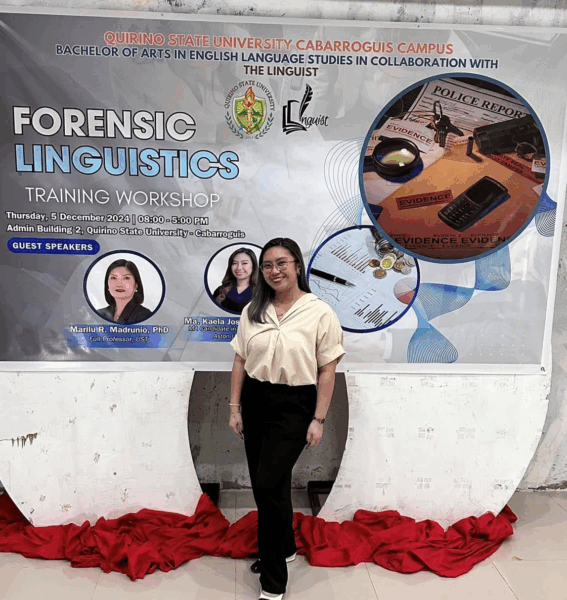
Kaela Madrunio, a guest speaker at the 2024 Forensic Linguistic Training Workshop at Quirino State University, The Philippines (Image credit: Kaela Madrunio)
Eleanor has previously worked as a teacher for adult English language learners in Australia and Italy, and as a curriculum and materials developer for basic English literacy materials in eSwatini, as well as developing teaching materials for use in ESL/EFL classrooms.
Recent presentations
Kettle, E., & Fraser, H. (2024a). Evaluating Transcripts of Poor-Quality Forensic Audio: Sine-Wave Speech and Forensic Audio. Proceedings of the Nineteenth Australasian International Conference on Speech Science and Technology, 242-246. https://assta.org/sst-2024/proceedings
Kettle, E., & Fraser, H. (2024b, 26-29 November). “Feel sorry for your ears”: Exploring challenges in transcribing speech with unknown content in unfamiliar varieties ALS Conference, ANU, Canberra. https://als.asn.au/Conference/2024/Program2024
Kettle, E., & Fraser, H. (2025, 30 June – 4 July). “We speak in broken English and a mix of languages”: Listener familiarity as a factor affecting the reliable transcription of non-mainstream varieties of English IAFLL Biennial Conference, University of the Western Cape, South Africa. https://iafll.org/2025/06/25/17th-biennial-conference-of-iafll-final-programme/
Kaela Madrunio
Ma. Kaela Joselle R. Madrunio is a faculty member of the Faculty of Languages and Literature at Philippine Normal University, Manila. She earned her Master’s degree in Forensic Linguistics from Aston University, UK, making her the first Filipino to hold a degree in this field. With this achievement, she embraces both the honor and responsibility of raising awareness of forensic linguistics in the Philippines and contributing to its development as an academic and applied discipline.
Kaela is currently working on a research project that examines migrant narratives through the lens of forensic linguistics, focusing on how migrants use language to frame their experiences and construct their past and present identities. She is also developing a separate paper that analyzes deception in migrant narratives as reflected in Philippine Senate hearings. In addition, she is working on a special issue on multilingualism in Philippine courtrooms, focusing on its implications for justice and legal understanding.
Kaela’s other research interests include plagiarism detection, deceptive language, the role of Philippine English in forensic linguistics, and forensic phonetics, with a particular focus on transcription. Passionate about bridging theory and practice, she currently serves as the Secretary of the Philippine Association for Forensic and Legal Linguistics (PAFLL) and is an Associate Member of the National Research Council of the Philippines (NRCP).
Recent publications
Madrunio, M. K. J. R., & Lintao, R. B. (2023). Power, Control, and Resistance in Philippine and American Police Interview Discourse. International Journal for the Semiotics of Law-Revue internationale de Sémiotique juridique, 37(2), 449-484. https://doi.org/10.1007/s11196-023-10045-8
Madrunio, M. K. J. R., & Madrunio, M. R. (2022). Language in Crisis Negotiations: The Rizal Park Hostage-Taking Incident. 3L: Southeast Asian Journal of English Language Studies, 28(3).
Dr Joe McIntyre
Joe McIntyre is a judicial studies scholar at University of South Australia. What does this mean? Well, basically, he studies all things related to judges and courts – including legal theory orientated work on the nature and function of judges, judicial accountability and impartiality, doctrinal work (particularly in constitutional and administrative law), empirical work (including in JusticeTech, civil justice, and accountability) as well as a range of comparative and interdisciplinary research on all things judicial.
In the last five years, this has led him to the very weird but incredibly interesting world of ‘pseudolaw’ where adherents utilise the forms of law, but not its substance, to advance their case in litigation. Think the sovereign citizen litigant (who was probably waving a red ensign at an anti-vax protest in 2021) arguing that they are not a legal entity and the court has no jurisdiction because the wrong coat of arms is displayed. Last year, he and colleagues undertook a world-first project interviewing judges and administrators whose work is being profoundly affected by pseudolaw. Given the central role language plays in the performance of pseudolaw, Joe has included two applied linguists on the project team, who helped the team understand the communicative expertise of adherents (look out for their upcoming article in the Alternative Law Journal). And now suddenly Joe feels himself falling down the law and linguistics rabbit hole…
 His most recent work in this area “Pareidolic Illusions of Meaning: ChatGPT, Pseudolaw and the Triumph of Form over Substance” explores the connections between pseudolaw and GenAI. In doing so it traverses territory of linguistics, psychology and computer science – and has a lot of fun along the way. Joe is still very new in this law and linguistics space but having fun – but please let him know new things to read or explore.
Recent publications
Hobbs, H., Young, S., & McIntyre, J. (Eds.). (2025). Pseudolaw and Sovereign Citizens. Bloomsbury Publishing. https://doi.org/10.5040/9781509978946.
McIntyre, J. (2025). Pareidolic Illusions of Meaning: ChatGPT, Pseudolaw and the Triumph of Form over Substance. SSRN eLibrary. http://dx.doi.org/10.2139/ssrn.5181165
Alice Richardson
Alice Richarson is a Doctoral Researcher in the Department of Language and Linguistic Science, University of York, UK. Alice’s PhD by publication examines the role of interpreters in the UK asylum process through three interconnected studies that move from stakeholder perceptions to real-world practice to legal outcomes. Paper 1 uses thematic analysis of interviews with 30 practitioners to reveal that while interpreters and legal professionals favour a ‘conduit’ role emphasising neutrality, this ideal is complicated by practical demands for cultural mediation, role misunderstandings, and the emotional toll of asylum work. Paper 2 employs Hymes’ ethnography of communication framework to analyse privileged observational data from real Home Office asylum interviews, demonstrating how interpreters navigate complex communicative demands in high-stakes institutional settings where prescribed neutrality often conflicts with actual practice. Paper 3 provides empirical evidence of interpreters’ impact on asylum appeal outcomes through mixed-methods analysis of asylum decision notices, showing that interpreting issues range from procedural to critical impacts, with serious errors sometimes forming the central basis for appeals and cases involving substantial interpreting problems being less likely to result in successful outcomes. Together, these papers demonstrate that interpreters can make or break asylum cases and highlight the need for institutional recognition of interpreters’ crucial role in ensuring fair access to justice, particularly given ongoing concerns about service quality following the 2011 outsourcing of court interpreting services.
Momee Tariq
Momee Tariq is a Higher Degree Research Candidate in the School of Law at the University of New England, Australia. Momee is undertaking an MPhil in Law under the supervision of Dr Laura Smith-Khan. Her experience of going through administrative appeal for herself and two dependent children with regards to citizenship made her think about legal literacy for migrant women in terms of self-representation without having any legal backup.
As a result, her research revolves around identifying barriers for migrant women self-litigants in Australia and enhancing legal education to contribute towards a gender-responsive migration system. Momee’s literature review so far suggests that in accessing migration-specific legal information, women face barriers from both internal and external factors. Internally, they may lack legal knowledge in terms of who to get in touch with in accessing relevant information and how to proceed within the prescribed timeframes, difficulty in understanding legal language in the forms and proceedings, financial issues and shame and stigma owing to their cultural background or migration status. Externally, they may be regarded as a burden on the judicial system due to their rising numbers and being a source of extra workload for staff amounting to prejudice and discrimination, the increasing demand for support services that community legal centres provide when they are already strapped financially, issues in translating and interpreting, the use of automated decision-making in government agencies, lack of definitive data regarding self-litigants, and the potential of Alternative Dispute Resolution in supporting migrant women navigate a legal system that is foreign to them. Her research methodology involves desktop research identifying community legal and settlement services and involving them in a survey questionnaire on what migration-specific issues their clients may have experienced. Since there are a limited number of community legal services dedicated to migration support, identifying migrant women’s information needs is essential in providing tailored solutions. This approach will help uncover information seeking practices among migrants and how advances such as AI and creativity can be harnessed towards promoting legal literacy.
Ifé Thompson
Ifé Thompson (pronounced Ee-feh-ee) is a Black Language Researcher, criminal defence barrister at Nexus Chambers, and community organiser leading pioneering work on Black language justice in the UK legal system. Her legal practice challenges how Black British English (BBE), African American Vernacular English (AAVE), and rap or drill lyrics are misrepresented in court as evidence of criminality rather than being recognised as cultural and linguistic rights.
 She has transformed defence strategies by centring linguistic expertise and racial justice. In R v LZ (2024), she defended a Black child prosecuted for using AAVE, and in R v L (2022), she successfully challenged the misinterpretation of Jamaican Patois by a non-expert witness. In the widely publicised March 2025 “N-word trial,” she secured the withdrawal of charges against a Black woman accused of obscene communication for using the N-word, arguing that intra-community use of the term must be understood within its cultural and historical context.
Thompson also critiques the weaponisation of hate crime and communications laws against racialised communities, where intra-community language and political critique are increasingly criminalised. In R v X (2023), she defended a client prosecuted for calling a prospective MP a “coon,” asserting the protection of Black political speech under human rights law.
She is the founder of Black Learning Achievement and Mental Health (BLAM UK), which defends BBE in education and has written teacher plenaries and worksheets on Black Languages. Her forthcoming book, Black British English (Palgrave Macmillan, 2025), looks at the history of this contemporary language, the influence of creolised languages and ways we can fashion spaces of linguistic joy and esteem for Black British English speakers.
She is also deeply engaged in language justice via using digital platforms to amplify conversations around Black British linguistic identity. Ife can be found on TikTok (@ifedior), where she shares content as a Black linguistic creator and explores the intersections of race, language, and power.
Podcast
The Black British English Podcast
What about you?
Do you work or do research in an area where language and law intersect? Join the LLIRN and visit our new website! We run online and in-person events and maintain a lively and growing mailing list, now with members from at least 43 different countries, at diverse stages of their careers, including students, academics, language and legal professionals, and those in policy and decision-making roles.
]]>
The material and linguistic representation of Aboriginal and Torres Strait Islander peoples in parliaments can be important against a history of exclusion. Similarly, this new mural at my workplace by Dr Kirsten Gray, a Yuwaalaraay and Muruwari woman, recent PhD graduate, artist and Associate Professor, aims to signal that the UTS Faculty of Law is a welcoming space for our Indigenous students and colleagues. It’s called Dhiirra-y, ‘to know’ in Yuwaalaraay language. I have permission to share the image.
In parliament of the Australian state of New South Wales (NSW) in 2014, parliamentarian Mr Troy Grant spoke in Wiradjuri in a speech about the North West Wiradjuri Language And Cultural Nest. The Hansard transcript records his four-sentence Acknowledgment of Country in Wiradjuri and the closing phrase, ‘Mandaang guwu ngaanha-gu. Thank you for listening.’
The lands of the Wiradjuri Nation comprise a huge proportion of what is now the state of NSW, and the NSW Parliament has existed for almost 170 years, but these Wiradjuri words had never before been spoken in it. Immediately, the NSW Minister for Aboriginal Affairs noted the milestone: ‘It is the first time in this Parliament that Aboriginal language has been spoken. It is a powerful symbol because this is the oldest Parliament in Australia.’
Aboriginal languages had by this point already been spoken in other parliaments around Australia, including in the national (Commonwealth) parliament since 1998, in Western Australia since 2013 and in the Northern Territory as early as 1981. In a just-published study, I’ve tracked down and analysed each instance of Aboriginal language use and also Torres Strait Islander language use (together, Indigenous languages) in Australia’s parliaments, up until 2023.
There are features of Mr Grant’s use of Wiradjuri in NSW that echo across the data. One is that the record of this language use had to be found by tracing back from online reports (e.g. this list on the AIATSIS website). The Hansard transcripts of each parliaments’ daily proceedings are all publicly available but there is no functionality to find when any particular language has been used.
I was therefore not terribly surprised to find after further digging that there had been an earlier but overlooked use of Wiradjuri in the NSW Parliament. Another elected representative, Ms Linda Burney, had in fact used Wiradjuri in 2003. Ms Burney is a Wiradjuri woman and politician who recently retired with many ‘firsts’ to her name, but her own landmark use of Wiradjuri in the NSW Parliament has not been widely recognised. As far as I can find, she is the first Aboriginal person, indeed the first person of any ethnicity, to use an Aboriginal language in Australia’s oldest parliament.
Ms Burney’s inaugural speech began ‘Ballumb Ambal Eoragu yindyamarra. Ngadu—yirra bang marang. I pay respect to the Ancient Eora [Nation]. I say this—good day.’ Neither Ms Burney herself nor the transcriber named this language at the time, although she has since named and used Wiradjuri in other parliamentary speeches.
This year (17 Feb 2025), I had the opportunity to interview Mr Grant about his 2014 speech and we discussed these two ‘first’ times Wiradjuri was spoken in parliament and how this public milestone could fall off the record:
Troy: I felt really proud. So, Linda Burney was in the Parliament at the time. So, I spoke to her, being an Indigenous woman, and you know, let her know that it was my intention to do it. And was she comfortable with that. And she said ‘Yes’. And so […] she says that she has had spoken an Indigenous language in the Parliament before me. But there’s no record of it. I checked with Hansard, and checked with the Parliamentary Library, and a whole and a whole raft of people so —
Alex: […] I did track down her first speech, and there are words in Wiradjuri to begin it. But it doesn’t say she’s speaking Wiradjuri. […] This is an ongoing problem we have with this research more generally, there’s no metadata. There’s no record there of what language she is speaking. […] Troy: […] so, she said, ‘yes, you can claim to have done the first speech in Wiradjuri. But I spoke Wiradjuri first’ and I said, ‘Okay’, so Linda and I always got on really well.
(Interview quoted here with Mr Grant’s permission.)
Later in her 2003 speech, Ms Burney names another language she also uses, Koori English. In my recent article I talk about the importance of representing this and other varieties of “Blackfula English”, sometimes called Aboriginal English(es), too.
Reading the Hansard transcripts of Ms Burney, Mr Grant and others’ speeches revealed another phenomenon which I discuss in the new article, as well, and that is the inclusion of individual words associated with Indigenous languages within English sentences. Many extended uses of an Aboriginal or Torres Strait Islander language in a parliament had already been rightly celebrated outside of academic literature (although not all; I gave the overlooked example of Ms Burney’s 2003 speech above) but individual word use had neither been recognised online, nor academically analysed, to my knowledge.
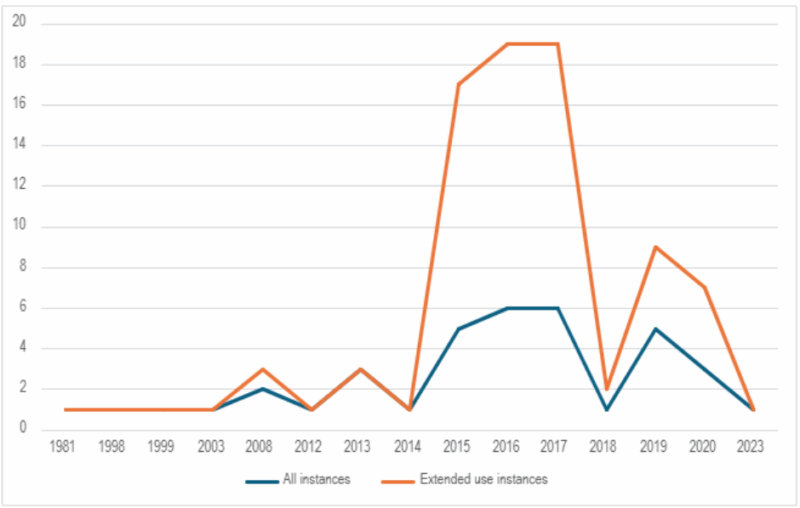
Figure 1 – Language use by year, from Grey (2025)
My article attempts to notice, celebrate and understand both small and large uses of Indigenous languages in Australia’s parliaments, identifying 86 instances in all. My study shows that these are sociolinguistic resources in the repertoires of both Indigenous and non-Indigenous parliamentarians, that their use is increasing over time, and that they are used in parliamentary debate as well as parliamentary ceremonies.
My study approaches Indigenous language practices in the otherwise English-monolingual parliaments of Australia as having the potential to resist symbolic domination. I argue that this is “a valuable form of representation of people’s diverse ways of speaking, the epistemologies Indigenous languages encode, and the ‘First Nations’ they co-construct through language practices.”
I frame the 86 instances as significant for “slipping and sliding” between different social spaces and identities, following Dr Robyn Ober, a Mamu/Djirribal woman and scholar from Northern Australia. While “moving to and fro between linguistic codes, and cultural, and social domains happens in all socio-cultural contexts”, it does not happen readily for Indigenous students in mainstream Australian education, Ober explains in her own study of a tertiary education context. I have extended her concept to the parliamentary context, which likewise gives normative priority to Standard Australian English. As such, these uses of Indigenous languages are “important in creating affordances, or social space, for later Indigenous language use and other Indigenous identity practices within parliaments”.
Churchill Research Fellow, Cara Kirkwood, who is a member of the Mandandanji and Mithaka peoples, has explained that the exclusion of Aboriginal and Torres Strait Islander peoples from Australia’s parliaments can be countered in part by material representation in parliamentary buildings today, for example through art. My study rests on a similar premise, that Indigenous language use in parliaments can be an important form of representation. Overall, I see these language practices as individually and collectively navigating and resisting the social and institutional power structures of parliaments.
I have started a series of chatty and fascinating research interviews about peoples’ experiences practicing multilingualism in Australia’s parliaments. Parliamentarians who have used Indigenous languages and guests who have been invited to use their languages in a parliament are welcome to get in touch to share their stories. My hope is to turn these interviews into an audio resource, with appropriate permissions from the speakers, so that Indigenous linguistic diversity becomes not only more visible but more audible.
References
Grey, A. (2025) ‘Celebrating Indigenous linguistic diversity in Australia’s parliaments’. 45(2) Australian Journal of Linguistics. [Open Access] ]]>
LLIRN members Dr Alexandra Grey, Dr Adrian Hemler and PhD Candidate Emma Genovese at UTS for Adrian’s seminar (Image credit: Alexandra Grey)
This April we celebrated the 6th birthday of the Law and Linguistics Interdisciplinary Researchers’ Network (LLIRN) with a fascinating research seminar about the potential for corpus linguistics in legal research.
Six years ago, LLIRN was born out of a new event, the Law and Linguistics Interdisciplinary Researchers’ Symposium, which Laura Smith-Khan and I hosted in Sydney. With researchers from multiple universities in Australia – including a number of people from the Language on the Move community – as well as visiting scholars from Asia and Europe, we workshopped the shared themes underpinning our varied case studies and how to collaborate across disciplines. We swiftly then set up the Law and Linguistics Interdisciplinary Researchers’ Network to continue the momentum.
We could only dream (and did dream) of this network becoming as active, friendly and international as it now is. We have over 260 members based in/from at least 40 countries. We’ve cast a spotlight on many of them recently in our LLIRN About US blog series, which we started to mark the 5th LLIRN anniversary.
It felt great to mark our anniversary this April with a visiting scholar, Dr Adrian Hemler from the University of Konstanz in Germany, presenting his innovative research to an interested audience online and in-person at the UTS Faculty of Law. Adrian’s topic was ‘Law and Corpus Linguistics – Current Trends and Future Applications’. He made corpus linguistic methods of analysis seem easily accessible even for those without a background in the field, and he shared a real passion for his research.
Enjoy this video recording of Adrian’s seminar to learn about the basics of Corpus Linguistics, the resources available online, and the potential he sees for corpus linguistic analysis in comparative legal research. You can also read Laura’s live posting about the seminar @lauraskh.bsky.social.
]]>
This conversation builds on a chapter written by Karen McAuliffe, Liana Muntean & Virginia Mattioli in the book Researching the European Court of Justice: Methodological Shifts and Law’s Embeddedness, edited by Mikael Rask Madsen, Fernanda Nicola and Antoine Vauchez and published by Cambridge University Press in 2022.
Karen mentions the Law and Linguistics Interdisciplinary Researchers’ Network. You can subscribe to the Network’s listserv and read member profiles on Language on the Move. She also mentions iCourts, which is the Danish National Research Foundation’s Centre of Excellence for International Courts and Governance, and the Language, Culture and Justice Hub at Bard College.
If you enjoyed this show, say hi to Alexandra on LinkedIn and to Karen on BlueSky @profkmca.bsky.social. Also, leave a 5-star review on your podcast app of choice 
Transcript
Alexandra Grey: Welcome to Language on the Move Podcast, a channel on the New Books Network. I’m Alex Grey, and I’m a research fellow and senior lecturer at the University of Technology in Sydney. My guest today is Professor Karen McAuliffe. Karen is a Professor of Law and Language, and a Birmingham Fellow, at Birmingham Law School in the UK. We’re going to talk about doing research that pools together, law and linguistics, a pet topic, a key interest for both of us. Karen, welcome to the show.
Karen McAuliffe: Thank you so much. It’s lovely to be here. Always a delight to talk about my research.

The European Court of Justice Building in Luxembourg (Image Credit: CJUE)
Alexandra: what we’ve decided to do today is to cover both a specific part of your recent research, and then to talk more generally about the research that you do and how you manage to straddle law and linguistics. But before we get into any of those specifics, let’s just first get to know you a little. You’ve got a really unusual job title. I just read it out. How did you come to be professor not only of law but of language at the same time?
Karen: Well, it’s an interesting story. It’s not a very linear journey to it. So, I originally studied my undergraduate degree was a common and civil law degree at Queen’s University, Belfast. As I’m Irish, I should add, I work in the UK. For anybody listening who wonders why I don’t have a British accent, that is why. So, I studied in Northern Ireland, in Queens University of Belfast, and also at Université catholique de Louvain in Belgium. So, I studied Northern Irish UK law and Belgian law and the Belgian law part of the degree was obviously in French. So, so I did this dual qualification, dual language degree. And when I graduated, to be honest, I didn’t really think very hard about my career, or what I wanted to do while I was at university, and after graduation I did a– what’s called a competition to work as a lawyer linguist in the European Union and the European institutions, the EU institutions. And so I got a job as a lawyer linguist in at the European Court of Justice in Luxembourg. Worked there for a while. I began to realize that I was a bit more interested in thinking about what I was doing than actually doing it. So, I returned to Academia to do a Phd. I was lucky enough to get a scholarship to do a Phd. And I went back to Queens to do it, actually back to Belfast, and this time not to the Law School, but to the Institute of Governance. While I was working in Luxembourg as a lawyer linguist, I just became fascinated with the job that I was doing. Insofar as you know, my job was to try to translate judgments that had been drafted in French into English in a way that they would have the same legal effects in Ireland and the UK then – which was part of the EU back then – as they would, you know, anywhere else in in the EU, and that intersection between law language and translation really, really fascinated me. So that was the topic of my Phd. It was on legal translation at the European Court of Justice, specifically, and in that Phd, I did a lot of I guess what you call it socio legal research.
I ended up staying. I stayed in Academia and in 2016, I moved to the University of Birmingham as a Birmingham Fellow, which was very exciting, really lovely post to get. I had previously got some large grants from the European Commission, so European Research Council Grants, including one, it’s called a Starter grant, which is like a 5 year project to look at law and language in the European Union. And when I got my Chair it was a named chair, and I was allowed to choose the Chair, so it was a Professor of Law and Language. That’s how I got here, I guess.
Alexandra: It’s marvelous to hear, Karen, because I think there are listeners out there, there are academics who email me, who say, ‘Look, I’m interested in law and language but until I, you know, found someone else doing that online, I had no idea that it was a career path’.
Karen: It was all very serendipitous, really, and not as linear as I’ve made it sound there.
Alexandra: But we’re going to make it sound even more linear because you’ve created a perfect segue to the specific piece of work that we’re going to talk about today. It’s a chapter you wrote and published in 2022, along with Liana Muntean and Virginia Mattioli. It’s called Through the Lens of Language; Uncovering the collaborative nature of Advocates General’s Opinions. I’ll put the full link in the show notes with the book that it’s from. But in this chapter you’re talking about a study where we meet lawyer linguists, exactly the role that you yourself once held and the kinds of people who work alongside them, or for whom they work at the European Court of Justice. The Advocates General, we hear a little bit about the judges. We hear about another type of staff member called a référendaire, who works alongside the Advocates General. And this chapter then gives us an insight into how those people are working together and doing exactly that interaction of law, language and translation that you’ve spoken about.
What I wanted to talk about with this chapter is a little bit your specific findings. But then also to talk more generally about what this chapter is saying in terms of method and how to do research that draws together law and language. So, we’ll come back to that more general question in a minute. But first we’ll focus on the specific context. And I’m just going to read out a little quote from the Chapter, too, to give a bit of background to listeners who might know nothing about the European Court of Justice.
Karen: Right.
Alexandra: Early in the chapter you and your co-authors begin by explaining that in ‘The EU legal order, with twenty-four official languages, integrated in twenty-seven member state legal systems, is linguistically, as well as substantively, unique.’ So, this is a really unusual legal system in many ways, I guess, but particularly here you’re highlighting how multilingual it is. And you’ve done a lot of analysis on how this multilingualism impacts on the development of law in the EU in this chapter but in other works as well. And so, this chapter is specifically a case study about the European Court of Justice, and even more specifically about the role of the Advocate General in presenting legal opinions to that court and the languages that Advocates General use to draft those opinions.
Karen: I might go back a bit further, if you don’t mind. I’m very aware that your listenership is very international, um, and so there may be people listening that don’t know anything at all about the European Court of Justice and how it works. So, the first thing to point out about this particular chapter is that I’m not talking about the judges. The Advocates General are separate. They’re not judges. So, the court itself, it’s seated in Luxembourg. I guess you could call it like the Supreme Court when it comes to European Union law. There’s two sections to it. There’s a General Court, which is the lower court, and then the European Court of Justice, which is the higher court, and I’m focusing on the higher court in this paper.
The court delivers judgments in 24 languages but it works in French. So internally the court works in French, but it delivers judgments in 24 languages. Each case that comes before the court will have what’s called a language of procedure or a language of the case. So, for example, if a Greek court um sent a question to the European Court of Justice for interpretation on a piece of EU law, the language of the case would be Greek, so the question would come to the European Court of Justice in Greek. It would be translated into French. It’ll be worked on within the Court in French, and then the judgment that is delivered, the first version of the judgment that’s drafted, will be in French, and then it’ll be translated into all the other languages. But the authentic version, the version that the judges sign will be the Greek version.
So that’s the first thing about judgments. The second thing is that they are collegiate documents. So, the deliberations of judges are secret. We never know, you know, where compromises might lie in the text of a judgment. They’re a very particular type of document. I’ve described them in in a previous paper as sort of Lego-like building blocks that are put together to make the judgement. The Court doesn’t engage with sort of legal reasoning in a very in-depth way. It answers the questions before it, and a large part of that is because the deliberations are secret. We don’t know what happens in there. Because of the nature of these judgments, because they are collegiate because of the deliberations are secret because there’s no dissenting judgments, you have these members of the court called Advocates General and this is borrowed from the French administrative law system.
So the Advocate General’s job is to deliver an opinion, a reasoned opinion on the case, to guide the court in its judgment and back in the early days of the court, the advocates general delivered opinions in every case but as workload grew, and as members of the European Union grew, you know that just became untenable. And so nowadays opinions, advocates, generals, opinions are delivered in sort of important cases, constitutionally important cases or cases where a Member States requests it specifically. And the Advocate’s general opinion, first of all, historically, was written in the language of the Advocate General. So, you know, there are 11 Advocates General, and there are a number of permanent Advocates General, as in there will be there’s a French permanent Advocate General, there’s a Polish permanent Advocate General, and then the others are rotated among the sort of smaller – in inverted commas – EU Member States. So, these people, they deliver opinions, and historically, that was in their own language. And so that’s the first thing. And the second thing is, the Advocate General can deal with anything they want in their opinion they don’t have to just stick to the questions the parties have asked. They don’t just have to stick to the things that have been raised by parties in the case, and you know, they can act almost as a sparring partner in that they can force the Court to engage in dialogue on certain concepts of EU law. And so any scholar of EU law will tell you that the judgments of the Court, while you know you can look at the judgment of the Court, and you can think about well, you know, how has the court applied that? Or how has the court interpreted the law here, where you really find the interesting dialogue and conversation about where EU law might be going is the is the opinion of the Advocate General. The Court of Justice of the European Unio is famously or infamously known for sort of creating the legal order of the EU. So you know this. The narrative is that that this EU legal order wasn’t created really by treaties and legislation. It was. It was done, you know, by the European Court of Justice kind of reading gaps in those treaties, and then creating these constitutional type principles.
But every one of those big constitutional type principles of EU law was fist seen in an Advocate General’s opinion. So, they’re really, really important in terms of EU scholarship. Now, they’re not binding on the court, but the court must take account of them when delivering the judgment.
Alexandra: They’re incredibly influential on the Court itself, but also influential on everyone else who’s teaching law.
Karen: Exactly. And so a lot of the work scholarship that had been done on the role of the Advocate General, when they talked about the opinion itself scholars would often point out that the fact that the Advocate General is writing in his or her own language first language makes a difference to how persuasive they can be. And so to finally come round to your question: in 2004 there was this sort of mega enlargement of the European Union. 10 new Member States joined in 2004, and then another 3 in 2007. And so what was happening was as Member States joined their languages got added to the list of EU official languages. So, prior to 2004 there were only 11 – only, I say! There were 11 official languages and then in– between 2004 and 2007, that number then rose to 24.
So two things with that. First of all, on a practical level, if you have to provide, if you have to do direct translation between 11 languages, now, I should have written this down beforehand, so don’t judge my math, but I think that it’s 52 combinations, I think. But if you are doing direct translation between 24 languages, that goes up to, I think it’s 552 or 554.
Alexandra: Wow!
Karen: It’s a lot. So in 2004, the European Court of Justice and the other EU institutions introduced a ‘pivot translation system’, they call it, which is relay translation. And the way it works in the court is that certain languages are assigned to– There are 5 pivot languages. So French is a pivot language for all of the other languages, because French is the working language of the Court, and then you have English, German, Spanish, Italian, and now, since 2018, Polish as well. So they’re the pivot languages, and all the other languages are assigned to a pivot language. So, to give you an example, what that means is, if a question or a case comes from a Lithuanian court or from Lithuania, it will be translated into English and then translated from English into the other languages. So, it’s sort of pivoted through relayed translation.
Alexandra: And so what is happening there to the role of the Advocate General, those people now have to start actually drafting and presenting their opinions in a pivot language. Am I right?
Karen: Yeah. Now, the interesting thing is that it’s not — it’s a convention rather than a requirement. They don’t have to. It was introduced early—the person who is, I believe he’s now Registrar of the Court, I think he’s still there, Alfredo Colon Escobar. He took over as Director of the Translation Directorate at the Court. And he introduced this system. But he was also thinking of what’s to come, and I mentioned earlier that Advocates Generals, they rotate. So you’ve got your permanent Advocate Generals, and then you have a number of Advocate generals that rotate countries. And so the court was aware and the director of the of the translation directorate was aware that in a few years you would have a Slovenian and a Slovakian Advocate General and if you had to wait for the translation to be pivoted from Slovenian into whatever the pivot language for Slovenian is back into another language, you’re adding a lot of time onto the process. So so this was all introduced for sort of for practical purposes, for expediency’s sake. And so in 2004 this convention was introduced, whereby Advocate Generals were asked to draft in one of the pivot languages of the court.
The reality of that is that you have the permanent Advocate Generals can continue to draft in their own language because they are the pivot languages of the Court. Other Advocate Generals have to choose to draft in in one of these languages, and they usually draft in English.
Alexandra: And, as you point out in your chapter, it’s not just they draft, as in, it’s not just the Advocate themselves. They have this whole team of a référendaire, who’s like a research assistant sort of position, maybe I’m underselling it; a lawyer linguist, you know. So actually, one of the things I found so interesting in your chapter, the data really shows how it’s a collaborative document, even though only one Advocate General sort of gets to put their name on it.
Karen: Yeah, so this is, this is the other very interesting thing about, I think, about this chapter in particular, is that again, historically. And the literature always talks about individual Advocates General and their opinions, but they’ve always worked in teams. So each advocate general has, I think, nowadays they have 4 référendaires. And a référendaire is similar to a clerk in the US System.
So there are lawyers and they will produce, like the initial drafts or the structures. It will differ from Advocate General to Advocate General. Some are much more hands on, some are much more hands off, but it is absolutely this this team effort. And that has always been the case. But that process remained invisible. And then all the literature talked about was the persuasiveness of this one person, this one very important person, the Advocate General. So what we were able to do in the research for this paper was sort of uncover or shine a light on on this process that’s happening behind the scenes and also shine a light on an additional role that only exists because of this linguistic convention. And that is, in certain cases some Advocate Generals or the teams of some Advocate Generals that the Chambers of some Advocate Generals will require what’s called ‘linguistic assistance’.
So because their référendaire may not be of English mother tongue, and they’re drafting in English, for example. And so what then they have is this wholly invisible part of the process from the outside, of a lawyer linguist coming in and providing what’s called linguistic assistance, and that linguistic assistance, again, will differ depending on who has written an opinion. It could be merely proofreading, there might be no need for linguistic assistance at all. Somebody might be very fluent in English, or, you know, in French, or whatever language they’ve chosen. But we’ll say English. But in other cases that linguistic assistance is much, much more than just proofreading. It’s it’s a rewriting in in certain cases, or a reframing of certain concepts. And so there’s much more of that legal creative work happening there. And that role of that sort of lawyer linguist as the linguistic assistant in the production of Advocate General’s opinions is something that, you know, just wasn’t known about outside of the Court or outside of the EU institutions, certainly not within EU scholarship, before we were able to do this research. So that was very exciting, very interesting.
Alexandra: It was interesting to me, not only to hear about that, but the way you found that out. So you and your co-authors in this chapter are very clear about what sorts of methods are allowing you to see what sorts of information, or what sort of behind the scenes reality might otherwise be invisible. And one of the key ways you do it is to interview not just the Advocates General, but the référendaires, the lawyer linguists, and in another, not in this chapter, in another part of the bigger study, the judges themselves. And what I found really interesting is that while, on the one hand, these interviews shine a light on the reality of this collaborative, interlingual production, on the other hand, what the people are overtly saying, and I’ll summarize, I’ll use a quote that you have in the chapter sort of summarizing the perspective of many interviewees: you say ‘language and substance appear to be distinct and separate things. Any overt acknowledgement of the impact of language on their work seems to be seen as undermining the quality of that work’. So even in the interviews, that invisibility is sort of perpetuated.
Karen: Absolutely. Yeah. And what was very interesting was when we when we coded the interviews the judges, the Advocate Generals for this paper, the référendaires, they all said, ‘oh, like it has no impact. The language that I’m working in has absolutely no impact on the substance that I’m producing, or the way that I’m thinking’. And then, in the same breath they will say, ‘Oh, but of course I think totally differently in my own language’. And I think there’s a quote we actually use in that paper, where they say, ‘my French colleague might come to a different conclusion’.
And what was very interesting to us was that you know, in the context of the interview, you come out of the interview and go, ‘Okay, they don’t think language is that important at all, really’. And at the same time when you go to code the interviews they’re saying this. They know it. It’s there in the back of their mind, and the Advocate Generals themselves will say, ‘Oh, no, no! My voice comes through, no matter what language I’m writing in, it’s my voice’. The fact that that goes against all research in sort of translation and linguistics is neither here nor there. But you know this is what they’re saying, ‘my voice, nothing’s different’. Everything is fine, it’s all the same, and in the same breath, they’ll say, ‘but it’s really important for me that I have a francophone, or that I have an English speaker in my chambers’. So again, they’re acknowledging it. And also the judges, when we interviewed them, said something along the lines of, ‘look, any EU lawyer can learn the law. What we need, what we need are people who are good at languages’. And they rate the linguistic capabilities of the lawyers that they’re hiring to be in their chambers, to be in their teams, higher. They say these things that don’t match up with how they’re acting, and that’s really interesting when you’re coding the interview to go.
Alexandra: One way you, you deal with that in this paper is, you know, to take that sort of reflective stance about the interviews. You don’t just take them at face value, but that’s not a reason not to do interviews. It’s very useful to find out some of these processes, but also to find out that sort of discursive production of the importance of just one voice. But then, what you do in this chapter is, you use an entirely different kind of data and method, and that is corpus linguistics, to then triangulate or compare, if you like, to show just how different these opinions can be depending on whether it’s the mother tongue language or another language that’s used for drafting.
Karen: You know, I am coming from this very privileged position, where I knew that the lawyer linguists were doing that job so I could. I could come up with this hypothesis quite easily, because it seemed to me that the opinions of Advocates General were becoming more synthetic, and more Lego-like, in in the same way. They were coming closer to judgments stylistically. And I was interested in that. So, I suppose I started with this hypothesis: you know I think these opinions are coming closer and closer stylistically to what the judgments are. And if that is the case, then then what’s the point of the opinion? So that’s where I started from, and we did the interviews. And then we did this corpus linguistics analysis on the actual texts themselves, the opinions themselves. And now I didn’t do– I’m not a corpus linguist, so I didn’t do the analysis. Virginia Mattioli did that analysis, and it’s all explained in detail in the paper. And Virginia and I have, I’m pretty sure, on Youtube, there are some presentations that we’ve done where she goes into a lot of detail about what we did there. But basically we compared opinions drafted in somebody’s first language. So, you know, French language opinions, or English language opinions. Italian; I think we looked at as well. Language opinions drafted in a first language. And then we compared them with opinions – post 2004 opinions – that were drafted in the first language as well in a second or third language, a non-native language. And what we found was very interesting, because the interview data which we had done first, so the interview data was saying, right, these people who are drafting the opinions don’t think that anything has changed. They don’t think there’s been a change in voice. They don’t think there’s been a change in style of the opinions since 2004. However, somewhere in the back of their mind they’re acknowledging that language is very important and maybe influences the results that they get to or the end product in some way. But fundamentally they don’t think there’s been a difference. And the corpus linguistics analysis showed us that indeed there is a difference, and the corpus linguistics data shows that opinions are becoming more stylistically like judgments. But very interestingly, not just those opinions drafted in a non-native language. So so even the opinions of the permanent Advocate Generals, Advocates General, who are ostensibly drafting in their own language, their first language, are becoming more stylistically synthetic and less fluent. Not reading so much like a like an academic article, like a fluent article.
Alexandra: Like a a genre, is converging the two genres.
Karen: Hmm, yeah. Yeah. And that’s where it becomes very interesting then to work in an interdisciplinary because, Virginia, I hope– I don’t think she’ll mind me saying this, you know, she got these results and was very excited. She was going, ‘Yes, look! This convention, this convention change in 2004 has resulted in these opinions becoming more like judgments. Wonderful. We’re finished’. And we had a difficult time for a while, because, you know, I was saying, ‘Well but it doesn’t necessarily mean that it’s because of that convention change that there’s this, as you call it, like a shift in genre. There could be other reasons. There probably are multiple reasons to do with workload’. There are things that we can’t find out even through interviews, even if you did an anthropological study where you’re embedded in an institution like that. I think it will be very difficult to find out. For example, say you have an Advocate General who has a team of référendaires who are from various different places, but they will have been educated in multiple places. So, for example, myself, you know, I’ve been educated in Northern Ireland, in Belgium, in Greece. So all of that will impact the way that you work with language, the way that your mind works, the way that you reason. So things like that are difficult, if not impossible, to uncover. And so I think it’s very dangerous to rely on just one method to come to any kind of conclusion. So for us, what the corpus linguistics study showed was that our coding and our analysis of the interview data was true, because we had looked at the interview data, we had said, ‘Right, they think there’s no change or difference or relevance to them drafting in a language that’s not their own’. But our coding and our analysis of that interview data shows that actually there is. But we can’t prove that unless we look at the text themselves. And when we look at the text themselves and do the corpus linguistics analysis that corroborated what we were finding in the interview data. And it, I think, makes for a stronger argument at the end of the day.
Alexandra: It does. It reads really well to show, I think you call it multiple strategies in the toolbox, you know, if you use multiple methodological strategies at once you get greater rigor. But also you manage to, you know, to articulate very clearly in this chapter that that doesn’t mean that any one of those strategies by itself is without any flaw or weakness, you know. That’s the point of combining them to sort of balance each other. And then I like that you end the paper on a, if you like a forward-looking note, or on a big question that none of that data by itself can answer but maybe another strategy or another study can, and that is well, what is the effect in terms of persuasion? So not just on sort of reaching one or a different legal conclusion in the opinion itself. What does that actually do on the forward development of the law in terms of the persuasiveness or the room to sort of tease out new and different and creative and dissenting ideas. That’s being reduced, you know. That’s a longer term, and if you like more difficult question, I guess, to answer.
Karen: Yeah. But I think in the conclusions to that paper, you know one point that I’m trying to get across, I guess, is that the research question is really important. So, all of that is interesting. You know what I what I have just described. It’s very interesting, but it’s quite– It is just descriptive. You know this conversation I’m telling you: ‘This is what we did. And this is what happened. And isn’t it interesting?’ But I don’t see the point of doing research – I mean, look, there is point in doing research just for interest’s sake – but in the context of legal research that has any kind of rigor I think you do need to be asking bigger, broader research questions from the outset. And I think that’s very important. And so we try in that paper to come back to those questions. Because yes, we observe all this stuff in the data. But so what?
Alexandra: Hehe.
Karen: And the ‘so what’ in this case will depend on what we think the opinion is for.
Alexandra: Yes.
Karen: And if the opinion, if the job of the opinion, as set out in the treaty, is to guide the Court in its decision in a particular case then maybe the converging of linguistic styles is not a bad thing, because you have the Court and the Advocates General speaking the same language, and everybody is working in their second or third language, anyway. And so you know, you have that phenomenon where everybody’s a non-native speaker. Nobody’s the eloquent speaker, and the power is is dissipated equally, you know, throughout. If that’s what the opinion is supposed to do then maybe it’s not so problematic, and that’s fine. But if the role of the opinion is, as EU scholars would claim, in fact, to persuade more widely and to explain how EU law is developing, and importantly, how it might develop. So one of the most important things about the Advocates General’s opinions are what it’s called prospective.
And it’s this idea of the direction, the future direction of EU law. And if that, in fact, is where the importance of these documents lie. And they lose their fluency, and they just become these very synthetic, Lego- like judgment style documents, they’re not really going to tell us anything about where the law is going to go, or how the law might develop. They’re not really going to engage in that sparring and that raising of dialogue between the Court and the Advocate Generals, and in that case that shift or convergence of linguistic styles does become more problematic, and it and it raises a bigger question about ‘well, what’s the role of the Advocate General then?’
So, for me coming back to an initial research question or understanding why you’re doing these methods. It’s very easy to get caught up in the method and excited about the method – and I mean I do it myself – enjoying doing the method. But I always think you really, really must come back to the ‘so what?’ question. And when I’m writing a paper, I often have a Post-It note stuck on my computer that just says ‘so what?’ because it’s a tough thing to come back to. But I do think it’s important.
Alexandra: Totally, and I think that’s a great tip for our listeners right now find that post it note.
Karen: Write a Post-It note: ‘so what?’
Alexandra: And this maybe brings me to a bigger question I was thinking of when I was reading your work, and it’s about how you make that ‘so what?” meaningful not just for other academics or people who might already be interested, but to a broader group of stakeholders, or, you know, would-be readers, and particularly working in the legal context, I was puzzling over this. You know, I myself also work in a legal context. You know, I came up as a lawyer, and then a linguist, have a similar background to you. And many of the stakeholders in the kinds of work that I encounter, or that you encounter, these are people who’ve probably studied legal research methods, way back, but those methods don’t center anything other than sort of finding and reading jurisprudence. So how do you convince these people that interviews, corpus analysis, other socio legal methods, other linguistic methods, how do you convince them to be trusting partners as participants in your study as they were here? Or, you know, having confidence in you as someone telling them an outcome or the knowledge that’s produced?
Karen: That’s a really good question. Sometimes, with great difficulty. Anybody who has engaged in interviews as a method will know that you are often interviewing people who don’t think very much of what you’re doing, or you as a person. In this case, again, as I say, I come from a very privileged position in this case, in that I have access to people at the Court. So I you know, I worked at the Court back in gosh! The early 2000s like 2000, 2002. And so people that I worked with and who stayed at the Court are now in very senior positions. And so I have access to that institution in a way that other people didn’t, or I had access, you know, in a way that other people didn’t. And people were willing to talk to me.
Then, in terms of yeah, in terms of the audience, like that is really tricky, and and it will depend like I, you will have different reactions. So you know, I’ve presented this type of work to audiences of lawyers, only lawyers, you know. And they’re like, ‘Well, that’s interesting. But it doesn’t really matter, because, you know, we’re making our money doing this, and and we need the law to be defined and definite, and not a malleable language like you’re saying it is.’
I’ve presented this type of work to audiences that are only linguists and linguists tend to be very focused on method, I find, and very interested in just observing these things that are happening. And they’re not always terribly interested in that big ‘So what?’ question.
And I, I suppose, finding your tribe, as anything in life, finding your tribe. The law and language community, I find, is is a very open, interested, curious, friendly community, generally. And this this paper is is published in a book that is specifically about new methods for studying law, studying European law or the European Court of Justice, I think, specifically, and that is the brainchild of researchers who are either permanently or temporarily based out of a center called iCourts, which is a Center for Excellence at the University of Copenhagen, and it’s a Centre of Excellence for international courts. And they are one of the pioneering institutes in law who have taken methods from the social sciences into law. And we actually had a book launch at the University of Luxembourg, and we had discussants from the European Court of Justice. So, we had judges and Advocates Generals discussing papers, which is kind of terrifying but also very fun, very pleasant.
So the Advocate General that that discussed this particular paper found it very interesting but remained unconvinced that their language, the language they were working in, affected their style, which is fine. That’s absolutely fine. People who are not scholars tend to think more in an ad hoc way, you know, than waiting to find out what the data says. And but interestingly, after that book launch, I had people from political science who had, who had come to the book launch. They all came up and went, ‘but these aren’t new methods, like we’ve been doing interviews for years, like, there’s nothing new about this.’ But the fact is that it’s new for Law.
Alexandra: Yes
Karen: Like you say, traditionally, this isn’t the type of stuff that has been done, particularly in European law where the focus has been much more doctrinal and sort of black letter.
Alexandra: Even in linguistics, you know what can be new is the combination of methods to answer one research question in one study. You know, you didn’t invent corpus linguistics, and I don’t think you’re pretending that you and your coauthors did.
Karen: God no!
Alexandra: You are making a really valid point, that it is quite novel and very useful to combine it with the interview method.
Karen: I like to think so. But I I think you know again to sort of try and answer your question a bit better, there are more of us now doing this type of work, which is wonderful. And so there are teams, you know: there’s my team at the University of Birmingham, there’s you guys, there are, you know, there, there are teams of more interdisciplinary people working on that interface between language and law, or just using language as a lens to interrogate other fields. And I think that’s the key. We just need more of us, more PhD students coming through – anybody want to come and do some more research with us? – and more, I guess, more freedom. And for, I guess, funding to do the type of projects that that we want to do. So, you also have to be convincing, depending on what you know the research academy looks like in your own country. You have to persuade a university or a funder that this is a good idea.
Alexandra: But, in fact, sometimes it can be that innovation of linguistics into law, you know, that can be the selling point that can be showing it’s new and worth funding. I’ll just jump in when you say, ‘and you guys’, I’ll just sort of put a little plug here. I think you mean the Law and Linguistics Interdisciplinary Researchers Network that Dr Laura Smith-Khan and I —
Karen McAuliffe: I do. It’s fantastic, and it’s so active. It’s wonderfully active and wonderfully supportive. It’s a it’s a wonderful research community that is somehow worldwide and feels very small and very supportive. There’s also the Language, Justice and Culture Hub.
Alexandra: Now based through Bard University.
Karen: Right. Yeah. And again, they’re all very, very welcoming communities and that isn’t a given, certainly not in the legal field.
Alexandra: It’s not, and that was Laura and my initial thinking, you know, sort of two things. First, we wanted a more welcoming space for ourselves and others. But also, back to what you were saying before, you know, a tide that lifts all boats, or, you know, a platform. It benefits each one of us to create a platform for the whole field.
Karen: And also, I think to create a field that’s rigorous, you know, in terms of scholarship because you sometimes– We can get very excited about building a new subfield and we get focused on our interesting data, and we don’t think about those bigger questions. And then the danger is that the subfield never becomes an established field because it doesn’t have [rigor] associated with it. So I think that’s important as well. And there’s lots of really interesting scholarship happening around the world. For a long time the law and language– the big names in law and language, we could list them on our on our hands, and they were white men.But there’s a lot more early career people, more people from the Global South that are doing really interesting and engaging work that is important to champion.
Alexandra: I totally agree. And so in the show notes, I’m going to put a link to a few other blogs where I think people can find those local and early career researchers in our law and linguistics field. But just to close the interview, I thought I might ask, where online can we find what you’re up to, or indeed in person, if you’ll be speaking.
Karen: I have no plans to speak right now. I have a period of study leave coming up, and I’m hoping that that is going to really get my creative juices flowing. I have been recently thinking about the construction of meaning in the context of multilingual legal reasoning. Jan Engberg, you may have had on this podcast before. He’s based out of Aarhus and he specializes in knowledge, communication, and the construction of meaning and has been doing some really interesting work recently about the construction of meaning in the context of comparative law and how we can’t–, we can’t get inside each other’s heads and fully understand what somebody is trying to communicate. And yet we manage to communicate. And yet global systems of law exist.
I’ve been working on the European Court of Justice for over 20 years, and haha! And I will always love it, and I don’t think I’ll ever move, you know, fully away from looking at it. It’s such an interesting institution. It works in 24 languages, you know. But I would like to do some work on other international courts. Thinking particularly of the Inter-American Court of Human Rights, or the African Court of Peoples and Human Rights. Also the Strasbourg court, the European Court of Human Rights. I’m just at that sort of hunch stage. Because, you know, if you look at work that has been done in linguistics and work that has been done in translation studies and knowledge communication, that shows that there’s no inherent meaning in language. And yet– so law is this linguistic construct. And yet courts, international courts in particular, are very fond of saying, ‘well, according to the inherent meaning of this concept’ or, ‘according to the inherent meaning of this treaty’. But if other fields have established firmly that there is no inherent meaning in language then how can there be an inherent meaning in law? And so I’m interested in exploring that, but this is really at the very early stages. So, I’m hoping that in 2025 I can do a bit more thinking about that.
Alexandra: That sounds fascinating, Karen. I can’t wait to hear on that, but I feel we can wait. You know, there’s such a pressure in academia to do things quickly, like, it’s great to actually make the time and take the time to think about something enormous.
Karen: I’m not a, yeah. I have to say, I don’t do things terribly quickly. But again, I think that comes from a place of privilege. I’ve got a Chair, you know I have that space now if I need to, to take time to think about these things, so I’m aware of that.
Alexandra: Oh, but you know we’re grateful that you do have that space ‘cause we’re interested in what you’re producing. Maybe we’ll do another interview at some future point.
Karen: Absolutely. Yeah, any time.
Alexandra: What I’ll do I’ll put in the show notes things that Karen and I have spoken about, if you’ve enjoyed the show, it really does help us if you subscribe to our channel, or if you leave a 5 star review on the podcast app that you use or indeed just recommend the language on the move, podcast to your friends, your colleagues, your students, and we’ll speak to you next time.
]]>In this video, I discuss the example of bilingual signage in Nanning City, China. I ask who recognises the Zhuang language that’s found on some public signage there, and some of the varied responses which people – even Zhuang speakers – have had to it. Then I explain what this case study can tell us about multilingual signage policies more generally, and about language policy research. I hope this helps you teach Linguistics, or learn Linguistics, or even do your own ‘linguistic landscape’ research!
Related resources:
Grey, A. (2022). ‘How Standard Zhuang has Met with Market Forces’. Chapter 8 in Nicola McLelland and Hui Zhao (eds) Language Standardization and Language Variation in Multilingual Contexts: Asian Perspectives (#171, Multilingual Matters series). De Gruyter, pp163-182. (Full text available)
Grey, A. (2024) ‘Using A Lived Linguistic Landscape Approach for Socio-Legal Insight’, Frontiers of Socio-Legal Studies’ Methodological Musings Blog, Oxford Centre for Socio-Legal Studies.
‘Language rights in a changing China: Brynn Quick in Conversation with Alexandra Grey’ Language on the Move Podcast, New Books Network (1 January 2025)
Transcript:
Alex and Kristen in the studio, 2024
[Opening screen shows text: Making Zhuang Language Visible, by Alexandra Grey and Kristen Martin, 2024.]
[Narrated by Alexandra Grey:] In 2004, the local government in Nanning, a city in South China, began adding the Zhuang language to street-name signage to preserve Zhuang cultural heritage. The Zhuang language, which originated thousands of years ago in this region, had largely been overshadowed by Putonghua, a standard form of Mandarin Chinese and the official language of China.
However, the public response to this initiative, including from Zhuang speakers, was not as positive as intended. In this video, I will share insights from my research in the 2010s on Zhuang language policy, including a case study of its implementation and reception in Nanning.
China officially recognises the minority group called the Zhuangzu, who have traditionally lived in south-central China, particularly in the Guangxi Zhuangzu Autonomous Region, where Nanning is the capital. There are millions of Zhuang speakers, but China has such a large national population that these Zhuang speakers constitute only a small minority.
The Zhuang language can hardly be read even by Zhuang speakers themselves. This is due to the inaccessibility of the Zhuang script; most people do not have access to formal or even informal ways of learning to read Zhuang. This has significant implications for the region’s linguistic landscape.
My research aimed to understand the impact of local language policy. I met with 63 Zhuang community leaders and Zhuang speakers for interviews, including interviews in which we walked and talked through the linguistic landscapes. I also found and analysed laws and policies about Zhuang language, from the national constitution down to local regulations. One important set of regulations were interim provisions introduced in 2004 and formalised in 2013 through which the local government added Zhuang script to street signs in Nanning.
This script these street names used was a Romanised version of Zhuang using the Latin alphabet, and it was always accompanied by Putonghua in both Chinese characters and its own alphabetic, Romanised form. The Zhuang script, which uses letters identical to English and also identical to Romanised Putonghua except for the additional letter ‘V’, was never displayed alone and was always in smaller font on the street name signs. In some cases, the signs contained additional information about nearby streets, but only in Putonghua.
In the broader linguistic landscape, these Zhuang street names were a visual whisper. Most public writing in Nanning is in Putonghua, with occasional English. Only a few public institutions, like the regional museum and library, have prominent bilingual signage that includes Zhuang. Otherwise, Zhuang is absent from common public texts such as road directions, commercial signage, transport maps, and safety notices.
From the community’s perspective, this new bilingual signage caused confusion. Newspaper reports from 2009 indicated Zhuang language was mistaken for misspelled Putonghua, leading to complaints. In my interviews, even some Zhuang speakers had been unaware of any Zhuang script in their environment, often mistaking it for English or Putonghua until it was pointed out to them, or until they started learning to read Zhuang as young adults, if they had that opportunity. Some were not aware that the Zhuang language could be written at all:
[Interview excerpt in Chinese dubbed in English by Kristen Martin]
A university student interviewee: Because it is Pinyin script, no one pays it any regard, they can’t read it. In the recent past, people even thought it was English or [Putonghua] Pinyin, something of that nature, but it is not Pinyin, so they could not conceive of it being Zhuang script.
Interviewer: Right.
Another university student interviewee: To look at, it looks the same as English, I think.
In my article, I argue that the invisibility of the Zhuang script is partly because people need to learn to read it, even if they speak Zhuang. My research, which includes reports and census data in addition to the interviews, shows that access to learning Zhuang literacy is very low. Additionally, people are not accustomed to seeing Zhuang as a public language, or as a written language.
Why is this the case? Besides its limited presence in public spaces, Zhuang is also largely absent from educational settings and from the media. There was an irregular newspaper in Zhuang and a bilingual magazine in print when I began my study, but by the late 2010s, that magazine was only printed in Putonghua. This lack of exposure to written Zhuang in everyday life affects the recognition of written Zhuang, even when it is displayed in Nanning today.
Two key themes emerged from my participants’ reactions to Zhuang in the linguistic landscape. Some Zhuang people appreciated the Government’s effort to include and preserve their cultural heritage, but they doubted the policy’s effectiveness; since they couldn’t read the script themselves, they wondered how anyone else would learn anything about Zhuang language or culture from these bilingual signs. Others viewed the policy as tokenistic. They highlighted the lack of accessibility to the Zhuang script and the frequent errors in its display.
[Interview excerpt in Chinese dubbed in English by Kristen Martin]
Interviewer: But I’ve heard it’s often written wrongly.
A community leader interviewee: That’s right, it’s often written wrong but no matter how erroneously those sorts of things are written there is no-one who can pick that out, because Guangxi people have no opportunity to receive a Zhuang script education; who can read and understand?
Another point of dissatisfaction was that the way Zhuang has been standardised, which has made it more similar to Han Chinese – more similar to Putonghua – which felt like a reminder of the marginalisation of Zhuang speaking people in Nanning.
[Interview excerpt in Chinese dubbed in English by Kristen Martin]
Another student interviewee: This Zhuang writing, frankly, this grammar is in my view a really erroneous usage. It’s completely Hanified Zhuang language. Our Zhuang script must have as its goal opposing that, Guangxi’s so-called Standard Zhuang, which is not endorsed. It doesn’t stick to the grammar of our mother tongue, so we feel relatively disgusted.
For these readers, the bilingual Zhuang street names in the landscape were a visual reminder of other aspects of Zhuang language policy that they felt did not adequately support the language.
[Interview excerpt in Chinese dubbed in English by Kristen Martin]
Interviewer: So, when you see those signs, what do you think?
A community leader interviewee: It’s simply a joke, to use Chinese it’s “to hang up a sheep’s head and sell it as dog meat”, so it’s on the façade, but in their hearts there is no respect.
These perspectives suggest that efforts to include minority languages in public spaces can be perceived as futile or even offensive if the community cannot engage with the script. The Zhuang case study highlights the importance of accessibility and education, not only display, when policies are aiming to support minority languages, but it also highlights the importance of policy responding to the habits and expectations about that language which people will have already developed from childhood onwards from the way they experience the language being absent or devalued in all sorts of places and activities. People bring those habits and expectations and value structures with them into the linguistic landscape.
Broadening our perspective from Nanning to consider the policies for marginalised or minority languages in general, this case study challenges two common assumptions about display policies.
First, there’s the assumption that displaying a minority language increases its visibility in the linguistic landscape.
[Screen shows text: Is the Zhuang language on display in public actually visible as Zhuang?]
Second, there’s the belief that when a powerful entity, like the government, includes a minority language in public spaces, this symbolises the inclusion and valorisation of the speakers of that language, or more broadly the people who share that linguistic heritage.
[Screen shows text: Does the display of Zhuang language symbolise the inclusion of Zhuang speakers?]
These assumptions are foundational in linguistic landscape research, but this study encourages us to question them. The findings suggest that public display policies need to be integrated with other language policies to be effective. In the case of Zhuang, literacy and script policies undermined the efficacy of Zhuang language displays, making them almost invisible.
[Closing screen shows text:
Making Zhuang Language Visible, produced by Ed Media Team at the University of Technology Sydney, 2024.
Narrated by Dr Alexandra Grey.
Interviews dubbed by Kristen Martin.
Script by Alexandra Grey and Kristen Martin, based on Grey (2021) Full text
Thanks to Dr Laura Smith-Khan for content consultation.
Thanks to Wei Baocheng for singing his translation of the song ‘Gaeu Heux Faex’ into Zhuang, from Qiao Yu and Lei Zhengbang’s 藤缠树. Full rendition at: https://m.youtube.com/watch?v=WO0-biO5xJI ]
]]>
The talk brings together three of my studies, as follows:
Study 1 (Grey and Severin, 2021)
Focus: legislation and policy about the decision-making framework and standards which might underlie multilingual government communications in Australia’s largest state, NSW.
Summary: The NSW government’s public communications are not made within a clear or informed decision-making framework as to choice of language, and do not consistently acknowledge, plan for, or manage the public’s actual linguistic diversity.
We developed a typology of laws about language choices. The most common type (40 of the 91 relevant laws) protects people by requiring that rights, obligations or information are explained to vulnerable types of people in language that they understand. Not being an English-speaker and/or literate in English is not generally recognised as a vulnerability in these laws.
Most of these require that certain government representatives communicate in an understandable way, but the standard is unclear and variously phrased: ‘plain language’, ‘ordinary language’, ‘simple language’, or ‘language likely to be understood’. There is no mention that this language may need to be a language other than English.
Another type of law that we found (merely) acknowledges linguistic diversity. The key example is the Multicultural NSW Act, which contains NSW’s Multicultural Principle that ‘all individuals and institutions should respect and make provision for the culture, language and religion of others within an Australian legal and institutional framework where English is the common language’.
Based on this Multicultural Principle and a few policies that we could locate, we conclude that there is enough of a framework in NSW that the question, how do government language choices differentially affect different language groups? should nowadays be asked when decisions about the NSW Government’s public communications are being made.
Study 2 (Grey and Severin, 2022)
Focus: web communications of 24 departments and agencies of the NSW government.
Summary: The study identifies that the NSW Government makes some effort to publicly communicate in LOTEs but also identifies problems: we found no consistency or predictability across websites in relation to the range of LOTEs used, the amount of LOTE content produced, or the steps by which it could be accessed. The image shows a table of 64 languages other than English which appeared at least once: how many of them, and for what, varied widely across the NSW government’s websites.
Overall, the actual NSW Government website communications practices we analysed did not appear to meet the standard set in the Multicultural NSW Act from which I quoted above, because provisions are not reliably or thoroughly made for non-English dominant speakers and readers.
We argue that the NSW government should not necessarily spend more money on multilingual public communications, although that may help, but rather that it should spend money on multilingual communications in an informed, strategic way, and in a way that is accountable both to policy and to the multilingual public.
Study 3 (Grey, 2023)
Focus: Covid-19 communications from the NSW government and the Australian national government.
Summary: This study finds weaknesses in multilingual Covid communications much like we found in the first two studies about general government communications, and about which I gave a preliminary report on Language on the Move.
In its final form, this study also reviews of the commentary of international organizations as to how to take a human rights-based approach to pandemic communications to fulfill certain international law obligations upon Australia (and other nations). It found expectations are emerging that governments’ multilingual health communications will be not merely partially available, but rather produced without (unreasonable) linguistic discrimination; produced with minority communities’ involvement at preparatory stages; and produced after strategic planning, which bolsters our calls in the prior studies.
The international commentary also stresses that multilingual government communications should be effective, not merely exist. In explaining what more effective multilingual communications could entail, I advocate assessing government communications’ Availability, Accessibility, Acceptability and Adaptability — that is, the ‘Four As’ recognized by the UN Committee on Economic, Social and Cultural Rights, crisis communications scholars and applied linguists (for example, Piller, Zhang and Li, 2020).
Recommendations
I conclude the webinar by suggesting ‘3 Rs’ in response to recurrent problems with how government communications reach, and represent, linguistically diverse publics:
- (further) Research (preferably with government collaboration because important data is not publicly available / governments are best placed to collect it);
- Redesigning communications and their access routes (for example, redesign the ‘monolingual logic’ of government websites, to use a phrase from Piller, Bruzon and Torsh, 2023); and
- Rights-based Regulation (to uphold standards and to strategically plan communities’ input).
References
Grey, A. (2023). Communicative Justice and Covid-19: Australia‘s pandemic response and international guidance. Sydney Law Review. 45(1) 1-43
Grey, A., & Severin, A. A. (2021). An audit of NSW legislation and policy on the government’s public communications in languages other than English. Griffith Law Review, 30(1), 122-147. doi:10.1080/10383441.2021.1970873
Grey, A., & Severin, A. A. (2022). Building towards best practice for governments’ public communications in languages other than English: a case study of New South Wales, Australia. Griffith Law Review, 31(1), 25-56. doi:10.1080/10383441.2022.2031526
Piller, I., Bruzon, A. S., & Torsh, H. (2023). Monolingual school websites as barriers to parent engagement. Language and Education, 37(3), 328-345. doi:10.1080/09500782.2021.2010744
Piller, I., Zhang, J., & Li, J. (2020). Linguistic diversity in a time of crisis. Multilingua, 39(5), 503-515. doi:https://doi.org/10.1515/multi-2020-0136

(Image credit: Tingey Injury Law Firm, via Unsplash)
The Griffith Law Review has just published a thematic issue on ‘Linguistic diversity as a challenge to legal policy’, which Laura Smith-Khan and I initiated and guest edited over the last two years.
Legal rules and policies about languages can have diverse, serious effects in the judicial system and beyond it, in administrative processes, in law-making (legislative) processes and in seeking to control the way people communicate in various aspects of public life, as we’ve discussed before on the Language on the Move “Language and Law” section.
Interdisciplinary law and linguistics research has emerged in response to a growing curiosity to better understand the potential inequalities and injustices, as we’ve discussed here before.
Yet until this thematic issue, the Griffith Law Review had never devoted an entire issue to language-based problems in laws and legal processes, and nor had it been a focus of legal scholarship more generally. We are hoping that our thematic issue opens readers’ eyes to language – particularly linguistic diversity – as a core concern of legal systems and legal scholarship that has been hiding in plain sight, and constructively links the resolution of concerns to legal policy reforms.
We include within ‘legal policy’ policies of differing form and formality, from court rules to ministerial guidelines to statutory regimes.
Our 11 contributing authors are almost all early career researchers from around Australia. They have diverse academic and professional backgrounds, spanning social sciences, humanities and law as well as professional experience teaching, practicing law and translating law, but they raise shared concerns.
The unifying concern to create better, more just legal policy is relevant to domestic and international audiences because linguistic diversity is part of the context in which most (if not all) legal systems operate. This diverse reality comes into conflict with monolingual processes in state institutions, entrenched beliefs about the value of monolingualism, and legal reifications of the essential linguistic identity of peoples and nations.
Our thematic issue includes the following research on linguistic diversity as a challenge to legal policy in legislative, administrative and judicial processes, with case studies mainly from Australia but also from overseas:
Griffith Law Review: Thematic Issue, ‘Linguistic diversity as a challenge to legal policy’ 2021, volume 30, issue 1.
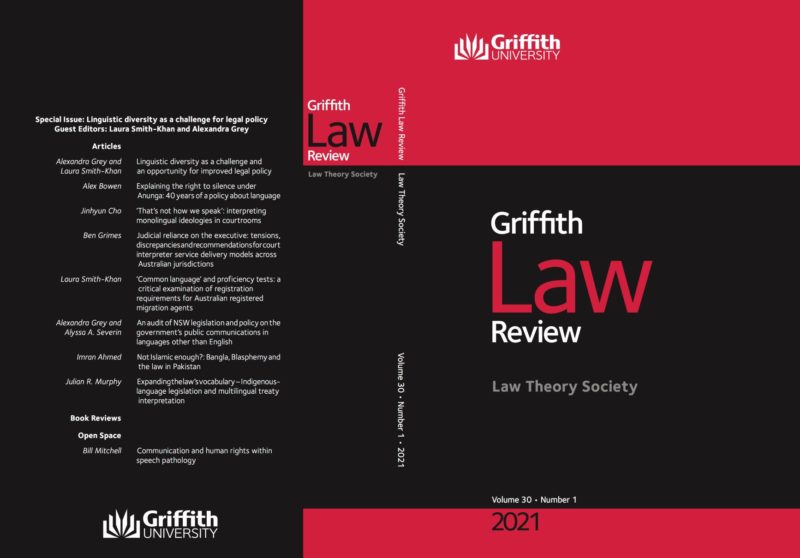 Editorial
- Alexandra Grey & Laura Smith-Khan ‘Linguistic diversity as a challenge and an opportunity for improved legal policy’ (Fifty free copies here; please only use this link if you do not have institutional access).
Our editorial proposes that more should be done to incorporate linguistic research within legal education. As future legal practitioners and law-makers, law students are an essential audience for this scholarship. Many of the policy suggestions across the research articles would be supported by corresponding reforms to legal education. We suggest that a workable first step could be for legal academics and linguistics academics to work together to develop, teach and share a unit. This is a timely discussion, given that the 11 compulsory subjects across Australian law schools (the ‘Priestly 11’) are currently under review.
In support of this proposition, our editorial reports on a sample inquiry we made into current offerings for university students in New South Wales (NSW) and the Australian Capital Territory (ACT). Overall, this small study found that while a range of subjects appear to touch upon one or more intersections of linguistic and legal scholarship, there are few that offer this intersection as a focus. Across 11 public universities in NSW, we identified only three university courses on language and law offered within law degrees, at the University of Technology Sydney, University of New England and Southern Cross University, while in the ACT, the Australian National University (ANU) offers a forensic linguistics minor in the School of Literature, Languages and Linguistics. We also found (just a few) other university subjects touching on aspects of language and law while having other primary focuses. For example, the ANU offers ‘Literature, Law and Human Rights’ as a law degree elective. And we know from our teaching experience that most law schools offer a foundational subject in which characteristics of legal writing may be covered.
Courts and the justice system
- Alex Bowen ‘Explaining the right to silence under Anunga: 40 years of a policy about language’ (Fifty free copies here; please only use this link if you do not have institutional access).
- Jinhyun Cho ‘“That’s not how we speak”: interpreting monolingual ideologies in courtrooms’.
- Ben Grimes ‘Judicial reliance on the executive: tensions, discrepancies and recommendations for court interpreter service delivery models across Australian jurisdictions’ .
Administrative rules and processes
- Laura Smith-Khan ‘“Common language” and proficiency tests: a critical examination of registration requirements for Australian registered migration agents’ (Fifty free copies here; please only use this link if you do not have institutional access).
- Alexandra Grey & Alyssa A. Severin ‘An audit of NSW legislation and policy on the government’s public communications in languages other than English’ (Fifty free copies here; please only use this link if you do not have institutional access).
Law-making in legislatures
- Imran Ahmed ‘Not Islamic enough?: Bangla, Blasphemy and the law in Pakistan’ . (Fifty free copies here; please only use this link if you do not have institutional access).
- Julian R Murphy ‘Expanding the law’s vocabulary – Indigenous-language legislation and multilingual treaty interpretation’ .
Book reviews
- Ana Sofia Bruzon ‘Shallow equality and symbolic jurisprudence in multilingual legal orders’ (reviewing Janny H C Leung’s 2019 OUP book; fifty free copies here; please only use this link if you do not have institutional access).
- Gareth Lloyd ‘Researching forensic linguistics: approaches and applications’ (reviewing Georgina Heydon’s 2019 Routledge book).
Open Space
- Bill Mitchell (2021) ‘Communication and human rights within speech pathology’ [public lecture] (Fifty free copies here; please only use this link if you do not have institutional access).
The Griffith Law Review is unusual in having an ‘Open Space’ section for non-traditional pieces. We’ve filled it with Bill Mitchell OAM’s 2020 speech on the just-commenced Human Rights Act 2019 (Qld), ‘Speech Pathologists as Human Rights Defenders’. Bill explains that ‘communication rights’ are ‘cross-cutting enablers of other rights’, including legislatively-enshrined rights to freedom of expression, recognition of equality before the law, cultural rights, freedom from cruel and inhuman or degrading treatment in institutional settings, and rights to education and health services. This emphasis on language practices and language rights as gateways to full and fair legal participation and protection echoes the thematic issue’s research articles.
We are proud to have assembled these contributions revealing current, specific issues of linguistic (in)justice as well as thoughtful and practical paths forward; we hope you enjoy reading about them!
]]> Language on the Move regulars, Jinhyun Cho, Loy Lising, and I have teamed up with a number of early career linguists to produce a special issue of the International Journal of the Sociology of Language that’s just been published and which is devoted to ‘Ideologies of English in Asia’. In a treat for fans of multilingualism and in response to the dominance of English in academic publishing, the articles include bilingual abstracts, in Korean, Mongolian, Mandarin, and Japanese, and of course the viewpoints of researchers in and from Asia. The issue’s contributions examine how socially constructed East-West binaries are interacting with language ideologies about English and other languages on sub-national scales in various Asian contexts including in Korea, China, Japan, Tajikistan, and Pakistan.
That English has spread in Asia is well-known, and the peer-reviewed editorial, five research articles, and a book review enrich the sociology of language literature with new case studies. The focus is on investigating how socially constructed East-West binaries interact with language ideologies about English and other languages.
Our contributors identify and analyze ideologies which map international Orientalist hierarchies onto socially salient hierarchies on more local scales, particularly in relation to language. The specific Orientalist ideologies that our authors analyze include Self-Orientalism, Internal Orientalism, and Internal Colonialism. The five contributions could each be summarized with a phrase that Brook Bolander uses to describe her own findings about the indexicality of English amongst Ismaili Muslim communities in Pakistan and Tajikistan: “ownership of English [is] polysemous”.
The articles also cover varied time periods. To start, Cho uses fascinating 19th century data from the diary of Korea’s first professional Korean-English translator, Yun Chi-Ho, to explore his participation in and reproduction of a process of self-Orientalization. He sought to identify with both the West and the East but became despondent in response to the exclusionary racialisation of English speaker identities which he experienced while living in America. Later in the Special Issue, Michiko Weinmann and her co-authors bring us right up to the present moment with their study of shifts in the sociolinguistic environment of Japan in relation to the 2020/2021 Olympic and Paralympic Games that some of us just had the chance to watch.
My own article, happily co-authored with Gegentuul Baioud, as well as Xiaoxiao Chen’s article examine forms of orientalism and colonization in China in recent times (Internal Orientalism and Self-Orientalism, respectively). Baioud and I foreground minoritized peoples’ experiences. You may have read about our two separate sociolinguistic studies of Chinese minority languages previously on Language on the Move (here and here). This time, we’ve come together to compare our studies and draw out similarities, showing how binary East-West ideologies are reproduced but not necessarily as Foreign language–Local language ideologies. Rather, English and Mandarin are both becoming constructed languages of East China, which further marginalizes minority languages.
This research on the sociology of language has been an intellectual pleasure to edit, research and write. Loy, Jean and I wish you happy reading!
Ideologies of English in Asia: Table of Contents
- Ideologies of English in Asia: an editorial (by Alexandra Grey, Loy Lising and Jinhyun Cho)
- Constructing a white mask through English: colonized consciousness and racialized identities (by Jinhyun Cho). This article is Open Access, i.e. free for all to read online.
- English as Eastern: Zhuang, Mongolian, Mandarin and English in the linguistic orders of globalized China (by Alexandra Grey and Gegentuul Baioud)
- Language ideologies and self-orientalism: Representing English in China Daily travelogues (by Xiaoxiao Chen)
- Voices of English: Language and the construction of religious identity amongst Ismaili Muslims in Pakistan and Tajikistan (by Brook Bolander)
- English language education reform in pre-2020 Olympic Japan: Educator perspectives on pedagogical change (by Michiko Weinmann, Ryo Kanaizumi and Ruth Arber); and
- a book review, It Is Never a Language Itself!: Language Ideologies of English, Gender, and Embodied Capital in South Korea (by Juyoung Song, reviewing Cho’s (2017) book, English Language Ideologies in Korea).
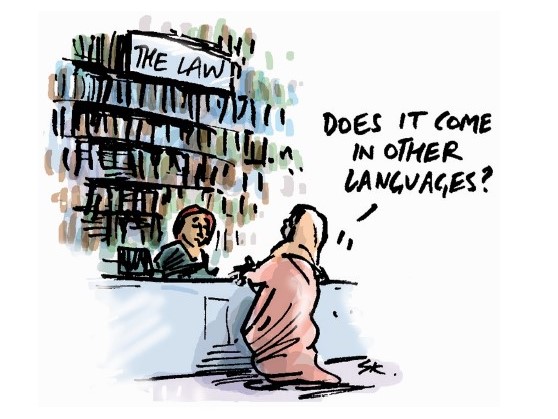
(Image credit: Grey & Smith-Khan, 2021)
Together with another Language on the Move regular, Laura Smith-Khan, I have just published a new article about ‘bringing linguistic research into legal scholarship and practice’. It is an effort to redress the lack of recognition within the law of relevant linguistic research. The article forms part of our pursuit of an alternative and more collaborative approach to legal scholarship and law reform that addresses issues of communicative barriers and linguistic injustice.
In the article, Laura and I propose a cohesive articulation of the shared basis upon which the interdisciplinary research field of law and linguistics is developing. We do this because:
The lack of a cohesive articulation of how (or whether) there are shared bases upon which this interdisciplinary field is developing also creates challenges for collaboration and for the accessible and impactful dissemination of findings. There is, therefore, a need to apply an over-arching critical analytical perspective to the emerging field to more cohesively articulate its shared basis, to make it more accessible and to identify pathways forward for research. (Grey and Smith-Khan 2021: 2).
Specifically, we propose an organisation of the research literature around the familiar three branches of the state: the legislature, the executive, and the judiciary. This, we hope, provides a map of the research literature for non-linguists and legal practitioners. This tri-partite organisation of the field also invites interdisciplinary scholars to critically reflect on future directions for law-and-linguistic research. It may therefore spark discussion and debate from a range of perspectives, leading to refinement.
The idea of dividing the research literature into these three branches – or around these three nodes if that metaphor works better for you – came to us from Professor Peter Gray. Peter was the discussant on our panel ‘Linguistic Diversity as a Challenge to Legal Policy’ at the Australian Linguistics Society Annual Conference just over a year ago, in December 2019. His use of these three themes to organise the discussion of that panel caused Laura and I to rethink the tentative conceptualization of the field which we had proposed at the 2019 (inaugural) Law and Linguistics Interdisciplinary Researchers’ Symposium at Sydney Law School, then developed in a speech at the symposium dedicated to Sharing Knowledge in the Spirit of Humboldt. and an article based on that presentation (Smith-Khan and Grey 2020).
Our earlier proposal had been to organise the burgeoning language and law research field around three main subject matters/research questions. The first was ‘language in legal or bureaucratic processes’, the second ‘language-related social justice’; and the third ‘regulation of language’. There were a few reasons to replace this heuristic with the legislature, executive, judiciary tri-partite structure. Not only is the newer structure more familiar and navigable for lawyers and legal scholars, but we also found once we started organising the literature around the three original themes that most of the research related to the theme of ‘language-related social justice’, and much of it split out of the categories of ‘language in legal or bureaucratic processes’ or ‘regulation of language’ as well.
The three branches of the state is, we accept, also a heuristic and so, as in our former model for organising the research literature, not every study will fit neatly into just one branch. Nevertheless, “We believe these three branches, based on the field’s major concerns, organise the research literature’s connections and complementarity in ways that may not otherwise have been obvious” (Grey and Smith-Khan 2021: 6).

Parliament House in Canberra
It was important to us, in developing this proposal, that we model how to organise the research literature in a way that does not categorise studies by their methodologies or theories, because that, we thought, would reinforce the disciplinary boundaries which already limit the engagement between linguists, on the one hand, and legal scholars, legal practitioners and policy-makers, on the other.
In the article, we explain the theoretical gap between a social constructionist view of language which is common in Linguistics and a static, objectifying view of language, as well as the real-world high stakes of this gap. We illustrate this with the murder conviction, then acquittal of Mr Gene Gibson based on a guilty plea that resulted from mistaken assumptions about language, which Language on the Move has covered, and with some of Helen Fraser and her collaborators’ work on the misuse of covert audio recordings in criminal trials. (You can read more about such work on the website of the new Research Hub for Language in Forensic Evidence at the University of Melbourne.) Then we describe the research concerns of each of the three branches, as follows, and cite examples.
The judiciary: Research around this branch is concerned with identifying, understanding and resolving unequal or simply inefficient court processes where the way language is used, and/or the beliefs people have about how language is used, are problematic. //Problems in judicial settings are especially common starting points for studies in the sub-field ‘Forensic Linguistics’. This research almost always analyses court processes, most often criminal proceedings. It includes research about preparing and giving expert linguistic evidence (eg, about who is likely to have written a particular ransom note or how consent might be expressed in a particular dialect). It also includes research on how mis-interpretation, mis-translation, priming, and racialised or prejudicial assumptions about language can affect justice. […]
The executive: Non-court legal processes – the executive/administrative/bureaucratic processes of the state, including pre-trial processes – form a significant portion of people’s interactions with governments, and disputed executive processes are often litigated. These processes are consequently another significant subject of interdisciplinary law and linguistic research. Thus, judges; barristers; socio-legal scholars; public and administrative law scholars; educators in courses on civil and criminal procedure, ethics and professional practice; migration lawyers; and even political scientists are likely to be professionally interested in legal processes of governance beyond courts, and language-related problems/injustices within them. //Linguistics-related research about administrative processes problematises, among other topics: intercultural communication; the role of interpreting and translation; the language and discourse of bureaucratic texts (decisions, procedures, submissions, application forms, etc.) and the interpretation and application of laws or guide- lines about bureaucratic processes. […]
The legislature: The most obvious topic here may seem to be language use within parliaments. While this is not actually a prolific area of research, there is an emergent strand of research in Australia about the equally emergent practice of using Indigenous languages in parliaments. The language of legislative drafting is a more prominent focus in research about language and legislative settings; this branch is therefore the home, in our model, for the well-established research strands on Plain English legislation, and on legislative translation between jurisdictions. //There is also significant empirical and philosophical research examining what constitutes a linguistically just state. Other such research is more applied, for example studying actual policies about Indigenous, minority or migrant languages and those policies’ impacts on inequality. //This branch is also the home for research about laws which govern language use. (Grey and Smith-Khan 2021: 4-5)
Of course we could not fit all the law-and-linguistics research out there into our article. The Alternative Law Journal runs 4,000-word articles and its editors were rightly aghast when we turned in a 7,000-word draft at one point, so some of the footnotes had to go! Therefore, we welcome responses to our proposed three branches by way of publications or emails, or as comments below.
References
Grey, A. and Smith-Khan, L. (2021), ‘Bringing linguistic research into legal scholarship and practice’, Alternative Law Journal, 46 (1), 64-70. doi:10.1177/1037969X20962830
Smith-Khan, L. and Grey, A. (2020) ‘Reflections on developing research collaborations across law and linguistics’, Journal & Proceedings of the Royal Society of NSW, 152(3). https://royalsoc.org.au/images/pdf/journal/152-3-07SmithKhanGrey.pdf
Law and Linguistics Interdisciplinary Researchers’ Network
Subscribe to our international listserv, the Law and Linguistics Interdisciplinary Researchers’ Network, to share your questions and announcements about research in this field.
]]>Background
My contribution is a study of 72 feedback questionnaires completed in 2011 and 2012 by participants over two courses of an English-Mandarin bilingual legal education program in the People’s Republic of China that my team and I designed and ran. The program was called the Yilian Advocacy Training Tournament (YATT), or in Mandarin “义联杯”公益倡导竞技性训练项目(i.e. ‘Yilian Cup’ Public Interest Advocacy Training Project), and it was run by the legal aid centre where I then worked, a place called Beijing Yilian Legal Aid and Study Centre for Labor (北京义联劳动法援助与研究中心; Yilian Centre). I’ve previously written for Language on the Move about the tension between aid work and English teaching during my time at the NGO.
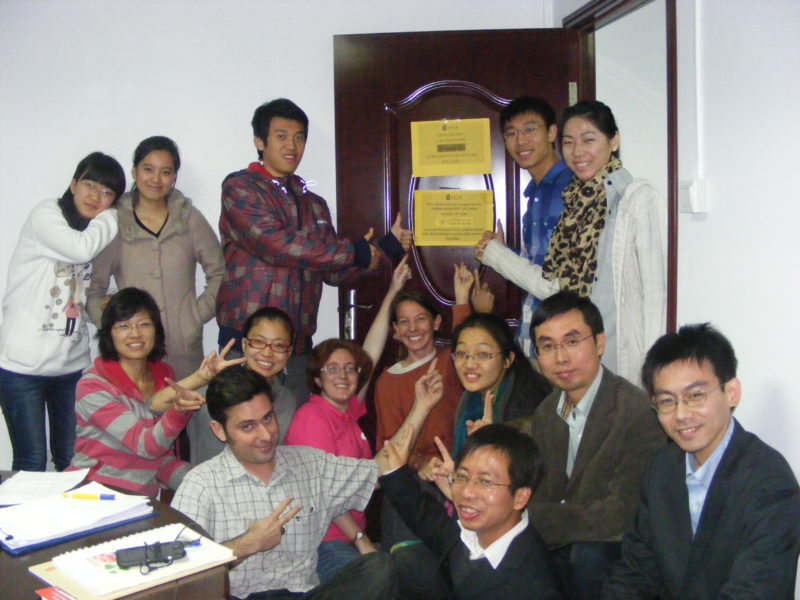
Members of the 2011 YATT team
What makes the YATT program worth studying is its atypical context: this is a Global South, civil-society-led, publicly interested, practical legal education program for university students. YATT thus provides a case for investigating important questions as to how novel forms of legal education are experienced and evaluated by participants, and whether civil-society-led legal education can extend our ideas of alternative forms of ‘clinical legal education’ (CLE), especially forms that may be adapted to contexts beyond the Global North. It is worth noting that participant experiences of CLE, particularly in the Global South, are under-represented topics in the CLE research literature.
An unexpected emphasis on language in the results
Particularly interesting from the interdisciplinary law and linguistics viewpoint is my finding that the themes of legal learning and language learning emerged together and as interrelated skills. Some of the skills which participants nominated as valuable may appear at first blush to be language rather than legal skills, such as speaking with both style and confidence, speaking clearly, organising ideas, responding quickly, using facial expressions and gestures, and adapting to being on stage or to being nervous. But lawyers (especially advocates) also rely heavily on these skills, in whichever language they use. It appears that YATT participants were particularly attuned to noticing improvements in these skills and providing feedback about them. I have suggested in the paper that this may be because YATT was offered bilingually and, for many, undertaken in their second language, and so language was on the participants’ minds.
Whatever the reason, these results can help illuminate something that seems to be somewhat invisible yet in plain sight: that the integration of communication skills with legal skills is one way most CLE around the world already distinguish themselves from lecture-based legal education.
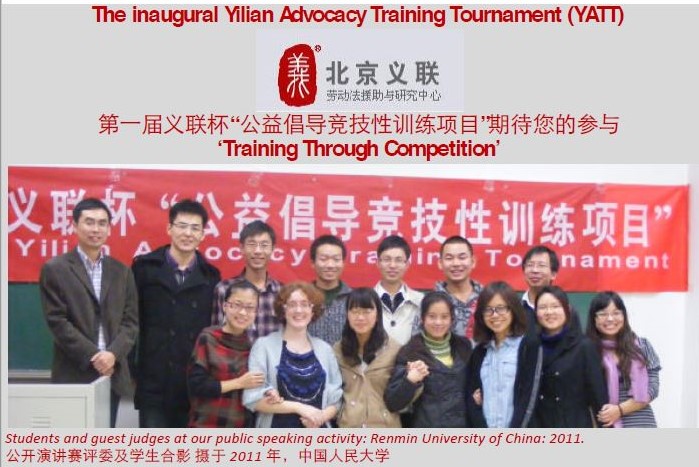 The students and professional volunteers who participated in YATT in 2011 and 2012 perceived it not only as educational, but as practical and legally-relevant education incorporating real-world activities and personnel. The practical learning was what the participants valued most about YATT. The high value on the language learning aspects of YATT is part of this overall evaluation of practical learning within the YATT program.
The emphasis on the language learning theme in the participant responses also highlights the methodological value of seeking insider perspectives. This is an approach that my sociolinguistic studies, rather than my legal studies, have taught me. Because the literature on CLE rarely foregrounds language learning, there could be no content-directed theme about language learning arising from the research literature and then applied to the data analysis; the theme had to emerge from the data itself.
Learning to communicate is language learning
This YATT feedback serves as a reminder that legal practice is in many ways about communication, not only legal know-how, and furthermore that language and communication skills are a facet of a legal education that practice-based learning, more than doctrinal learning, can develop. Learning to communicate appropriately is at the core of practical legal training because communication practices are embedded in lawyering in “real world” contexts. An improved ability to express one’s thoughts, to be confident (authoritative, even), clear and quick off the mark, to effectively emphasise or clarify a message through body language and many of the other language skills that the YATT participants noted are “soft skills”, which law students should hope to develop. I argue that this holds even if CLE is undertaken in the students’ first language, in order to improve their ability to work with various clients and in court.
I therefore argue that practice-based language learning should be recognised and researched as an important part of experiential legal education and vocational legal training generally, and specifically of CLE. Communicative and linguistic skills are surely key aspects that CLE educators around the world hope students will learn through interacting and doing lawyering (for real or in mocked-up scenarios), all the more because these skills are not studied or practiced much in the law school classroom.
Nevertheless, when reviewing the literature I noted that legal education scholarship does not foreground this aspect of CLE, in contrast to the foregrounding of the language aspect from the internal perspective in my study. The relative invisibility of language and communication skills in CLE theory is not necessarily because these are unimportant in reality; the communication skills which the YATT participants felt they had beneficially practiced are recognisable as the stock in trade of good legal advocates and advisers. I suggest, rather, that the relative invisibility of language in legal education scholarship is the product of a disposition well-known in the sociolinguistic literature, namely, that non-linguists often mistakenly regard language as something that is simply there and “naturally” learnt and known.
This study gives an illustration of why there is a benefit to making language learning and linguistic research much more visible in legal education. Here, the context is clinical legal education, but there is surely value to be found by increasing the visibility of language learning and linguistic research across legal education. Dr Laura Smith-Khan and I have made this broader point before on Language on the Move, e.g. when noting Prof Janet Ainsworth’s call at IAFL 2019 for scholars to deliberately communicate our research where it is most likely to influence positive change, and we have a related paper just out in the Alternative Law Journal.
References
Grey, A. (2020) ‘The value of participant feedback: Insights from learners in a novel, non-university CLE setting in China’, International Journal of Clinical Legal Education 27(2) (2020), 5-67.
Grey, A. and Smith-Khan, L. (2020). ‘Bringing linguistic research into legal scholarship and practice’. Alternative Law Journal.
]]>

Exterior of a pub at an intersection in the shopping hub of Burwood, a highly diverse suburb of Sydney
Editor’s note: Do public health messages about the Covid-19 pandemic match the linguistic profile of Australia’s population? In this latest contribution to our series of language aspects of the COVID-19 crisis, Dr Alexandra Grey, Postdoctoral Research Fellow at the University of Sydney Law School, shares her submission to the Australian Senate’s Select Committee on COVID-19’s inquiry into the Australian Government’s response to the COVID-19 pandemic. The call for contributions to the series continues to be open.
***
My submission is based on my current, still ongoing research project, ‘Good Governance in Multilingual Urban Australia’. This submission addresses the important question: How do you access COVID-19-related public health information in Australia in languages other than English (LOTEs)? It is based on preliminary results of my current study and provides recommendations about better reaching the linguistically diverse Australian public with official public health communications.
The Committee will decide which submissions to put on the public record. However, Language on the Move is making a copy of mine available here, because we believe it will be beneficial to draw attention to, discuss and even debate these recommendations. Please read the submission (11 pages plus images) or simply my 6 recommendations, which you can find on page 3, and share your perspectives in the comments below.
The submission identifies these key problems with Australia’s official COVID-19 public health communications in LOTEs, which emerge from the study:
- There are barriers to the accessibility of official public health information for those in the community who are not confident reading/able to read the English-medium public health communications on display in their local areas or available (albeit often buried) on government websites
- State and federal governments have left it to local councils to provide LOTE-medium public health communications in public areas, without any requirement on local councils to actually take up this task, and with varying outcomes even in areas with similar multilingual profiles
- There is an under-utilization of the LOTE-medium public health posters which the NSW and federal governments have specifically produced in response to the COVID-19 pandemic
- Government health agencies’ Twitter feeds have not cultivated LOTE readerships before or during the pandemic and do not appear to be engaging the LOTE-using public; these feeds are haphazard, infrequent and unreliable in their LOTE tweeting as well as in their references to LOTE resources.
Amongst various possible ways of addressing these problems, my recommendations focus on:
- Research: improving the efficacy of both physical and online official LOTE public health communications by increasing the collection and analysis of appropriate data
- Redesigning online communications: improving the efficacy of online official LOTE public health communications through simple, practical changes to government websites and tweets, including increased and consistent use of LOTEs and their scripts
- Standard setting: improving both the quality and the reliability of LOTE public health communications across government agencies through legal requirements, at federal and state levels, for government bodies to plan for, execute and monitor the effective dissemination in LOTEs of official public health information, at least during times of emergency/pandemic, with associated best practice guidelines to be developed and implemented across government. I anticipate that this last will be the most controversial, but potentially also the most impactful.
Acknowledgement
I’d like to acknowledge Dr Allie Severin and Dr Hanna Torsh for their help with data collection in this project, and the Language-on-the-Move Reading Group for insightful discussions of language aspects of the Covid-19 pandemic.
Language challenges of the Covid-19 pandemic
Visit here for our full coverage of language aspects of the COVID-19 crisis.
]]>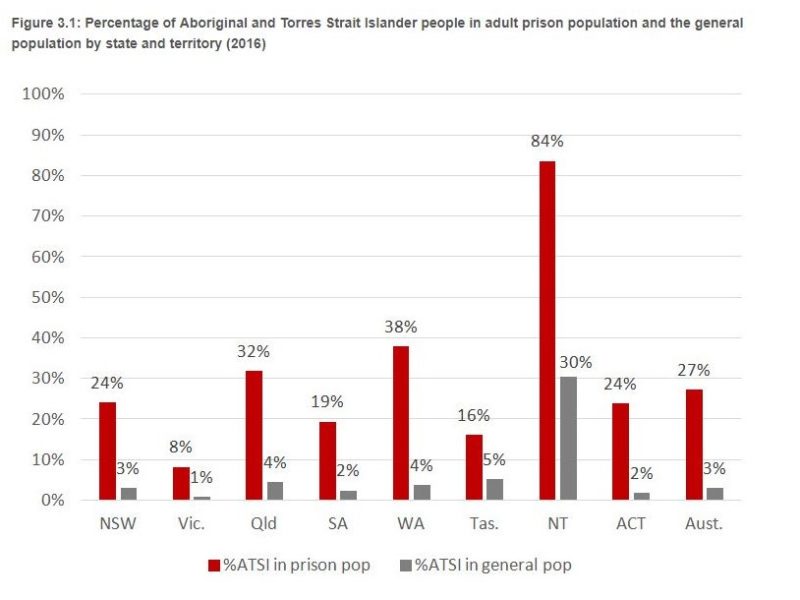
Indigenous Australians are imprisoned at much higher rates than non-Indigenous Australians (Source: Australian Law Reform Commission)
Note: This post was co-authored with Laura Smith-Khan.
Language on the Move mover-and-shaker, Dr Laura Smith-Khan, and I are just back from the 14th biennial conference of the International Association of Forensic Linguists at RMIT University in Melbourne (1-5 July 2019; program and abstracts here). This association, which goes by the acronym IAFL, brings together academics, police, lawyers, judiciary and language professionals, and offers stimulating research from scholars around the world, much of it revealing how legal processes and justice outcomes could be improved by better understanding language practices and mistaken beliefs about language.
The presentations by researchers, translators and interpreters here in Australia working with and on Indigenous languages were especially fascinating, and follows on from last week’s overview of IAFL research about law reform.
For international visitors, conferences in Australia can be an introduction to the customs of acknowledgement and welcome to Country. Attending this conference, we acknowledged that the conference venue sits on the traditional land of the Wurundjeri people of the Kulin Nation.
Amongst the many presentations relating to the International Year of Indigenous Languages, and specifically to Australian Indigenous languages, a highlight was Michael Walsh’s (University of Sydney) keynote. He spoke about his many encounters with the mistaken belief by non-specialists that, if an Indigenous person speaks any variety of English, then their participation in complex legal matters in English will be fair and unproblematic. Drawing on the extensive work on Aboriginal ways of using English by Diana Eades (who also presented at the conference), Michael talked us through a range of Englishes which are often conflated with Standard Australian English and Legal English. He also explained differing English discourses, making the provocative suggestion that sometimes ‘bad English’ can be to the claimant’s advantage and ‘good English’ to their disadvantage.
Also provoking reflection and discussion, Ben Grimes (Charles Darwin University) moderated a panel of speakers from the Aboriginal Interpreter Service, and presented his own ideas for timely advocacy by linguists to the judiciary. Linguistic evidence is highly relevant when assessing whether a defendant’s admissions were made reliably, as the new Uniform Evidence Act section 85 calls upon judges to consider. This could, and should, include greater and more technical consideration of the linguistic challenges faced by many Indigenous people in Australia who do not have Standard Australian English as their dominant language variety.
Aboriginal Ways of Using English, by Diana Eades
Some of those linguistic challenges – which become challenges in equal access to justice – were presented by Alex Bowen (ARDS Aboriginal Corporation). Alex examined transcripts of police giving the “right to silence” caution to Indigenous people (for the broader context of research related to this caution, see here). Police guidelines recognise a potential for miscommunication and therefore require police to give the caution in undefined “simple terms” and to ask people they are arresting to explain back what they have heard so as to check their understanding of the warning. This is important legally because the assumption that the right was understood then means any admissions are taken to have been voluntarily made. However, Alex’s analysis revealed a great variety of apparent mistakes about the caution having been understood. Problems included conversational sequencing affecting how suspects interpreted police language; chains of paraphrases producing confusion, especially relating to the meaning of conditional clauses; failure to add information; and police not providing clear feedback to suspects about whether or not they have demonstrated an accurate understanding of their rights. Alex made the plausible suggestions that it would help if police announced the topic, i.e. explained that what they were about to do was to give a caution and test whether it had been understood, rather than to start an interrogation. His recommendations included:
- That people who lack familiarity with mainstream legal culture and institutions be educated about the legal system outside the interview room
- That police start with a clearer text in plain English if they are going to explain the caution (see CORG 2015 recommendation 1)
- That police develop and evaluate a process for explaining and testing the caution in arrest conversations
Problems with the police caution underpinned years of litigation relating to manslaughter for which Mr Gene Gibson, an Indigenous man from Kiwirrkurra in the Gibson Desert, was arrested in 2010. After years of imprisonment and legal appeals, Mr Gibson was finally released in 2017, when the WA Court of Appeal found there had been a miscarriage of justice. Mr Gibson’s first language is Pintupi and his second language is another Indigenous language, Kukatja. The court found that Mr Gibson’s initial guilty plea had not necessarily been “attributable to a genuine consciousness of guilt” but resulted from mishandled language barriers and mistaken assumptions about language.
It was encouraging to hear at IAFL that the expert evidence of Professor Diana Eades had been considered by the courts and played a key role in Mr Gibson’s eventual release. Diana’s presentation explained language problems which arose in the initial police interview. In this part of Australia (Western Australia), police investigations involving Indigenous suspects must include an “interview friend” to provide support. However, for Mr Gibson, the police misunderstood the difference between an interview friend and an interpreter, deciding not to call an interpreter and instead to rely upon the interview friend to interpret between Indigenous languages and Standard Australian English. Rather than relaying the information that Mr Gibson was free to choose not to answer police questions, and that, if he did, he risked incriminating himself unnecessarily, the interview friend advised Mr Gibson that he must answer the police questions. Not knowing the relevant Indigenous languages, the police officers did not pick up this problem at the time.
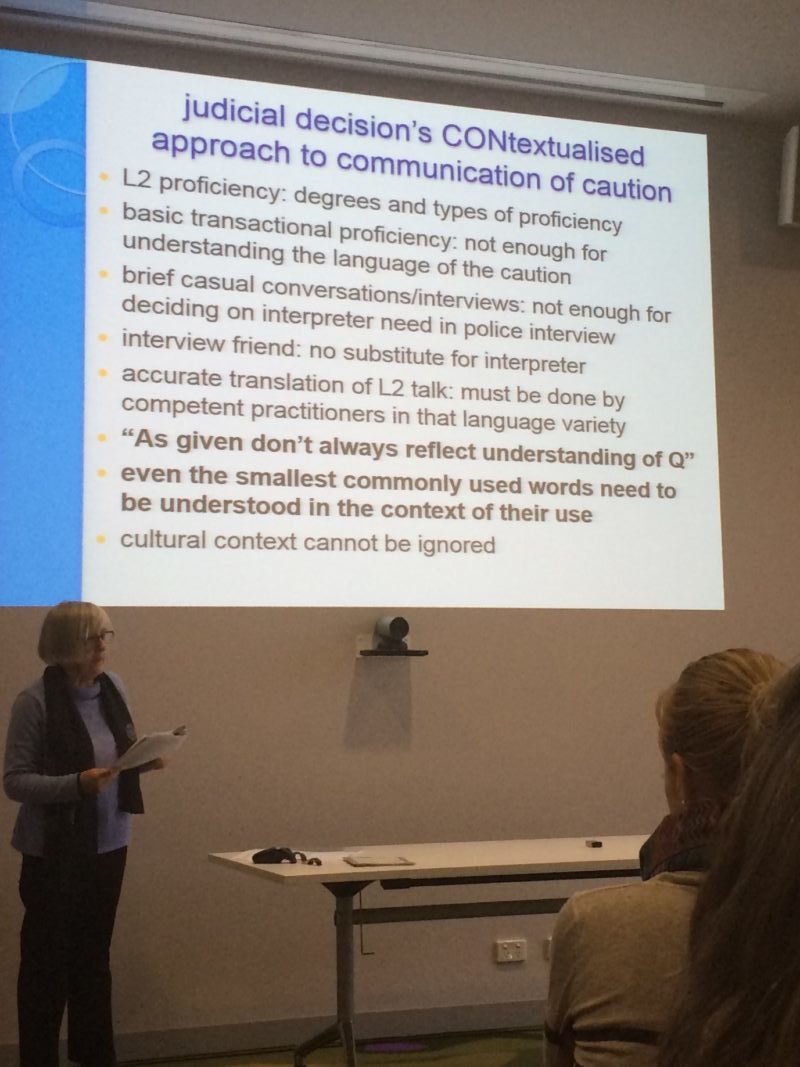
Diana Eades’ recommendations for basic linguistics instruction for police and lawyers
Diana used this case to illustrate two approaches to language: one in which meaning is (mis)understood as independent of context and one in which meaning is contextual. The de-contextualised approach is the source of many language-related injustices in legal processes, from taking simple words like “yes” on face value as consent or affirmation, to misunderstanding the different linguistic demands of an interview compared with a casual chat about the footy and therefore not arranging an interpreter. That Mr Gibson finally won his release was due to certain judges, unlike the police, understanding that meaning is contextual (see e.g. the 2014 judgment). Diana concluded with the recommendation that the points listed on the slide be taught to police and lawyers (see image).
Widening out to look across multiple cases of unreliable admissions of guilt, David Moore (University of Western Australia) reaffirmed that there are high-stakes linguistic “false friends” between Central Australian Englishes and Standard Australian English, e.g. “kill” and “rape”, which can lead to false confessions from Aboriginal defendants.
Natalie Stroud (Monash University) focused on another type of court, the Koori Court of Victoria, which is designed to provide a culturally sensitive forum for Indigenous offenders and give them a voice in the criminal justice system, including by integrating community Elders into “interactive sentencing conversations”. She highlighted that the introduction of video conferencing is impacting on their inclusion, narrowing the conversation back to a Magistrate-defendant dialogue.
These presentations about legal processes were complemented by research on phonetics. For example, Deborah Loakes (University of Melbourne) has been building up the technical description of the phonetics of two Victorian varieties of Aboriginal English, and the variations within them, which could better assist decision-makers in the legal system to identify speakers of these varieties and specific inter-lingual communication issues such as mistaken identification of a speakers’ background.
Attendees also heard from experts from beyond linguistics, for example lawyers from the North Australian Aboriginal Justice Agency presented the case for using cultural brokers instead of legal interpreters in Government service delivery to remote Indigenous communities. Similarly, Dima Rusho (Monash University) described the innovative collaborations of legal professionals and Indigenous community members in the Northern Territory to develop translations that draw on Indigenous conceptualizations to improve the understanding of key terms in legal processes.
In this International Year of Indigenous Languages, these researchers are helping us all think through the links between the minoritisation of Indigenous languages and the systematic inequalities faced by Indigenous people in Australia’s (and other nations’) legal systems, providing ideas and impetus for reform.
References
Bowen, A. (2019). ‘You Don’t Have to Say Anything’: Modality and Consequences in Conversations About the Right to Silence in the Northern Territory. Australian Journal of Linguistics, 39(3), 347-374. doi:10.1080/07268602.2019.1620682
Eades, D. (2013). Aboriginal ways of using English. Canberra: Aboriginal Studies Press.
Eades, D. (2018). Communicating the Right to Silence to Aboriginal Suspects: Lessons from Western Australia v Gibson. Journal of Judicial Administration, 28(1), 4-21.
Smith-Khan, L. & A. Grey (2019). Lawyers need to know more about language. Language on the Move.

The Language-on-the-Move team proudly celebrate the graduation of Drs Alexandra Grey and Gary O’Neill
Editor’s note: This week the 20th and 21st PhD students I have supervised to completion graduated from their degrees. You can read the theses of Dr Alexandra Grey about language rights in China and of Dr Gary O’Neill about multilingualism in Dubai through our PhD Hall of Fame. Dr Alexandra Grey, who also received a Macquarie Vice-Chancellor’s Commendation for Academic Excellence and an Australian PhD Prize for Innovation in Linguistics for her thesis, delivered the graduation speech on behalf of the graduating group. It is with immense pride in her achievement and that of all our PhD students that we share her speech here on Language on the Move. Alternatively you can watch the ceremony here (Alex’ speech starts at 1:13:35).
****
Chancellor, members of the University, guests, and especially my fellow graduates here in fantastic hats; hello! I am delighted and deeply honoured to give voice to the gratitude that I’m sure most of us feel towards our guests, and to reflect briefly on my own personal path towards today.
Today, I celebrate the completion of a PhD. Let me tell you a little about it. My own PhD is 100,000 of my very best words, four years of intense work and learning, and a childhood dream achieved. The chancellor was right in saying that when you see a parent graduating it inspires you. I collected most of my PhD data in China, interviewing young adults and looking at how policy protections for one particular minority language work in practice. In preparation for the PhD I learnt Mandarin. The Linguistics Department supported me to go to China for fieldwork in four provinces. I remember one day in 2015 in South China, when I hopped onto smaller and smaller vehicles – trains, then buses, then minibuses – to get to a village in the rural, rice farming fields. Eventually, the bus conductor informed me:
Zài zhèlǐ xià chē. Shāo děng yī huǐ’er. Zhè liàng chē bù zuǒ zhuǎn…
He was saying I had to simply get off on this small winding road. His explained that his minibus was turning right at the fork in the road, but if I waited 20 minutes another minibus turning left would pass by. zhen de ma?! Had I understood that right? My little suitcase and I sat by this fork in the road, alone for once in such a populous country, and I remember thinking “I may not feel certain about where I am on a map right now, but I know for certain that I’m in the right place in my career.” I loved doing my PhD. Most days.
But doing a PhD involves a lot of independent work, which can feel lonely. And I felt even more alone when my husband fell seriously ill at the start of my final year. We passed a very difficult eight months juggling his health and my PhD. Luckily, I had a caring family, and my supervisor, Prof Ingrid Piller, had developed a great peer support group around me. Ingrid’s many years of experience has only strengthened her passion for supervision.
I am sure my success comes in part from having this bunch of boffins, this support network. Now, we can become the supporters! Isn’t it exciting for us graduates to know that, now we have this university experience under our belts, we can be sounding boards and sympathetic listeners for friends or siblings who undertake university studies, or perhaps one day even support our own students! Being able to give back to my research team, not just to take their willing support, has added so much meaning to my PhD journey.
Despite the scale of my project, and the personal pressures, I nevertheless finished my thesis within the four year limit, then won a Vice-Chancellor’s Commendation and a national thesis prize, and I’ve just started a job running my own exciting project at Sydney University. So it is with an unashamed sense of triumph that I am graduating today.
I hope very much that every graduate here at every degree level feels triumphant, too, as each has surely overcome their own obstacles. I couldn’t be more proud to represent us all in thanking the community here today who have fostered us in our achievements and, I hope, fostered in us a lifelong love of learning.
]]>
“This is English”, a shop assistant told me.
Language is literally “on the move” in the writing on clothing. We’ve all seen it but may not have taken much notice. It deserves attention as an increasingly visible and fashionable type of “banal cosmopolitanism”, which “refers to mundane discourses that enact globalization in everyday life”.
Wearable text was certainly part of everyday life in Wuhan, China, where I lived the last half year. Alphabetic letters on a garment, in particular, jumped out from the wearer’s surrounding linguistic environment, which consisted mainly of Mandarin written in simplified characters, and standing out from the crowd may have been exactly the reason the wearer chose letter-emblazoned clothes. This was articulated by one garment itself, on a breast pocket I saw when I looked up from my noodles over a cafeteria table one lunchtime, which read: “Fascinating//CROSSD CULTURAL HERO//96”
The wearer of this textile text literally becomes more “fascinating” (or distinct, in Bourdieuian terms). Wearing “foreign” language is an archetypal example of the “consumption of spatially distant places, [and] signifiers of cultural diversity, and opening up of lifestyles to new experiential spaces and horizons”, which is how Adam Jaworski (2015, p. 220) describes banal cosmopolitanism.
Wearing language is a personal, but often banal, embodiment of cosmopolitanism and I am interested how distant places and cultures are transformed into graphics, printed onto textiles, bought and worn in China. Of all the scripts and languages I saw on clothing, the alphabetic script, and recognizably (if not always 100% correctly spelled) English words predominate. Wearing English is vastly more popular than wearing any other foreign language in Wuhan, but also vastly more popular than wearing Mandarin. For months, I took note of what I saw on sale in shops and worn in classrooms, restaurants, buses and trains. When I saw a textile bearing a Chinese or other non-English text, I then kept a rough count of how many items of clothing bearing English I saw until I next came upon a Chinese or other non-English wearable text. Never were the numbers even close: I saw many more English-emblazoned clothes every day.

Scattered letters on a jacket
The types of textile texts I observed can be subdivided for analysis:
- Brand names (both foreign and Chinese) and trade-marked slogans;
- Stand-alone messages that are not readily connected to any one brand;
- Decorative use of writing without forming words
English predominates
In all these categories, English was more popular than any other language, although I saw some Chinese, French, Russian, Latin (Carpe Diem and Veni, Vidi, Vici, so arguably English borrowings from Latin), a little Korean and Dutch, and some non-languages, which I will come back to. As one of my students observed, the language her peers wear is “usually English. It looks more fashionable. But some extremely popular [Chinese] characters will be printed on clothes”.
Even Chinese brand names were often written on clothing in Romanized pinyin script instead of characters. For example, the puzzling ZYGW and PNADA on clothes or the pinyin brand name YUYUANPAI on a suitcase. This practice clearly positions Chinese brands within an international fashion of alphabetic brand names and logos, even if these Chinese brands are targeting the domestic market.
Examples in the second category ranged from short messages like TRENDY, Woosh! or fashion to whole sentences. For example, I saw someone wearing shoes with this long phrase printed on them: “Lets be [obscured] YOUTHFUL [obscured] LEADING THE [obscured] MORE CONFIDEN [obscured]”.
Texts on shoes, especially long texts like the sentence above, are uncommon on shoes in English-dominant places I’ve been to, but a more common sight in China. Similarly, work attire and men’s formal attire would not normally carry text in Australia, but I saw, for example, a middle-aged man wearing a work blazer embroidered with Autumn on a high speed train to Wuhan. The unspoken conventions about wearable text are of course different across cultures, and part of constructing locally-meaningful divisions and prejudices. I argue that in China, the local symbolic power of foreign languages affects the conventions about which clothes are appropriate for bearing text. English, in particular, is desirable enough as a mark of distinction to break into new micro-spaces (like a shoe or a work blazer), whereas foreign languages have less symbolic power and would therefore be less fashionable – maybe even inappropriate – if printed on similar garments in an English-dominant country like Australia.
Examples in the second category (stand-alone messages) abound as the butt of jokes on the internet because of the preponderance of language-like but incorrect or nonsensical phrases. I could add a belt I saw for sale shouting NANAN!!!, an overcoat reading Courtesy to a lady is a gentleman’s and pyjamas emblazoned with Slaap lekkeri (Google tells me this might be slightly off Dutch for “sleep well”).
However, I have long been intrigued rather than amused by these: are clothing manufacturers keen to identify their products with international fashion/culture/language but unwilling to pay for English language work in the design process? Are such language services difficult for designers and manufacturers to access for some reason other than cost? That is, do wearable texts reveal unequal access to linguistic resources, rather than differing aesthetics?
I asked a shop keeper such questions when I saw a top with the lettering “ADD SHE SSR ESSEG” in a relatively expensive women’s clothing store, which had correct English on other garments. I asked the shop assistant what this said, and she responded that it was English. Aware of my disbelief, she starting picking a glued-on letter off and explaining they could all come off. I said the top made no sense in English and she responded that it looked good, though. In a contrasting example, the assistant at a smaller, cheaper shop informed me that she was aware that a nonsense textile text was not English but, even so, it was selling well.

With its irregular spelling this “Vivienne” on a pyjama top is difficult to read (and its meaning even less clear).
Language play
Do designers and manufacturers simply not care about language quality assurance because they can sell the clothes regardless of language errors or oddities, and at a better price than clothes without any words? Or is “bad English” actually the design goal?
Playing with language can make it even more eye-catching. The brand Yishion is widespread in China and is a good example of such multilingual play: Yi is the pinyin of the Mandarin for clothes, and is combined with the English word fashion.
Whole playful phrases are rarer but include fun examples such as a female student’s overcoat, which read “Words//Boys//Empty words”; in another example, also observed on campus, a female student was wearing a jacket, which announced in French “J’ai perdu//Ma veste” (“I have lost my jacket”).
Adding visual value
Some of these fashion choices may cause you to ask “did the wearer know what the text said, or even that the text was (or was not) English?” That is, what if some wearable texts are worn for aesthetic or price-point reasons, and not “read”? The third category allows us to look at this further, as these are texts without an explicit meaning such as the scattered letters on the coat in the image.
Even so, these texts still have an indexical meaning as symbols of “English”, i.e. international, global culture. That is, these texts highlight the re-purposing of language into visual design resources; it is precisely the stripping back of meaning that makes this archetypal banal cosmopolitanism. To have no lexical meaning to wearers and viewers, and no desire for it, represents the ultimate indicator of language as bearer not of any one ethno-national identity; but of global consumer identity.
In certain markets like China, “foreignized, visual-linguistic forms” (Jaworski 2015, p. 217) are a more saleable commodity than local languages. As the “fascinating crossd cultural hero 96” in the cafeteria explained to me, he did not know the meaning of the text on his jacket but bought it because it looked 《好酷》(“cool”). In other words, the medium is the message, and the message is membership in the global. Or, as one of my students sighed: “sometimes people use the letters just because they worship foreign things”.
And readers, please feel free to tweet us further examples under the hashtag #wear_language (@Lg_on_the_Move).
Related content
- Banal cosmopolitanism
- More on banal cosmopolitanism
- Is English a local language in Berlin?
- Banal nationalism and the internationalization of higher education
- Halloween mystery
]]>