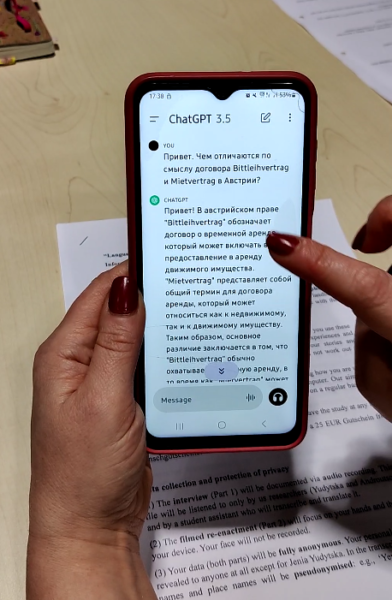
Ukrainian migrant asking ChatGPT to explain different types of rental contracts in Austria (still from Yudytska & Androutsopoulos 2025)
For nearly four years now, I’ve been heavily involved in online (Telegram-based) communities for Ukrainian forced migrants in Austria. Such communities sprang up all across Europe after Russia’s full-scale invasion of Ukraine in early 2022, serving as grassroots digital info-points. In those early, chaotic days, the groups focused on a Ukrainian’s first steps upon getting off the train in their new country. They have since expanded to cover everything from where to buy buckwheat (a very pressing question!) to the fine details of the local education system, health insurance, job market, etc.
The communities are run for Ukrainian refugees, by Ukrainian- and Russian-speakers, that is, overwhelmingly by migrants – forced, labour, student; first-gen, second-gen; etc. It truly is mutual aid: those who migrated earlier answer questions on integration, those who left recently give tips on how best to reach relatives in occupied territory. My family left in 1999, when I was five; I co-admin one group for Ukrainians in my home state of Upper Austria (ca. 3,700 members) and one group focused on how to change from the Temporary Protection status to a longer-term work/residence permit (ca. 8,300 members), plus I occasionally help out in other groups.
In 2025, our communities gained one more, less welcome, “member”: ChatGPT.
Migrants’ search for information
Understanding the role of ChatGPT in these communities requires understanding the complex informational space newly arrived migrants are in. There is an avalanche of info to take in. Some involves the everyday differences: when your child has a fever, at what temperature can you call the ambulance without getting in trouble for wasting their time? Other aspects are specific to the (forced) migrant status, and would stump a local too. Language barriers make accessing information difficult. Even with machine translation, it’s hard to know what term to google or how to interpret a bureaucrat’s answer.
This is where the Telegram communities come in, providing an easy place to ask for help and discuss problems.
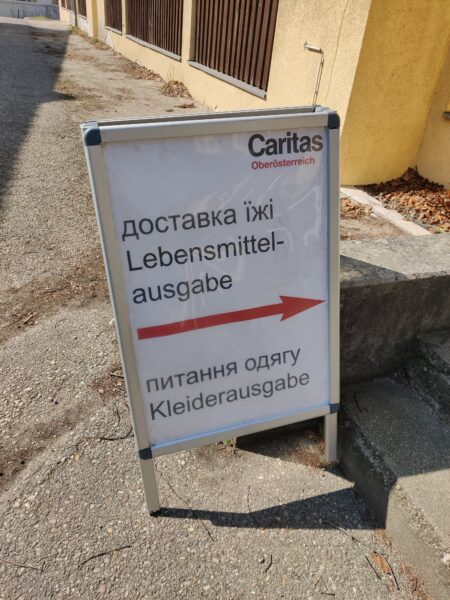
An NGO’s German-Ukrainian sign about food and clothing distribution; the understandable but incorrect Ukrainian suggests machine translation (photo taken by author)
Still, they’re not a panacea. Us volunteers learned only on the fly the ins-and-outs of the Austrian asylum system in all its kafkaesque glory: we sometimes misremember, misunderstand, and mistranslate. Grasping a question can take real detective work, especially when there’s a dozen ways to translate a single German term. Official Austrian sources give a lot of information orally; this leads to bewildering discussions where one person informs the chat their social worker said X, another says it was Y, and the third Z. Maybe it’s miscommunication, maybe the official sources have no clue either.
Above everything loom the rumours, best illustrated by the (admittedly pretty sexist) Russian acronym, ОБС – одна бабка сказала, lit. “some old lady said”. It’s used in the sense of, “Uh-huh, riiight, you got that info from your cousin’s friend’s mom’s neighbour”. In 2027 all Ukrainians in the EU will be put on the next train home, even if the war is still ongoing. Truth or ОБС? Great (unanswerable) question!
Enter ChatGPT
Into all this chaos slams the iron certainty of ChatGPT. If it worked as advertised, it would be an invaluable resource for migrants. You ask a question, it searches for and provides a summary of official information. No linguistic barriers, no mistranslations, no complex legalese; no petty online fights to wade through. The appeal is clear.
The only tiny problem is that it doesn’t work as advertised.
The biggest issue is in how ChatGPT functions: it doesn’t search for and copy-paste information from a database, but rather generates a statistically likely sequence of tokens (words) based on the data it was trained on. This is why it can “hallucinate”, that is, make up answers which are linguistically coherent but factually untrue. It has also obviously been fed more data (law databases, official websites, forum discussions, etc.) from Germany than Austria. For example, it has confidently explained to a Ukrainian that she’s legally obligated to have health insurance – true in Germany, not so in Austria.

Linz Castle on the Danube, Upper Austria, lit up in the colours of the Ukrainian flag (photo taken by author)
The AI technique ‘Retrieval Augmented Generation’ (RAG) is meant to resolve this: ChatGPT first searches for and pulls relevant information from a website, then incorporates it into the answer. (ChatGPT uses RAG sometimes, but not constantly. It costs more energy, thus more money.) But the answer is still generated, so hallucination is still possible. This leads to ChatGPT claiming, for example, “According to the City of Vienna website, Ukrainians have to hand in their old refugee ID card. [Link to website]” Except its generated summary missed a negation: the website explicitly states Ukrainians do not have to hand in their old refugee ID card. RAG can thus lead to even greater misinformation, as it implies a direct source.
The other huge problem is the limited information actually available on migrant issues; even if hallucination was somehow solved, the adage of ‘garbage in, garbage out’ for machine learning remains. For example, to switch to a longer-term residence permit requires the migrant to have an ortsübliche Unterkunft (“housing according to local standards”). ChatGPT physically cannot answer what these local standards are. I know this because, according to my old-fashioned research techniques of searching law databases, skimming court cases, and asking lawyer friends, neither can anybody else! Unfortunately, it is too often the case that there is too little concrete info for ChatGPT to be trained on.
In short, using ChatGPT for information is a gamble. Sometimes it works great, sometimes it generates nonsense. To know which is which, the migrant is left with the same problem of surmounting the language barrier they started with.
Mutual aid with and against machines
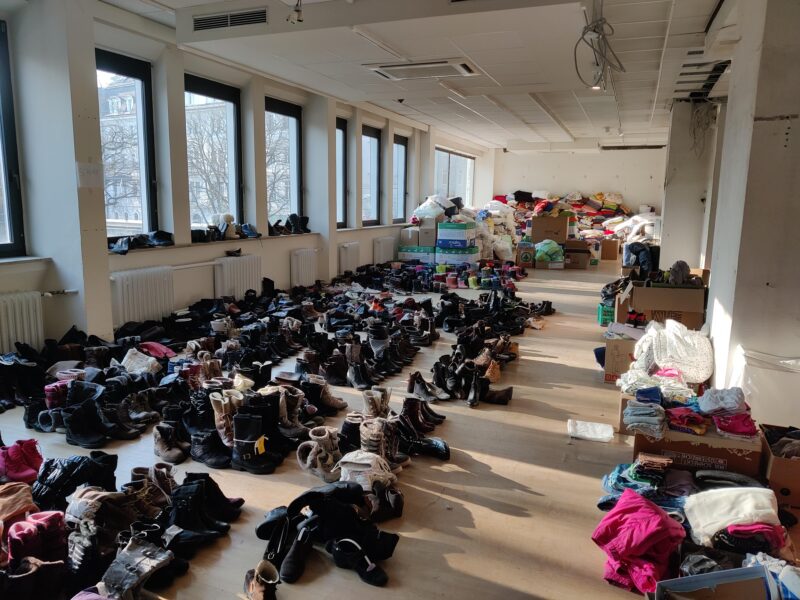
Rows of donated women’s shoes at SUNUA, a grassroots organisation supporting Ukrainians in Upper Austria, 3 weeks post-invasion (photo taken by author)
I don’t consider myself a techno-pessimist – actually, I rely on language technologies heavily in my online volunteer work. My phone’s autocorrect is a life-saver. While I can read and write in Russian, I left Ukraine before starting formal education, and find it slow and frustrating to spell without autocorrect. Similarly, machine translation is a great help. I occasionally need it to double-check my understanding of more complex Ukrainian-language questions; I also machine translate German-language official updates for the sake of speed, then post-edit the Russian text to correct mistakes and stilted phrasing before posting.
That is, due to my background as a child migrant from a primarily Russian-speaking area of Ukraine, I have varying levels of competencies in the three languages I need: Russian, Ukrainian, German. For all their faults, language technologies are an invaluable resource for stuffing the gaps so I can help people successfully. And efficiently, as this has always been 100% unpaid labour in my free time, next to my full-time uni work.
But all this is why I find the intrusion of ChatGPT into our spaces so infuriating on a personal level. In the midst of a horrible situation, between fear, grieving, trauma, burnout, we’re all trying to use the linguistic and technological resources available to us to help each other. I accept arguing against a community member’s cousin’s friend’s mom’s neighbour’s experience as part of that – that connection is also a resource, and it’s human to trust an acquaintance over a fuzzily written law in a language you don’t speak yet. I’m willing to spend my free time picking apart where the confusion lies.
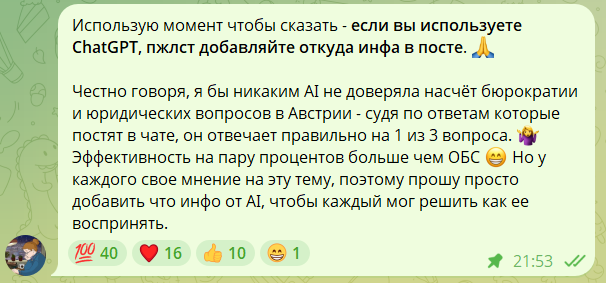
The author’s post in a Telegram group explaining that AI as a source must be clearly stated, with over 60 users leaving reaction emoji of agreement (screenshot taken by author)
I don’t accept arguing with ChatGPT screenshots.
ChatGPT adds beautiful formatting, with eye-catching emoji as bulletpoints. ChatGPT switches between Cyrillic and Latin easily, writing out German acronyms and translating them to Russian in brackets: ÖGK (Österreichische Gesundheitskasse – Австрийская касса медицинского страхования), wow. ChatGPT cites laws using a fancy § paragraph sign I have to copy-paste each time.
Sure, the actual information may or may not be correct, but that’s less important than the style, which so neatly mimics that of official sources. It simply looks trustworthy – the complete opposite of my own messages, written one-handed on a moving bus, with at least one butchered case suffix apiece. It’s unsurprising that people cling to ChatGPT’s information more stubbornly than to the usual ОБС.
Arguing against it is thus extra tedious and, frustratingly, requires me to do additional work. “Wait, no, where did you get that information from, is that an official source?” “Uh, nope, that website ChatGPT cited says the opposite.” “Dude, did you actually read the law ChatGPT ‘references’ – it’s about industrial chemicals, not document translation.” Most unsatisfactorily for all involved, having to prove a negative: “I’m sorry, but there’s no information on that. I don’t know why ChatGPT says there is, maybe it exists for Germany, but not for Austria.”
As a migrant who’s also stared at bureaucratic German in confusion and anxious despair, I don’t blame people for turning to AI. As a volunteer, it’s genuinely made me want to quit: in anger, in exhaustion, with a childishly vindictive, “Well, if they prefer machine over human, so long and thanks for all the fish.”
Where to next?
In principle, the issues explored here are no different from those we’re facing in other areas: education, academia, news, etc. Misinformation is rife everywhere; so is a lack of digital literacy on what current AI can and can’t do. For me, the crucial point is how vulnerable forced migrants are. Misuse of ChatGPT can lead not to a failed homework assignment but to problems on an existential level: with the legal status, with housing, with having enough money for food. Similarly, to put it bluntly, I’m paid to deal with students’ AI use; in volunteer work, it’s just one more weight tipping the scales in favour of finally quitting. It’s also important to add that not all my fellow admins share my worries. Some eagerly embrace ChatGPT answers themselves, which of course save time and energy for volunteers who have little of either to spare.
Our current ‘solution’ is that people must state openly that the information they’re posting is AI-generated. Then other members can decide themselves to what extent they trust it. In this, I would say, we’re ahead of the curve compared to many organisations, and for now, this will have to be enough.
Reference
Yudytska, J. & Androutsopoulos, J. (2025). The use of language technologies in forced migration: An explorative study of Ukrainian women in Austria. In M. Mendes de Oliveira & L. Conti (eds.), Explorations in Digital Interculturality: Language, Culture, and Postdigital Practices (pp. 135-166). Transcript. https://doi.org/10.1515/9783839476291-007
]]>NILS4 will be conducted in late 2025 to 2026 and reported upon in 2026.
There’s currently a national target in Australia about strengthening Aboriginal and Torres Strait Islander languages by 2031. This is Target 16 in a policy framework called Closing the Gap. Zoe and I talk about how language strength can be measured in different ways and how the team have chosen to ask about language strength in this survey in ways that show clearly that the questions are informed by the voices in the co-design process.
Then we discuss the parts of the survey which ask about how languages can be better supported, for example in terms of government funding, government infrastructure, access to ‘spaces for languages’ and access to language materials, or through community support. The latest draft of the survey also mentions legislation about languages as a possible form of support. This is great; the data should encourage policy makers not to intuit or impose solutions, but rather to listen to what language authorities are saying they need. What I especially noticed in this part of the survey was the question about racism affecting the strength of a language – or reducing racism as a form of supporting languages – so I ask Zoe to tell me what led the team to include it.
We go on to discuss the enormous efforts and progress underway, and the love which many Aboriginal and Torres Strait Islander communities around Australia have for language maintenance or renewal. People may get the impression that language renewal is all hardship and bad news because a focus on language ‘loss’, ‘death’, or oppression pervades so much of the academic and media commentary. But Zoe and I both recently met in person at a fabulous, Indigenous-led conference in Darwin called PULiiMA in which delegates from 196 Aboriginal or Torres Strait Islander languages participated. That’s just one indication of the enormous effort and progress around Australia, mainly initiated by language communities themselves rather than by governments. We talk about why, in this context, it’s important that this survey also has section about languages ‘flourishing’ and being learnt.
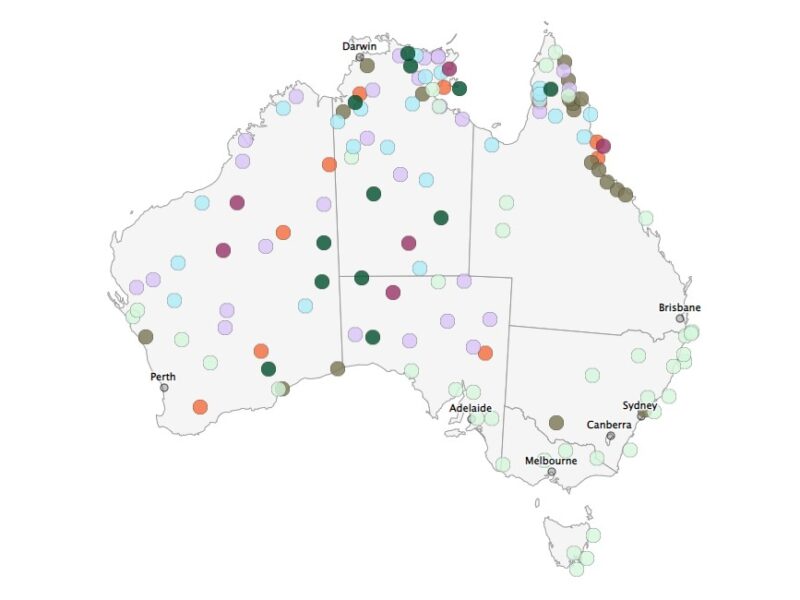
Language groups that participated in NILS3
We discuss the plans for reporting on the survey; incorporating the idea of ‘language ecologies’ was one of the biggest innovations in the National Indigenous Languages Report (2020) about the 3rd NILS and continues to inform NILS4. Finally, we talk about providing Language Respondents and communities access to the data after this survey is completed, in line with data sovereignty principles.
The survey should be available for Language Respondents to complete, on behalf of each language, in late 2025. AIATSIS will facilitate responses online, by phone, on paper and in person. If you would like to nominate a person or organisation to tell us about an Aboriginal or Torres Strait Islander language, please contact the team at [email protected]. Respondents will have the option of talking in greater depth about their language in case studies which AIATSIS will then include as a chapters in the report, as part of responding to calls in the co-design process to enable more access to qualitative data and data in respondents’ own words.
If you liked this episode, support us by subscribing to the Language on the Move Podcast on your podcast app of choice, leaving a 5-star review, and recommending the Language on the Move Podcast and our partner the New Books Network to your students, colleagues, and friends.
Transcript
Alex: Welcome to the Language on the Move Podcast, a channel on the New Books Network.
My name is Alex Grey, and I’m a research fellow and senior lecturer at the University of Technology in Sydney in Australia. This university stands on what has long been unceded land of the Gadi people, so I’ll just acknowledge, in the way that we do often these days in Australia, where we are. Ngyini ngalawa-ngun, mari budjari Gadi-nura-da and I’d really like to thank
Ngarigo woman, Professor Jaky Troy, who, in her professional work as a linguist, is an expert on the Sydney Language, and has helped develop that particular acknowledgement.
My guest today is Zoe Avery, a Worimi woman and a research officer at the Centre for Australian Languages. That centre is part of the Australian Institute for Aboriginal and Torres Strait Islander Studies, which we’ll call AIATSIS. Zoe, welcome to the show!
Zoe: Thank you! I’m really excited to be here and talking about my work that I’m doing at AIATSIS.
Alex: Yeah, so in this work at AIATSIS, you’re one of the people involved in preparing the upcoming National Indigenous Languages Survey. This will be the fourth National Indigenous Languages Survey in Australia. The first one came out now over 20 years ago, in 2005.
This time around, you and your team have made some really important changes to the survey design through the co-design process. Let’s talk about that. Can you tell us, please, what is the National Indigenous Languages Survey, what’s it used for, and how this fourth iteration was co-designed?
Zoe: Yeah, so, the National Indigenous Languages Surveys, or I’ll be calling it NILS throughout the podcast, they’re used to report the status and situation of Indigenous languages in Australia, as you mentioned. This is the fourth one. The first one was done all the way back in 2004 and, the third NILS was done about 6 years ago, in 2019. So it’s been a while, and it’s kind of just to show the progress of how, languages in Australia are being spoken and used, and I suppose the strength of the languages, which we’ll kind of go into a bit more detail. But the data is really important, because it can be used by the government to develop, appropriate language revitalisation programs or understand the areas that require the most support, but it can also be used by communities, which is really important as well.
And so, NILS4 has been a little bit different from the start compared to previous NILS, because the government has asked us to run this survey in order to measure Target 16 of Closing the Gap, which is that by 2031, languages, sorry, by 2031, there is a sustained increase in the number and strength of Aboriginal and Torres Strait Islander languages being spoken.
So, the scope for this project is much bigger than the past NILS, and AIATSIS has really prioritised Indigenous leadership in the design, and will be continuing to prioritise Indigenous voices in the rollout and reporting of the results of the survey.
So, because this is a national-level database, and we want to make sure as many languages as possible are represented, including previously under-recognized and under-reported languages, including sign languages, new languages, dialects. It’s really important that we have Indigenous voices, prioritized throughout this entire research process. And we want to make sure that the questions that are being asked in the survey are questions that the community want answers to, whether or not to advocate, to the government that these are the areas that need the most support, the most funding, or whether or not the community want that data for themselves to help develop, appropriate, culturally safe programs.
So what we did is we had this big co-design process, this year to design the survey. We had 16 co-design workshops with Indigenous language stakeholders across Australia, and this was, these workshops were facilitated by co-design specialists Yamagigu Consulting. We had, in total, about 150 people participate in the co-design process, and of these 150 people, about 107 of these were Indigenous. And so these Indigenous language stakeholders included elders, language centre staff members, teachers, interpreters, sign language users, language workers, government stakeholders, all sorts of different people that have a stake in Indigenous languages, for whatever reason. And we had 8 on-country workshops, which were held in cities around Australia, and 8 online workshops as well, which helps make it easier for, people that kind of came from different places, and weren’t able to come to an in-person workshop.
Alex: That’s a huge… sorry, just congratulations, that sounds like it’s been a huge undertaking. So many people, so many, so many workshops, well done.
Zoe: Yeah, it has been huge, and we’ve had so many different people from a variety of different language contexts, participate as well. So, the diversity of language experiences that were kind of showcased at these workshops was immense and has had a huge impact on drafting the survey, which is obviously the whole point of the workshops, but yeah … We took all the insights from the co-design workshops, we analysed them, thematically coded everything, and started incorporating everything into the survey. And then we went back to the people who participated in the co-design workshops and held these validation workshops so we could show them the draft of the survey, show them how we had planned on incorporating all of their insights, you know, that we weren’t just doing it for the sake of ticking a box to say, yes, we’ve had Indigenous engagement, but we were actually really wanting to have Indigenous input from the start, and right until the end of the project. And we had really good feedback from the validation workshops, and it is, you know, not just a massive task running these workshops, but also, making sure that everybody’s listened to, and sometimes they were kind of contrasting views about how things should be done, and yeah, we wanted to make sure that we had as much of a balance as possible.
We also consulted with the Languages Policy Partnership, which are kind of key workers in Indigenous languages policy and, advocacy. They’re kind of leaders in the Closing the Gap Target 16 that I was just talking about, so their input and advice has been really important to us, as have consultations with the Australian Bureau of Statistics and the Mayi Kuwayu Study of Aboriginal and Torres Strait Islander Wellbeing. So yeah, there’s been a lot of input, and we’re really excited that we’re at the point now where we’re finishing the survey! Dotting all the I’s, crossing all the T’s and getting ready to start rollout soon.
Alex: Yeah, well, I mean, one would hope good input, good output! You know, such a huge process of designing it. You should get really well-targeted, really informative, useful results.
And you’ve mentioned a few things there that I’ll just explain for listeners, because not all our listeners will be familiar with the Australian context. It’s coming through that there’s enormous diversity of Indigenous peoples and languages in Australia, so to explain a little bit, because we won’t go into this in much detail in this interview, Zoe’s mentioned new languages like, contact languages, Aboriginal Englishes, Creoles, like Yumplatok, which comes from the place called the Torres Strait. If you’re not familiar with Australia, that area is between Australia, the Australian mainland, and Papua New Guinea, in the northeast. And then there’s an enormous diversity of what are sometimes called traditional languages across Australia, both on the mainland and the Tiwi Islands as well. So we have a lot of Aboriginal language diversity, and then in addition, Torres Strait Islander languages, and then in addition, new or contact varieties.
Zoe: Sign languages.
Alex: And sign… of course, yes, and sign languages. Thank you, Zoe. And then you’ve mentioned Target 16. So we have in Australia a policy framework called Closing the Gap. For the first time ever, the current Closing the Gap framework includes a target on language strength.
But as the survey goes in to, language strength can be measured in different ways. So how have you chosen to ask about language strength in this survey, and why have you chosen these ways of asking?
Zoe: Yeah, so, along with, kind of, Target 16 of Closing the Gap, there’s an Outcome 16, which is that Aboriginal and Torres Strait Islander cultures and languages are strong, supported, and flourishing. So it’s important for us in the survey to, kind of, address those kind of buzzwords, strong, supported, and flourishing. But it is very clear, from co-design, that the widely used measures of language strength don’t necessarily always apply to Australian Indigenous languages. So these kind of widely used and recognised measures of how many speakers of a language are there, and is the language still being learned by children as a first language? These are not the only ways of measuring language strength, and we really wanted to make sure that we kind of redefined language strength in the survey based off Indigenous worldviews. So, language is independent [interdependent] with things like community, identity, country, ceremony, and self-determination.
How do we incorporate that into the survey? So we’re still going to be asking questions, like, how many speakers of the language are there? What age are the people who are speaking the language, but we’re also going to be asking questions on how many people understand the language, because people may not be able to speak a language due to disability, cultural protocol reasons, or due to revitalisation, for example. But they can still understand the language, and that can still be an indication of language strength. We’re also asking questions about how and where it’s used. So, do people use the language while practicing cultural activities, in ceremony, in storytelling, in writing, just to name a few? We know that Indigenous languages are so strongly entangled with culture and country, and it’s difficult to measure the strength of culture and country. But we can acknowledge the interdependencies of language, culture, and country, and by asking these kinds of questions, we can get some culturally appropriate and community-led ways of defining language strength.
Alex: And that’s just going to be so useful for, then, the raft of policies that one hopes will follow not just the survey, but follow the Target 16, and even once we get to 2031, will continue in the wake of, you know, supporting that revitalisation.
Zoe: Yeah, absolutely, and I think that, another thing that we heard from co-design, but just also from Indigenous people, in research and advocacy, that language is such a huge part of culture and identity, that by, you know, developing these programs and policies to help address, language strength, all the other Closing the Gap targets, like health and justice and education, those outcomes will all be improved as well.
Alex: Yeah, I guess that’s why, in the policy speak, language is part of one of the priority response areas for the Closing the Gap. And I noticed this round of the survey in particular is different from what I’ve seen in the earlier NILS in the way it asks questions, which also appears to reflect the co-design. So, for example, these questions about language strength, they start with the phrase, ‘we heard that’ and then a particular kind of way of thinking about strength. And then another way of thinking about strength might be presented in the next question: ‘We also heard that…’. So on, so on. So, is this so people trust the survey more, or are you conscious of phrasing the survey questions really differently compared to, say, the 2019 version of the survey?
Zoe: Yeah, absolutely we want people to trust the survey, and understand that we respect each individual response. Like, as much as it’s true, we’re a government agency, and we’ve been asked to do this to get data for Closing the Gap, we want language communities to also be able to use this data for their own self-determination, and we want to try and break down these barriers for communities and reduce the burden as much as possible. So, making sure that the survey was phrased in accessible language, and the questions were as consistent as possible.
But yeah, we wanted to make sure that we were implementing insights from co-design, but making it clear in the survey that we didn’t just kind of come up with these questions out of nowhere, that these were co-designed with community and represent the different priorities of different language organisations, workers, and communities across Australia. So, we want the community to know why we’re asking these questions. And also, why they should answer the questions. Because ultimately, that’s why we’re asking the survey questions, because we want people to answer the questions.
Alex: Yeah, yeah, and I think that also comes through in the next part of the survey as well, which is about how languages can be better supported, which again gives a lot of, sort of co-designed ideas of different ways of support that people can then talk to and expand on, so that what comes through in your data, hopefully, is really community-led ideas of what government support or community support would look like, rather than top-down approaches.
So, for example, the survey asks about forms of government funding, reform to government infrastructure, access to what the survey calls ‘spaces for languages’. I really like this idea as a sociolinguist, I really get that. Access to language materials through community support. The survey also mentions legislation about languages as a possible form of support. So this should encourage policymakers not to intuit or impose solutions, but rather to listen to the survey language respondents and what they say they need.
What I especially noticed in this part of the survey was the question about racism affecting the strength of language. Or, if you like, reducing racism as a way of supporting language renewal. I don’t think this question was asked in previous versions of the survey, right? Can you tell us what led your team to include this one?
Zoe: Yeah, so, this idea of a supported language, as I measured… as I explained before, is one of the measures in, Outcome 16 of Closing the Gap, and that we want policymakers to listen to what the language communities want and need in regards of support, because, you know, in Australia, there’s so much language diversity, it’s not a one-size-fits-all approach. Funding was something that all language communities had in common, whether it was language revitalisation they needed funding for, resources and language workers, but also languages that, one could say are in maintenance, so languages considered strong languages, that have a lot of speakers, they also need funding to make sure that their language, isn’t at risk of being lost, and that, it can stay a strong language.
So, there are other kinds of ways that a language can be supported, and if we’re talking about, kind of racism and discrimination as a way that a language isn’t supported. It was important for us to kind of ask that question, because in co-design it was clear that racism and discrimination are still massively impacting language revitalisation and strengthening efforts. The unfortunate reality of the situation of Australian languages, Indigenous languages, is that due to colonisation, Indigenous languages have been actively suppressed.
We want to make sure that respondents of the survey have the opportunity to, kind of, participate in this truth-telling. It is an optional question. We understand it can be somewhat distressing to talk about language loss and the impacts of racism and things like that, but if respondents feel comfortable to answer this question, it does give communities the opportunity to share their stories about how their language has been impacted by racism. So, yeah.
Alex: I really think that’s important, not just to inform future policy, but the act of responding itself, as you say, is a form of truth-telling, and the act of asking, and having an institute that will then combine all those responses and tell other people. That’s an act of what we might call truth-listening, which is really important in confronting the social setting of language use and renewal. This goes back then, I guess, to strength. It’s not just how many people learn a language, or how many children exist who grow up in households speaking a language. There has to be a social world in which that language is not discriminated against, and those people don’t feel discriminated against for wanting to learn that language or wanting to use it.
Now, people may get the impression that language renewal is all hardship and bad news because of a focus on ‘language loss’, in quotes, or language ‘death’, or oppression. This pervades so much of the academic and media commentary. But you and I, Zoe, we met recently in person at a fabulous Indigenous-led conference in Darwin called PULiiMA and there, there were delegates from 196 Aboriginal or Torres Strait Islander languages participating. So, that’s just one indication of the enormous effort and progress in this space around Australia, and mainly progress and effort initiated by language communities themselves, rather than governments.
So in that context, it’s important, I think, that this survey also has a section about languages flourishing, the positive focus. Languages are being learnt and taught and used and revived and loved. Tell us more about the design and purpose of the ‘flourishing’ sections of the survey.
Zoe: Yeah, I just want to say that how awesome PULiiMA was, and to see all the different communities all there, and there was so much language and love and support in the room, and everyone had a story to tell about how their language was flourishing, which was so awesome to hear. A flourishing language in terms of designing a survey and asking questions about, is a language flourishing, is a tricky thing to unpack, because in co-design, we kind of heard that a flourishing language can be put down to two things, and that’s visibility and growth of a language. And so growth of a language is something that you can understand, based off the questions that we’ve already asked, in kind of the strength of a language, how many speakers, is this number more or less compared to last time, the last survey? We’re also asking questions about, ‘has this number grown?’ in case it kind of sits within the same bracket as it did in the last survey.
And visibility is, kind of the other factor, which can be misleading sometimes as well. We’re asking questions about you know, is it being used in place names, public signage, films and media. Just to name a few. But a language that is highly visible in public maybe assumed to be strong, but isn’t strong where it matters, so, being used within families and communities. So, this section is a little bit smaller, because it kind of builds on the questions in previous sections.
It will be interesting to see, kind of, the idea of a flourishing language, and we do have the opportunity for people to kind of expand on their, responses in, kind of, long form answers, so people can explain, in their own words, in detail, if they choose to, kind of, how they see their language as being flourishing,
But, yeah, for a language to be strong and flourishing, it needs to be supported, and that’s something that was very clear in co-design, and people wanting things like language legislation, and funding, and how these things can be used to support the language strength, and to allow it to flourish. So in this section, we also have, kind of, an opportunity for people to give us their top 3 language goals. So whether that’s, they want to increase the number of speakers, or they want to improve community well-being. All sorts of different language goals and the opportunity for people to put their own language goals and the supports needed to achieve those language goals. So, the people who would benefit from the data from this survey, the government, policy makers, communities, they can see what community has actually said are their priorities for their language, and what they believe is the best way to address those language goals. So, encouraging self-determination, within this survey.
Alex: And following on from that point, I have a question in a second about, sort of, how you report the information, and also data sovereignty, how communities have access to, in a self-determined way, use this resource. But I just wanted to ask one more procedural question first. So, you shared a complete draft with me, and we’ve spoken about the redrafting process, so I know the survey’s close to ready, but where are you at the team at AIATIS is up to now – and now, actually, for those listening in the future, is October 2025. Do you have an idea of when it will be released for people to answer, and who will you be asking to answer this survey?
[brief muted interruption]Zoe: Yeah, so we’ve just hit a huge milestone in the research project where we’re in the middle of our ethics application. So, we’ve kind of finished drafting the survey, and it’s getting ready for review from the Ethics Committee at AIATSIS. And hopefully, if all goes well, we’ll be able to start rolling out the survey in November [2025].
So yes, it’s been a long time coming. This survey’s been in the works for many years. I’ve only personally been working on this project for a little under 12 months, but there have been many people before me working towards this milestone.
And the people that we want to be completing this survey are what we’re calling language respondents. So we don’t necessarily want every Indigenous person in Australia to talk about their language, but rather have one response per language by a language respondent who can kind of speak on the whole situation and status of their language, and can answer questions like how many speakers speak the language. So that could be anyone from an elder to a language centre staff member, maybe a teacher or staff member at a bilingual school. We’re not defining language respondent and who can be a language respondent because we understand that that’s different, depending on the language community, and if there are thousands of speakers of a language, or very few speakers of a language. We also understand that there could be multiple people within one language group that are considered language respondents, so we’re not limiting the survey to one response per language, but that’s kind of the underlying goal that we can get as many responses from the different languages in Australia, but at least one per language.
Alex: That makes sense. So, it’s sort of at least one per speaker group, or one per language community.
Zoe: Yeah.
Alex: Yep. Yeah. Yep. And then… so the questions I foreshadowed just before, one is about the reporting. So, I noticed last time around the National Indigenous Languages Report, which came out after the last survey – so the report came out in 2020 – that incorporated this really important idea of language ecologies, and that was one of the biggest innovations of that round of the survey. And that was, I think, directed at presenting the results in a way that better contextualized what support actually looks like on the ground, rather than this very abstracted notion of each language being very distinct and sort of just recorded in government metrics, but [rather] embedding it in a sense of lots of dynamic language practices, from people who use more than one variety.
So do you want to tell us a little bit more about how you’ve understood that language ecologies idea? Because I see that comes up in a question as well, this time around in the survey, and is it in the survey because you’re hoping to use that in the framing of the report as well?
Zoe: Yeah, so the third NILS, which produced the National Indigenous Languages Report in 2020, contributed massively to increasing awareness of language ecologies, and this idea that a language doesn’t exist within a bubble. It has contextual influences, particularly when it comes to multilingualism and other languages that incorporate, are incorporated into the community. So NILS4 aims to build on this work, in collecting interconnected data about what languages are being used. Who are they being used by? In what ways? Where are they being used at schools? At the shops, in the home. Different languages, as you mentioned before, different varieties of English, so that could be Aboriginal English, for example, or Standard Australian English. It could be other Indigenous, traditional Indigenous languages, so some communities are highly multilingual and can speak many different traditional languages. Some communities may use sign languages, whether that’s traditional sign languages or new sign languages, like Black Auslan. And kind of knowing how communities use not only the language that the survey is being responded to about, but also other languages, which will help with things like interpreting and translating services, education services, all sorts of different, things that, by understanding the language ecology better and the environment that the language exists in, yeah —
Alex: That makes sense, and there you’ve mentioned a few things that I didn’t really ask you about, but I’ll just flag they’re there in the survey too, translation and interpreting services, education, government services, and more broadly, workforce participation through a particular Aboriginal or Torres Strait Islander language. That’s important data to collect. But the last sort of pressing question I have for you in this podcast is not about language work but about data sovereignty. This is a really big issue in Australia, not just for this survey, but for all research, by and with Indigenous peoples, and particularly looking at older research that was done without the involvement of Indigenous people, where there’s been problems with who controls and accesses data. So, what happens to the data that AIATSIS collects through this survey?
Zoe: Yeah, so data sovereignty is obviously one of our priorities and communities fundamentally will own the data that they input into the survey. And there will be different ways that, this information will be shared or published, depending on what the respondent consents to. So, part of the survey includes this consent form, where they basically, can decide how their data will be used and shared. And so the kind of three primary ways that the data will be used is: it will be sent to the Productivity Commission for Closing the Gap data, as I mentioned before, we have been funded in order to produce data for Closing the Gap Target 16, and so the data that’s sent to the Productivity Commission will be all de-identified. And this will be all the, kind of, quantitative responses, so nothing that can kind of be identified will be sent to the Productivity Commission. And this kind of data is kind of the baseline of what people are consenting to by participating in the survey. If they don’t consent to this, then, they don’t have to do the survey, their response won’t be recorded.
And then the other kind of two ways that AIATSIS will be reporting on the data is through the NILS4 report that will be published next year [2026], and also this kind of interactive dashboard on our website. So people will be able to kind of look at some of the responses. And communities will have the option on whether this data is identified or de-identified, so some communities may wish to have their responses identifiable, and people will be able to search through and see kind of data that relates to their communities, or communities of interest, or they might choose to kind of remain anonymous and de-identified, and so these are going to be mostly quantitative responses as well.
However, we are interested in, kind of publishing these case studies in the NILS report, which will be opportunities for communities to tell their language journey in their own words. And so this is a co-opt, sorry, an opt-in co-authored chapter in the NILS report, that, yeah, language communities can not just have data, or their responses, but have the context provided, the story of their language and their data. And that was something that was really evident in co-design, that the qualitative data needs to exist alongside the quantitative data, and that’s a huge part of data sovereignty as well, like, how communities want to be able to share their data. So, we’re really excited about this kind of, co-authored case study chapter in the report, because community are excited about it as well. They want to be able to tell their story in, in their own words.
And so, that’s kind of how the data will be used and published, but, there are other ways that the community will be able to kind of access their data that they provide in the survey. So, that’s also really important to us, and we’re following the kind of definitions of Indigenous data sovereignty from the Maiam Nayri Wingara data sovereignty principles. So, making sure that, yeah, community have ownership of their data, and they can have access to it, are able to interpret it, analyse it. And this is kind of being done from the beginning of co-design all the way up to the reporting, and that, yeah, community have control over their data at all points of this process.
Alex: It sounded like just such a thoughtfully managed and thoughtfully designed survey, so thanks again, Zoe, for talking us through it, and all the best for a successful rollout. The next phase should be really interesting for you to actually get people reading and responding, and I’ll be looking out for the survey results when you publish them later in 2026. Is there anything else about the survey that you’d like to tell our listeners?
Zoe: I think that we’ve had a really, productive conversation about our survey. We’re really excited to start rolling it out, and we’re really excited for people to look out for the results as they start to be published and shared next year. So, yeah, if anybody has any questions, or would like more information, I encourage everyone to kind of check out our website and send us an email. But yeah, thank you for having me, and for letting me chat about this project. It’s been a huge part of my life for the past few months, and excited for the rest of the world to get to experience this data, which is hopefully going to have such a big impact on communities having this accurate, reliable, comprehensive national database, that can be used for, yeah, major strides in Indigenous languages in Australia.
Alex: Well, we’ll definitely put the AIATSIS website, which is AIATSIS.gov.au, in the show notes, and then when the particular survey is out for people to respond to, we’ll put that in the notes on the Language on the Move blog that embeds this interview as well. And then people will be able to, as I understand it, respond online to the survey, or over the phone, or in person, and in a written form as well. So, as that information is available, we’ll share that with this interview.
So, for now, thanks so much again, Zoe, for talking me through this survey, and thanks everyone for listening. If you enjoyed the show, please subscribe to our channel, leave a 5-star review on your podcast app of choice, and of course, please recommend the Language on the Move podcast and our partner, The New Books Network, to your students, your colleagues, your friends. Speak to you next time!
Zoe: Thank you.
]]>In this episode, Brynn and Leah discuss a 2024 paper that Leah co-authored entitled “Language Access Systems Improvement initiative: impact on professional interpreter utilisation, a natural experiment”. The paper details a study that investigated two ways of improving the quality of clinical care for limited English proficiency (LEP) patients in English-dominant healthcare contexts, by:
- Certifying bilingual clinicians to use their non-English language skills directly with patients; and
- Simultaneously increasing easy access to professional interpreters by instituting on-demand remote video interpretation.
Brynn and Leah talk about the results of this study and what they mean for improved communication with LEP patients in healthcare.
If you liked this episode, be sure to say hello to Brynn and Language on the Move on Bluesky! Also support us by subscribing to the Language on the Move Podcast on your podcast app of choice, leaving a 5-star review, and recommending the Language on the Move Podcast and our partner the New Books Network to your students, colleagues, and friends.

The Multiethnic Health Equity Research Center is based at UCSF (Image credit: UCSF)
References
A discussion about the terms “limited English proficiency” (LEP) and “non-English language preference” (NELP) in healthcare, which is also laid out nicely in Ortega et al.’s (2021) Rethinking the Term “Limited English Proficiency” to Improve Language-Appropriate Healthcare for All
Leung et al.’s (2025) paper entitled Partial language concordance in primary care communication: What is lost, what is gained, and how to optimize
And for more Language on the Move resources about the intersection between language and healthcare:
- Reducing Barriers to Language Assistance in Hospital
- Language policy at an abortion clinic
- Mismatched public health communication costs lives in Pakistan
- Why it’s important to use Indigenous languages in health communication
- Linguistic diversity in a time of crisis: Language challenges of the COVID-19 pandemic
Transcript (coming soon)
]]>
US flags (Image credit: Wikipedia)
To help our readers make sense of it all, we bring you a new occasional series devoted to the politics of language and migration.
Following on from Rosemary Salomone’s essay providing the historical and legal background, political anthropologist Gerald Roche today shows how the axing of language access service provision is an exercise in necropolitics – a use of power that leads to the suffering and death of certain groups of people.
***
On March 1st, 2025, President Donald Trump signed an executive order designating English as the official language of the United States of America. As a result, people are going to be harmed, and some will die.
There are direct and indirect reasons why this order will get people killed. Most directly, people will die as a result of this order because it will deny language access services to the more than 25 million people in the USA who need them. Apart from declaring English the USA’s official language, this order revokes Executive Order 13166 (August 11, 2000), which obliged US government agencies to provide language access services to people who need them.
Government agencies didn’t necessarily always fulfill their obligations under this order. But now, any motive they had to respect people’s language rights has been removed. Access to critical services will have life-threatening consequences in at least three arenas.
First, during natural disasters, such as fires, earthquakes, hurricanes, and floods, people require timely access to accurate information to have the best chance of survival. However, linguistic exclusion and discrimination are reproduced in how this information is provided to the public, resulting in what Shinya Uekusa calls ‘disaster linguicism’. Research during the recent LA wildfires by Melany De La Cruz-Viesca, showed that thousands of Asian Americans were denied access to disaster alerts and other information in their preferred language
Secondly, healthcare is another setting where language access is vital. When people’s language rights are respected in healthcare, they are more likely to use healthcare services, which are also more likely to be effective. When people’s language rights are violated, they are more likely to die in mass health incidents, such as pandemics. The individual consequences of linguistic exclusion can be seen in the case of Arquimedes Diaz, who called 911 after being shot, but was denied interpretation services for 10 minutes. Those crucial minutes were enough to leave him paralyzed. Any longer and he could have died.
A third area where people will be exposed to increased risk of death due to this executive order is the justice system. Sociolinguists such as Diana Eades, John Baugh, and many others have demonstrated that failures to account for linguistic differences lead to miscarriages of justice in police encounters, courtrooms, and elsewhere. This has life and death consequences particularly in the 27 states of the USA that still have the death penalty. However, we also need to take into account the fact that incarceration reduces life expectancy by 4 to 5 years, and that after incarceration, people experience twice the risk of death by suicide. Any miscarriage of justice on linguistic grounds that leads to imprisonment therefore has life and death consequences.
So, in disaster management, healthcare, and the justice system, the reduction or removal of language access services will directly expose people to harm and increased risk of death. There are also two additional, less direct ways that this order could lead to death.
First, we can look at the complex link between Trump’s official English order and death that particularly threatens Indigenous people. Trump’s order is almost certainly inspired by a law previously drafted by his vice-president, JD Vance: the English Language Unit Act of 2023. That proposed law included a clause stating that it could not limit Native Alaskan or Native American peoples’ use or preservation of their languages. The new order contains no such clause.
To understand why this is a problem and how it relates to death, we need to look more broadly at Trump’s record on Indigenous policy. During his first term, Trump carried out ‘continuous attacks’ on Indigenous communities, starting with a memo that reinstated construction of the Dakota Access Pipeline. Starting his second term, Trump signalled his hostility to Indigenous languages by using one of his first executive orders to wipe an Indigenous place name (Mount Denali) from the map. This prior hostility towards Indigenous communities, and Trump’s general austerity agenda, mean that Indigenous languages are likely to be underfunded during his second term. This will have life and death consequences, because decades of research has shown that language revitalization has health benefits, improves wellbeing, and reduces suicide rates.
Finally, Trump’s promotion of English and his hostility towards Indigenous peoples and languages should be viewed as part of a broader white supremacist agenda that has life and death implications for people of color. The push to make English the official language of the USA has always involved opposition to bilingualism, and often to specific languages: Jane Hill has noted how English-only movements often go hand-in-hand with efforts to limit the use and legitimacy of Spanish. These movements have gathered steam since the 1980s, and have consistently been associated with the right, and its more xenophobic, white-supremacist fringes: the linguistic fascists, as Geoffrey Pullum once memorably dubbed them.
Trump’s executive order effectively mainstreams the far-right linking of whiteness, English, and belonging in the USA. Asao Inoue has argued that the life-and-death consequences of this linkage start with the discursive circuits and communicative practices that shape judgments about whose language and life are considered valuable. But more directly, this order will legitimize the white supremacist practice of using perceived proficiency in English to target people for violence. We saw this in December 2024 in New York City when one person was killed, and another injured, after their attacker asked them if they spoke English. In another incident in July 2024, a man shot seven members of a family after telling them to “speak English” and “go back where they came from.” Trump’s official English order risks inciting similar acts of violence.
Taking all of this together, we can see that Trump’s executive order making English the official language of the USA will almost certainly harm people, and is also likely to lead to deaths. That’s why I think we need to take what I call a necropolitical approach to language – one that examines how language, death, and power intersect. A necropolitical approach demonstrates that designating English as the USA’s official language is not just a symbolic declaration, it is also, for some people, a death sentence.
Related content
In this episode of the Language-on-the-Move Podcast, Gerald Roche talks with Tazin Abdullah about his new book The Politics of Language Oppression in Tibet. Gerald is also a regular contributor to Language on the Move and you can read more of his work here.
For more content related to multilingualism in crisis communication, head over to the Language-on-the-Move Covid-19 Archives.
]]>
The White House (Image credit: Zach Rudisin, Wikipedia)
Editor’s note: The Trump administration has recently declared English the official language of the USA while simultaneously cutting the provision of English language education services. This politicization of language and migration in the USA is being felt around the world.
To help our readers make sense of it all, we bring you a new occasional series devoted to the politics of language and migration.
We start with an essay by Professor Rosemary Salomone, the Kenneth Wang Professor of Law at St. John’s University in New York City. Professor Salomone, an expert in Constitutional and Administrative Law, shows that longstanding efforts to make English the official language of the USA have always been “a solution in search of a problem.”
***
English in the Crossfire of US Immigration: A Solution in Search of a Problem
Rosemary Salomone
Making English the official language of the US has once again reared its head, as it does periodically. This time it has gained legal footing in a novel and troubling way. It also bears more serious implications for American identity, democracy and justice than the unaware eye might see and that the country should not ignore.
Trump Executive Order
Amid a barrage of mandates, the Trump Administration has issued an executive order that unilaterally declares English the “official language” of the United States. It does not stop there. It also revokes a Clinton Administration executive order, operating for the past 25 years, that required language services for individuals who were not proficient in English.
The order briefly caught the attention of the media in a fast-paced news cycle. Yet its potentially wide-sweeping scope demands more thorough scrutiny and reflection for what it says and what it suggests about national identity, shared values, the democratic process and the role of language in a country with long immigrant roots. It also calls for vigilance that this is not a harbinger of more direct assaults to come on language rights. Subsequent reports of closing Department of Education offices in charge of bilingual education programs and foreign language studies clearly signal a move in that direction.
English and National Identity
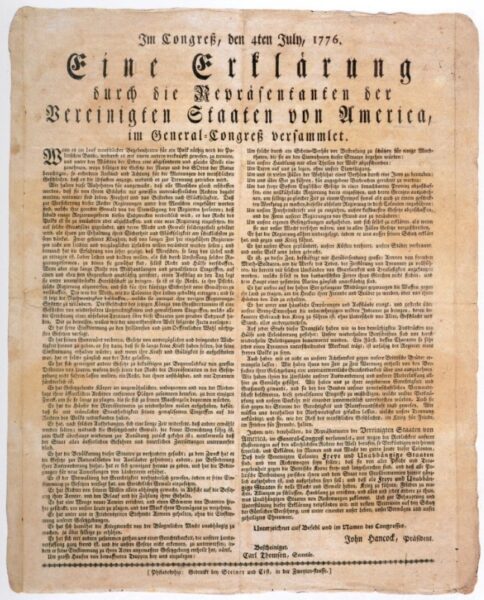
German Translation of the Declaration of Independence
English has been the de facto official language of the United States for the past 250 years despite successive waves of immigration. Though the nation’s Founders were familiar with the worldview taking hold in Europe equating language and national identity, they also understood that they were embarking on a unique nation-building project grounded in a set of democratic ideals. As a “settler country” those shared ideals and not the English language have defined the US as a nation unlike France, for example, where the French language became intertwined with being a “citoyen” of the Republic.
In the early days of the American republic, the national government issued many official texts in French and German to accommodate new immigrants. Languages were also woven less officially into political life. Within days of the adoption of the Declaration of Independence on July 4, 1776, a newspaper in Pennsylvania published a German translation to engage the large German speaking population in support of the independence movement. As John Marshall, the fourth chief justice of the U.S. Supreme Court, noted in a letter to Noah Webster in 1831, geographic and social mobility, rather than public laws, would create “an identity of language through[out] the United States.” And so it has been.
The executive order distinguishes between a “national” and an “official” language. English has functioned well as the national language in government, the courts, schooling, the media and business. It has evolved that way through a maze of customs, institutions and policies that legitimize English throughout public life. It is the language spoken by most Americans. Over three-quarters (78.6 percent) of the population age five and older speaks English at home while only 8.3 percent speaks English “less than very well.” And so, by reasonable accounts, formally declaring it the official language after 250 years seems to be a solution without a problem unless the problem is immigration itself and unwarranted fears over national identity.
While benign on its face, at best the Trump order veers toward nationalism cloaked in the language of unity and efficiency. At worst it’s a thinly veiled expression of racism and xenophobia, narrowly shaping the collective sense of what it means to be American. Though less extreme in scope, its spirit conjures up uniform language laws in past autocratic regimes where language was weaponized against minority language speakers. Think of Spain under Franco and Italy under Mussolini where regional languages were outlawed.
Context and Timing
Context and timing matter. The order comes on the heels of the Trump Administration’s shutting down, within an eye-blink of the inauguration, the Spanish-language version of the White House website along with presidential accounts on social media. Reinstated throughout the Biden years, the website had first been removed in 2017 during the first Trump Administration.
During the 2016 presidential campaign, Trump blasted former Florida governor Jeb Bush, who is married to a Mexican-American, for speaking Spanish on the campaign trail. “He should really set the example by speaking English while in the United States,” Trump remarked, projecting what became an administration openly hostile to “foreigners” and the languages they speak. Against that history, the official English order now signals rejection of the nation’s large Spanish-speaking population and the anti-immigrant feelings their growing numbers have engendered.
The irony is that Trump, not unlike other politicians, has courted that population with Spanish language ads. With 58 million people in the United States speaking Spanish, political operatives understand that Spanish is the “language of politics.” But the “politics of language” is far more complicated. The 2024 Trump campaign ad repeating the words, “Que mala Kamala eres” (“How bad Kamala you are’) to the tune of a famous salsa song with the image of Trump dancing on the screen is hard to reconcile with his prior and subsequent actions as president.
The current shutdown of the Spanish-language website did not go unnoticed among public dignitaries in Spain. King Felipe VI described it as “striking.” The president of the Instituto Cervantes, poet Luis Garcia Montero, called it a “humiliating” decision and took exception to Trump’s “arrogance” towards the Hispanic community. On the domestic front, the executive order raised even more pointed concerns among immigrant and Hispanic groups in the United States.
Issued at a time of mass deportations, hyperbolic charges of immigrant criminality, attacks on “sanctuary” cities and states, and rising opposition to immigration in general, the new executive order will further divide rather than unite an already fractured nation. Fanning the flames of hostility toward anyone with a hint of foreignness, it can incite lasting feelings of inclusion and exclusion that cannot easily be undone.
Official Language Movement
The Trump order did not come from out of the blue. It is the product of years of advocacy at the federal and state levels promoting English to the exclusion of other languages. Proposals to make English the nation’s official language have been floating through Congress since 1981 when the late Senator Samuel I. Hayakawa (R. CA), a Canadian-born semanticist and former college president, introduced the English Language Amendment. Though the joint resolution died, it set a pattern for congressional proposals, some less draconian, all of which have stalled. The most recent attempt was in 2023 when then Senator J.D. Vance (R. Ohio) introduced the English Language Unity Act.
Hayakawa went on to form “U.S. English” in 1983. It calls itself the “largest non-partisan action group dedicated to preserving the unifying role of the English language in the United States.” It currently counts two million members nationwide. In 1986, its then executive director Gerda Bikales tellingly warned, “If anyone has to feel strange, it’s got to be the immigrant, until he learns English.”
The group’s website now celebrates the Trump order as “a tremendous step in the right direction,” a supposed antidote to the 350 languages spoken in the United States. Obviously that level of diversity can also be viewed as a positive unless “diversity” is totally ruled out of even the lexicon. Two other advocacy groups with similar missions subsequently joined the movement: English First and Pro English.
Defying Democratic Norms
The fruits of those efforts can be found in official English measures in 32 states. The earliest, from Nebraska, dates from 1920 in the wake of World War I when suspicion of foreigners and their languages reached unprecedented heights. By 1923, 23 states had passed laws mandating English as the sole language of instruction in public schools, some in private schools as well. With immigration quotas of the 1920s (lifted in the mid-1960s) diluting the “immigrant threat,” the official English movement didn’t seriously pick up again until the 1980s as the Spanish-speaking population grew more visible. The remaining Official English laws were largely adopted through the 2000s, the last in 2016 in West Virginia. Some of them, as in California and Arizona, were tied to popular backlash against public school bilingual programs serving Spanish-speaking children.
Some of these state laws were passed by a voter approved ballot measure, others by the state legislature. Some reside in the state constitution, others in state statutory law. Unlike the Trump order mandated by executive fiat, they all underwent wide discussion by the people or their elected representatives, which a measure of such high importance, especially with national reach, demands. And they can only be removed using a similar process, unlike an executive order subject to change by the mere stroke of a future presidential pen. This is not like naming the official state flower or bird, a mere gesture. The consequences are far more serious.
 As official English supporters are quick to point out, upwards of 180 countries also have official languages, some more than one. Standing alone, that argument sounds convincing. In well-functioning democracies, however, those pronouncements are carved into the nation’s constitution from the beginning or by subsequent amendment, or they’ve been adopted by the national legislature, again through democratic deliberation. At times they’ve been triggered by a particular event. France added the French language to its constitution in 1992 for fear that English would threaten French national identity with the signing of the Maastricht Treaty creating the European Union. Exactly what is triggering the current move in the United States? The answer is quite transparent. It’s immigration.
Some countries, like Brazil and the Philippines, allow for regional languages. Other approaches are less formalized. In the Netherlands and Germany, the official language operates through the country’s administrative law. In Italy, though the Italian language is not officially recognized in the constitution, the courts have inferred constitutional status from protections expressly afforded linguistic minorities. Other countries, including the United Kingdom, Mexico, Australia and Argentina, the latter two also “settler countries,” recognize a de facto official language as the United States has done since its beginning.
Clinton Order Protections
While the official English declaration might mistakenly pass for mere symbolism, the revocation of the Clinton order quickly turns that notion on its head. Rather than “reinforce shared national values,” as the Trump order claims, revoking the Clinton order protections undermines a fundamental commitment to equal opportunity and dignity grounded in the Constitution and in Title VI of the Civil Rights Act of 1964. From that Act and its regulations prohibiting discrimination on the basis of national origin, the Clinton Administration drew its authority, including using national origin as a proxy for language, to protect language rights. In an insidious twist, the Trump executive order uses language as a proxy for national origin, i.e. immigrant status, to pull back on those same protections.
The Clinton order, together with guidance documents issued by the Department of Justice, required federal agencies and other programs that receive federal funds to take “reasonable steps” to provide “meaningful access” to “information and services” for individuals who are not proficient in English. As advocates argue, removing those requirements opens the door for federal agencies and recipients of federal funds, including state and local governments, to deny critical language supports that assure access to medical treatment, social welfare services, education, voting rights, disaster relief, legal representation and even citizenship. In a virtual world of rampant disinformation, it is all the more essential that governments provide non-English speakers with information in emergencies, whether it’s the availability of vaccines during a flu pandemic or the need to evacuate during a flood or wildfire, as well as the facts they ordinarily need to participate in civil life.
With current cutbacks in federal agency funding and staff, rising hostility toward immigrants, and the erosion of civil rights enforcement, one can reasonably foresee backsliding on any of those counts. One need only look at the current state of voting and reproductive rights to figure out where language supports may be heading when left to state discretion with no federal ropes to rein it in.
Multilingualism for All
The Trump order overlooks mounting evidence on the value of multilingualism for individuals and for the national economy. Language skills enhance employment opportunities and mobility for workers. Multilingual workers permit businesses to compete both locally and internationally for goods and services in an expanding global market
It takes us back to a time not so long ago when speaking a language other than English, except for the elite, was considered a deficit and not a personal asset and national resource. It belies both the multilingual richness of the United States and the fact that today’s immigrants are eager to learn English but with sufficient time, opportunity and support. They well understand its importance for upward mobility for themselves and for their children. That fact is self-evident. With English fast becoming the dominant lingua franca globally, parents worldwide are clamoring for schools to add English to their children’s language repertoire and even paying out-of-pocket for private lessons.
Rather than issuing a flawed pronouncement on “official English,” the federal government would better spend its resources on adopting a comprehensive language policy that includes funding English language programs for all newcomers, along with trained translators and interpreters for critical services and civic participation, while supporting schools in developing bilingual literacy in their children. Today’s “American dream” should not preclude dreaming in more than one language. In fact, it should affirmatively encourage it for all.
In the meantime, the Trump order promises to provoke yet more litigation challenging denials in services under Title VI and the Constitution, burdening the overtaxed resources of immigrant advocacy groups and of the courts. Worst of all, it threatens to inflict irreparable harm on thousands of individuals and families struggling to build a new life while maintaining an important piece of the old.
It’s not the English language or national identity that need to be saved. It’s the democratic process, sense of justice and clear-eyed understanding of public policy now threatened by government acts like the official English executive order.
Related content
In this episode of the Language on the Move Podcast, Rosemary Salomone chats with Ingrid Piller about her book The Rise of English.
]]>Tazin and Jia discuss crisis communication in a linguistically diverse world and a new book co-edited by Dr. Jia Li and Dr. Jie Zhang called Multilingual Crisis Communication that gives us insights into the lived experiences of linguistic minorities affected during the Covid-19 pandemic.
Multilingual Crisis Communication is the first book to explore the lived experiences of linguistic minorities in crisis-affected settings in the Global South, particularly during the Covid-19 pandemic. China has been selected as a case of inquiry for multilingual crisis communication because of its high level of linguistic diversity. Taking up critical sociopolitical approaches, this book conceptualizes multilingual crisis communication from three dimensions: identifying communication barriers, engaging communication repertoires, and empowering communication justice.
Comprising eight main chapters, along with an introduction and an epilogue, this edited book is divided into three parts in terms of the demographic and social conditions of linguistic minorities, as indigenous, migrant, and those with communicative disabilities. This book brings together a range of critical perspectives of sociolinguistic scholars, language teachers, and public health workers. Each team of authors includes at least one member of the research community with many years of field work experience, and some of them belong to ethnic minorities. These studies can generate new insights for enhancing the accessibility and effectiveness of multilingual crisis communication.
This book will be of interest to academics and postgraduate students in the fields of multilingualism, intercultural communication, translation and interpreting studies, and public health policy.
 This volume brings together 23 contributors and covers a range contexts in which crisis communication during the COVID19 pandemic has been investigated. Focusing on China owing to a high level of linguistic diversity, this book uses critical sociopolitical approaches, to identifying communication barriers, engaging communication repertoires, and empowering communication justice.
Advance praise for the book
‘Setting a milestone in critical sociolinguistic and applied linguistic studies, this volume offers critical insights into overcoming communication barriers for linguistic minorities during crises, promoting social justice, and enhancing public health responses through inclusive, multimodal, and multilingual strategies. It also serves as testimonies of resilience, courage and kindness during the turbulent time’ (Professor Zhu Hua, Fellow of Academy of Social Sciences and Director of International Centre for Intercultural Studies, UCL, UK)
‘The global pandemic has brought to the fore the key role of multilingual communication in disasters and emergencies. This volume contains cutting edge ethnographic studies that address this seriously from the perspective of Chinese scholars and minoritized populations in China. A decisive contribution to the burgeoning field of multilingualism and critical sociolinguistics in times of crisis.’ (Professor Virginia Zavala, Pontificia Universidad Católica del Perú, Perú)
Related content
For related content, visit the Language on the Move Covid-19 Archives.
Transcript (coming soon)
]]>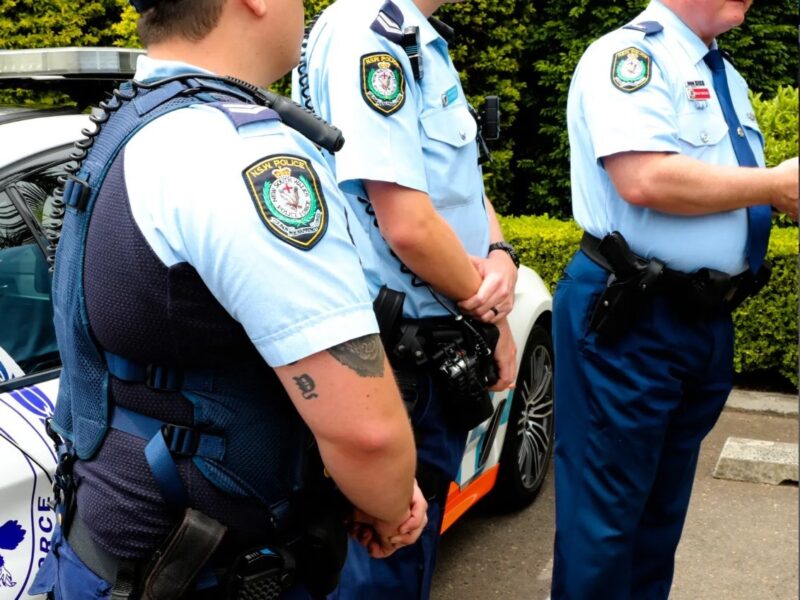
NSW Police (Image credit: Edwina Pickles, SMH)
Editor’s note: The Language on the Move team closely collaborates with the Law and Linguistics Interdisciplinary Researchers’ Network (LLIRN). To raise awareness of LLIRN and feature the research of its members, we are starting a new series about exciting new research in specific areas of language and law.
In this first post in the series, LLIRN founders and conveners Dr Alex Grey and Dr Laura Smith-Khan introduce the research of three early career researchers working on language, policing, and criminal justice.
***
Alex Grey and Laura Smith-Khan
***
The Law and Linguistics Interdisciplinary Researchers’ Network (LLIRN) came into being in 2019, after an initial symposium involving a group of academics and students, mainly from Australian universities, whose research is interested in the various intersections of language and law. One of our key goals of the symposium was to learn more about each other’s work and create new opportunities to collaborate.
Since then, LLIRN has grown and we have organized and run a number of different initiatives, including multiple panels at conferences across both linguistics and law, a special issue that showcased the work of several of our (mainly early career) members, and a lively and growing mailing list.
Fast forward to 2024, our Listserv now includes members from at least 37 different countries, at diverse stages of their careers, working as academics, as language or legal professionals, and/or in policy or decision-making roles. However, as LLIRN convenors, we have felt that we still have much to learn about the members who make up the network, the expertise they have and their goals. This new blog series intends to address this gap: we want to learn (or “LLIRN”) more about each other, and to make our learning public so that others too can learn more about us.
,_Supreme_Court_--_2019_--_4347.jpg)
Northern Territory Supreme Court (Image credit: Dietmar Rabich, Wikipedia)
In the first of this new series, we showcase LLIRN members, Alex Bowen, Dr Fabio Ferraz de Almeida, and Dr Kate Steel, who are working in areas related to language, policing, and criminal justice.
Alex Bowen, University of Melbourne, Australia
Alex Bowen’s in-progress PhD looks at communication about criminal law and justice with Aboriginal people in the Northern Territory (NT) of Australia. His earlier research was about how police in the NT explain the right to silence in police interviews, producing the publications listed below. He has previously practised criminal and commercial law.
Alex Bowen is interested more broadly in police interviewing, language in legal processes, interpreting and translation, how we understand and talk about law and justice interculturally, and how legal language is influenced by monolingual and colonial assumptions. He is interested in discussing these topics, especially with Indigenous scholars and practitioners, and developing interdisciplinary and intercultural resources for training and education. He may be available for peer review related to the above topics.
Recent publications
Bowen, A. (2019). ‘You don’t have to say anything’: Modality and consequences in conversations about the right to silence in the Northern Territory. Australian Journal of Linguistics, 39(3), 347–374.
Bowen, A. (2021). Explaining the right to silence under Anunga: 40 years of a policy about language. Griffith Law Review, 30(1), 18–49.
Bowen, A. (2021). Intercultural translation of vague legal language: The right to silence in the Northern Territory of Australia. Target. International Journal of Translation Studies, 33(2), 308–340.
Bowen, A. (2021). “What you’ve got is a right to silence”: Paraphrasing the right to silence and the meaning of rights. International Journal of Speech Language and the Law, 28(1), 1–29.
Dr Fabio Ferraz de Almeida, University of Lincoln, UK
Dr Fabio Ferraz de Almeida has experience conducting ethnographic and conversation analytic research in police and judicial settings. This has included research on police interviews with suspects in the UK, criminal hearings in Brazil and, more recently, International Criminal Court (ICC) trials, producing the publications listed below. He is currently working on a paper about the role of judges in witness examination at the ICC, focusing particularly on the tensions associated with their dual-role as both referee and truth-finder. He lectures in Criminology.

International Criminal Court, The Hague (Image Credit: Wikipedia)
Dr Ferraz de Almeida is broadly interested in studying social interactions in any form of police or legal context and welcomes contact from researchers with similar interests.
Recent publications
Ferraz de Almeida, F., & Drew, P. (2020). The fabric of law-in-action: ‘formulating’ the suspect’s account during police interviews in England. International Journal of Speech Language and the Law, 27(1), 35-58.
Ferraz de Almeida, F. (2022). Two ways of spilling drink: The construction of offences as ‘accidental’ in police interviews with suspects. Discourse Studies, 24(2), 187-205.
D’hondt, S., Perez-Leon-Acevedo, J. P., Ferraz de Almeida, F., & Barrett, E. (2022). Evidence about Harm: Dual Status Victim Participant Testimony at the International Criminal Court and the Straitjacketing of Narratives about Suffering. Criminal Law Forum, 33, 191.
D’hondt, S., Pérez-León-Acevedo, J. P., Ferraz de Almeida, F., & Barrett, E. (2024). Trajectories of spirituality: Producing and assessing cultural evidence at the International Criminal Court. Language in Society, 1-22.
Ferraz de Almeida, F. (2024). Counter-Denunciations: How Suspects Blame Victims in Police Interviews for Low-Level Crimes. International Journal for the Semiotics of Law, 37, 119–137.
Dr Kate Steel, University of the West of England (UWE), Bristol, UK
Dr Kate Steel’s PhD (2022) and continuing research explore interactions ‘at the scene’ between police first responders and victims of domestic abuse, producing the publication below. This work draws from police body-worn video footage within one force area in the England & Wales jurisdiction of the United Kingdom. This research responds to the typical simplification of the crucial role of communication at the scene is and its under-emphasis in official procedure for the first response to domestic abuse, at both local and national levels.
Dr Kate Steel is now working with another police force to develop language guidance specific to the policing context of domestic abuse first response. She lectures in linguistics.
Recent publications
Aldridge, M., & Steel, K. (2022). The role of metaphor in police first response call-outs in cases of suspected domestic abuse. In I. Šeškauskienė (Ed.), Metaphor in Legal Discourse (224-241). Cambridge Scholars Publishing. Available from https://uwe-repository.worktribe.com/output/9900169
Steel, K. (2023) “Can I have a look?”: The discursive management of victims’ personal space during police first response call-outs to domestic abuse incidents. International Journal for the Semiotics of Law 37(2): 547-572.
What about you?
Do you work or research in an area related to criminal justice and language, or another area where language and law intersect? Join the LLIRN!
What other language and law topics would you like to learn about? Have your say on our next LLIRN “What’s new in language and law research?” blog post. Let us know in the comments or join the network and send us an email!
Upcoming events of interest in this area
Dr Fabio Ferraz de Almeida and Dr Kate Steel will both be presenting their research in the coming months, including at the IAFLL European conference in Birmingham. Dr Fabio Ferraz de Almeida will also present at the Forensic Conversations in Criminal Justice Settings Symposium in Loughborough in September.
]]>Can you share about your work and your pro bono global initiative defending language rights?
Irene: Linguistic Justice® is my personal advocacy initiative. It was born during the early pandemic days in 2020 after I quit my job as an interpreter for the New York State Court System. During my time in the system I witnessed first-hand state violence against linguistic minorities who were trying to access justice, particularly how it impacted Indigenous peoples. Founding Linguistic Justice® was my response to that experience; it provided an outlet for my desire to use my skills working with linguistically marginalized communities, instead of enabling state violence against them.
Since then, I have worked hands-on with multiple grassroots organizations in the US looking to implement a language justice approach in their operations. I consult with those organizations to help them remove access barriers, provide meaningful language access, and encourage them to create effective multilingual participatory settings.
On the global front, The Spanish Group Pilot Initiative was my pro bono initiative and my shot at raising awareness of language rights and justice in spaces traditionally dominated by the English language. Rolled out through the Global Coalition for Language Rights (GCLR), it aimed to shine a light on language rights during the Global Language Advocacy Days (GLAD) volunteer initiatives in February 2024, themed “No Justice Without Language Rights”.
The initiative was launched in July 2023 through the Coalition’s social media platforms, and my main aims were two. First, to build a global community by providing participants with quality education and a safe space to share their diverse perspectives. And second, to disseminate our educational content about language rights and justice, in Spanish, from a global platform.
To structure the educational initiative, I developed a 7-month program to facilitate community development and targeted learning. A diverse and talented group of participants spanning seven countries engaged in non-traditional learning methods inspired by my background as a former attorney, my experience as a seasoned linguist, as well as my integration of restorative practice processes for developing social capital.
The overall success of the initiative stands as a testament to the need for serious investment in the advancement of language justice, including through fully funded multilingual community education programs like this one.
Can you share more about the handbook you developed as part of your pro bono initiative?
Irene: To conclude the pilot initiative, I authored and gathered the introductory language rights handbook titled ‘Queremos escuchar tu voz’ (or ‘We want to hear your voice’).
Throughout this resource, the term ‘voice’ is used in a figurative sense to emphasize the significance of individual language preference in shaping our identity and asserting our self-determination. I wanted to underscore that our ‘voice’ represents the power of communicative autonomy of each person: a fundamental aspect of our human dignity.
In a nutshell, this handbook is a call to action to catalyze support for language justice. It aims to tackle the prevalent collective unawareness surrounding language rights, striving to expand consciousness regarding these rights and, consequently, expand our collective capacity to create language justice. It is meant to provide vocabulary for anyone who wants to understand and articulate how people are disadvantaged as users of non-dominant languages.
What are you hoping to achieve with the first edition of this handbook?
Irene: Firstly, I am hoping that the pilot initiative, along with its resulting handbook, inspires future initiatives to foster community development through multilingual education about language rights.
We must acknowledge that people cannot advocate for rights they don’t know they have in the first place. Our language is intertwined with every facet of our lives, and withholding language rights from people profoundly impacts their lives, hindering their access to social structures: information, opportunities, critical services, education and justice. So, supporting communities in understanding their language rights is crucial to nurturing their self-determination and fostering their own advocacy efforts for those rights.
Secondly, I hope it facilitates a shift in perspective, recognizing linguistically marginalized communities as rights-holders.
When linguistically oppressed communities lack the capacity to articulate their experiences, those in power may not fully understand how pervasive language rights violations are. We have unaware people in positions of authority within our systems.
The result? Without understanding language rights and the impact language oppression has on our communities, efforts remain insufficient. Holding systems accountable is crucial, but supporting them with education on this topic is equally important to foster systemic change.
Those in a position of authority within systems—public and private institutions, policymakers, and the language access industry as a whole—need to better understand language rights, and the impact language oppression has in our communities, to be able to shift their perspective: from linguistic discrimination, half-hearted compliance and indifference, to awareness, inclusion and repair.
We must care for both of these needs seriously: from the bottom-up with our communities, and from within our social structures and its systems.
Can you share more about the content of this handbook?
Irene: This introductory resource provides a thorough examination of language rights on a global scale, encompassing their legal foundations in international humanitarian law, as well as the legal framework for language rights in the United States, including relevant jurisprudence.
Among its features are discussions of language rights theory and practice, guidance on filing national origin discrimination complaints before the US Federal government, and community insights aimed at advancing language justice for all people.
Irene Gotera, Linguistic Justice®
By amplifying the voices of the participating community in the pilot initiative, I also share our findings underscoring several key imperatives to create language justice:
- Promoting self-awareness and recognition of one’s own linguistic privileges.
- Fostering collective understanding of language rights.
- Making the resources like this handbook available and accessible to staff members of organizations serving linguistically diverse populations worldwide.
- Engaging in global dialogues on language oppression to cultivate the solidarity necessary to confront it.
- Proactively defending our language rights to enhance awareness of them.
- Urging states worldwide to enact legislation guaranteeing respect for language rights, recognizing that with language rights come corresponding obligations for compliance.
The handbook closes with my perspective on the connection between language rights and justice: to create language justice for all people, we all need to develop and apply a language rights-conscious lens. I’m hopeful that this resource could be a significant catalyst in fostering exactly that. Download it here.
There is no justice without language rights.
]]>In this episode of the Language on the Move Podcast, Emily Pacheco speaks with writer and researcher Jessica Kirkness about her 2023 memoir, The House With All The Lights On: Three generations, one roof, a language of light. Jessica has published in Meanjin and The Conversation, as well as other outlets. Her PhD focused on the ‘hearing line’: the invisible boundary between Deaf and hearing cultures. She is also a teacher of nonfiction writing at Macquarie University in Sydney, Australia.
You may have seen the movie, CODA, which portrays the experience of a hearing teenager that has a Deaf family. A Coda, a child of Deaf adults, is an identity that represents the experience of having Deaf parents. Jessica showcases a perspective that is not widely discussed, which is the perspective of a Goda, a grandchild of Deaf adults. Her memoir explains the navigation of Deaf and hearing cultures in Australia with grandparents who migrated from the UK. The House With All The Lights On highlights and discusses themes around oralism, language deprivation, Deafness and music, and more!
The House With All The Lights On explores linguistic and cultural dynamics within Deaf-hearing families. Jessica shares her experience having Deaf grandparents and navigating the cultural borderline between Deaf and hearing cultures. It is a wonderful memoir about family, the complexities of identity, and linguistic diversity.
Enjoy the show!
This is early days for the Language on the Move Podcast, so please support us by subscribing to our channel on your podcast app of choice, leaving a 5-star review, and recommending the Language on the Move Podcast and our partner the New Books Network to your students, colleagues, and friends.
 Transcript
Emily: Welcome to the Language on the Move Podcast, a channel on the New Books Network. My name is Emily Pacheco, and I’m a Master of Research candidate in Linguistics at Macquarie University in Sydney, Australia.
My guest today is Dr Jessica Kirkness. Jessica is an author, researcher, and teacher of nonfiction writing at Macquarie University. Her work includes researching the value of life writing and creative nonfiction in animating the hearing line: the invisible boundary between Deaf and hearing cultures. As a Goda, spelled G-O-D-A, which stands for a grandchild of deaf adults, she writes about deafness, disability, and family.
Today we are going to talk in general about linguistic diversity in Deaf-hearing families, and in particular about a 2023 novel that Jessica wrote entitled The House With All The Lights On.
Jessica, welcome to the show, and thank you so much for joining us today.
Dr Kirkness: Thanks so much for having me, Emily.
Emily: It’s wonderful to have you here! And so just to start off, could you tell our listeners a bit about yourself? What led you to undertake your PhD in life writing and Deaf studies?
Dr Kirkness: Well, I guess family and love, which sounds trite, but I grew up in a house next door to my grandparents, so it was sort of a dual occupancy household where my grandparents lived in a granny flat on one side of the property and then my family, my mum, dad, brother and sister and I were in the main house. And so, I grew up with Deaf people all around me.
So, my grandparents had a huge hand in my upbringing, and they always hosted really lively Deaf parties and gatherings where I was around sign language and Deaf culture. And I guess naturally I was fascinated by that, I suppose, and just the you know, it was at once kind of part of my everyday life but also a point of intrigue and so when I got really into writing, particularly telling true stories, so creative nonfiction and life writing, I started to dabble with telling stories about my family and my upbringing and I wrote this little essay in an undergraduate course at Macquarie actually. (Emily and Dr Kirkness laugh) Which was called Telling True Stories, and I had this wonderful tutor who encouraged me to keep going. So, I wrote this 3,000-word essay, which then became a series of essays which then became a book.
So it was, also part of the PhD that I wrote. So, this was really investigating this idea of the hearing line that you mentioned in your opening, this boundary, this kind of cultural borderline that exists between Deaf and hearing cultures and again, I was really obviously invested in that having been sitting at that threshold, at that boundary for much of my life and thinking about how I embodied hearingness, how I enacted hearingness as a, as an identity and that was something that I came to in my studies and that was quite radical.
I’d always sort of understood my grandparents to be marked as different and other and that they had a cultural and linguistic background that was their own that they were that you know they identified as part of a cultural and linguistic minority group. And I had a relatively sound understanding of that, but when I started doing my PhD research and I found a lot of Deaf studies material, was doing a lot of research, I was kind of floored by the idea that hearing culture exists and that there are hearing ways of understanding the world and being in the world and it was this real sort of Aha! sort of a moment where it was like, yes, that’s so true! There are particular idiosyncrasies that I have that that show me to be a hearing person that I’m very auditory and that I, you know, I like listening to lectures and podcasts, for example, and I, learn about the world through through that particular sense, whereas my grandparents were very, very visual people and very tactile as well. So, sign language is obviously a kind of a spatial and visual language and so they used their bodies and to communicate but they were also highly sensitive to anything visual unfolding before them. And I really wanted to write about that and that kind of the boundary, the borderlines between our cultures, the ways that we were both similar, I suppose, but then and different in a way that was really important.
Emily: Yeah, yeah, I love that. I absolutely love everything you just said. (Emily laughs) I think it is really, fascinating because you know, I myself, I have Deaf parents which we’ll talk about a bit later in the interview, but, you know, being raised by Deaf people like you were in your childhood being raised by your grandparents where they were very present in your childhood. You have a moment where you’re like, oh, like my ability to hear has influenced the way I function as a human, right?And so, people, there is a Deaf culture and I think people kind of are like, oh, what does that mean?Like, isn’t it just a language difference or a linguistic thing? But no, that visual language, that visual nature really shapes the Deaf community and certain things that are important, that maybe hearing people are perplexed by or don’t kind of relate to and that’s always fascinating to talk about and discuss I think for sure that people don’t realize they have the label as hearing, you know, that Deaf people refer to them as hearing and they may refer to the Deaf as Deaf but that is the thing, that is that difference, that boundary of difference which I think is really interesting that you talked about so thank you for that great kind of introduction.
And so, to talk about your memoir, in particular, The House With All The Lights On, definitely resonated with me as a Coda which is spelled C-O-D-A, a child of Deaf adults for those who might not be familiar with that term. So could you explain the meaning behind the title and other deaf-friendly technologies that you discuss in chapter 3, kind of those cultural things that might be different, people might not be aware of.
Dr Kirkness: Absolutely. So I think, just as preamble, I think a lot of people are surprised to learn that there is a vibrant Deaf culture and that we tend to understand in our culture deafness as a medical problem as something that needs to be fixed and every time I brought a new person home, a new friend or a partner, for example, I always had to navigate that threshold where there was some languagebrokering, there might be some interpreting, people tended not to be able to understand my grandparents voices.And so there was a lot of sort of cultural bridging that I was doing in those moments. And I was always astounded that people weren’t sure.They were very uncertain about how to communicate first of all, but also like, oh, there is a Deaf culture?And so, it felt to me like there was a real need to write a story that came from a Deafcultural space. But to be a sort of a facilitator or that cultural bridge so that I could allow hearing people an insight into the kind of the richness of Deaf culture and language.
But The House With All The Lights On really refers to the idea of literally light being in the house all the time. So, my grandparents needed to have conversations with the lights on because without the light one cannot see. (Emily and Dr Kirkness laugh) And so you can’t read lips. You can’t also read sign language. So, the house was always awash with light and so my grandmother had a million and one lamps on of an evening and she was quite frightened of the dark, because it was, I think it was just very, it took away her ability to understand the world and so darkness had a very different meaning for her I think than it did for me.
And so, the house was always full of light, but also there’s a sort of double meaning here in that sign language is often referred to as the language of light and Deaf people are often referred to as the people of the eye. And so, this kind of light and visual sort of phenomenon was something that I wanted to tease out and flag in the book, which is why the book is called The House With All The Lights On.
Emily: Yeah, I think that’s great. And certainly, sometimes people when they find out I have Deaf parents they will say oh it must be so quiet in your house, and I think that’s not the case either you know sometimes people have these assumptions but just the importance of light like you said. And The House With All The Lights On I just love that visual I think myself, so I wanted you to kind of highlight that in our interview as well.
I really enjoyed reading about the different language practices as well in your family. So could you maybe explain how your grandparents’ upbringing influenced their language and what communication looked like in your family in particular.
Dr Kirkness: Yeah, so communication was a really mixed bag in my family, and I guess for some sort of, a potted history, I suppose. Sign language was banned in many educational contexts for much of the 19th and 20th century. So, my grandparents went to schools where they were encouraged to speak and to lip read and they had a lot of speech therapy and things like that as a vital part of their education. And this was all part of a practice called oralism. And this was basically a pedagogy that encouraged children, not just encouraged, did in fact force them to speak and use auditory kind of practices. If, possible if the, if the child had any residual hearing as well. And that had left a real mark on my grandparents, and I think that they grow up, grew up, acutely aware that they were different. And that their language was not celebrated or encouraged, certainly not when they were in “hearing spaces”, and so there was a real self-consciousness that they developed. Signing in public was something that was quite difficult for them at times. They were always really aware of people staring, sometimes just out of pure curiosity, which was fine, but I think it after a while it would grate, but also people saying unkind things, or being punished at school for signing, for example.
So back in the days of oralism, children had their hands tied behind their backs. They were beaten, they were caned, they were called animals, monkeys, apes for using their native language, which is incredibly sad. But that kind of perception that speech is and and verbal language is better than signed language has been something that I think a lot of Deaf communities have had to contend with over the last several 100 years. And so that really, I think influenced the way that they felt within themselves.
So, they could be quite shy and protective about sign language and where they would sign. So, at home they would sign to one another, and they would sign with their Deaf friends and when we were very small, my siblings and my cousins and I, we would use fingerspelling, which is a, a manual way of representing the alphabet. And we did that for clarification purposes, and we knew very basic signs. So, food, home, more, chocolate, the things that we would want to ask for, the kind of the basics of communication, I suppose. But there was a limit, I think, to how we were able to communicate with one another. And once we went to school and, I actually went to a signing bilingual preschool. So, I was taught to sign at preschool, and it was a sort of I think they called it reverse integration where there were hearing and Deaf kids present and so there was a bilingual educational program and I really loved that, and my brother went to the same one. My sister actually missed out because of mum’s work.
But we, we all knew how to communicate at that basic level, but then there was just this big gap once we went to school. Signing fell to the wayside, and it was something that we, communication was something that we always had to work on. You know, it was never seamless. It was never easy. It wasn’t a thing that we took for granted. But I think as with many families with Deaf members a lot of us didn’t know how to sign fluently and that was something that I learned later in life. So even though I could always use, do the basics, my grandfather went blind in one eye later in his life and that meant that lip reading was incredibly difficult for him and was no longer a solution for us. And so, I put myself through multiple Auslan courses and got myself accredited, which was great. But it also, I guess it really enabled us to have a more meaningful relationship. It was a really beautiful thing to learn, but also a wonderful way of connecting to my grandfather in the last sort of decade of his life. And that was a really radical thing for the both of us and, and something that I still really treasure being able to, to sign with my grandmother now. That’s a real gift.
Emily: Yeah, absolutely. I think a lot of people don’t know what oralism means and thank you for explaining that and also how recent those practices were still in place I’m from the US and so that practice is not really as common anymore, but it was for even the early stages of my parents’ education. So, it’s just recently that signed languages around the world have finally been celebrated and cherished like you said for the cultural values they have and that importance there, but it was something that was kind of, you know, something you did in secret and not in public. So, I think people often don’t realize that experience of Deaf people like your grandparents and how that does influence the language practices your family had, but that’s awesome that you, you know, got to take formal Auslan courses and have that, you know, opportunity. So, thank you for sharing a bit of that story.
And if we can kind of shift now to talk about, in chapter 14 of your book, you discuss the misconceptions around cochlear implants, which are also known as CIs, and maybe the clashes that exist there with Deaf culture. So, I personally was shocked to read the comparison of the implantation rates. So, in the US, it being 59% of profoundly deaf babies receive CIs. While, in Australia, it is as high as 98% for candidates under the age of 2. So, can you tell us more about the misconceptions you’ve researched around CIs and how Deaf communities are responding to technology?
Dr Kirkness: So, I think, on that question of technology, there are lots of technologies that my grandparents did use, they were not implanted with cochlear implants and there’s a long history there that I will go into.But the technologies that were in their house were things like a doorbell that had a flashing light system, and that was connected to the main electrical system in the house.And so, when there was a caller at the door, they’d ring the, press the button and all the lights in the house would flash.There were also alarm clocks that had light functions where they would flash or vibrate and things like that.So, there were all those kinds of technologies too, but one particular technology that is quite, has been quite controversial in the Deaf community has been cochlear implants and they are an Australian invention, so, Graeme Clark pioneered these devices, and they were developed in Australia.
And so that’s one of the reasons that Australian children in particular have a very high uptake of them. And I think the, the comparison with the US is a really interesting one because we have different health systems. And so, there’s, I guess, limited access for potentially to cochlear implants in the US. I think here they’re there are rebates and sort of government incentives that allow children to be implanted at a young age. But they have been without their controversy.
So, I think back in the eighties when they were really becoming, when the public were becoming aware of them a lot of hearing people saw them as a medical miracle and it, you know, they were the bionic ear and it was fantastic and they were going to be this panacea, you know, it’s gonna fix deafness, it’s going to cure deafness. But that is antithetical to what Deaf people believe about their own state of being, that deafness is part of what makes them, them. And that they belong to a linguistic and cultural minority group and though they absolutely understand and, and experience barriers, cultural barriers and barriers with access to information, they don’t always have interpreting when it’s needed. There are, you know, all sorts of kind of barriers that Deaf people are confronting. Nevertheless, deafness and their, language and their close-knit communities and the kind of incredible, close-knit community that Deaf people have is rich and wonderful and they they don’t want to be cured and so that was a real point of tension I think between medical ways of understanding deafness and cultural ways of understanding deafness.
And so, these devices have been seen as a form of eugenics, you know, to eradicate the scourge of deafness and people have used that kind of really loaded language and there is also a long history of eugenics, and you know Deaf people being killed and exterminated in World War 2 and you know this is a really sensitive issue. But I think nowadays people have a more nuanced perhaps take on cochlear implants. There are many culturally proud Deaf people that still want to give their children cochlear implants so that they have access to the world of sound, but they want them to be raised as culturally and linguistically kind of bilingual I suppose, you know, bicultural, bilingual, so that they have access to the Deaf world from a young age but also have access to the hearing world.
So, I think it’s a really complicated thing, but they have been, you know, there’s been protests over the years about cochlear implants. And also, just challenging this idea that once you fit a child with a cochlear implant that they are hearing because they’re not that device gets switched off or taken off at the end of the day and that child remains deaf and there are lots of kind of challenging factors to understand and audiologists have their work cut out for them here. You have to learn to hear with a hearing device, whether it’s a cochlear implant or a hearing aid. And that takes a lot of investment. It takes a lot of investment from the child that’s being fitted with the device, but also from the parents, a lot of speech therapy and audiological training, you know, this is an improving technology, it’s improving all the time, but it’s not the same as hearing and that child, that person once they grow up will still be deaf.
So, I think a lot of a lot of culturally Deaf people really advocate for the use of bilingualism and giving a child access to sign language from a young age because there is that period where it’s incredibly exhausting to get used to the device and there’s a lot of arguments about fitting a child very early so that they have access to language. But there’s also another argument to be made that giving that child any language, whether it’s wherever you come from, I guess in Australia it’s probably spoken English, or whether it’s sign language, you just have to give them something so that you avoid that problem of language deprivation. So, there’s lots of conversation around this, but yeah, that’s, I guess, a little bit of the history of the (Dr Kirkness laughs)-
Emily: I know, I know it’s a loaded question, hey, and it’s definitely something the Deaf community still, is discussing and you know, audiologists do have their work cut out for them, I agree, but I think it is important to bring to the forefront like the voice and opinion of the Deaf community regarding these devices. And so, people are aware, you know, that it’s not as easy as, oh, like now you can hear and that’s, there’s a lot of work that goes into this. I think that’s important to mention. Yeah.
Dr Kirkness: Yeah, exhausting work, you know, really exhausting.
Emily: And in your novel as well, you also discuss the language barriers, which you kind of mentioned a bit so far in the interview, language barriers that you witnessed your grandparents face. And in particular, you share a few stories about the barriers your grandfather faced in hospital. So, in my personal experience I have done a fair bit of language brokering for my parents but what was it like for you to witness the language barriers and you having access to both Auslan and English in those situations?
Dr Kirkness: I think, I open the book with a passage about the moment I had to tell my grandfather he was going to die, that he was quite unwell for the last years of his life and he was rushed to emergency having had a, I don’t know if it was a heart attack, but a heart failure, he was in organ failure and there was nothing more that the doctors could do for him at that time. And he just regained consciousness and there was no interpreter available. And so, I ended up being the one to tell him that there were no more medical interventions possible. And that was a really difficult conversation to have. Not one I imagined having. And one that I, I had because I wanted to spare my mother and my uncle from having to be in that position. And I think Codas often do a lot of that language brokering as you, as you would well know and I, I think that in that moment they really wanted to be family members and they didn’t want to be a conduit for that information, particularly that information. And so that ended up coming to me and it also made sense I think because I had the skills to be able to do so and in a way it was a privilege, but it’s that double-edged sword, I think, of, of having that intimacy with a family member, and delivering such awful news, and being able to break it gently and in a way that I would like him to be treated. I suppose, you know, being able to choose the words is a sort of privilege. But also, an incredibly huge responsibility that weighed on me and I would have loved to be a family member in those moments too.
And I think his experience in hospital was, I’m going to say traumatizing and I don’t say that lightly, it was really awful to feel that he didn’t receive adequate care during his time in hospital. At various hospitals throughout Sydney, the language barriers were so profound that we didn’t feel safe to leave him on his own at any time. And so, we developed a roster so that someone would be with him to be his advocate. We, my mother would write handwritten signs and stick them on the walls with communication tips, you know, things like make sure you tap Grandpa on the shoulder to get his attention before speaking. You can’t yell, yelling will just distort your lip patterns and will mean he can’t understand you. You know, raising your voice does nothing in fact and it’s just confusing. So, there were lots of things like that, that we tried to put in place and there were some end-of-life meetings that we had at the hospital where we had an interpreter present and that was wonderful, but there were lots of moments throughout the day where, you know, an interpreter can’t shadow your loved one, 24/7. That’s just not possible.
So, there were many times that we turned up and and grandpa had had procedures without having informed consent being taken and that was very distressing for him and very distressing for us to witness and we would arrive first thing in the morning with things having been done overnight. And just grandpa having no understanding of them whatsoever. And so there was a lot of sort of calming and pacifying that we had to do for him in those moments. And it was very, very difficult. And in palliative care spaces as well, just that kind of communication breakdown and the lack of cultural awareness and lack of Deaf awareness and this is a really hard systemic thing you know, there’s not a lot of Deaf awareness in the world and you know, medical practitioners are not given a lot of training in this if at all. They might have a couple of hours in a lecture about hearing loss, not about deafness and certainly not about cultural Deafness. And so, you know, and then there’s all the other kind of structural systemic issues within hospitals themselves that I have a lot of sympathy and empathy for, but it was very very difficult to watch a loved one be so alone and so unsupported in that, in that space.
Emily: Yeah, I’m sorry to hear your family had to go through, you know, a traumatizing experience for your grandfather and for you as family members to see that happen to someone you cared about so deeply and people don’t always realize that sometimes in those instances having an interpreter is a luxury almost like you said you know, because there’s interpreter shortages in the US and inAustralia from what I’ve heard for Auslan interpreters, there is a desperate need for more people to become professional Auslan interpreters.And so, when you do get one because they’re very busy and these instances typically in medical situations are last minute or not always planned far in advance, like to book someone in can be, you know, a miracle.(Emily laughs)So, to speak, but we, I wish it wouldn’t be that way, you know, that, hospitals would have a better system and it is a systemic thing like you mentioned and then, families are impacted by that when they should be just thinking about their loved one and caring for them as a family member and not as a language broker or interpreter and so. Yeah, I think it is a huge systemic issue.So, thank you for discussing that and your personal experience. And I really do hope doctors and medical professionals really get that Deafness training because Deaf people exist and they’re gonna be their patients one day.It’s not an if chance there are Deaf people that exist and it’s important to recognize them as part of the population that they’re going to be servicing and giving care to, right?
To switch gears a bit again to discuss some of your fieldwork that you did for your PhD. It was fascinating to read the chapters where you describe doing your fieldwork for your PhD in England. You discuss oralism, Deaf education, Deaf musicians, and how diverse the experiences of the Deaf community are. So could you tell us a bit about how Deaf communities might be misunderstood by hearing society; some people might even be confused by me saying there are Deaf musicians. So, if you want to talk a bit about that.
Dr Kirkness:
Yeah, absolutely. So, I had the great pleasure of going to the UK because my grandparents were raised in the UK and they moved to Australia when I was one years old, one year old, (Dr Kirkness laughs) when I was an infant. And they were from the UK originally and went to schools for the deaf in the UK and so I got to go to both of their schools, which was really incredible, and I got to stay on site at Mary Hare Grammar School where my grandmother went to school, and they have this incredible music program which is initially what sparked my interest. I also am quite musical myself. I grew up performing a lot at school in plays and musicals and singing and playing piano. They were things that I did regularly and I actually had a little keyboard in my grandparents’ home when I was a child and I would come over to their granny flat and I would play on the keyboard and write songs and Nanny, my grandmother, would come and bring me little cups of pineapple juice because I told her that it was good for singing (Dr Kirkness laughs) and she would watch me play on on the piano, the keyboard and she would ask me about music and she was really interested in what I was doing. And then I sort of reached a point in my adolescence where I felt it was this illicit thing that I was really interested in music, and I started hiding it away from my grandparents. I felt this guilt that this was a hearing activity that I was participating in, and I thought that, you know, my grandparents can’t have any access to that world or to that particular cultural practice. So, I best keep it from them.
And so later on when I started doing some research around deafness and music, I realised in fact that I’ve been really quick to make an assumption there and in fact there are many people who are interested in music, many Deaf people who are interested in music and even perform and play professionally as deaf musicians, they might also identify as being culturally Deaf and they might also use sign language, but they’re really they love music as a language and as a phenomenon that is not just an auditory phenomenon. It’s something that is felt in the body, something that exists on a piece of paper, you know, a written score where they’re interpreting a piece of music on the page where there’s a sort of imaginative process and even in some cases with the musicians I spoke to a kind of synesthesia where all these kind of senses are kind of overlaid on one another in different sort of sensory pathways, neural pathways, in the ways that they understand music. And that was fascinating to me, and I was really, really pleased to work with an organization called Music and the Deaf, which are the only organization of their kind as far as I’m aware in the world, and they’re based in Yorkshire in the UK. And they do all sorts of work with deaf children and introduce them, particularly to rhythm and then they move on to pitched instruments and some of these kids have cochlear implants or hearing aids and so they have some auditory perception of music but there’s also that sort of embodied aspect I was talking about and one musician in particular his name’s Sean, he would talk about taking his shoes off when he plays trumpet so he can feel the drum so when he’s playing in a group he would take his shoes off so he’d feel the vibrations and keep time in that way. And he had this really interesting sort of perfect pitch and a way of locating pitch within his body. I think he talked about F sharp being his nose and F natural being in his lips or something like that. It was really, really interesting to hear his take and along with a lot of the other musicians.
I also came to realize that my grandparents were not just interested in me playing the piano because I was playing the piano, they were really fascinated by music in the world too and my grandfather in fact loved musicals and all of his favourite movies were musicals. He loved the sound of music and when my mom was a little girl she actually before captions existed, she actually transcribed the entire film including the songs by hand and my grandfather had a handbook that he would put on his lap as he was watching the film so he could move between the screen and the paper. And he just loved it. He loved the kind of the spectacle of music, performed music, especially dance and things like that. My grandmother loved dance. A lot of rhythmic things, marching bands, my grandfather loved marching bands, The Last Night of the Proms and the the Military Tattoo as well. He was fascinated by that and also things like Songs of Praise. There’s a BBC program called Songs of Praise, which is sort of a, it’s a religious program, but there’s a choir that sings and my grandmother was fascinated by faces in the ways that they would be animated when singing. So, there were all these visual elements that I was suddenly privy to as I started unpicking that assumption that I had that, oh well, music belongs in the hearing world. But in fact, just like sound, Deaf people have an understanding of sound. It’s just not an auditory one all of the time. It’s something that they feel through vibrations. It’s something that they identify with mouth movements and shapes and all sorts of other ways of apprehending the world. Yeah, and I guess that was linked in with this idea of the hearing line that music for me was this kind of threshold. So, there are, I mean, it’s not always adopted in Deaf culture. Sometimes it is seen as a kind of, belonging to the hearing world and almost as a normalising force. There are some people for whom music is just not for them. They say, I’m Deaf, music just that doesn’t appeal to me, it’s not my thing, but there are equally people for whom, music is for them. And I think that was really interesting to consider.
Emily: Yeah, absolutely. I absolutely can resonate with what you’re saying and, you know, my parents, they love music, you know, (Emily laughs) like you’re saying, certain Deaf people in the community do like want to be a part of that, you know, musical experience and I’ve taken my mom to like heavy metal concerts and she loves it! (Dr Kirkness laughs) Like it’s a great experience. Everyone should take their Deaf parents, their Deaf family to a heavy metal concert a lot of the vibration and being close up to the speaker, the spectacle it is, right? And the feelings that you feel in an environment like that, I think it’s awesome! So yeah, I loved reading about that in your book. And kind of to bring our interview to a close, what is next for you and your work? What other research are you working on now? If you could tell us a bit about that.
Dr Kirkness: Yeah, so another memoir actually that I’m working on, and I’m really fascinated with you know ideas around the body and so I’m interested in health and disability and embodiment and all those things. So, the next book I’m writing is actually about sudden illness and I had, it’s a personal story, so it’s about my lived experience being a carer for someone who had a very kind of cataclysmic life changing event. He had a sudden cardiac arrest in his sleep when he was very, very young and I was the first person to find him. So, I’m really writing about you know, what happens to that person who has that kind of life-altering moment, but also what happens to the people around that individual, what happens to the witness and to the to the carer and the people who provide that network of care.
Emily: Yeah, yeah, fascinating. I can’t wait to read your next memoir!
And so, thanks again, Jessica! And thanks for joining, everyone! If you enjoyed the show, please subscribe to our channel, leave a 5-star review on your podcast app of choice, and recommend the Language on the Move podcast and our partner the New Books Network to your students, colleagues, and friends.
Till next time!
]]>
Flag for autism rights (Image credit: Deviantart)
In this post written for autism acceptance month, autistic anthropologist Gerald Roche discusses connections between the communication styles and life expectancy of autistic people, and encourages sociolinguists, linguistic anthropologists, and applied linguists to help work towards a better life for autistic people.
Content warning: This post discusses suicide, sexual and physical violence, discrimination, and negative attitudes about autistic people. If you are in Australia and find this post distressing, you can call Lifeline on 13 11 14 or chat online. Lifeline offers language support services. For non-urgent information about autism, call the Australian national autism helpline on 1300 308 699.
***
Hi  I’m simply dying to speak to you! I have so much I want to tell you about being autistic because I’ve learned so much since I found out that I’m autistic. I’d love to tell you everything I know but that would probably take too long, so let me just tell you one thing about being autistic. Let me tell you why I went online and searched up “autism life expectancy” soon after I was diagnosed.
Around that time, I’d just published an article examining how linguistic minoritization reduces life expectancy. To write that article, I’d been reading across literatures in the anthropology of violence, genocide studies, and critical public health for several years, learning about how different minoritized populations are subject to structural violence that produces a ‘slow death’ and reduces their chances of living a long, healthy life. This creates ‘death gaps’ in the social fabric, where the ultimate benefits of privilege are additional years of existence. So when I found out that I was autistic, I had a sense that I might be living in a death gap. And I was right.
Autistic people in Australia, where I live, have a life expectancy 20 years below the national average. Similar findings have been produced elsewhere. Studies from the UK, USA, and Sweden all show that autistic people die alarmingly early. A recent study in The Lancet has suggested that the ‘death gap’ might be closer to 7 years, showing that the figures are still being debated. But, the pattern of severely reduced life expectancy seems clear. Why is this, and what does it have to do with language?
First, it’s important to understand that differences in communication styles and preferences are central to how autistic people experience the world. Whilst autistic people don’t speak a different language from allistic (non-autistic) people, our communicative practices are vastly different from those of allistic people. The differences are found across multiple areas of language, including acquisition, gesture, pragmatics, lexicon, and preferred modalities. Failure to acknowledge, accept, and accommodate these communicative differences plays a crucial role in reducing autistic life expectancy.
The most direct connection between autistic communication and premature death relates to health communication. Autistic people experience increased rates of multiple chronic health conditions, including physical health problems across all organ systems, as well as increased rates of multiple mental health issues, such as anxiety and depression. The impacts of all these health conditions is multiplied by failures to accommodate autistic communicative styles and preferences in healthcare settings. For example, one study from 2022 found that many autistic people struggle to make doctors’ appointments by phone (we generally have a strong preference against using phones), and then experience difficulties communicating with doctors, often feeling misunderstood. A 2023 study from Australia found that autistic people frequently felt that healthcare providers did not take their concerns seriously. These communication issues potentially result in delayed treatment, undiagnosed conditions, misdiagnosis, healthcare avoidance, and other problems that lead to poor health.
Beyond issues of health communication, there are also more diffuse links between communication and the premature death of autistic people. To understand these, we need to think about autistic people as a minority group who experience “exclusion due to discrimination, stigma, and their perceived inferiority.” Since communication is part of what makes us different, it is also part of what makes autistic people vulnerable as a minority.
Like other minoritized groups, autistic people experience personal and systemic discrimination from the dominant population. The press typically reports negatively on autistic people. Derogatory views of autistic people circulate openly online. Allistic people find us to be deceptive and lacking credibility, in part because of our ‘low quality and inaccurate’ facial expressions. They judge us as less likable, trustworthy, and attractive than allistic peers, and have reduced interest in pursuing social interactions with us. Even when allistic people express explicit positive views of autistic people, psychological testing shows that their behavior is guided more by their implicit negative views. Exposure to such bias and stigma is ‘constant’ for autistic people.
Rather than simply experiencing bias and stigma in the abstract, they manifest in our lives as violence. This begins in childhood, with autistic children experiencing much higher rates of multiple forms of violence than their allistic peers. This continues into adulthood, with autistic people experiencing higher rates of several forms of violence, including sexual harassment, stalking and harassment, sexual violence and physical violence, producing a condition known as poly-victimization. One recent study found that 99.6% of autistic adults had experienced at least one form of violence. Autistic women suffer disproportionately: in one study, nine out of ten autistic women reported being victims of sexual violence. Surrounded and overwhelmed by this violence, many autistic people normalize it as an inevitable part of our life, and even blame ourselves for it.
Allistic people are able to target us for discrimination and violence in part because our communicative difference makes us visible to them. Perhaps not surprisingly then, many autistic people engage in ‘masking’ or ‘camouflaging’ – suppressing visible signs of autism, such as stimming, and changing our communicative practices to be more acceptable to allistics. However, this only defers the direct and immediate harm of allistic discrimination and violence. In the long term, masking is bad for our mental health, leading to higher levels of depression and anxiety, as well as lower self-esteem. It also contributes to autistic burnout, a debilitating condition characterized by “exhaustion, withdrawal, executive function problems and generally reduced functioning.”
Masking, discrimination, and violence accumulate in a form of ‘minority stress’ in autistic people that results in “diminished well-being and heightened psychological distress.” In research carried out with other minoritized populations, the impact of such chronic stress on the body has been described as a ‘weathering’ that reduces overall immune function and leads to higher incidence and severity of disease. Chronic discrimination and violence thus harm autistic people both physiologically and psychologically.
But perhaps the most distressing and tragic impact of this violence and discrimination is autistic people’s increased risk of suicide. Numerous studies show that autistic people are more likely to think about, attempt, and commit suicide; a 2023 meta-review of this literature concluded that “suicidality is highly prevalent” in the autistic population.
When I look at all this information as an autistic person, even though I’ve only learnt the statistics recently, none of it is particularly surprising. It more or less accords with my own lived experience. However, when I look at this information as a researcher, I am surprised: not so much by the information itself, but by who produced it and how.
We are looking here at a population that is minoritized, in part, because of communicative differences. They are then subjected to discrimination and violence, with tragic outcomes. Despite the centrality of language to this situation, research in this area is led primarily by psychologists, with some speech therapists, a few sociologists, and the occasional anthropologist. The cluster of allied disciplines that look at language and communication in relation to social justice, including applied linguistics, linguistic anthropology, and sociolinguistics, have so far had very little to say about this issue.
It’s clear to me that our disciplines have a significant contribution to make here. We collectively know so much about the harms of language: slurs, labels, insults, jokes, and insidious discourses. We pay attention to the maldistribution of respect and resources to different language communities. We study how minoritization is produced and reproduced in everyday institutions, like schools, and how it enters into the most banal and intimate spaces and relations. We think carefully about how policy and practice stratify, exclude, and harm through and on the basis of language. And we also have plenty of ideas about what justice looks like, and the languages it uses. It therefore seems to me that we have an important part to play in conversations about what it really means to accept autistic people, and how to go about doing it. As a researcher, I know that we can, and as an autistic person, I hope that we will. Because right now, I’m dying to speak to you, and I wish that I wasn’t.
]]>
Hospital corridor, by Sadami Konchi ©
In this episode of the Language on the Move Podcast, Brynn Quick speaks with Erin Mulpur about how hospitals can provide linguistic minority patients with access to interpreting services.
Erin holds a Master of Public Health and is the System Director at Houston Methodist Global Health Care Services in Houston, Texas, United States.
The conversation addresses the potential barriers to both communication and healthcare that linguistic minority patients may face in hospitals, as well as Erin’s 2021 paper Reducing Barriers to Language Assistance During a Pandemic which details Houston Methodist Hospital’s innovative use of a particular language assistance technology during the first waves of Covid-19.
This episode is a natural extension of Distinguished Professor Ingrid Piller’s chat with Dr Jim Hlavac, so be sure to listen to both episodes!
Enjoy the show!
This is early days for the Language on the Move Podcast, so please support us by subscribing to our channel, leaving a 5-star review on your podcast app of choice, and recommending the Language on the Move Podcast and our partner the New Books Network to your students, colleagues, and friends.
Artwork
The artwork in this post is from Sadami Konchi’s hospital collection. To learn more about Sadami Konchi’s art visit her website or follow her on Instagram.
Surgery, by Sadami Konchi ©
Reference
Mulpur, E., & Turner, T. (2021). Reducing Barriers to Language Assistance During a Pandemic. Journal of Immigrant and Minority Health, 23(5), 1126-1128. https://doi.org/10.1007/s10903-021-01251-2
Episode Transcript
Brynn: Welcome to the Language on the Move Podcast, a channel on the New Books Network. My name is Brynn Quick, and I’m a PhD candidate in Linguistics at Macquarie University in Sydney, Australia.
My guest today is Erin Mulpur. Erin holds a Master of Public Health and is the System Director at Houston Methodist Global Health Care Services in Houston Texas, United States. Today we are going to talk in general about her work with hospital patients from non English-speaking backgrounds, and in particular about the 2021 paper that she co-authored with Travis Turner entitled “Reducing Barriers to Language Assistance During a Pandemic”.
Welcome to the show, Erin. It’s lovely to have you.
Erin: Thank you so much, Brynn. I am delighted to be here today.
Brynn: So, can you start us off by telling us a bit about yourself? How did you become interested in working with hospital patients from non-English speaking backgrounds, and what kind of work do you do now?
Erin: Absolutely. So, I originally grew up in Montana, a state in the US, and I actually grew up on an Indian reservation. It was the Flathead Indian reservation, so the Salish and Kootenai tribes both lived on that reservation. At a young age, I had a deep, deep desire, instilled by my family, to be respectful of all cultures, and also a deep understanding that language is such a vital part to people’s culture. It’s their voice, it’s how they articulate themselves in the world, and when there isn’t a shared language, then it’s really difficult to connect.

Nurse, by Sadami Konchi ©
And so, at a young age that is definitely something that was a part of my life. Moving on, I went to graduate school and, you know, went to undergrad and then to graduate school, and ended up getting my Masters in Public Health after spending some time in Uganda working for a government-run hospital in Iganga District. And again, this focus on wanting to deeply understand other cultures, be respectful of other cultures, and understanding that language is such a vital part of that – it really led me into this role at Houston Methodist, where I am now.
So, what I do at Houston Methodist, I’ve been here for about 10 years, and I oversee our Special Constituent Management Program and also our Global Patient Services Program. So, what that means is that we have patients who travel from over 70 countries from around the world, speak multiple different languages, and they are facilitated by an amazing team here at Houston Methodist that I have the privilege to work with every day. And my staff come from over 30 countries from around the world. They speak so many different languages, and it’s this beautiful, diverse scenery where we have the ability to take care of patients from different backgrounds, different cultures here at out hospital because they travel to Houston for care.
And we also oversee our Domestic Language Program. So, when you think about it from a healthcare perspective, when a physician walks into a room and he notices that a patient does not speak English, he or she is not thinking, “Is this patient traveling internationally, or is this patient a local patient from our community?”. So, our team, my team, has the privilege to take care of both of those patient populations here at this hospital.
And for those who may not know as much about Houston, TX, we are the fastest-growing diverse city in the United States. So, over 40% of people over the age of 5 speak another language than English in our city, and so when you think about that, over 140 languages are spoken in our city. And when we just looked at our data last year, over 70 languages are spoken just by patients at our hospital. So, it’s so, so important to think about language assistance and think about making sure that patients understand the care that they’re receiving, and that is what I’m doing today.

Treatment room, by Sadami Konchi ©
Brynn: That is fascinating, and what an amazing opportunity to do that kind of work. That’s incredible. So, can you tell us what are some common barriers that patients face if they don’t have a high level of English proficiency and seek treatment at an English-dominant hospital? And this could apply at Houston, but it could also apply to where I’m coming from in Sydney, Australia.
Erin: Absolutely. Absolutely, Brynn. I would say that everything can be a barrier, honestly. When you think about patients navigating a website to a hospital – is the website available in multiple languages? If the patient is calling the call centre to schedule an appointment, is that call centre offering language assistance? Are there options to push for Spanish or Arabic or Vietnamese? What is that infrastructure around language assistance? So, I can say that everything is a barrier if it’s not thought about and intentional to make sure that you’re opening access to everyone, not just English-speaking patients.
And that’s what we see here at Houston Methodist, and that’s why we have created content that’s in multiple languages. That’s why we have our phone system that can be in multiple languages. We have so much infrastructure and technology because we know that if you don’t create that, then patients don’t have a voice.
Brynn: Absolutely, and I absolutely agree. And that brings us to your paper, “Reducing Barriers to Language Assistance During a Pandemic”. This is a fascinating paper, and if anyone has the chance to read it, I would highly recommend. So, can you tell us a bit about something called the Vocera Smartbadge? What is that, and how was your hospital already using it before the Covid-19 pandemic struck?
Erin: Absolutely, so our nurses, prior to Covid, had what is referred to as a Vocera Smartbadge. The way that I would articulate that is that it’s like a smart walkie-talkie where you can dial in, you have the ability to ask the device to call other departments and other services, and so it was really leveraged and utilised amongst the clinical team for patient care. So, if the nurse was in a room, needed another nurse, she could push the button and she could say, “Dial this nurse in this other room”, and so it had that technology and was utilised in that way prior to Covid. It was really helpful because it allowed a hands-free way to care for patients, but also have the ability to connect with other people on the care team.
Brynn: And I think for those of us who’ve been in hospitals before, we’ve seen this happen with handheld phones. We’ve seen nurses be in hospital rooms and call each other on handheld phones, so from my understanding, the Vocera Smartbadge is really kind of that same idea, but, like you said, hands-free, and it’s more voice command, voice-activated.
Treatment, by Sadami Konchi ©
Erin: Absolutely, so it can attach to the lapel or a jacket, and you don’t have to dial anything, you can push a button and you can ask the Vocera device to call into a directory that has already been created.
Brynn: Exactly, and so your hospital, during Covid-19, was able to use the Vocera Smartbadge in a really novel way to provide language services to patients during the pandemic. Can you tell us how that happened and what you observed?
Erin: Absolutely, so unfortunately, with the Covid pandemic, here in the US and in many other countries, we had a limited supply of personal protective equipment. So, I currently have staff who provide in-person interpretation. So, you think about any time an in-person, someone needs to go into the room and provide in-person interpretation, they would have to don and doff gowns. So, with the limited supply of PPE, really the goal was to just use PPE for people who were physically clinically caring for the patient to keep them safe. So, it was really a difficult time to think about, “How are we going to provide language assistance and still keep with that value of ours and making sure that our patients understand the care they are receiving, but not have enough PPE for our in-person interpreters?”
So, what we ended up doing is we ended up integrating our technology around language assistance. Over the phone interpretation was then embedded within that Vocera device to where a nurse who was in PPE, speaking with a patient who was limited English proficient, would have the ability to dial in an over-the-phone interpreter and that patient would still be able to hear, from the nurse’s chest, to that patient to be able to understand the care that they’re receiving, and receive care in the language that is needed to them. That was something that we were able to do. We were able to stand that up fairly quickly because we already had the Vocera device in action and already utilised across our system. It made it really, really easy for us to be able to do it once we were able to accomplish that.
What we found during some of the waves during the Covid pandemic, a few of the surges of patients, there was a large Latino population that ended up receiving care at our hospital that were Spanish speaking. So, it came right in the nick of time, I would say, for us to be able to have that in-person, that interpretation provided by the nurse between the patient and the nurse.
Brynn: And that’s so important because, part of the research that I’ve been doing has been looking into the disparities, the health disparities between majority language speakers and linguistic minorities. We know that there was a larger Covid-19 mortality amongst linguistic minority patients. So, the fact that you were able to integrate this technology could have made the difference, literally, between life and death for patients. So, that is fantastic that that was able to happen.

Patient, by Sadami Konchi ©
You mentioned this, this is something that I found really interesting in your paper, was that concept of the voice coming from the person’s chest because the Vocera Smartbadge was located on the chest, so it was almost like that interpreting voice was coming from the healthcare provider which, as we know, can sometimes be something that is tricky to deal with. When there is this, especially over the phone interpreting, or video interpreting, is this idea of distance between the person who is trying to receive the healthcare and then the healthcare provider. So, the fact that it was literally coming from the healthcare provider’s chest, I think, made it that much more valuable.
Erin: Absolutely, no you’re absolutely right, Brynn. When talking with patients and, you know, hearing their experience with that, they understood the limited amount of PPE, and they also understood and felt that that connection with the nurse and having that voice be so close to the person’s heart, it allowed it to be more intimate than it otherwise has been in the past with some of the technology that has been created around language assistance.
Brynn: Absolutely, thank you. Sort of shifting gears a little bit, what do you feel is something that people, generally monolingual English-speaking or Americans or, even in my case, monolingual English-speaking Australians, I know I don’t sound Australian, I’m originally American, obviously. What do you think is something that those people get wrong when they think of people from non-English speaking backgrounds who seek treatment in predominantly English-speaking hospitals?
Erin: That’s a great question, Brynn, and I would have to say that there’s a tremendous amount of unconscious bias that can occur in a healthcare setting, and even outside of a healthcare setting. It persists in the world that we live in, and so that unconscious bias can impact the provider, it can impact the patient, and so what I would say is – have no assumptions. Be curious. Always be willing to learn something new.
So, as an example, in the role I’m in, I work with patients who are coming from the Middle East, and there are Muslim men who come to our hospital for care, and I know that I’m not to extend my hand. It’s a sign of respect in US culture to extend your hand and to shake someone else’s hand, but in other cultures it’s not necessarily seen as respectful. So, that is something that I have had to learn and implement into my life and my routine. That’s the piece around monolingual cultures, I think it’s important to draw no assumptions. To be curious, and to be open to learning. And, when you’re open to learning, you’re also open to making mistakes. Once you’ve made a mistake because, maybe you find out that you have unconscious bias that you’re not aware of, change. Adapt. Evolve. Learn. Continue to grow. Be curious about other cultures.
Brynn: Absolutely, I couldn’t agree more. In your opinion, what can hospitals do to ensure that linguistic minority patients can access care in a language they can understand?
Patient, by Sadami Konchi ©
Erin: I would say, Brynn, that depending on where these hospitals are located – I know that not all hospitals are looking at this data. Maybe some hospitals don’t even have data to look at. So, you know, in our system, we have an electronic medical health records system, and we utilise EPIC. We’re able to see, based on how that patient is flagged within EPIC, we’re able to see if they need language assistance or not. So, we’re able to see that data, and we’re able to implement solutions and structure and infrastructure and policies around that.
For other hospitals, maybe there are some hospitals that don’t have that kind of access to data, and so what I loved about your paper, Brynn, is that you’re looking at what is the community? What is the language of the community that you’re serving? If you don’t have the data within your hospital, expand to your population. What languages are spoken in your population? Those people are coming to your hospital for care. So, what language programs and language assistance do you need to set up to make sure that these patients feel seen and valued and heard? That is something that I think is so important.
And if you don’t have that expertise, it’s ok! There are consultants. There are different organisations, I mean we have a consulting arm to our operations as well. We have the ability to come in and advise, but be ok asking for support and expertise outside if you don’t have that infrastructure created, because, ultimately, what will happen in any hospital setting, is if a patient receives care that does not share the language of the provider, and they consent, or they end up having a surgery, and they have some sort of complication that they were not aware of, the legal risks and the lawsuits that come from patients not understanding their care are so grave for organisations. So, first and foremost, providing language assistance is just the right thing to do. It’s just the right thing to do. If that’s not convincing you enough, there are major financial risks if you do not provide language assistance to patients.
Brynn: 100%, absolutely. So, before we wrap up, can you tell us what’s next for you and your work? It sounds like you all are doing some truly amazing work at Houston Methodist, and I would just love to know where you go from here.
Erin: Yes, so as you can hear from my history, I am a bridge-builder. I like to bridge people to have access and resources and understanding. So, I love the idea of building bigger bridges in the future so more people have access to care, more people understand the care that they’re receiving. I also believe that when you look at healthcare right now, it’s being so rapidly disrupted. There’s so much technology that is being pushed into healthcare. You see so much artificial intelligence as well being utilised in healthcare. That is where I see language assistance going next, but it could be leveraged. I do think artificial intelligence will be leveraged in a healthcare setting in the future and even with language assistance in the future.
But artificial intelligence will never take away from human connection. It will never take away from in-person interpretation and from a person being seen, heard and valued by a person who physically is there with them and is able to speak their language. But when you think about the amount of care that patients receive at a hospital – there’s nurses rounding on them, physicians rounding on them, specialists, respiratory therapists, occupational therapists – there’s all sorts of people that are part of the clinical care team that help that patient while they’re here. Being able to allow them access to multimodalities for language assistance just means that that patient is getting as much language assistance as they can while they’re at our hospital. So, I do see the bridge getting bigger and wider in the future, and I see technology being a big part of that. And that is really where we are looking in the future here at Houston Methodist.
Brynn: And I love that idea of, yes, there’s absolutely a place for these technologies that we’re seeing expanding and developing, but that, at the core, we as humans still need other humans. We need that human connection and interaction that human interpreting can provide.
With that said, Erin, thank you so much for speaking with us today. We really appreciate it, and I feel like our listeners have learned a lot. Thank you.
Erin: Wonderful, thank you so much, Brynn, it has been such a pleasure connecting today.
]]>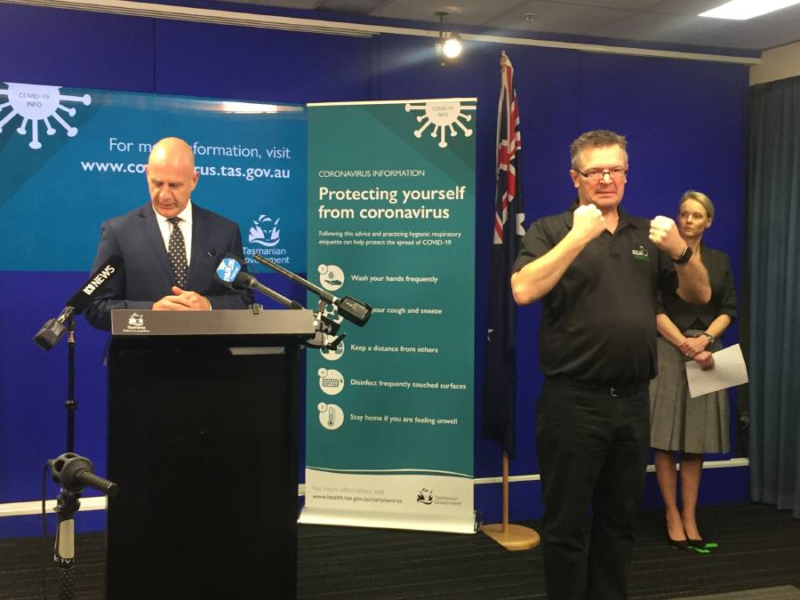
Auslan interpreter Stephen Nicholson gained prominence in Tasmania during Covid (Image credit: The Advocate)
When you think about Australia’s linguistic diversity, which languages come to mind?
Based on the nation’s most prominent social discourses, it is likely you first think of Australian English, the Australian Aboriginal languages, and our vast collection of migrant languages. One native Australian language that receives little attention though, is Auslan, Australia’s main sign language. Our Deaf community have a rich and interesting linguistic and cultural heritage, which traces back as far as our hearing community’s, but despite this, Auslan is often neglected from the social spotlight, and left forgotten amid the rest of Australia’s voices.
History
Auslan was developed from the signed languages brought to Australia by the first settlers and convicts, particularly British Sign Language and Irish Sign Language. The first deaf convict to introduce a European sign language into Australia was Elizabeth Steel, who arrived in 1790 on the Second Fleet. Interestingly though, the name “Auslan” was only coined relatively recently in the 1980s, when the language gained more social attention.
The latest census revealed that over 16,000 Australians use Auslan as their primary language, with the number of users growing considerably over time. The 2021 census was the first to accurately capture Auslan’s prevalence in the country, as previously ‘Auslan’ was not identified as an option to select in the “languages other than English used at home” question. A large number of Auslan users were not aware that they could nominate Auslan as an “other language,” meaning the statistics did not reflect the language’s real pervasiveness.
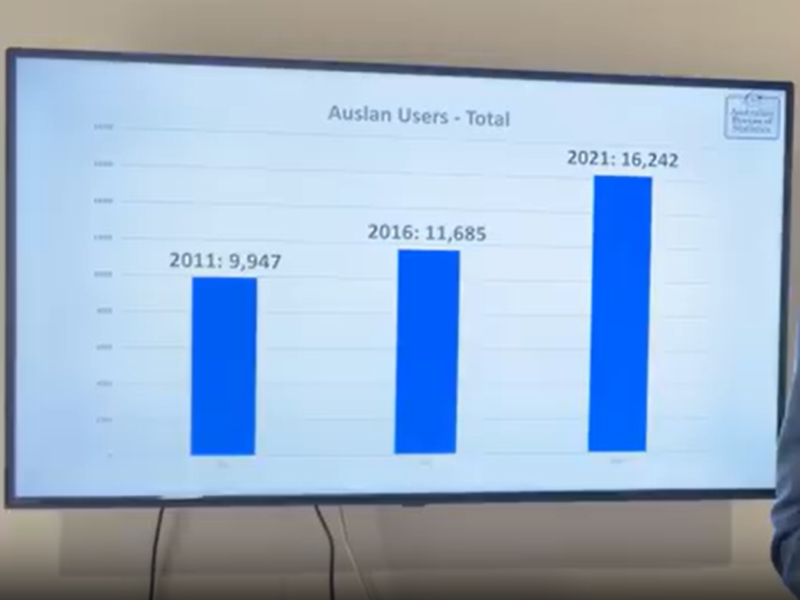
The number of Auslan users recorded in the census has been steadily increasing (Image credit: DeafConnect)
In 2021, Auslan was used as the prompt language for the “other” category, so the census question read:
Does (person) use a language other than English at home?
If other, for example, Auslan, please write here.
The previous lack of recognition of Auslan in the census is quite surprising, considering the Deaf community have always existed in Australia – and even now, in its home country, Auslan is still considered an “other” language. This is one example of how the Australian Deaf community have historically been socially disadvantaged and overlooked. A lack of social awareness and inclusive social structures has meant that Auslan users have had to fight for their acceptance and rights, and this struggle continues even today.
It should be noted that deaf people existed in Australia long before the Europeans arrived, and Aboriginal communities had their own signed languages. These languages are still in use today and deserve recognition, but are less prevalent than Auslan.
Recognition
One major period for Auslan’s recognition was in 1981, which was the International Year of Disabled Persons. In Australia, this year fostered pride in Deaf culture and heightened the social status of Auslan users. This newfound acceptance led to the first signing classes being offered in TAFEs, which gave hearing Australians the opportunity to connect with the Deaf community. In reality, these classes mostly taught signed English rather than Auslan, but nevertheless, it promoted recognition of signed languages as legitimate forms of communication. This significant year also inspired publication of the first Auslan dictionary.

Auslan interpreter Mikey Webb interprets at a music festival (Photo courtesy of Auslan Stage Left)
Unfortunately though, Auslan users are still far from equal in Australia today. I recently read an eye-opening article about the discrimination against sign language users in Australian juries. Currently, Auslan users are excluded from jury duty because there are no provisions in place that allow interpreters to sit with the jury. Researchers have found no linguistic evidence to justify their omission, which means Australia is in violation of its human rights obligations by treating Auslan users unequally. Their unfair exclusion in such a high status domain is significant, as it reifies flawed ideologies about the deficiency of signed languages, and only serves to block Auslan users from achieving equal status.
On a more positive note, if you were in Australia during the pandemic, you may remember that many of the official media announcements featured an Auslan interpreter. This sudden nation-wide uptake of interpreters was significant, as it marked recognition of the Deaf community and highlighted the need for accessible information for Auslan users. It brought attention to the fact that, previously, there had been a language barrier in place for Auslan users in the context of media announcements. This acknowledgement and increased visibility of the language has boosted the number of Australians wanting to learn Auslan, which is hopefully another step towards reaching equality and cross-cultural understanding.
This year, the NSW government announced that an Auslan syllabus will be introduced into the state’s schools in 2026. This comes as a response to Auslan’s recognition during the pandemic, as well as the state’s shortage of interpreters. This change has the power to shift the perspectives of the next generation towards a more inclusive, culturally-sensitive mindset, giving the Australian Deaf community hope for a better future.
Take-Home
It is clear that Australia still has a long way to go to support its Deaf community, however, it seems that progress is slowly happening. Deaf Australians have been limited for hundreds of years by a society that was not designed to include them, but the nation’s shifting attitude offers potential for better outcomes. To my fellow linguists, I encourage you to learn more about Auslan’s history, and to consider how signed languages might play a part in your own linguistic endeavours. Without increased awareness and solidarity, how can we expect to build a nation where everyone’s voices are heard?
]]> We are looking for contributors to a workshop about “Conceptual and methodological challenges in linguistic inclusion.”
When: Thursday, December 14, 2023, full day
Where: Macquarie University
Keynote speakers:
Dr Alexandra Grey, University of Technology Sydney
Dr Trang Nguyen, University of Melbourne
What: Despite the ever-increasing linguistic diversity of Australian society, our institutions continue to be organized as monolingual spaces. This creates barriers to full and equitable social participation for those who do not speak English, do not speak it well, or have low levels of (English) literacy. At this point in time, research into language barriers to education, work, healthcare, law, and all aspects of social life faces at least three intertwined conceptual and methodological challenges, which this workshop is designed to explore:
- Emerging languages: some of the fastest-growing communities in Australia include speakers of under-served, under-resourced, and non-standardized languages. This raises significant challenges for the provision of language services, from translation and interpreting to heritage language maintenance and community schooling.
- Language technologies: the past few years have seen an explosion in assistive language technologies from automated translation via multilingual chatbots to digital diasporas. These technologies offer fresh opportunities for linguistic inclusion while also creating new barriers for linguistically minoritized populations.
- Epistemic justice: the open science movement challenges us to rethink the research life cycle from design to dissemination. Co-design, data-sharing, multilingual team research, big data, and citizen science are some of the issues reshaping how we approach linguistic diversity and social participation.
The workshop is designed to be highly interactive and we are particularly interested in hearing from HDR candidates and early career researchers working in these areas. We have a small number of short presenter slots (10-15 minutes) on our panels. To have your abstract considered for presentation, submit here by Monday, November 06.
Attendance is free.
]]>
Nagoya City poster titled “Pleasant Communication with Simple Japanese”. Note the play on words for “Nagoya” and “pleasant” (nagoyaka)
“Cheers, mate.” It’s a cold January night in Hokkaido, Japan, the snow is knee-high and we’re sheltering in a ramen shop. I am with friends visiting from Australia, and most had never seen snow until a few days ago.
We’re a mixed group. One of my friends is speaking clearly, slowly, pointing to the menu, adding in “arigatō” and bowing. Another talks as though he’s still in Australia, whether the other party speaks fluent English or only a few words. Just a few days prior the situation was reversed, and this same friend shook his head saying, “Why do they talk to me as though I speak Japanese?”
Obviously it goes both ways. And maybe these encounters are less a question of which language we speak, and more of how we think about those who don’t.
Over my seven years of living in Japan, almost every day has involved some type of multilingual interaction. I’ve seen people across languages either overcompensate or undercompensate for the other party’s perceived lack of understanding. In doing so, we tend to either ignore language barriers, or conversely imagine them up, yet both are problematic.
No one wants to be patronised as a competent language user, and no one wants to be ignored or even belittled as a language learner.
With occasional pride but usually chagrin, I’ve been on all sides of these assumptions at one point or another. Over recent years I’ve reflected on such encounters, including my own incorrect assumptions, and tend to hit upon a pattern of two main factors. The first is assumptions about the other person’s language ability. The second is our perceptions about how best to respond to people in light of those language abilities.
The first factor of assumptions can often be mitigated through an open-mind, by avoiding a priori judgements, and being proactive and observant enough to gauge someone’s language ability through their actual language use. By and large, this approach takes little more than practice, awareness and the willingness to stave off our assumptions.
The second issue of how best to respond, and especially how to cater for less confident language learners’ needs, is more complex. It’s also rarely discussed, at least beyond academic and pedagogical circles, and in the everyday lives of the people actually engaging in such interactions. What I will introduce today, therefore, are several practical examples of Japanese language support, in both its productive and counterproductive forms. For ease of comparison and to provide concrete examples, focus will be dominantly on written Japanese language.
Simplifying Language, Done Right
Let’s start with the concept of Yasashī Nihongo. Yasashī Nihongo (やさしい日本語) literally translates as easy or kind Japanese. It’s useful in situations where Japanese learners lack ready access to translations or interpreting services in their own languages. Other people may choose to interact with people or written texts in Japanese, but find this process easier with language support.
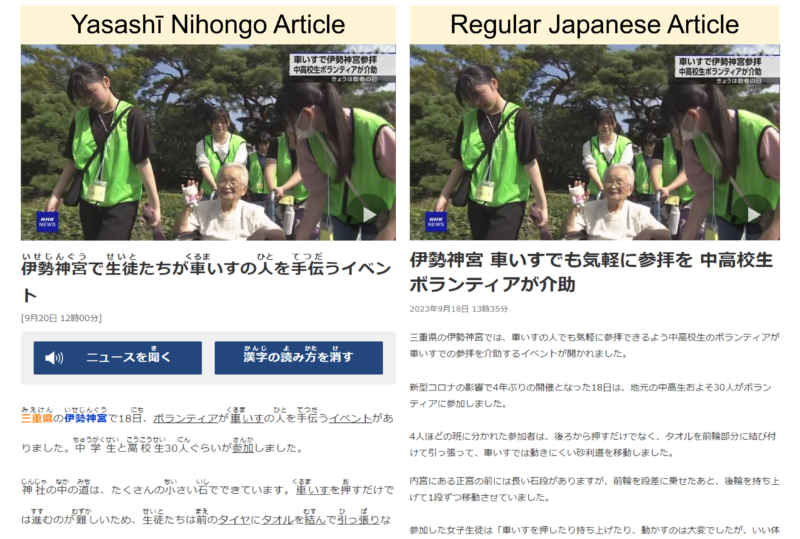
Sample article from NHK’s News Web and News Web Easy. News Web Easy title reads “Students Helping People in Wheelchairs in Event at Ise Shrine”
What then, does Yasashī Nihongo look like in practice? The bright yellow poster in Figure 1 from the Nagoya City website is a good example. In it, two rows of people hold up sketchbooks, each containing a difficult word or phrase. This may be a term in intermediate, formal Japanese, or a loanword requiring knowledge of English or other languages. Arrows point to everyday, simple expressions, which are more accessible for Japanese learners. Both the poster and the Nagoya City website publishing it highlight the value of such communication methods in everyday life, and during emergencies or natural disasters.
Beyond mere simplification of vocabulary, there are many ways to increase language accessibility. Another example is the NHK website News Web Easy. A quick visual comparison of one and the same article in its Yasashī Nihongo version and regular Japanese version shows differences in form and complexity, even without an understanding of Japanese.
Font and line size adjustments have been made. Spaces, absent from most Japanese writing, have been added between words, and phonetic furigana readings are visible above the kanji (the more complex Chinese-based symbols, separate from the Japanese syllabaries). The text, and noticeably the title, have been simplified and shortened, making the whole Yasashī article 23% shorter than the original. Other changes include colour coding names, a hover over function showing definitions for underlined words, a reduced speed audio version of the text, and even additional images or graphics.
Remembering the concept of meeting learners’ needs in light of their language ability, a final feature of the website is adjustment options for the level of simplification. This includes hiding the colour coding and phonetic furigana readings, and links to view the original article in standard Japanese. This allows readers to tailor or gradually increase difficulty, similar to the scaffolding process in language learning.
Simplifying Language, Done Wrong
There are other instances of Yasashī Nihongo that are less positive, and lack the multimodal accessibility of the previous example. Below is a sample from the Japanese Ministry of Health, Labour and Welfare’s website, “COVID-19 Vaccine Navi”. This website also has a Yasashī Nihongo option, indeed it is one of only three language options (the other two being Japanese and English).
Created during the pandemic, this website has developed since I first came across it in mid 2022, and was like many foreign nationals looking for vaccine information. At that time, the texts for the Yasashī Nihongo version and the regular Japanese version were identical. No simplification had taken place and while phonetic readings for kanji were included, these were in full-sized parentheses beside the original words.
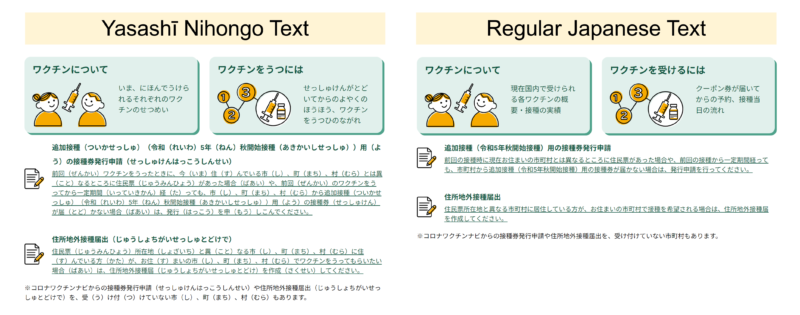
2023 sample from the Ministry of Health, Labour and Welfare’s website. Which text looks more approachable?
The result was a text linguistically no less confusing, but visually and structurally disjointed, and dauntingly twice the length. I consulted with other speakers of Japanese as a second language, and all agreed that we would rather read the original Japanese than the “easy” version.
Since this time, the Covid Navi website has thankfully improved. However, this was done in an inconsistent manner. Some sections have been paraphrased into simpler versions of the Japanese text, while others keep the same wording as the original. Some sections keep the phonetic readings for kanji in parenthesis, while others only have the phonetic readings, having removed the kanji characters entirely. Also absent from these pages are any different formatting techniques, such as spacing between words and lines, or a larger font size. These internal inconsistencies and missed potential for increased accessibility suggest there is still room for improvement for the website.
Implications
So what do these different instances of Yasashī Nihongo tell us? Clearly there are positive and negative ways of making language accessible. It is noteworthy that organisations, particularly governmental ones, are taking steps in the right direction, but how effective these steps are, and why they have taken so long, remains in question.
If we are not meeting the needs of language learners, it is a sign that we need better education about language learning processes and challenges, and more importantly, chances to hear the voices of language learners about their own accessibility needs. The earlier version of the corona vaccine information website strongly suggested to me (and those I shared it with) that no learner of Japanese as a second language had been consulted in its construction.
Providing language support is more than just ticking a box. While it is frustrating to be overcompensated for as an adept language user, it can be distressing and even have detrimental consequences to be neglected as a language learner. This is why language accessibility support in particular deserves attention, and not only in organisations publishing written materials. We have opportunities within our everyday interactions, both to be more vocal about our needs as language learners, and to consider the effects for other language learners, positive or negative, of how we communicate.
Referenced Websites
City of Nagoya. (2017, November 30). Yasashī nihongo no pēji [Easy Japanese page]. https://mt.adaptive-techs.com/httpadaptor/servlet/HttpAdaptor?.h0.=fp&.ui.=citynagoyahp&.ro.=kh&.st.=rb&.np.=/kurashi/category/395-0-0-0-0-0-0-0-0-0.html
Ministry of Health, Labour and Welfare. (2023). Shingata korona uirusu wakuchin o utte morau koto no oshirase [Information about receiving novel coronavirus vaccines]. Corona Vaccine Navi. https://v-sys.mhlw.go.jp/ja-pl/
Ministry of Health, Labour and Welfare. (2023). Shingata korona uirusu wakuchin sesshu no sōgō an’nai [General information about novel coronavirus vaccine injections]. Corona Vaccine Navi. https://v-sys.mhlw.go.jp/
NHK. (2023, September 18). Isejingū kurumaisu demo kigaru ni sanpai o chūkōkōsei borantia ga kaijo [Ise Shrine: Easy access for shrine visits even in wheelchairs: Middle and high school students volunteer assistance]. NHK News Web. https://www3.nhk.or.jp/news/html/20230918/k10014199131000.html
NHK. (2023, September 20). Isejingū de seito-tachi ga kurumaisu no hito o tetsudau ibento [“Students helping people in wheelchairs in event at Ise Shrine”]. NHK News Web Easy. https://www3.nhk.or.jp/news/easy/k10014199131000/k10014199131000.html
The talk brings together three of my studies, as follows:
Study 1 (Grey and Severin, 2021)
Focus: legislation and policy about the decision-making framework and standards which might underlie multilingual government communications in Australia’s largest state, NSW.
Summary: The NSW government’s public communications are not made within a clear or informed decision-making framework as to choice of language, and do not consistently acknowledge, plan for, or manage the public’s actual linguistic diversity.
We developed a typology of laws about language choices. The most common type (40 of the 91 relevant laws) protects people by requiring that rights, obligations or information are explained to vulnerable types of people in language that they understand. Not being an English-speaker and/or literate in English is not generally recognised as a vulnerability in these laws.
Most of these require that certain government representatives communicate in an understandable way, but the standard is unclear and variously phrased: ‘plain language’, ‘ordinary language’, ‘simple language’, or ‘language likely to be understood’. There is no mention that this language may need to be a language other than English.
Another type of law that we found (merely) acknowledges linguistic diversity. The key example is the Multicultural NSW Act, which contains NSW’s Multicultural Principle that ‘all individuals and institutions should respect and make provision for the culture, language and religion of others within an Australian legal and institutional framework where English is the common language’.
Based on this Multicultural Principle and a few policies that we could locate, we conclude that there is enough of a framework in NSW that the question, how do government language choices differentially affect different language groups? should nowadays be asked when decisions about the NSW Government’s public communications are being made.
Study 2 (Grey and Severin, 2022)
Focus: web communications of 24 departments and agencies of the NSW government.
Summary: The study identifies that the NSW Government makes some effort to publicly communicate in LOTEs but also identifies problems: we found no consistency or predictability across websites in relation to the range of LOTEs used, the amount of LOTE content produced, or the steps by which it could be accessed. The image shows a table of 64 languages other than English which appeared at least once: how many of them, and for what, varied widely across the NSW government’s websites.
Overall, the actual NSW Government website communications practices we analysed did not appear to meet the standard set in the Multicultural NSW Act from which I quoted above, because provisions are not reliably or thoroughly made for non-English dominant speakers and readers.
We argue that the NSW government should not necessarily spend more money on multilingual public communications, although that may help, but rather that it should spend money on multilingual communications in an informed, strategic way, and in a way that is accountable both to policy and to the multilingual public.
Study 3 (Grey, 2023)
Focus: Covid-19 communications from the NSW government and the Australian national government.
Summary: This study finds weaknesses in multilingual Covid communications much like we found in the first two studies about general government communications, and about which I gave a preliminary report on Language on the Move.
In its final form, this study also reviews of the commentary of international organizations as to how to take a human rights-based approach to pandemic communications to fulfill certain international law obligations upon Australia (and other nations). It found expectations are emerging that governments’ multilingual health communications will be not merely partially available, but rather produced without (unreasonable) linguistic discrimination; produced with minority communities’ involvement at preparatory stages; and produced after strategic planning, which bolsters our calls in the prior studies.
The international commentary also stresses that multilingual government communications should be effective, not merely exist. In explaining what more effective multilingual communications could entail, I advocate assessing government communications’ Availability, Accessibility, Acceptability and Adaptability — that is, the ‘Four As’ recognized by the UN Committee on Economic, Social and Cultural Rights, crisis communications scholars and applied linguists (for example, Piller, Zhang and Li, 2020).
Recommendations
I conclude the webinar by suggesting ‘3 Rs’ in response to recurrent problems with how government communications reach, and represent, linguistically diverse publics:
- (further) Research (preferably with government collaboration because important data is not publicly available / governments are best placed to collect it);
- Redesigning communications and their access routes (for example, redesign the ‘monolingual logic’ of government websites, to use a phrase from Piller, Bruzon and Torsh, 2023); and
- Rights-based Regulation (to uphold standards and to strategically plan communities’ input).
References
Grey, A. (2023). Communicative Justice and Covid-19: Australia‘s pandemic response and international guidance. Sydney Law Review. 45(1) 1-43
Grey, A., & Severin, A. A. (2021). An audit of NSW legislation and policy on the government’s public communications in languages other than English. Griffith Law Review, 30(1), 122-147. doi:10.1080/10383441.2021.1970873
Grey, A., & Severin, A. A. (2022). Building towards best practice for governments’ public communications in languages other than English: a case study of New South Wales, Australia. Griffith Law Review, 31(1), 25-56. doi:10.1080/10383441.2022.2031526
Piller, I., Bruzon, A. S., & Torsh, H. (2023). Monolingual school websites as barriers to parent engagement. Language and Education, 37(3), 328-345. doi:10.1080/09500782.2021.2010744
Piller, I., Zhang, J., & Li, J. (2020). Linguistic diversity in a time of crisis. Multilingua, 39(5), 503-515. doi:https://doi.org/10.1515/multi-2020-0136
Brynn’s research examines what happens when people go to a hospital but don’t speak the dominant language (well). How do these linguistic minority patients communicate their health concerns, and how do hospital staff help them if a language barrier exists? What kinds of multilingual communication strategies and tools exist in hospitals? How do hospital staff even know if a patient needs a multilingual communication strategy?
Watch the award-winning entry here and find the script below.
Curing Confusion: How do hospitals communicate multilingually? Brynn Quick’s 3MT script
Have you ever been a patient in a hospital? If you have, do you remember feeling confused or scared? Imagine having to navigate that process……. in another language. What if you were hospitalised and you couldn’t understand what your healthcare providers were saying to you? What would you want the hospital to do to make sure that you received the same quality of care as the patients who could understand the language?
My research looks at the ways in which hospitals facilitate communication when there is a language barrier between linguistic minority patients and the hospital’s healthcare providers. Since I can’t call every hospital and ask how they manage linguistic diversity, I’ve done the next best thing – a systematic literature review. This means that I developed a very specific search strategy to find academic papers from the last 5 years that would answer my questions about this topic. First, I wanted to know what communication tools and strategies are currently in use in hospitals. And second, I wanted to find out how a hospitalised patient is identified as needing a multilingual communication strategy. After a rigorous screening process, I landed on 50 studies that would help me find the answers to these questions. So, I got to reading, and found an answer that I wasn’t expecting.
Here’s what I found. Human interpreters are really important to bridging language barriers between hospitals and linguistic minority patients. Professional medical interpreters are considered the gold standard, and even though it’s 2023, translation apps and AI are not yet reliable methods of conveying the complexities of medical concepts and emotions that interpreters can. But here’s the catch – healthcare providers are hesitant to actually use an interpreter if they feel that the process of organising for one will take a long time, OR if they feel that the interpretation itself will be time-consuming.
But how do these healthcare providers even know that a patient needs an interpreter? The answer to that question is what surprised me most – in almost half of the studies I looked at, this wasn’t even addressed. But! Of the studies that did, the majority pointed to hospital admission staff as the people who were responsible for finding out if a patient needed an interpreter. In most of the studies, this is where the responsibility seemed to end, though. Admission staff noted the need for an interpreter in the linguistic minority patient’s record, but then whose responsibility was it to actually organise the language service? The answer to that question was much less clear.
So what does my study tell us? Hospital admission staff with language needs training may be an untapped resource when trying to ensure that all hospital patients have equal access to information and care. Healthcare providers may be more inclined to utilise interpreters if they know that there is a dedicated team of people who are trained to identify a patient’s language need, book a language service, and follow up to make sure the patient is receiving that service. My research is important because it is identifying areas for health communication improvement – and ensuring equal communication access means ensuring a healthier community for us all.
]]>