I have always been fascinated by the human voice. When you speak on the phone with a stranger, it can reveal so much about them. You can often tell whether it’s a man or a woman, estimate their age, and sense their attitudes and emotional state — whether they sound polite, distant, nervous, happy, or sad.
And, importantly, you can almost immediately recognize whether the person speaking has a foreign accent or not. Pronunciation is never just about sounds: it reflects the social meanings attached to language.
A different kind of accent training
In my phonetics and phonology classes, I usually deal with a familiar scenario: students ask me how they can improve their pronunciation in their L2 Italian or L2 Spanish and sound more “natural”. How to avoid a foreign accent — or at least minimize it.
Of course, there is nothing wrong with having a foreign accent. It simply shows that you grew up speaking another language. But many students want to refine their pronunciation, and I am a happy companion on that journey.
This time, however, it was different. A friend asked me to do a favor for one of her friends — an actress. In her new movie production, she had to play a German woman speaking Spanish with a strong German accent.
She told me: “Well, I know I have to do the German R sound, which is very different from Spanish. But I feel there’s more.”
Exactly. There are even native Spanish speakers who have difficulty pronouncing the rolled R — this phenomenon has a name: «rhotacism» or «the French R» (la erre francesa). But even speakers who don’t “roll” the R can still sound perfectly native-like.

(Image credit: Andrea Pešková)
So, what is it all about?
What makes Spanish sound German
Let’s take a closer look at some of the most distinctive features of “German” Spanish.
German speakers don’t only struggle with R sounds. One of the most noticeable characteristics is the aspiration of the voiceless stops /p t k/: pala ‘shovel’ may sound like [ˈphala], tono ‘tone’ like [ˈthono], and cosa ‘thing’ like [ˈkhosa]. The aspiration should remain subtle and light — otherwise it may begin to sound more “English” than “German”.
Another typical feature is that the final [o] may sound overly close, almost like [u], turning perro ‘dog’ or loco ‘crazy’ into perru or locu in Spanish ears.
German speakers also tend to pronounce the Spanish approximants [β ð ɣ] between vowels as full stops, so la bodega ‘the wine cellar’ [laβoˈðeɣa] becomes something like [laboˈdeɡa] rather than the softer Spanish version.
They also often insert a glottal stop before vowel-initial syllables or words. El auto ‘the car’ becomes [elˈʔawto], and otra ‘other’ turns into [ˈʔotɾa]. This gives Spanish a slightly “choppy”, segmented rhythm.
Orthographic influence plays its role too. Speakers may pronounce the normally silent h, voice the s between vowels as z (casa ‘house’ [ˈkaza]), or mispronounce <eu> as [ɔɪ̯] instead of [ew]. And the infinitive ending -er may shift towards something like -a in the word comer [komˈea] ‘to eat’.
Prosody contributes as well. Stressed open syllables may sound unusually long, unstressed vowels may be reduced, stress placement may shift, and intonation patterns often diverge. For example, the end of neutral statements may sound exaggeratedly emphasized, lacking the subtle falling contour typical of Spanish.
Making the accent sound real
We worked on all these phonetic features, and my student did an excellent job. We wanted the accent to sound authentic and recognizable, but never exaggerated or comical.
While we focused mainly on pronunciation, I also pointed out that in real-life speech, grammatical transfer phenomena often accompany a foreign accent. In many movies, accented speech is portrayed with perfect grammar but an overdone pronunciation, which feels unnatural.
In reality, small deviations are common in second-language speech — for instance, occasional omission of articles (Me gusta pizza ‘I like pizza’ instead of Me gusta la pizza ‘I like the pizza’), overuse of subject pronouns that are usually dropped in Spanish, or transfer of verbal tense and aspect.
These subtle grammatical influences, combined with pronunciation, shape the overall impression of an accent and make speech sound more believable.
From correction to creation
What we both found most fascinating in this experience was the shift in perspective: instead of trying to eliminate a foreign accent, we tried to recreate one. It was a playful reminder that accents are not errors but expressions of our identity, multilingual experience and authenticity.
We often see how accent becomes a marker of belonging — or of difference.
But when we learn to listen closely, every accent tells a fascinating story about who we are, where we come from, and the paths our languages have taken.
Additional resources
If you want to explore more accents in Spanish, visit this page that my students in Osnabrück (Germany) created: https://andrea-peskova.com/archivo-de-los-acentos-l2/. There you will find examples of Czech, Italian, Slovak, Greek, and American English accents in Spanish.
]]>Have you ever listened to a language you don’t know and thought you recognized a word—only to realize later that you were completely mistaken? Our ears play tricks on us.
A while ago, I ran a small experiment with my German students. I played them two short sentences in Czech, my native language, and asked them to transcribe what they heard. The results were fascinating.
For example, about 90% of the forty students wrote down the Czech word malí [maliː] ‘small’ as mani [maniː]. To me, this seems puzzling—there is no n in the word! But for my students, the Czech l-sound somehow resembled the German n-sound. None of the Czech speakers I consulted ever had this impression.
This little classroom experiment shows something important: we don’t all hear sounds the same way. Our ears—or better said, our brains—are tuned by the language(s) we grow up with.
Why do we hear differently?
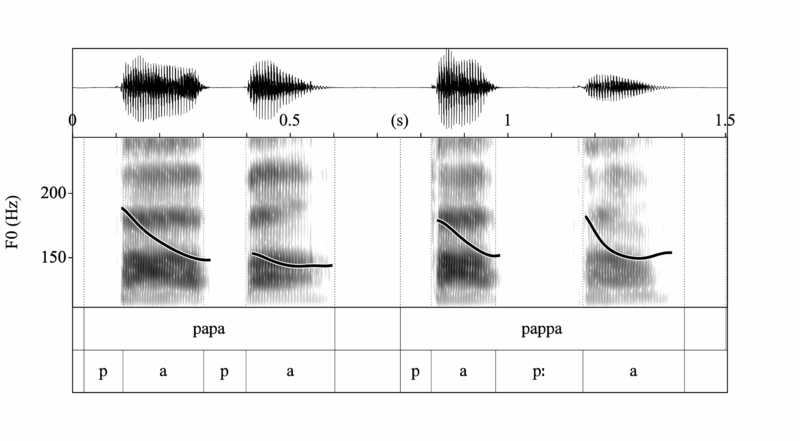
Image 1: Oscillogram and spectrogram of the Italian words papa ‘Pope’ and pappa ‘porridge’
Long before we speak, we are already great language users. Research shows that newborn babies can already distinguish speech sounds from noises. Even more surprisingly, they are able to recognize the rhythm of their native language from a non-native one before birth.
After birth, infants are surrounded daily by an enormous amount of speech input. Step by step, they build categories for the sounds of their native language. Up until around 8 to 12 months they can distinguish nearly all of the world’s speech sounds, even those that never appear in their environment.
A Japanese baby, for example, can hear the difference between r and l just as well as American or German babies can. But this ability does not last. As children grow, their brains focus on the categories that matter in their own language and ignore the rest—like the difference between r and l. This is why many Japanese adults often find it notoriously difficult to distinguish the two consonants in languages like English. What was once easy for the baby can become very challenging for the adult.
We perceive foreign languages through native filters
Learning the sound system of a language doesn’t stop with vowels and consonants. It also includes rhythm and intonation. And even for individual sounds like a or o, it’s not only about how you articulate them but also how long you hold them. This brings us to segmental quantity, or length. It refers to the use of duration (short vs. long) of vowels or consonants to distinguish lexical meaning. Quantity shows remarkable cross-linguistic variation.
The case of long consonants in Italian
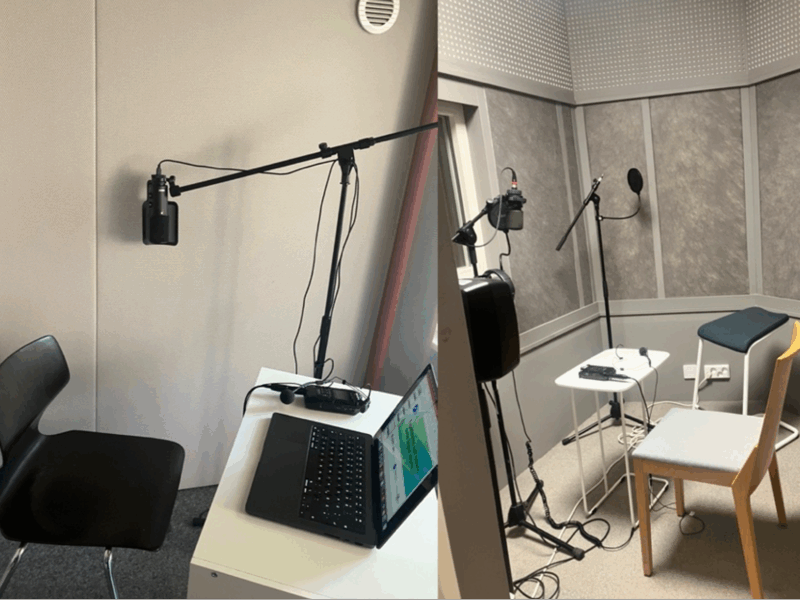
Image 2: Soundproof cabins at the Free University of Berlin (left) and University of Helsinki (right)
What feels natural in one language may not exist in another. Take Italian. It belongs to just 3.3% of the world’s languages that distinguish short from long consonants (Ladefoged & Maddieson 1996).
This contrast appears in more than 1,800 Italian words, such as papa /ˈpapa/ ‘Pope’ versus pappa /ˈpapːa/ ‘porridge’ (Image 1). To be understood and to speak well, learners must get long consonants (called geminates) right—although it can be very challenging (e.g., Altmann et al. 2012).
Cross-linguistic differences in learners
In our project “Production and perception of geminate consonants in Italian as a foreign language”, we examine how Czech, Finnish, German, and Spanish learners acquire this feature.
The selection of these languages is not random. They all handle consonant length differently. German, for example, has no consonant length but contrasts short and long vowels in stressed syllables (e.g., Stadt [ʃtat] ‘city’ vs. Staat [ʃtaːt] ‘state’). Czech, like German, distinguishes vowel length, but unlike German, it does so in both stressed and unstressed syllables (e.g., nosí [ˈnosiː] ‘(s/he) carries’ vs. nosy [ˈnosɪ] ‘noses’). Finnish is the most similar to Italian, since it has both vowel and consonant length (e.g., muta [ˈmutɑ] ‘mud’ vs. mutta [ˈmutːɑ] ‘but’). And finally, Spanish has no length contrasts at all.
This diversity allows us to test how a learner’s native language shapes the way they hear and produce length in Italian.
How good are learners at perceiving length in Italian?
In a laboratory setting (Image 2) and by means of a perception experiment, we tested and compared 20 Czech, 20 Finnish, 20 German, and 20 Spanish learners of Italian.
We used 45 short nonsense words that followed Italian spelling and sound rules but had no meaning. Each word had two versions, differing only in whether a consonant was short or long (e.g., sàpolo vs. sàppolo; milèta vs. millèta).
The words covered different consonants and stress positions and were recorded by a native Italian speaker. In every trial, participants had to answer the question: “Does the audio pair you hear belong to the same or different word?”
What we found
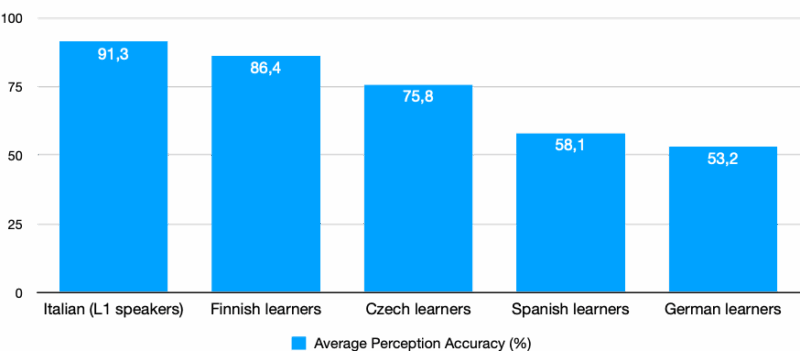
Image 3: Learner accuracy in perceiving Italian consonant length in comparison to native listeners
First language has great impact! Finnish learners, whose native system is closest to Italian, were the most accurate in hearing the difference between short and long consonants.
Czech learners followed, while German and Spanish learners struggled more (Image 3). Other factors also played a role. Learners heard contrasts more easily when the crucial sound appeared in stressed syllables, and some consonants were easier to notice than others.
Proficiency helped too—advanced learners did much better than beginners.
However, it is unexpected that the German group scored lower than the Spanish group—sometimes research simply surprises us!
Many factors could explain this, since every learner has their own story. Things like previous language experience, weekly study time, exposure to Italian, time spent in Italy, Italian friends, motivation, and personal talent can all play a role.
In our case, German learners had spent fewer hours per week learning Italian and had less experience studying or staying in Italy. Immersion—the experience of being surrounded by a language in real-life settings—seems a plausible factor behind their performance.
Why perception matters in language learning?
Why does pappa sometimes turn into papa in the ears of Italian learners? Because we all hear foreign languages through the features we are familiar with.
Our experiment showed that perception is difficult—but it can be improved. The key is to notice what is different and to train your ears. This means: Pronunciation training must start with perception (e.g., Colantoni et al. 2021).
In the end, learning a language is not just about new words—it’s about learning to hear differently.
References
Altmann, H.; Berger, I., & B. Braun (2012). Asymmetries in the perception of non-native consonantal and vocalic contrasts. Second Language Research 28(4), 387–413.
Colantoni, L., Escudero, P., Marrero-Aguiar, V., & J. Steele (2021). Evidence-based design principles for Spanish pronunciation teaching. Frontiers in Communication, 6, 639889.
Ladefoged, P., & I. Maddieson (1996). The sounds of the world’s languages. Oxford: Blackwell.
Acknowledgement
This blog post was written as part of the DFG-project “Production and perception of geminate consonants in Italian as a foreign language: Czech, Finnish, German and Spanish learners in contrast”, funded by the German Research Foundation (Project number 521229214) and executed at the Free University of Berlin. Project website: https://italiangeminates-project.com/
]]>

The White House (Image credit: Zach Rudisin, Wikipedia)
Editor’s note: The Trump administration has recently declared English the official language of the USA while simultaneously cutting the provision of English language education services. This politicization of language and migration in the USA is being felt around the world.
To help our readers make sense of it all, we bring you a new occasional series devoted to the politics of language and migration.
We start with an essay by Professor Rosemary Salomone, the Kenneth Wang Professor of Law at St. John’s University in New York City. Professor Salomone, an expert in Constitutional and Administrative Law, shows that longstanding efforts to make English the official language of the USA have always been “a solution in search of a problem.”
***
English in the Crossfire of US Immigration: A Solution in Search of a Problem
Rosemary Salomone
Making English the official language of the US has once again reared its head, as it does periodically. This time it has gained legal footing in a novel and troubling way. It also bears more serious implications for American identity, democracy and justice than the unaware eye might see and that the country should not ignore.
Trump Executive Order
Amid a barrage of mandates, the Trump Administration has issued an executive order that unilaterally declares English the “official language” of the United States. It does not stop there. It also revokes a Clinton Administration executive order, operating for the past 25 years, that required language services for individuals who were not proficient in English.
The order briefly caught the attention of the media in a fast-paced news cycle. Yet its potentially wide-sweeping scope demands more thorough scrutiny and reflection for what it says and what it suggests about national identity, shared values, the democratic process and the role of language in a country with long immigrant roots. It also calls for vigilance that this is not a harbinger of more direct assaults to come on language rights. Subsequent reports of closing Department of Education offices in charge of bilingual education programs and foreign language studies clearly signal a move in that direction.
English and National Identity

German Translation of the Declaration of Independence
English has been the de facto official language of the United States for the past 250 years despite successive waves of immigration. Though the nation’s Founders were familiar with the worldview taking hold in Europe equating language and national identity, they also understood that they were embarking on a unique nation-building project grounded in a set of democratic ideals. As a “settler country” those shared ideals and not the English language have defined the US as a nation unlike France, for example, where the French language became intertwined with being a “citoyen” of the Republic.
In the early days of the American republic, the national government issued many official texts in French and German to accommodate new immigrants. Languages were also woven less officially into political life. Within days of the adoption of the Declaration of Independence on July 4, 1776, a newspaper in Pennsylvania published a German translation to engage the large German speaking population in support of the independence movement. As John Marshall, the fourth chief justice of the U.S. Supreme Court, noted in a letter to Noah Webster in 1831, geographic and social mobility, rather than public laws, would create “an identity of language through[out] the United States.” And so it has been.
The executive order distinguishes between a “national” and an “official” language. English has functioned well as the national language in government, the courts, schooling, the media and business. It has evolved that way through a maze of customs, institutions and policies that legitimize English throughout public life. It is the language spoken by most Americans. Over three-quarters (78.6 percent) of the population age five and older speaks English at home while only 8.3 percent speaks English “less than very well.” And so, by reasonable accounts, formally declaring it the official language after 250 years seems to be a solution without a problem unless the problem is immigration itself and unwarranted fears over national identity.
While benign on its face, at best the Trump order veers toward nationalism cloaked in the language of unity and efficiency. At worst it’s a thinly veiled expression of racism and xenophobia, narrowly shaping the collective sense of what it means to be American. Though less extreme in scope, its spirit conjures up uniform language laws in past autocratic regimes where language was weaponized against minority language speakers. Think of Spain under Franco and Italy under Mussolini where regional languages were outlawed.
Context and Timing
Context and timing matter. The order comes on the heels of the Trump Administration’s shutting down, within an eye-blink of the inauguration, the Spanish-language version of the White House website along with presidential accounts on social media. Reinstated throughout the Biden years, the website had first been removed in 2017 during the first Trump Administration.
During the 2016 presidential campaign, Trump blasted former Florida governor Jeb Bush, who is married to a Mexican-American, for speaking Spanish on the campaign trail. “He should really set the example by speaking English while in the United States,” Trump remarked, projecting what became an administration openly hostile to “foreigners” and the languages they speak. Against that history, the official English order now signals rejection of the nation’s large Spanish-speaking population and the anti-immigrant feelings their growing numbers have engendered.
The irony is that Trump, not unlike other politicians, has courted that population with Spanish language ads. With 58 million people in the United States speaking Spanish, political operatives understand that Spanish is the “language of politics.” But the “politics of language” is far more complicated. The 2024 Trump campaign ad repeating the words, “Que mala Kamala eres” (“How bad Kamala you are’) to the tune of a famous salsa song with the image of Trump dancing on the screen is hard to reconcile with his prior and subsequent actions as president.
The current shutdown of the Spanish-language website did not go unnoticed among public dignitaries in Spain. King Felipe VI described it as “striking.” The president of the Instituto Cervantes, poet Luis Garcia Montero, called it a “humiliating” decision and took exception to Trump’s “arrogance” towards the Hispanic community. On the domestic front, the executive order raised even more pointed concerns among immigrant and Hispanic groups in the United States.
Issued at a time of mass deportations, hyperbolic charges of immigrant criminality, attacks on “sanctuary” cities and states, and rising opposition to immigration in general, the new executive order will further divide rather than unite an already fractured nation. Fanning the flames of hostility toward anyone with a hint of foreignness, it can incite lasting feelings of inclusion and exclusion that cannot easily be undone.
Official Language Movement
The Trump order did not come from out of the blue. It is the product of years of advocacy at the federal and state levels promoting English to the exclusion of other languages. Proposals to make English the nation’s official language have been floating through Congress since 1981 when the late Senator Samuel I. Hayakawa (R. CA), a Canadian-born semanticist and former college president, introduced the English Language Amendment. Though the joint resolution died, it set a pattern for congressional proposals, some less draconian, all of which have stalled. The most recent attempt was in 2023 when then Senator J.D. Vance (R. Ohio) introduced the English Language Unity Act.
Hayakawa went on to form “U.S. English” in 1983. It calls itself the “largest non-partisan action group dedicated to preserving the unifying role of the English language in the United States.” It currently counts two million members nationwide. In 1986, its then executive director Gerda Bikales tellingly warned, “If anyone has to feel strange, it’s got to be the immigrant, until he learns English.”
The group’s website now celebrates the Trump order as “a tremendous step in the right direction,” a supposed antidote to the 350 languages spoken in the United States. Obviously that level of diversity can also be viewed as a positive unless “diversity” is totally ruled out of even the lexicon. Two other advocacy groups with similar missions subsequently joined the movement: English First and Pro English.
Defying Democratic Norms
The fruits of those efforts can be found in official English measures in 32 states. The earliest, from Nebraska, dates from 1920 in the wake of World War I when suspicion of foreigners and their languages reached unprecedented heights. By 1923, 23 states had passed laws mandating English as the sole language of instruction in public schools, some in private schools as well. With immigration quotas of the 1920s (lifted in the mid-1960s) diluting the “immigrant threat,” the official English movement didn’t seriously pick up again until the 1980s as the Spanish-speaking population grew more visible. The remaining Official English laws were largely adopted through the 2000s, the last in 2016 in West Virginia. Some of them, as in California and Arizona, were tied to popular backlash against public school bilingual programs serving Spanish-speaking children.
Some of these state laws were passed by a voter approved ballot measure, others by the state legislature. Some reside in the state constitution, others in state statutory law. Unlike the Trump order mandated by executive fiat, they all underwent wide discussion by the people or their elected representatives, which a measure of such high importance, especially with national reach, demands. And they can only be removed using a similar process, unlike an executive order subject to change by the mere stroke of a future presidential pen. This is not like naming the official state flower or bird, a mere gesture. The consequences are far more serious.
 As official English supporters are quick to point out, upwards of 180 countries also have official languages, some more than one. Standing alone, that argument sounds convincing. In well-functioning democracies, however, those pronouncements are carved into the nation’s constitution from the beginning or by subsequent amendment, or they’ve been adopted by the national legislature, again through democratic deliberation. At times they’ve been triggered by a particular event. France added the French language to its constitution in 1992 for fear that English would threaten French national identity with the signing of the Maastricht Treaty creating the European Union. Exactly what is triggering the current move in the United States? The answer is quite transparent. It’s immigration.
Some countries, like Brazil and the Philippines, allow for regional languages. Other approaches are less formalized. In the Netherlands and Germany, the official language operates through the country’s administrative law. In Italy, though the Italian language is not officially recognized in the constitution, the courts have inferred constitutional status from protections expressly afforded linguistic minorities. Other countries, including the United Kingdom, Mexico, Australia and Argentina, the latter two also “settler countries,” recognize a de facto official language as the United States has done since its beginning.
Clinton Order Protections
While the official English declaration might mistakenly pass for mere symbolism, the revocation of the Clinton order quickly turns that notion on its head. Rather than “reinforce shared national values,” as the Trump order claims, revoking the Clinton order protections undermines a fundamental commitment to equal opportunity and dignity grounded in the Constitution and in Title VI of the Civil Rights Act of 1964. From that Act and its regulations prohibiting discrimination on the basis of national origin, the Clinton Administration drew its authority, including using national origin as a proxy for language, to protect language rights. In an insidious twist, the Trump executive order uses language as a proxy for national origin, i.e. immigrant status, to pull back on those same protections.
The Clinton order, together with guidance documents issued by the Department of Justice, required federal agencies and other programs that receive federal funds to take “reasonable steps” to provide “meaningful access” to “information and services” for individuals who are not proficient in English. As advocates argue, removing those requirements opens the door for federal agencies and recipients of federal funds, including state and local governments, to deny critical language supports that assure access to medical treatment, social welfare services, education, voting rights, disaster relief, legal representation and even citizenship. In a virtual world of rampant disinformation, it is all the more essential that governments provide non-English speakers with information in emergencies, whether it’s the availability of vaccines during a flu pandemic or the need to evacuate during a flood or wildfire, as well as the facts they ordinarily need to participate in civil life.
With current cutbacks in federal agency funding and staff, rising hostility toward immigrants, and the erosion of civil rights enforcement, one can reasonably foresee backsliding on any of those counts. One need only look at the current state of voting and reproductive rights to figure out where language supports may be heading when left to state discretion with no federal ropes to rein it in.
Multilingualism for All
The Trump order overlooks mounting evidence on the value of multilingualism for individuals and for the national economy. Language skills enhance employment opportunities and mobility for workers. Multilingual workers permit businesses to compete both locally and internationally for goods and services in an expanding global market
It takes us back to a time not so long ago when speaking a language other than English, except for the elite, was considered a deficit and not a personal asset and national resource. It belies both the multilingual richness of the United States and the fact that today’s immigrants are eager to learn English but with sufficient time, opportunity and support. They well understand its importance for upward mobility for themselves and for their children. That fact is self-evident. With English fast becoming the dominant lingua franca globally, parents worldwide are clamoring for schools to add English to their children’s language repertoire and even paying out-of-pocket for private lessons.
Rather than issuing a flawed pronouncement on “official English,” the federal government would better spend its resources on adopting a comprehensive language policy that includes funding English language programs for all newcomers, along with trained translators and interpreters for critical services and civic participation, while supporting schools in developing bilingual literacy in their children. Today’s “American dream” should not preclude dreaming in more than one language. In fact, it should affirmatively encourage it for all.
In the meantime, the Trump order promises to provoke yet more litigation challenging denials in services under Title VI and the Constitution, burdening the overtaxed resources of immigrant advocacy groups and of the courts. Worst of all, it threatens to inflict irreparable harm on thousands of individuals and families struggling to build a new life while maintaining an important piece of the old.
It’s not the English language or national identity that need to be saved. It’s the democratic process, sense of justice and clear-eyed understanding of public policy now threatened by government acts like the official English executive order.
Related content
In this episode of the Language on the Move Podcast, Rosemary Salomone chats with Ingrid Piller about her book The Rise of English.
]]>Migration separates families
I am a second generation migrant from my mother’s side. When my grandfather migrated from the former Czechoslovakia to Australia after World War 2, only one member of his immediate family was a fellow survivor, his older brother. The brothers were desperate to get out of war-torn Europe and start a new life, but there was a catch. They weren’t able to go to the same place. While my grandfather received permission to emigrate with his young family to Sydney, his brother received the same from the United States. Despite already losing their parents, grandparents, aunts, uncles and cousins in the war, the brothers were unable to prevent losing each other. After they emigrated, although they wrote letters, and spoke on the phone very rarely, they never saw each other again.
Today in Australia where I live and work, cross-border communication is likely to be by phone, not letter and for the majority of migrants the greatest barrier to seeing family is likely to be economic. Many of the participants I spoke to for my research into mixed language couples living in Sydney frequently spoke to family members by phone, sometimes even daily. This is significantly more affordable now than it was fifty years ago. However, migrant families continue to be separated for many years and often permanently. The border closures during the pandemic were a very difficult period for migrants unable to travel to spend time with family, particularly aging parents and relatives. So how does communication maintain family ties across borders? And how can we as scholars engage with this topic, theoretically, methodologically and ethically?
A theory of communicative care
I was recently lucky enough to speak to Dr Lynnette Arnold about her new book on this topic, Living together across borders: communicative care in transnational Salvadorean families. In the book she describes how communicative care both sustains and resists dominating geo-political forces which maintain continued migration from El Salvador to the United States across multiple generations as solution to meeting the economic needs of the nation.
In the book Arnold details an analytical approach based on the concept of communicative care. By this she means that the everyday communication which families engage in is an enactment of care, and that this care is “the most fundamental way that transnational families maintain collective intergenerational life in the face of continued, and seemingly endless, separation.” (p.6) She uses the term convivencia or living together, to describe the culturally specific practices she observed in her data collection with transnational Salvadoran families.
I found communicative care a particularly useful lens for examining the links between what are sometimes referred to as local or micro practices and processes and their connection to larger macro processes such as the economic and political systems governing nations. An example of this is the role of communication in maintaining the flow of global remittances which support the Salvadorean economy as well as the individual families. In this sense the book is a powerful tool for researchers who are interested in both a nuanced exploration of language practices in context and in the transformational power of research to speak back to hegemonic forces such as borders, global capitalism and neoliberalism.
Participants as researchers: researchers as participants
This study took a two stage approach to collecting the data. Starting with a lengthy ethnographic study of a village in El Salvador where she lived and worked as a young women, Arnold built up relationships with two transnational families. These families then formed the research participants for the second stage of the study, where four months worth of telephone conversations between migrant and non-migrant family members were recorded.
This stage centred the agency of the participants themselves by training them as data collectors of the recorded phone calls between transnational family members. In the interview, Dr Arnold discusses how she also employed research assistants from El Salvador who recognised the social identities – as well as the language varieties – of the research participants. This facilitated their contributions, both as accurate transcribers of the audio data but also as cultural informants in the data analysis process.
The ethics of working with migrants and language issues
For those of us working in the field of migration and language, how can we behave ethically in a space where there are profoundly unequal power relations, the stakes are high and global tensions continue to bubble around issues of migration, borders and citizenship? This is especially true for scholars like me, who are not first generation migrants themselves and thus speak from a relatively privileged position.
According to Arnold, we can start by asking what is language doing? How does it connect with the relational aspect of people’s lives and the geopolitical contexts they exist in? Thinking critically about the role of language in creating social reality allows us to become informed advocates for linguistic diversity. It enables us to think about issues of access, inclusion and ultimately social justice.
I’ll leave you with one example from the book’s conclusion which I found particularly compelling due to my own research interests into the links between language maintenance in migrant families and second language education. Arnold makes the point that one way we can support transnational families to maintain networks of communicative care is to change existing educational language policy “which all too often functions as a tool of state-sponsored family separation by pushing the children of migrants towards monolingualism in dominant languages like English” (p. 171). Instead of turning bilinguals into monolingual, language in education policy must be guided by what migrant families themselves need, which is the communicative resources to maintain ties across borders. This includes a recognition of the linguistic variety in migrant repertoires, which extend way beyond standard languages.
Reference
Arnold, L. (2024). Living Together Across Borders: Communicative Care in Transnational Salvadoran Families. Oxford University Press.
Related content
Piller, I. (2018). Globalization between crime and piety. Language on the Move. https://languageonthemove.com/globalization-crime-piety/
Weiss, F. (2012). Christmas in Nicaragua. Language on the Move. https://languageonthemove.com/christmas-in-nicaragua/
Transcript
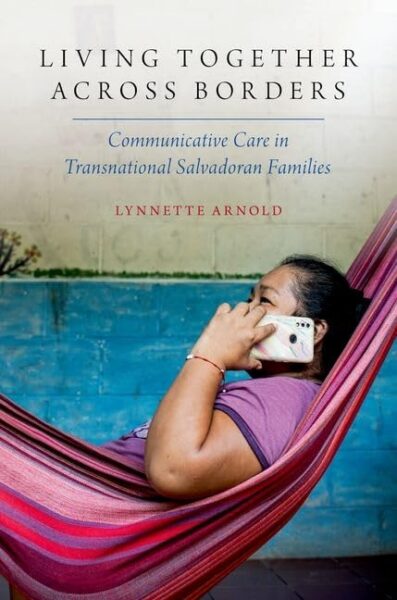
Hanna Torsh: Welcome to the Language on the move podcast, a channel on the new books network, my name is Hannah Torsh, and I’m a lecturer in linguistics and applied linguistics at Macquarie University, Sydney, Australia. My guest today is Dr. Lynette Arnold, Dr. Lynette Arnold is an assistant Professor of Anthropology at the University of Massachusetts, Amherst, and we’re going to talk about her new monograph living together across borders, communicative care in Transnational Salvadorian Families published by Oxford University Press. Welcome to the show. Lynette.
Lynnette Arnold: Thank you so much. Hi, everybody! Ola.
Hanna Torsh: Can you start us off by telling us a bit about yourself, and how you got interested in the topic of your book?
Lynnette Arnold: Sure! So my book, Living together across borders, explores how members of transnational families find ways to live together despite being separated across borders. The families I work with are from a small rural village in El Salvador, with migrant relatives living in urban locations across the United States. I am not Salvadoran. I do not have Salvadoran family members. So you might wonder, what is it? How did I get involved in this? And my interest in this topic really emerged from 2 different but interrelated personal experiences.
I spent 5 years living in El Salvador from 2,000 to 2,005 during the years when most people are in college. I was living in El Salvador, and this is a really eye opening experience, because I got to know many young people, my age, who had grown up during the Salvadoran Civil War that happened in the 19 eighties, and in getting to know them I learned a lot about the involvement of the Us. Government in perpetuating this 12 year conflict through immense financial support of the Salvadoran military and training Salvadoran soldiers in brutal, scorched Earth tactics. All of these, the ways that us support had really caused a lot of harm in El Salvador, and that was an eye opening experience for me to realize that this big gaping hole in my education as a Us. Citizen not understanding something so vital about my country’s history and involvement in the world.
So that was one inspiration was really to help my fellow citizens better understand the human impact of us foreign policy. Our involvement in the Salvadoran Civil War was a direct cause of the widespread emigration that El Salvador shows still today. And so that was kind of one piece was recognizing that I hadn’t learned these things and wanting to share them with my fellow citizens.
The second experience was sort of more deeply relational, and it has to do with the ways that the relationships I made in El Salvador continued. When I moved back to the United States to go to college. When I moved to the US. I stayed in contact with people in El Salvador through phone calls, and I suddenly found myself part of this transnational network of folks in El Salvador, their relatives here in the United States, who I had met in El Salvador, but who had since migrated, and I started to get really interested in what was happening in those phone calls and all the kinds of complicated things that people were working out on the phone across borders. At the same time, at that moment in my life I was navigating a kind of growing realization or separation from my own family of origin. I had left at that point permanently left the Christian Commune where I was raised, and where my family still lives, so I have a very different reason for separation. But I was navigating in my own life how to be family with people that I wasn’t living together with. And so, though I juxtaposing those 2 experiences, got me really interested in how people do family at a distance and the role of language? So that was really what brought me then to the topic of the book.
Hanna: That’s so fascinating. And just a quick follow up question. You know you talk about living there, living in this rural village at a time when sort of other people were at college. How was that experience of language learning for you at that age, in this very remote community, especially when we consider today how almost how difficult that experience is to have with the new affordances that we have in terms of technology and the reach of technology.
Lynnette Arnold: That’s such a great question. Yeah. So I went to El Salvador, knowing very little Spanish. I had been raised in a kind of bilingual culture with German. So I had German as kind of a heritage language, not for my family, but from my community growing up and understood a lot of German, but went to El Salvador, so I knew how to be bilingual. I didn’t know Spanish. I took 2 weeks of intensive one-on-one Spanish courses in the capital.
And I told the guy, the instructor like this is what’s going to happen. I’m going out to this rural village by myself for the next 4 months like I need to be able to survive in Spanish, and I had a dictionary, and I had a grammar workbook and then I went out into the village. I knew one other person in the country who spoke English, who I saw maybe twice the entire time that I was there. So it was really immersion. I was living with a family. I was trying to figure out how to, you know, support the English teacher who didn’t really speak English, you know, like all of these things while also learning the language. So I think obviously, having already been bilingual, helped me like my brain, knew how to learn language, knew that, like learning, the grammar was helpful, and that then I could be like, oh, that person just used the subjunctive! That’s what it sounds like in real life, you know. I remember having experiences like that.
I think the other thing that came out of that experience for me was that I was really learning the language and the culture at the same time. So it wasn’t that I was learning these abstract grammatical forms, but I was learning how to communicate in the language as a young woman, so that was the other, like the gendered, and age the fact that I was, you know, a Us. Citizen, a foreigner. All of those things I had to learn how to use Spanish in that very kind of accurate, contextual way. And still to this day, when I speak Spanish, I find myself realizing how much that has influenced the way that I speak Spanish today. People are not familiar with my accent. I have a very Salvadoran accent. The vocabulary that I’m most comfortable with is like about farms, and, you know, growing food and animals and raising children and not, you know, academic things. And I think that experience was certainly also influential in shaping my research trajectory and the project of this book, because it made me think a lot about the really close connection between language and culture and the sort of social work that language does.
Hanna Torsh: Yeah, wonderful. I think a lot of our audience can resonate with that experience of finding their voice in another language, and having to learn how to be an identity in that language, and then perhaps shifting to another space, and having to then relearn how to be in that language.
So moving on to your book in your book, you talk about two really important concepts, and I’m interested in hearing what these mean. I think our audience would like to hear about them, too. So the 1st one is this idea of convivencia, or living together, and the other one is the idea of communicative care. Can you explain what these 2 concepts mean, and how you use them in your research and in the book.
Lynnette Arnold: Sure I’ll start with convivencia, because it’s the title of the book. So convivencia is two words; con together, and vivencia, live, so live together, made into one word in Spanish convivence as a noun form. It can be all these different things. It’s really a flexible word. People use it a lot when talking about social life. In El Salvador in general, it’s just a very high frequency word. Convivio is another related noun, that is a word for a gathering. Many different kinds of gatherings can be called convivios.
So, in addition to using the word convivencia a lot. People also spend a lot of time carving out opportunities for convivencia or living together what we might call at least an American lingo hanging out just spending time. So it’s a very common thing in rural Salvador culture to see people sitting around on the patio, kind of intermittently talking. Maybe somebody is doing some husking of corn or some other kind of work is happening. Children are in or out, in or out but that sort of spending time together, talking, hanging out, not doing a whole lot of anything is a really important part of the culture. Sometimes convivencia happens in more formal ways, like big gatherings for birthdays, or, you know, religious celebrations or things like that. But they can also be much more informal.
So when I this really sort of caught my attention in the context of the book project, because when I talk to members of transnational families both in El Salvador and in the United States. Many of them mentioned that they missed the ways that they used to convier with loved ones. So they missed that kind of living together when they were separated across borders. So I heard that truth coming out over and over in the interviews, but at the same time from my research perspective, I was seeing these families still doing a whole heck of a lot of conviviando. Even if they weren’t in the same place, they were still finding ways to live together. So I knew that from participating in the transnational networks that from sort of a research perspective, convivencia was still happening, but families were telling me that it looked different than it did when they lived together.
And so, as part of the kind of participating in these transnational phone conversations. I really started to realize that my intuition about where a lot of this living together was happening was that it was happening in these phone calls and these transnational conversations were a really crucial way that families were still able to live together when they couldn’t be in the same place. So that’s what really got me into thinking about what’s happening with this communication and communication away as a way of being together, living together when you’re separate.
So that seems like, if we want to put a label on it, we could call that the more Emic framing right the more the way that people in the community would understand what’s happening here. Convivencia is probably the label they would put on it. Communicative care is really my term and is kind of more informed by my theoretical considerations. I’m a scholar of language and communication, and I’m very interested in how language acts in the world and what language does. And at that time I had been thinking a lot about and reading a lot about feminist scholarship around care and feminist scholars, writing about care often describe it and define care as the labor or the work that we do to keep ourselves alive as a species. So it’s the work that allows individual and collective well-being and survival.
And I came to feel that what was happening in the conversations was families doing precisely that work through language? So I decided to come up with this idea of communicative care as a theoretical frame to capture what I what I thought the work was that was happening in the Conversations. I also wanted to label for the fact that I saw that care and communication were entangled in some very complex ways, and so I wanted a framework that could capture all of those different ways of entanglement. So I decided the communicative care would be a capacious way to talk about that.
Hanna: So just for our audience to understand, you have talked about those transnational phone calls. So maybe we could just take a step back and you could just describe the actual data that you work with in this book, so that so that we have a context for that.
Lynnette Arnold: The data that I’m working within the book primarily are recordings of transnational phone calls. So they are dyadic, mostly dyadic conversations between a person in the United States and a person in the El Salvador who are related to one another in some way. I have interviews and other kinds of ethnographic data that I use to sort of triangulate. These were conversations that were recorded over a 4 month period. So in many cases I could track how something developed over time. The conversations involved, although they were dyadic, many different dyads within the family. So I could track how different dyads talked about different issues.
So that’s when I’m saying that the families are doing a lot of this conivencia, this living together through conversations, I was able to see that in recording, these phone calls and paying really close attention to what exactly they were doing when they were talking to each other on the phone and why they spent all of this, you know, effort, money and time to have these regular phone calls with one another.
So I felt the need for a framework, because I wanted something to capture the different ways that language and care were connected. So it was very clear to me that language is something that makes other kinds of care possible. So think about many kinds of care that we all engage in on, you know, part of our everyday lives. Language is absolutely central to those for these families. The money that immigrants send home is probably the form of care that most people associate with transnational families. That is not possible without communication. There’s a lot of communicative work that goes into making those remittances, those economic transfers happen. But beyond that I wanted to show. And I show in the in the book that language enacts care. Language is something that does itself do care work. It’s a way of maintaining and forging the kind of relational bedrock that is the foundation of all other kinds of care. So that was really important to me to draw that out. That language is not just facilitating other care, but that it is itself a kind of care. And then also, as we know, scholars of language know, language is always making meaning. So as it’s facilitating remittances. And as it’s enacting relational care, language is also a way that people. I used to create meetings about like what kinds of actions, when carried out, by which people count as care and which things don’t count? So all those things are sort of entangled and happening at the same time. So with a communicative care perspective, I was really trying to come up with a theoretical and analytical way to approach that and fully grapple with what was happening with this communication. And the book demonstrates ultimately that communicative care.
This approach really sheds light on how transnational families are able to forge convivencia and live together across borders, through language when they can’t be at the same place for many years at a time.
Hanna Torsh: One of the things that I found really fantastic about reading your work is that the approach you took to data collection, this very inclusive, very participant centered approach to data collection. Could you tell us a bit about how you approached the methodology in your work, and why?
Lynnette Arnold: Sure. And I want to answer this question in a way that will be helpful to emerging scholars who are maybe formulating their first research project or anybody embarking on a new research project. Because, as we know, things often don’t go to plan when we’re doing research. In fact, they often tend not to go to plan but really, if my research had gone to plan, I would not have the book that I have.
So that’s the kind of message here that things can go differently than you imagine, and still be great. So my project started off as a very traditional ethnographic. Sort of like an ethnography of communication. In that tradition I did a lot of participant observation in El Salvador and in the United States with family members, spending time in their homes, eating meals with them, hanging out on the weekends, trying to go to their workplaces, going to their schools. Just kind of spending time understanding what was happening in their lives. And then I conducted interviews with members of families in both countries. And I had that, you know, interview data that I recorded and started to analyze, and, you know, have some other work about narratives that were told in those interviews, for instance.
And then I was planning to do a longer stint in El Salvador of sort of more intensive ethnographic research, and really tracking what was happening. Over an intensive period of time in El Salvador. But then things beyond my control happened. Things got very dangerous in El Salvador. So this was in 2,014 which was a time when there was an intense spike in organized crime and gang violence, especially targeting young people. And there was a whole crisis of unaccompanied minors coming across the Us. Mexico border in relation to this and the area where I do. My research is kind of on a line between the territory of two gangs and got incredibly dangerous.
So my advisor felt like it was really unsafe for me to go back and spend a long time in El Salvador, and she was probably right. So I had to pivot and I decided to pivot to a project that was much more focused on the transnational communication.
So I ended up focusing on the phone calls and deciding to work with two extended families that I had. I knew the most members of and had the deepest relationships to. And I worked with them to record phone calls that they made across borders over a period of 4 months. I based on the interviews I had a sense of from the interviews how much people spent on phone calls per month, and I gave families this kind of stipend per month to cover the costs of the communication during the time that the recording was happening, and then I also hired research assistants in in each family. These were in both cases young people living in the United States because I was able to get to them and train them. So these were young people who were more tech savvy, who were literate and who crucially didn’t have tons of family obligations like they weren’t parents yet and so I was able to go visit them and train them in how to use the recording technology. I used a very, very simple earpiece recorder that you just held the phone up to. I had a little carrying thing for the recorder, so people could still walk around on their cell phones. These were all cell phone calls while having a little MP. 3 recorder on the kind of in their holster
And the family decided amongst themselves which calls to record. And then they didn’t necessarily have to pass all the recordings on to me. They could delete data if they wanted to. I still did delete some things that were passed on to me that I felt, especially when they were pertaining to people’s immigration situation. That I felt like legally, I didn’t want to be responsible for having that information. So I just deleted those recordings.
So that was the sample that I got was the things that families, you know felt okay about me having. And I was still surprised. You know they still felt very from my experience, participating in these networks, very authentic conversations. And there’s conflict. And there’s, you know, disagreements. There are things that happen in these calls. So I I would definitely say it’s not a entirely representative sample in that. Maybe, like the most extreme cases of conflict were not recorded, or whatever but I didn’t get the sense, either, that people were like consistently, always on their best behavior on these phone calls, for instance, it felt like they had. You know they were kind of in the habit of doing this.
Hanna: What did you then do with the with the recordings that you had. How did you go about analyzing that data?
Lynnette Arnold: Yeah. So this is another thing that many of us who do language research, you know, end up with hours and hours of recorded data, and we want to look at it closely, and it gets really overwhelming. So one thing I did that I learned from my undergraduate advisor, Mary Bucholz, was, instead of transcribing all my data. First, st I did a 1st pass of doing what’s called an in what she calls an index, which I think, is a good term. So you’re making a time stamped kind of account of what is happening every minute or so. 30 seconds, depending on how fast moving. The data is in the call, and that is a good way to listen through your data. And just what is in there, what’s happening. Get it in your head right in a way that maybe transcribing especially. This was obviously in the time before AI. But I know now lots of people are using AI to do a 1st pass on transcription. It’s not getting the data in your head in the same way. So working through an index is really good because it makes you start to see the patterns so indexing allowed me to do some qualitative sort of coding of what were some communicative patterns that I started to see what were. Think, what were things that people were doing over and over and over and over again? And decided to focus on transcribing, then, examples of those things that were happening a lot, and you’ll see if you read the book that there’s a chapter about greetings. That’s a thing that happens a lot in these phone calls. And by an example of greetings. There is a chapter about negotiating remittances which is also a thing that’s probably the thing that happens for most of the time.
And then there’s a chapter about remembering in conversations kind of reminiscing in conversations, which was one that I hadn’t, you know. It wasn’t 1 that I went in looking for necessarily but jumped out at me as something really powerful that was happening in these conversations. I was really fortunate.
During my graduate time, when I was collecting and preparing the data to be able to work with undergraduate research assistants. All of whom were Salvador of Salvadoran descent, which meant that they had the linguistic capability to understand this variety of Spanish I think at one time I tried to work with a Mexican descent student, and they were just like this. Spanish is so different from the Spanish that I’m familiar with. I don’t think I can transcribe this accurately. So it was a lovely, lovely opportunity to also extend mentoring towards you know, 1st generation largely Salvadoran American students who were an amazing help for me as well in doing the transcription, and they are all named in my acknowledgements.
Hanna Torsh: Excellent. Yeah, that’s that’s a real challenge for us here in Australia, because we are so linguistically diverse. Having that match with research support in terms of linguistic repertoire.
Lynnette Arnold: And I think even in doing the transcriptions we would meet to talk about the transcriptions. But our conversations would diverge just from the actual transcript. And they would say things like, Oh, my mom. Salvi, mom, this is a thing my mom does all the time. Or, you know, topics of conversations. They were all parts of, you know, transnational families as well. So it was really enriching, not just in the transcriptions, but also in helping me to recognize that what I had in my data was something that was broader than just the two families I was working with.
Hanna Torsh: In your book, you talk about the contradictory ways that digital communication has impacted on the families that you worked with, but also on transnational and cross border family communication generally. So could you tell us a bit about what you found out about these contradictions for your research participants, and any examples that you had would be also fascinating to hear.
Lynnette Arnold: I think there’s kind of a couple of possible answers here. And I think I’ll go with. There’s like a technology answer. And then there’s like a social life answer. And I think we maybe can do both. The technology answers that we often assume that like newer technology, more inclusive, like video technology is better and that people will default to using technologies that are more complete. So if families have access to video calling, they will use video calling, for instance, research with transnational families beyond mine. But just within the field of transnational family research has found that video calling can actually be very emotionally challenging and costly for people to engage in, and that sometimes people dis prefer, even if they have access to videos, that they prefer other forms of communication. So I argue in my work that for these families, phone calls are a real sweet spot. Because they don’t require as mo as much emotional investment. I mean, imagine yourself as a parent or as a family member separated from your loved one for years at a time. You see them on screen, and you see in real time that they’re different than they were when you were there with them. So it’s a real physical visceral reminder of the passing of time that you’re not together. On the phone that is a little bit more held at bay. But you still have the intimacy of somebody’s voice, and you can really hear all of those cues of emotion and all of those things that are so important, especially in the sort of delicate communication that families are doing often on the phone.
Phone calls are also very accessible. So I think that’s another thing to think about in terms of technology is like, and the family is who within the family can use a given technology and phone calls for the families I worked with were maximally inclusive because preliterate children can still talk on the phone and also in the families I worked with elders, and the families were often not literate or had very low literacy levels, and certainly did not have technological literacy to know how to navigate something more complex than a phone call. So phone calls were really a sweet spot, both kind of relationally and what they allowed but also because of their accessibility to everybody within the family. So talk a little bit about that in the book. Why, phone calls in this era of all polymedia. I felt the need to talk about that. It also had to do with the fact that smartphone technology hadn’t really entered El Salvador quite yet. Now it has but I still talk on the phone to my comrade. The mother of my goddaughter in the El Salvador we sell each other voice memos on Whatsapp. So you know again, you see that kind of preference for the voice communication over over video, even though it’s now more possible than it used to be.
And then there’s another answer that has to do with what digital communication affords for these families in terms of their relationships. So as I’ve been talking already, on the one hand, communication is absolutely vital. It’s the way that families are able to live together and sustain their relationships across border. It’s a means of emotional support. It forges the groundwork for this ongoing economic support like remittances. So it’s really positive things for families. But we also know from transnational family scholarship in general that digital communication for families can be really charged. It can lead to people feeling surveilled or micromanaged, especially children and women in families.
In my book, I found that kind of the the negative consequences or effects of digital communication were the ways that it perpetuated divides between migrants and non migrants within families. So if you think about a transnational family, you’ve got this big division of people living in different countries, and the migrants are perceived as those with access to more resources, and the non migrants as those with less access to resources who need help from their migrant. This is kind of a pretty broad generalization that holds for most transnational families, I think.
And what I found in my research was that this divide played out in communication, so that in family conversations there were very different communicative expectations placed on people depending on if they were migrants or non migrants. So, for instance, non migrants needed to learn that when they needed remittances they shouldn’t just ask. They shouldn’t just say, Hey, can you send me 100 bucks?
But they should tell these elaborate stories about family life in El Salvador, in which they would embed conversations of somebody else complaining to somebody else about needing money. So this very like indirect, layered way that people learned a very specific way of doing like a remittance request right?
And then, if you zoom out to think at the kind of macro level. This kind of communication is sustaining and shoring up migration right? It sustains the transnational family form. It keeps the remittances flowing so from a nation perspective, it makes migration succeed as an escape valve, as a means of generating revenue through migrant migrant remittances. Right? So in that those ways, we can see that the communication is really shoring up some inequalities right at the interpersonal and kind of the global level.
Even as it’s a lifeline for these families. So both of those things are true at the same time. And I just want to kind of end by saying it isn’t the case that communication only re in reinscribes inequalities. There are. There are ways in which communication also opens up space for people to resist and create, create new ways of doing things.
Hanna Torsh: Yeah, I’m I’m really keen to hear if you could tell us about some of the participants that you talk about in the book, and some examples of those ways of maybe either kind of perpetuating those inequalities or resisting those inequalities.
Lynnette Arnold: Yeah, I think I’ll go with the resisting examples, because they’re more interesting to me.
Hanna Torsh: Sure.
Lynnette Arnold: So one thing that’s really interesting about digital communication is that it opens up ways for young people to participate in family communication. So some transnational family research shows that young people are actually really get involved in family communication because they have to be the tech. And they’re let the tech help, you know, and then they’re there helping grandma with the laptop or whatever, and then they participate in the conversation. In my families, I found that the kind of a polymedia kind of situation where there were phone calls, but also other kinds of technology happening. Between family members opened up some conflict. So in this one case, some young men were being raised by their grandparents in El Salvador, and their dad was in the United States. He sent them a laptop. They opened Facebook accounts. They started messaging their dad on Facebook. Their grandparents are not literate. Their grandparents are not tech literate. They have no idea like what’s happening when their sons are on the laptop and so the sons use this kind of private channel of communication to complain to their dad about some stuff like teenagers do right.
Hanna Torsh: Yes, I do. Yes.
Lynnette Arnold: As they do and the dad was just hearing from them about this, and so then he called his parents, and, you know, kind of scolded them, taking his son’s word as like you know the truth rather than realizing that it was just kind of one perspective on what was happening. And this resulted in a lot of conflict within the family that then got resolved by multiple phone calls from multiple people, in which people then navigated and kind of smooth things over, and he eventually called and apologized to his mother for not understanding the situation more clearly. But so there there was a case where young people were using technology to kind of have more agency right in what’s going on in the family and try to pressure, you know, put some weight on the scales in terms of things coming out in the way that they wanted it to come out. The other example that I I like to talk about and think about is about gender. So we haven’t talked about gender yet, but it is a theme throughout the book. We know from feminist work that women around the world do the lion’s share of care in pretty much every context you can think of, and that is also true in communication.
I do have cases of men doing amazing communicative care work, a lot of like really touching emotional communication between men. So this is not to say that men are not doing the work. But one thing that I find is that women get asked to do kind of the most onerous tasks. So if a report about oh, the migrants sent money for the cornfield, and there was a flood, and all the corn seedlings died, and we need more money so that we can replant women get asked to have that conversation, even though agriculture isn’t traditionally feminine domain. But they get asked to kind of communicate that information and take on that less pleasant communicative burden. But what I found in some cases was that sometimes women were then using that that they were put in this kind of conduit position to migrants. They were using that to kind of carve out more space for themselves within family decision making. So in one instance, the father in El Salvador had sold one of the family’s cows. He had not consulted with his daughter, his eldest daughter, who lived with him in El Salvador about this decision, and she was kind of mad that he hadn’t consulted with him. But then he this was the same corn example. He needed her to talk to her brother in the United States, his son, and, you know, get some money for the corn so he came over at one night and asked her to do that the next time her brother called to ask him for more money so that they could replant I happened to be there when the brother called, and she didn’t say anything, but instead she told all about the cow, and how her brother had, how her dad had sold the cow without consulting with her, and how it was a poor decision and a waste of the family’s resources and blah blah, and that she should be consulted. So really getting a kind of word into the migrants. And then, when her Dad came back the next day to see what had happened. And what if the money was coming? She was like? Well, I didn’t tell him about it, because, you know, if I’m not consulted on things, I I can’t. You know I can’t communicate. So she really kind of used her. She was in this pivot Lynch kind of PIN position communicatively, and she used that to try to press for a like more decision, making power within the family in these kind of agricultural domains that traditionally, in traditional kind of salvadorange roles would not have been within her purview. So those are the kinds of things, and I think there were more of those things happening than I saw where people were using women especially. We’re using communication to do this kind of torquing in the mechanical sense of gender roles and kind of incrementally shifting things a little bit. So all that’s to say, I think that there are.
There were other ways to in which people were using communication to resist. So I in my, in my account, I wanted to kind of resist. One size fits all characterization of what was happening here, and really capture the complexity of communication as a wonderful lifeline for these families, but also as reproducing inequalities, and also maybe sometimes allowing for resistance, especially to gender them, and generational hierarchies within families.
Hanna Torsh: That’s wonderful. It’s a great example it kind of reminds me of also the the kind of dual role of women in households where they have to do the bulk of the domestic labor, but that also affords them a certain amount of power over some decisions. And so it’s often hard to for them to give it up, because that is then their only power traditionally, in the in those sorts of family situations. So I think that’s a yeah. And it’s really interesting, the way that intersects them with the digital world. And how the same sort of negotiations are taking place. So like, Okay, well, if this is my job, then I am going to try and carve out more agency for myself in a system where I have less agency, you know a patriarchal system. So yeah. Oh, look I I would love to talk more with you, but I am have to jump to my last question. And and and make it really open for you. I I think one of the one of the things that you talk about in your book is how you’re essentially interested in, in, as you say, providing a much more contradictory and nuanced picture of particularly transnational migrants when they have been traditionally particularly, you know, in in public discourse, cast as victims and and and really there’s been a lot of focus on the negative. So I guess I would like to ask you, you know, what? What did you? What are the key? Things that you would really like? The key findings. You would like emerging and established researchers in linguistic diversity and in transnational migrants, to take away from your wonderful book.
Lynnette Arnold: Thank you. I’ll start with a linguistic diversity piece. And I just the I cannot say strongly enough that we cannot. We can’t study linguistic diversity without also be thinking, thinking about what language is doing. So linguistic diversity cannot be separated from the function of language. What people are doing with their communication and the context in which they’re doing those things really shape what linguistic diversity does and what it’s made of. So it’s really vital to think about. One of the main things that people are doing with their communication always is relational. They’re doing relational work of all kinds, with family members, with bosses, with everybody. Right? We’re constantly managing relationships through our language. And so we need to think about that. And also the kind of geopolitical context within which those relationships are playing out. So this may get to your question about language maintenance. Actually, because I wanted to talk here for a little bit about the children of migrants in the United States. So I noticed in my research that the children of migrants in the Us. Were largely excluded from transnational communication.
This was not the case for children in El Salvador, who participated quite actively in and were trained actively trained to participate in the transnational communication, as I show in my chapter on Greetings. That shows how kids learn even before they’re verbal. They’re taught how to do these greetings.
So why does that happen? Well? Linguistic diversity is part of an answer to the question. Relatives in El Salvador tended to perceive the children of migrants in the US as not being Spanish speakers, and therefore they perceived the language barrier that kept them from communicating with grandchildren, nieces, nephews.
Whatever the relationship was, there are, of course, language barrier issues here. There are educational issues at play. Many of the children in the United States did not have access to bilingual education in Spanish and English, and obviously the social dominance of English, certainly reduced Spanish fluency for some, at least, some of the children, but many of the children who were perceived in El Salvador as monolingual English speakers would actually be characterized as bilingual. They just didn’t speak Salvadoran Spanish. They spoke US Spanish, which is a variety of Spanish that has large has been in contact with English right for a long period of time. And so it’s grammar. Its vocabulary is shaped by English and so I think that the unfamiliarity of the children Spanish was perceived by some relatives in El Salvador and this dialect difference was perceived as a as a full on language, barrier, and led to to children being excluded.
So the linguistic causes of children’s kind of exclusion from family communication were really complicated. But it’s also important to recognize that their exclusion from this communication was also influenced by non linguistic, relational and structural issues. So when families envision their future generations down. You know they envision the future of continued emigration, of continuing. So today’s children in El Salvador are tomorrow’s future immigrants. And so it was really essential for children in El Salvador to be heavily socialized into being members of transnational and families to being committed to these cross border relationships, because they would then be the ones to carry those seeds with them. When they traveled the children of migrants are seen as kind of less predictable sustainers of transnational families like well, they just really weren’t sure what was going to happen with these kids.
They weren’t sure they were going to stay committed to the family, so they were less pro. Those relationships were less prioritized in the kind of communicative care work that families were sustaining across borders. The relationship with children in the in the Us. Just wasn’t a priority. Because of this way of thinking about right and this way of understanding their future makes a lot of sense from a geopolitical perspective. It’s heartbreaking.
But I think, unfortunately, realistic reading of the inequitable global distribution of resources, and that for families to get access to those resources. People are gonna have to keep migrating right? So what this example shows us is that the kind of linguistic, the relational, the geopolitical, are all like really tightly entwined with each other. So I just want this example to sort of be a call for us as researchers of linguistic diversity, to be able to think on all of these scales at once, and to think about their interconnections.
And for me, thinking about what language is doing in the world for people. What people are doing with their language is a way to get at that and the lens of care has been a really for me a very capacious lens that has allowed me to think about the relational and interpersonal and the geopolitical kind of within the same framework and their interrelationships. So that’s really my big takeaway for kind of language researchers. Is to think about what language is doing?
I think I have takeaways that are kind of more broad for people living in a global world, which is all of us. Now. And I think I want to especially speak to readers who may not themselves be migrant to listeners right who may not be migrants themselves may not be the children of migrants themselves. And just say that it’s really important for us to understand the lived experiences of migrants. They are so integral to maintaining our societies today. But their lives do not stop at our borders. You know they have connections that go, you know, far beyond what we can see in terms of what we think is happening with migrants and what their lives are like. So this is just kind of a call for all of us to think about, how can we establish relationships with the migrants that are in our communities? And start to think about? You know what’s happening in their lives? Beyond, you know, our immediate communities, our immediate national context.
To think about also the policies and that our governments are passing their foreign policy, their immigration policy, and how that’s affecting lots of people far beyond our national borders through these transnational family connections. So again, that’s kind of going full circle back to where I started of like wanting to educate us citizens about El Salvador. Just to say that there’s so much more that we need to be aware of as you know in thinking about migrants and the roles that they play in the world. And really, yeah, wanted to make sure that they ultimately, I think what I call for my book is that migrants? I want a world where people can have full self determination over how they choose to live as a family. And that is not true for most of us in today’s world. But it is really not true for transnational families. They do not necessarily want to live in 2 different countries for decades at a time, with no chance to visit each other. And so ultimately. That’s where I end. The book is just to say, like, What can we do? How can we work in our own individual ways? For a world in which people have more self determination over care in their own. Of all kinds, including communication.
Hanna Torsh: Oh, thank you so much. I think that’s such an important message and a a great place to finish, a great message to end with. The idea of self-determination for families. And yeah, absolutely reminding us that this we might find all of this very fascinating. But of course, this is not something that any family wants. It’s kind of decade, long separation. And I really love the idea of imploring non migrants to think about migrants, and to that idea of not finishing their lives, not ending at the borders. So yeah, thank you so much.
We’d like to thank you again for talking to us about your work. We will put a link in the blog to the book. Thanks everyone for listening to us today, and if you enjoyed the show, please subscribe to our channel, leave a 5 star review on your podcast app of choice and recommend the language on the move podcast and our partner, the new books network to your students, colleagues and friends. Thanks. Again, Lynette.
Lynnette Arnold: Thank you so much for having me. It’s been a real pleasure to talk to you today.
Hanna Torsh: Thank you until next time.
]]>
(Image credit: Sandy Millar via Unsplash)
Are you a family who speaks Spanish at home? Do you have a school-aged child between 5 and 8 years of age? Are you raising your children without extended family in Australia, and have you been in the country for at least 3 years?
Researchers from Macquarie University would like to talk to you about your parenting experiences as they relate to Spanish language maintenance. We are particularly interested in your family’s home language practices, the use of technology, ties with family abroad, and how your multilingualism has influenced your child’s language learning trajectory.
Participation involves attending an informal online or in-person interview. For more information, please contact the researcher, Ana Sofia Bruzon.
Participation in this research is voluntary and can be withdrawn at any time. This research has the approval of the Human Research Ethics Committee at Macquarie University.
]]>
Mis dos voces (Image credit: Rayon Verde)
Imagine this: you go out to a fast-food restaurant and order a burger. While you wait for your order to be filled, you anxiously hope that the server will get your order right and that the food in the bag will be exactly what you wanted. Sometimes, that is what happens, and you feel a great sense of accomplishment and gratitude. Other times, you get the extra hot sauce that burns your tongue and the chicken that your child refuses to eat. When that happens, you experience a sense of shame and guilt. Not even for a second do you entertain the thought of returning the incorrect order and asking for a substitute.
Sounds strange? Well, this is not someone with an anxiety disorder or a social phobia but an immigrant who does not (yet) speak the language of their new country (well). It is the story of one of the three Colombian and Mexican immigrant women in Canada featured in Mis Dos Voces (My Two Voices).
To read on, head to the Berlinale Forum website.
]]>***

San Miguel Tenango
There can be no question about the crucial role that good quality communication plays in health care. Clearly, the aim of any responsible health care provider is to offer services of a high standard even when multilingual and multicultural settings may present challenges to mutual understanding between doctors and patients. Hence, for years, research in social medicine has been addressing linguistic diversity mostly from the perspective of obstacles that it created for effective health care. Practical, day-to-day considerations still make health professionals focus on ‘overcoming’ or ‘removing’ language barriers rather than view language as a value in itself.
Indigenous minoritized groups worldwide are known to have a worse health profile than majority populations, and they also tend to lose their languages in favor of the languages of majority. The main source of both problems is centuries-long, institutionalized marginalization of Indigenous peoples in the countries where they dwell. Such is the case of Mexico, a country that still counts 67 living Indigenous languages although all of them are in decline.
In Mexico, as elsewhere, Indigenous languages are heavily underrepresented in health care. There are no government-sponsored medical interpreting services in Indigenous languages despite the fact that there are still many citizens that need them – especially elderly persons who have little or no command of Spanish. Medical workers, doctors and nurses alike, are not trained in cultural competence before going to work in predominantly Indigenous communities, nor are they required or even encouraged to learn the languages spoken there.
.svg)
Location of Puebla state in Mexico (Image credit: Wikipedia)
In San Miguel Tenango, a Nahuatl-speaking community in the northern part of Puebla state, a clinic, or Centro de Salud (‘Health Center’), was established 35 years ago. Although it provides services that are in great demand there, contact with clinic employees has remained very complicated and, on many occasions, painful. Until recently, discrimination against patients and obvious disdain for their culture and traditions on the part of medical personnel has unfortunately been commonplace. And barely any medical worker assigned to the Tenango clinic by the state department of health could speak any Nahuatl.
The older generation of Tenango residents, who have little proficiency in Spanish, have to rely solely on the assistance of their younger, bilingual relatives and friends when they need to go to the clinic. But the presence of such ad hoc interpreters, however helpful, conceals the fact that elderly patients will almost always omit important details that they are embarrassed to share. This risk increases even more when a medical worker, seeing that such a patient comes unaccompanied, picks any random person in sight and asks them to interpret. To prevent such cases, old people who live on their own try to organize chains of assistance between themselves, so that one who speaks better Spanish can help a number of her neighbors in case of necessity.
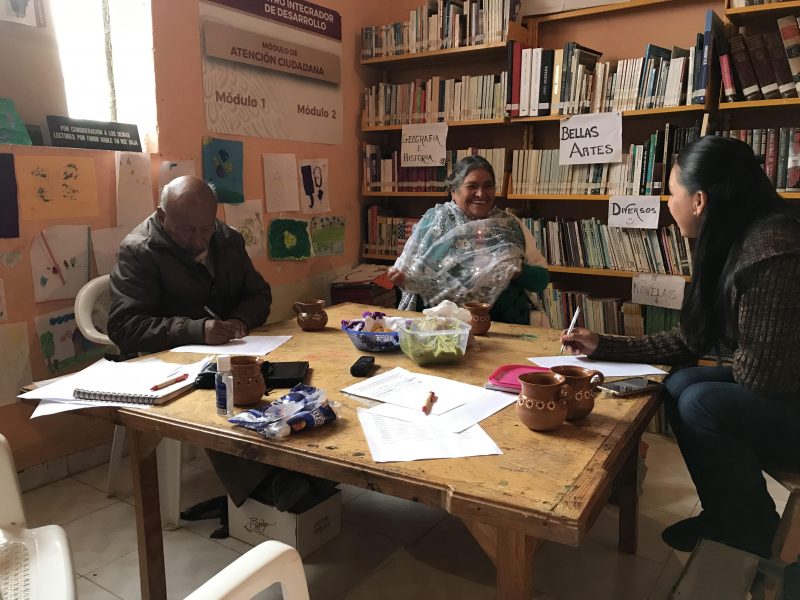
At the terminology workshop
Another problem is that even fairly bilingual residents come into difficulties when they have to translate biomedical discourse, full of specialized terminology and unfamiliar concepts, from Spanish to Nahuatl. Not every medic has been sensitive enough to assess the gap – social, cultural, and educational – between them and the population they serve. Thus, rarely enough effort has been made to ensure that the patients understand the doctor’s words correctly.
At some point health authorities established a position of ‘health educator’ in rural communities, whose duty was to organize informational meetings with the residents. More than that, the attendance of these meetings was made obligatory for persons who receive government assistance for the poor. But in Tenango all such meetings have been conducted in Spanish by a person from outside the community, and old Nahuatl speakers, who were required to show up and sit there until the end, could hardly understand a word.
Such disregard on the part of health authorities and employees could not but lead to a lack of trust towards public health services in Tenango. Even in cases when a member of the clinic’s personnel managed to build a bond with the community, they could be reassigned to another clinic at any moment, without consulting the residents in any form. For the public health system, the people of Tenango have been no more than numb recipients of services and their language has been treated as if it was non-existent.
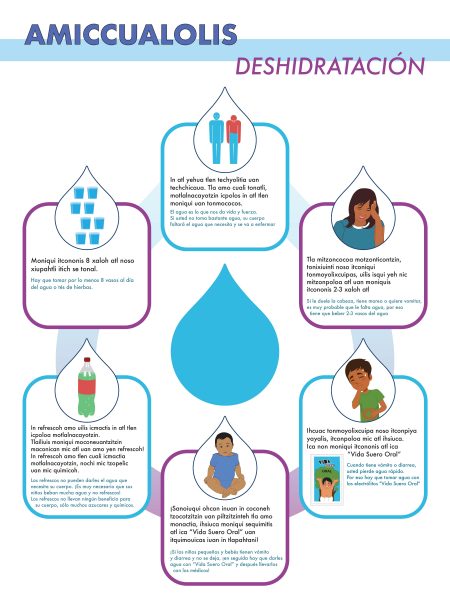
Bilingual poster about dehydration
Talking with the residents, we realized how little it would actually take in terms of language in order to make people feel welcome on their visit to the clinic. And yet, even basic accommodations were rarely done, even in case that did not even involve any knowledge of Nahuatl. For example, doctors who worked in Tenango used to address any patient, irrespective of their age, with tú and not with usted, which is a more polite form of address in Spanish. In Tenango, however, politeness traditionally plays a crucial role in communication. In Nahuatl, the honorific prefix -on- in a verb is almost obligatory when you are talking to an adult, and this manner of speech has also influenced the way of how the local population speaks Spanish. Even using more formal language in Spanish could go some way to make patients feel respected.
The people of Tenango do not really expect that the employees of the health center would start to learn and speak Nahuatl with them, oh no. “But”, they were telling us, “even a greeting in the language would suffice”: that simple tzinōn that you can hear anywhere you go through the green hills of this sprawling community.
This situation inspired us to launch a participatory action research project, focused on the introduction of the Nahuatl language into the work of local health services. Our main aims were, on the one hand, to enhance the prestige and functional utility of Nahuatl, and, on the other hand, to improve health communication and health literacy in Tenango and neighboring villages. We have managed to involve in this project both locals who were eager to contribute to the well-being of their community and the personnel of the health center. As an active group, we hold regular meetings where we discuss vital health issues, trying to solve misunderstandings that have long festered between medical personnel and villagers.
Our first practical step was the development and production of bilingual Nahuatl-Spanish educational posters that tackled the most acute health issues in the community: diabetes type 2, dehydration, healthy nutrition, and high blood pressure. After discussing the content of the posters with the doctors, we then worked on the Nahuatl text and carefully tested it with as many speakers as possible before preparing the final version and the design.
We were well aware that the majority of elderly patients in Tenango could not read or write, but it was important to make Nahuatl visible in the clinic for the first time. Then we could proceed to the creation of audio materials.
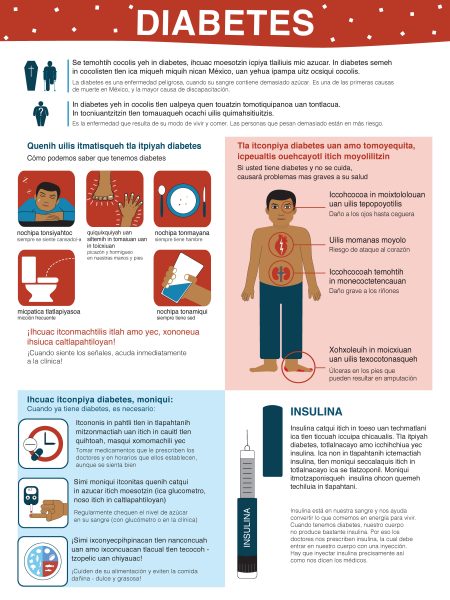
Bilingual poster about diabetes
That symbolic appearance of Nahuatl in the local health center provoked a lot of interest among the residents, including young people, who started to take photos of the posters and disseminate them on social networks. Some older visitors noted that it would also be good to make signs in the clinic bilingual, and we happily included this task into our project. Medical personnel, in their turn, started asking us to translate other informational materials into Nahuatl, such as questionnaires distributed by the regional department of health.
The outbreak of Covid-19 seemed to bring our project to a halt but, in fact, also provided us with new opportunities. Although we both happened to be far from Mexico when the pandemic was declared, we decided to produce an informational video about the coronavirus and precautions against it in the variety of Nahuatl spoken in Tenango. At that moment, the virus had only recently emerged in Mexico and hardly any measures had been taken to curb its spread. But the inhabitants of Tenango were excited about the video, and it got shared by tens of people and seen hundreds of times just in a few days. Two weeks later, when certain anti-coronavirus measures had come into force, the village council asked us to produce another video in Nahuatl, with updated information, which we gladly did.
In addition, Herlinda recorded an informational audio message, which was then played in communal gatherings and from a loudspeaker attached to a truck belonging to the council, making the warnings heard across the whole village.
Nothing of this sort had ever been done in this region by health authorities. For the first time, health information in Tenango was given a Nahuatl voice, but even more importantly, it was a voice that many villagers easily recognized – it was one of their own voices. The impact of these innovations is yet to be assessed, but the demand for them and the impression they have had on the community already tell a great deal.
We can only hope that the current pandemic will make health authorities in Mexico – and in linguistically diverse societies around the globe – rethink their attitudes and policies towards Indigenous people, giving Indigenous languages and their speakers an adequate role in the services provided for the communities where these languages are spoken. There is a growing awareness of the importance of language-centered approach to health. As for now, we represent only a small community project, but we also want to set an example of how things can be changed and how a healthier language can also improve societal health.
Reference
A longer account of the study of communication in health services in Sierra Norte de Puebla will be published in Multilingua shortly.
Language challenges of the Covid-19 pandemic
Visit here for our full coverage of language aspects of the COVID-19 crisis.
]]> How is your Language-on-the-Move Reading Challenge coming along? One month has gone by and you should have ticked off at least one book from our list. I started with an ethnography of language on the move and picked a study of Christian piety and gang prevention in Guatemala by religious studies scholar Kevin O’Neill. While not ostensibly concerned with language, Secure the Soul is engrossing in a way academic books rarely are and will keep you glued to your reading.
Secure the Soul examines Christian practices of self-transformation in five spaces of globalization: high security prisons, reality TV shows, offshore call centers, child sponsorship programs, and Pentecostal drug rehabilitation centers. One key participant, Mateo, who has been in and out of all these institutional spaces, provides the narrative arc of the book. Mateo is introduced early in the book as an iconic type of a particular global person: a Guatemalan child migrant who is “illegal” in Los Angeles, becomes involved in drugs and organized crime, and, as a young adult is deported back to Guatemala, where he gets stuck between belonging and non-belonging:
Mateo, […] was not tall, but he was obviously strong. He had broad shoulders, a thick neck, and a sturdy back. He could be mistaken for an athlete, a boxer perhaps, were it not for his gait. He walked like a gangsta. This is his word, not mine. He walked a little slower, a little more stridently than the average Guatemalan. Mateo had a kind of swagger that made him stand out. He knew it, and he liked it. The bald head, the baggy jeans, and the tattoos peeking out from under his collar—it all signaled a certain kind of time spent in the States. His stunted Spanish was also a tell. Mateo was not from Guatemala. Everyone knew as much. But, of course, he was. Everyone knew that, too. (O’Neill, 2015, p. 2f.)
 Language – “his stunted Spanish” – is a key signal of Mateo’s identity as someone who got caught up in the specific global circuits that link Guatemala and the USA.
A very short history of Guatemala
The territory that today constitutes Guatemala was sucked into the vortex of globalization in 1511 with the conquista, the Spanish colonization of Latin America. After more than 300 years, Guatemala gained independence from Spain in the 19th century. By that time, its agricultural exploitation by multinational companies based in the US was in full swing. By the mid-20th century, United Fruit was the largest landowner and employer in Guatemala. As the interests of United Fruit would have been jeopardized by an attempted modest land reform by a democratically elected government in 1954, the United States intervened. The coup d’état plunged Guatemala into more than three decades of a genocidal civil war. Today, Guatemala is officially at peace but is the most violent non-combat zone on earth. It is also still in the clutches of an exploitative globalization for which Guatemala is nothing but a way station: in 2011, 84% of all cocaine produced for the US market passed through Guatemala.
Many have sought to escape this hell by migrating north. However, while Guatemalan bananas and drugs are welcome there, its people are not. Caught up in the “War on Drugs” and the “War on Terror”, deportation back to Guatemala has soared since the beginning of the 21st century.
Language and global crime
Guatemala’s civil war pushed tens of thousands of refugees into poor neighbourhoods of Los Angeles in the 1980s (along with El Salvadorians, Hondurans and Nicaraguans). In these harsh circumstances, their children quickly became involved in gangs and two transnational criminal organizations, Mara Salvatrucha (MS-13) and Barrio 18, gained strength from the 1990s onwards. From modest beginnings in Los Angeles, these gangs have now gone global. One step in their globalization was the US policy of deporting migrants with a conviction.
These deportees met minimum life chances, a complete lack of social services, and a glut of weapons left over from the region’s civil wars. And, as men and women born in Central America but oftentimes raised in the United States, the youngest of these deportees did not speak Spanish fluently; they had no close family ties and no viable life chances but gang life. (O’Neill, 2015, p. 15)

Call center signage, Guatemala (Source: O’Neill, 2015, p. 107)
Lack of proficiency in Spanish is one of many factors that further limits the opportunities of deportees back in Guatemala and pushes them into gangs. Conversely, their proficiency in English is another. However, their proficiency in English sometimes becomes profitable in other ways.
Language and global service work
In addition to organized crime, a sector that has been growing in Guatemala is call center work. Off-shoring call center work to India or the Philippines has increasingly given way to “near-shoring”. In this process, the work is still outsourced to a low-wage country but one that is in the same time zone and has greater “cultural affinity.” Linguistically, deportees make ideal call center workers. Having learned English “not just in LA public schools but also in the U.S. prison system or while shuttling product from Los Angeles to Las Vegas” (p. 99), their English accents are ideal to maintain the illusion that the US customer is actually speaking to a US service agent.
At the same time, their habitus constitutes a problem. The fact that their bodies are full of tattoos remains invisible in call center work but addiction, problems with punctuality and following tedious scripts, or anger in the face of customer abuse were more difficult to hide. Call centers attempt to manage employee’s habitus through Protestant Christian piety mixed with corporate maxims. In most cases, this was not enough to keep employees on the job, off the streets and out of drugs for long. As long as the deportees came rolling back in, this was no problem for management, though:
Instead they troll the airports looking for more talent. “The ones that we fight for are the mojados [wetbacks],” the director of human resources admitted. “They are the most valuable here. Because they have perfect English. Perfect. We can place them in any account. We find them in the airport.” (O’Neill, 2015, p. 116)

Prisoner transport vehicle, Guatemala (Source: O’Neill, 2015, p. 35)
Language and global Christianity
The language of Protestant self-improvement permeates the sites in which the deportees circulate. Without material resources or any vision for social change, North American Christian piety is the sole means through which a destitute population comes to be governed. These global communications readily descend into farce, as is the case in the child sponsorship program, where US sponsors commit to a monthly contribution of US$35 to the education of a Guatemalan child. Additionally, sponsors are encouraged to enter into an exchange of letters with “their” child. These exchanges end up producing highly disparate texts, as the head of one child sponsorship NGO explained:
“It was ridiculous,” the director of child sponsorship complained. “Sponsors would write these wonderful letters. They’d write about their life and their hobbies. And then they’d get a letter back from a fourteen-year-old kid who should know how to write, and all it says is, ‘Dear sponsor. I love you. Love, your sponsor child.’” These scrawny efforts suggested ungracious subjects. (O’Neill, 2015, p. 136)
The idea behind the letter exchange is that it would help the sponsored child find god, show them they are loved, and, ultimately, prevent them from getting into drugs and crime. However, for children growing up in a Guatemalan slum keeping up a correspondence with middle-class North Americans constituted an almost impossible task. In the end, NGOs coach the children how to write letters following templates. Unsurprisingly, the content becomes entirely fictional in the process.
Ethnography of language on the move
Secure the Soul is a brilliant ethnography of Christian piety as a form of soft security. It also offers instructive glimpses into the ways in which language has become enmeshed in global circuits of crime, service work and security efforts. Highly recommended!
 Full reference:
O’Neill, K. L. (2015). Secure the Soul: Christian Piety and Gang Prevention in Guatemala. Berkeley, CA: University of California Press.
Those of you who are after recommendations for ethnographies located more centrally in sociolinguistics, here are some of my favourites:
- Codo, E. (2008). Immigration and Bureaucratic Control: Language Practices in Public Administration. Berlin: Mouton de Gruyter.
- Duchêne, A. (2009). Ideologies across Nations: The Construction of Linguistic Minorities at the United Nations. Berlin: Mouton de Gruyter.
- Farr, M. (2006). Rancheros in Chicagoacán: Language and Identity in a Transnational Community. Austin, TX: University of Texas Press.
- Heller, M. (2006). Linguistic Minorities and Modernity: A Sociolinguistic Ethnography (2nd ed.). London: Continuum.
- Hoffman, K. E. (2008). We Share Walls: Language, Land, and Gender in Berber Morocco. Oxford: Blackwell.
- Martín Rojo, L. (2010). Constructing Inequality in Multilingual Classrooms. Berlin: Mouton de Gruyter.
- Prendergast, C. (2008). Buying into English: Language and Investment in the New Capitalist World. Pittsburgh: University of Pittsburgh Press.
- Sabaté i Dalmau, M. (2014). Migrant Communication Enterprises: Regimentation and Resistance. Bristol: Multilingual Matters.
- Zentella, A. C. (1997). Growing up Bilingual: Puerto Rican Children in New York. Oxford: Blackwell.
Happy reading! And don’t forget to share your progress. If you tweet about it and mention @lg_on_the_move, you’ll be in the running for our monthly draw of a copy of Intercultural Communication. The February winner will be announced on Twitter shortly.
]]>
“How bad is your cultural cringe?” (Source: Jenna Guillaume, BuzzFeed)
Keith: I’m still really shit at pronouncing Lisa’s surname. With the umlaut o.
Hanna: What is Lisa’s surname?
(laughter)
Keith: Do I get three goes?
(Keith, Australian, in a relationship with Lisa from Germany)
Despite the increasing value of multilingualism in a globalised world, English-speaking countries such as Australia remain stubbornly monolingual. At the same time the benefits of speaking more than one language are regularly touted in public discourse. My research investigates how speakers of Australian English with a partner from a non-English-speaking background feel about their linguistic repertoires. Embarrassment, as in the example above from Keith (all names are pseudonyms), comes up a lot. So does inferiority. Because of their low proficiency in foreign languages (often as a consequence of their poor quality or limited language learning experiences in formal education) these participants feel they are bad language learners. This response seems to be one way of engaging with and mitigating their own privilege as native speakers of the powerful global language, English, compared to their partners who learned English as an additional language.
“It’s my deficiency”: being a bad language learner
And I I think I was completely in awe of that the fact that she could speak so many different languages freely, and a little bit jealous, and at the beginning was a bit more kind of definite about trying to learn German, um and I think the whole experience intimidated me cause I think I’m the kind of person who if they don’t pick something up really quickly kind of just gives up very quickly (…) (Keith)
For Lisa and Keith, Keith’s first and Lisa’s second language, English, has been the language of their relationship. Keith sees Lisa’s language skills as impressive while blaming himself for his own inability to learn German. He feels that Lisa “probably speaks better English than most native English speakers in Australia”. While Lisa learnt languages formally in her school education as a child and young adult, Keith faces all the frustration of learning another language as an adult.
In his own education Keith’s choices were limited. Although he comes from an Italian migrant background, Italian was not available at his public school in inner Sydney in the 1990s. He decided to take Latin instead, but he dropped it after junior high school when he lost interest in his schooling. He has done no further foreign language study in contrast to Lisa, who studied four languages over many years in her schooling in Germany. So when it comes to saying Keith’s Italian surname their pronunciation reflects their differing language learning trajectories:
Hanna: And how are you at pronouncing Keith’s last name (laughs)?
Lisa: I am tempted to pronounce it Italian which then nobody understands (laughs).
Keith: She- like I’m reading out a, a pizza on the pizza menu from our local pizzeria and she makes fun of my Italian accent. You know like quattro formaggi, she’s like (puts on a strong Australian accent) quattro formaggi. ‘Cause she speaks Italian, you know, these fucking Europeans!
(laughter)
In Keith’s comment about his partner’s Italian pronunciation of his Italian surname we could read humorous disparagement of her ability to pronounce it in the Italian way; in Australia foreign names are usually anglicised or pronounced in an English way. Both his lack of educational opportunity to study Italian and his Anglicized pronunciation cause him in that moment to position himself as a (monolingual) Australian in opposition to (multilingual) Europeans.
Stephen, from Australia, who is married to Christina from Argentina feels similarly critical of his own poor Spanish skills. He describes his attempts to learn Spanish as “a token effort”, says he “hasn’t got an ear for languages” and it dismissive of his own attempts to learn Spanish:
Hanna: You said you’re the odd one out; how do you feel…
Stephen: No, not at all, because uh because I recognise that it’s my deficiency in not having had the time to devote to learning a language. Now, I I make the standard joke I have 50 words of [unclear] of Spanish that I know. I work very hard and uh it’s a standing family joke (…)
In fact, Stephen studied Spanish at night, has a Spanish speaking community in Sydney and has two children who are bilingual. He also regularly visits Argentina and has frequent Argentine house guests. Spanish is a regular feature in his life. In the interview he also says that learning Spanish is “a commitment I’ve probably made and haven’t fulfilled” and feels he is a “handicapped Aussie” compared to his multilingual relations.
Another participant, Amy, has a strikingly similar evaluation of her own language skills. When I asked her why she was interested in talking to me about language she said:
Well, I suppose, I suppose it’s just there and I suppose for me it’s that I’ve got to learn more Spanish (…) And I went to lessons and I started learning and I was enthusiastic because we were going to Columbia, but as soon as we came back from Columbia I was just like that’s it, I’m just not interested anymore. And I learnt that I’m not a good language learner(…) (Amy, in a relationship with German from Columbia)
Amy’s language learning experiences at school were typical for my participants. In twelve years of state school education all she studied was ten weeks each of Italian, German and French in her seventh school year. In contrast, she praises her partner for his excellent English language skills which he acquired in Columbia from the “movies and music” he consumed from their powerful northern neighbour.
A new kind of language cringe
It seems these participants characterise their persistent monolingualism as a personal failing, a source of embarrassment, a source of language cringe. In Australia language cringe is a child of the cultural cringe. It has traditionally been associated with being embarrassed about speaking Australian English, rather than the more highly valued British English of the mother country. However, in my research I have found a new form of language cringe, related to monolinguals who speak the most valuable global language compared to multilinguals who are non-native speakers. This kind of language cringe contradicts the idea that a native speaker will always be “better” than a non-native speaker through an acknowledgment of the level of skill and knowledge which come with learning an additional language to a high proficiency.
This is most obvious when it comes to accent, because language cringe views an Australian native accent as lower value than (some) non-native accents. Lisa points out that she found the Australian accent strange on first hearing.
Lisa: I just remember the first Australian I ever met in my life (…) we started talking in English and I just thought who the fuck is this person? (laughter) It sounded so outlandish I’d never heard that before.
When I asked Keith about what kind of accent he would like his daughter to have, he reluctantly admitted that he wanted hers to be more “international”. Stephen points out that on first travelling to the United States with his wife, the locals “struggled” with his “obvious Australian accent” while she “was much more readily understood”. The implicit high value of a native accent is challenged by the transferability of a more international non-native accent.
Understanding and being able to explain the grammar of a language is another site where language cringe manifests itself. Paul, from Sydney, met Sara from Spain while travelling around South America. He was quickly hired as an English teacher because he was a native speaker. But it was Sara who taught him enough English grammar to make it through the first lesson.
(…) when Sara and I first met I needed to get some work and we were in Chile, um I just before I arrived to Chile we’d split up for a few weeks on the way to. and I’d asked Sara can you hand out a few CVs to English schools when we get there, or when you get there, which she did and I basically arrived and there was a job waiting for me which was perfect. But I’d never taught, I’d never thought about English I had no idea [Sara laughs]. and so the very first lesson I had to do (…) and uh [laughs] they, you know, the school said uh here’s the book this is Headway, this is what you’re using, they’re up to page thirty two or whatever. I opened it up and it was the present perfect and I looked at it and I was like what’s the present perfect, what’s a past participle and Sara sat down and taught me. (Paul, my emphasis)
Sara also spoke four languages to, at that time, Paul’s one. Although Sara is the one with the multilingual skills, Paul was seen by the language school as a better language user because he is a native speaker.
Managing native speaker privilege
Like Keith, Paul is impressed by his wife’s linguistic skills but he also recognises that because of the privilege of the English native speaker Sara’s multilingualism may be less valued. Rather than being embarrassed about his own failings as an individual language user Paul draws attention to the wider failings of the native speaker ideology in terms of its tenuous relation to actual knowledge about language as a system or teaching expertise. Paul acknowledges his partner’s linguistic superiority and the inherent injustice of an employment situation where he benefitted from a discriminatory language ideology because he is a native speaker.
For my other participants it may be that their conception of their own language skills as inferior in relation to the linguistic repertoire of their partners is their way to manage the inequalities brought about by this privilege. Recognising their own limited linguistic repertoire and casting it as a personal failing may be a way to tip the scales back in favour of the linguistic repertoire of a multilingual partner.
]]>
Bilingualism has a gender
A while ago, I reported on the findings of a US study that demonstrated that children of immigrants who achieve high-level bilingual proficiency in both English and their home language have, as young adults, a significantly higher earnings potential than their English-dominant peers (Agirdag 2013). A new study throws gender into the mix and complicates the relationship between bilingualism in adolescence and status attainment in young adulthood further.
Both studies use data from the US National Education Longitudinal Study (NELS). This is a nationally representative dataset based on a longitudinal survey of 12,144 young US Americans who were first surveyed in 1988 when they were in eighth grade. Subsequent follow-up surveys were conducted biennially until 2000, when the respondents were in the mid-to-late twenties.
NELS includes full-data sets (the participant has taken each survey and parent survey data are also available) for 1,245 Latinos, and this subset is the focus of the recent study by Jennifer Lee and Sarah Hatteberg. Like Agirdag (2013), the researchers ask whether bilingualism during adolescence has a long-term influence on education, occupation, and income. Additionally, they examine whether this relationship varies by gender.
The authors measure bilingual proficiency as follows:
- A biliterate is someone who has high levels of oral and written proficiency in both English and Spanish. 303 respondents (just under 25%) were biliterate.
- A fluent oral bilingual is someone who has high levels of oral proficiency in both English and Spanish but has little or no written proficiency in Spanish. 237 respondents (19%) were fluent oral bilinguals.
- A passive bilingual is someone who is English dominant but understands Spanish well without speaking Spanish well. 151 respondents (13%) were passive bilinguals.
- In contrast to a passive bilingual, an English dominant person does not understand Spanish well. 456 respondents (32%) were English dominant.
- A limited language proficient person is someone who is fluent in neither language. 71 respondents (6%) had limited proficiency in both languages.
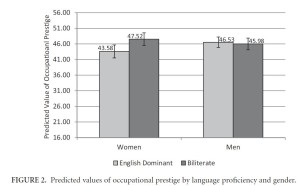
Occupational prestige by gender and bilingual proficiency (Source: Lee & Hatteberg 2015, p. 17)
Boys and girls in the sample were equally likely to be English dominant and limited language proficient. However, there were notable gender differences related to bilingualism: girls were a lot more likely to be biliterate than boys (30% for females vs. 20% for males); but boys were more likely to be fluent oral bilinguals (22% for females vs. 27% for males) and passive bilinguals (9% for females vs. 16% for males).
What does this finding of gendered bilingualism mean for future life chances? Do girls’ higher biliteracy rates translate into higher high school completion rates, higher status occupations and higher incomes? The literature on the multiple benefits of bilingualism – for an overview of the cognitive, educational, and economic benefits of high level bilingual proficiency you can listen to this podcast on the Bilingual Avenue – would lead us to assume so.
Well, it did not quite turn out that way.
The researchers found that biliteracy did indeed do wonders for the high school completion rates of girls: biliterate girls in the sample were five times more likely to complete high school than English dominant girls. However, it did not work this way for boys: the high school completion rates of biliterate boys were almost identical to those of English-dominant boys. What is more, orally and passively bilingual boys were less likely to complete high school than their English dominant peers.
With regard to occupational prestige in young adulthood the findings were similar: biliterate women were significantly more likely to be employed in roles with higher occupational prestige than English-dominant women. Biliterate men, by contrast, were slightly less likely to be employed in roles with high occupational prestige than English-dominant men.
How can bilingualism be advantageous for females but detrimental to males? Surely the cognitive benefits of bilingualism – greater brain plasticity and better executive control – accrue to males and females equally.
The answer to this conundrum is that ‘bilingualism’ does not equal ‘bilingualism.’ The benefits of (high-level) bilingual proficiency are not absolute but social. What is means to be Hispanic in the USA is different for men and women. As the authors point out, “men and women experience race and ethnicity differently and indicators of ethnicity, like language, have different meanings for boys and girls, and for men and women” (Lee and Hatteberg 2015, p. 21).
That bilingualism is gendered is not a new finding (two overview articles about bilingualism and gender research by Aneta Pavlenko and myself are available here and here).
Girls in migrant families often act as language brokers and mediate between their family and mainstream institutions. Maybe such practices socialize them into the ‘feminine’ communicative styles built on cooperation, rapport building, sympathetic listening and showing empathy that are highly valued in contemporary service work, as Deborah Cameron has pointed out in Good to talk? Where such ‘feminine’ communicative styles are valued – as they are in schools and the workplaces of the service economy – it is perhaps not surprising that being able to deploy such styles in more than one language confers advantages.
By contrast, Spanish-speaking boys in the US schools are often stigmatized as trouble makers. For Latino boys and men, speaking Spanish is associated with working-class ‘macho’ styles that are not valued in educational environments nor in occupations that carry conventional prestige. Rather than being advantageous, bilingualism thus becomes a liability for Latino boys and men because it is associated with the ‘wrong’ kinds of masculinity; masculinities neither appreciated by school teachers nor by employers in the tertiary sector.
So, what about income? Does biliteracy pay? At least for the women? Unlike Agirdag (2013), whose research answered this question in the affirmative for participants from a variety of language backgrounds, Lee and Hatteberg (2015) found no relationship between bilingualism, including biliteracy, in English and Spanish, and income.
While surprising at first blush, this finding is really not unexpected. We know that “men have higher incomes than women despite having lower average levels of educational attainment and that the attributes that benefit women in school do not necessarily translate into labor market rewards” (Lee and Hatteberg 2015, p. 19). We also know that middle-class feminized work in education, health care or retail may be relatively prestigious but poorly remunerated compared to equally prestigious jobs in male-dominated industries.
Hispanics’ high-level bilingual proficiency in English and Spanish in the USA may well go the way of nursing and teaching: once it becomes feminized, it may well become ‘respectable’ and ‘prestigious’ but it will also become devalued economically.
 Agirdag, O. (2013). The long-term effects of bilingualism on children of immigration: student bilingualism and future earnings. International Journal of Bilingual Education and Bilingualism, 17(4), 449-464. doi: 10.1080/13670050.2013.816264
Cameron, D. (2000). Good to talk? Living and working in a communication culture. London: Sage.
Lee, J., & Hatteberg, S. (2015). Bilingualism and Status Attainment among Latinos The Sociological Quarterly DOI: 10.1111/tsq.12097
Pavlenko, A., & Piller, I. (2001). New Directions in the Study of Multilingualism, Second Language Learning, and Gender. In A. Pavlenko, A. Blackledge, I. Piller, & M. Teutsch-Dwyer (Eds.), Multilingualism, Second Language Learning and Gender (pp. 17-52). Berlin and New York: Mouton de Gruyter.
Piller, I., & Pavlenko, A. (2007). Globalization, gender, and multilingualism. In H. Decke-Cornill & L. Volkmann (Eds.), Gender Studies and Foreign Language Teaching (pp. 15-30). Tübingen: Narr.

Children of migrant cotton field workers from Oklahoma (Source: Library of Congress)
I’ve just come across a fascinating article about the schooling of migrant children during the Great Depression era in the US West Coast states. The authors, Paul Theobald and Rubén Donato, tell a fascinating tale of the manipulation of schooling as an efficient way to perpetuate class relationships. By comparing two groups of rural migrants the article also offers an illuminating analysis of the intersections of class and ethnicity. The two groups are external migrants from Mexico and internal migrants from the dust bowl of the Great Plains states. The latter group came to be collectively known by the disparaging term ‘Okies,’ and is epitomized by the Joad family in John Steinbeck’s novel The Grapes of Wrath.
In California, schooling for Mexicans had developed in the 19th century in a way that systematically segregated Mexican children although Mexicans were not included in the legal provisions for segregation that applied to Asians, Blacks and Native Americans. In 1920, for instance, eighty percent of all Mexican children attended separate ‘Mexican schools’ or ‘Mexican classrooms.’ The justification for segregation was that Mexican students were ‘problem students’: they were stereotyped as slow learners with a language problem and un-American habits and values. Their racial status was also frequently debated and there were a number of efforts to have Mexicans classified as ‘Indian,’ which would have legalized their segregation.
Efforts to legalize the segregation of Mexicans were never successful and so their segregation was achieved through other means such as the construction of ‘Mexican’ schools, the gerrymandering of school attendance zones, and internal segregation through tracking. Segregation coupled with the irregular attendance of families who were seasonal agricultural workers resulted in very early dropout, and most Mexican children left school without having learnt how to read and write.

‘Fruit tramp’ family from Texas, 1935 (Source: Library of Congress)
In the early 1930s around 250,000 Mexicans, including US citizens, were deported to Mexico. This created a labor void, which desperate dust bowl migrants were eager to fill. Like Mexicans, Okies were despised because of their poverty and the burden they were seen to place on the taxpayer. In contrast to Mexicans, there was no readily-available ideology that would justify their segregation: they were white and English-speaking.
Okies disrupted the logic of agricultural work and segregation in California because here were white Americans doing ‘non-white’ work. This meant that the ‘inferior’ ethnicity of agricultural workers could no longer be used to justify their low wages and abominable working conditions. Theoretically, there were two options to deal with this dilemma:
Either the conditions and circumstances of agricultural labor would have to improve to meet white standards, or the Okies would have to be shown to be as inferior as Mexican migrants. Regrettably, there was (and is) no place like school for defining inferiority. (Theobald & Donato 1990, p. 34)
Although race and language were not available as rationales for segregation, the low quality of schooling in Arkansas, Oklahoma and Texas was. A 1939 survey found that ten percent of Okie migrant children were as far as four years behind their non-mobile Californian peers. Another twenty percent were three years behind and forty percent were two years behind. As a result school authorities felt compelled to institute ‘special’ classes for Okie children.
The result was the same as it was for Mexican children: poor attendance, early drop-out and dismal outcomes. A contemporary account explains the inferiority complex schooling instilled in Okie children:
Year by year, as they grow older, the embarrassment of their ignorance increases; held back sometimes four and five grades, when they enter new schools tall youths of 13 are out of place in classes with small-fry of 7. Bashful at their own backwardness and ashamed of their clothes or “foreign” accent, they stand out as easy targets for the venomed barbs of their richer and settled schoolmates. “He’s from the country camp, that’s what they said of my child on the school ground. Don’t you see how it hurts?” one transient mother explained. (Quoted in Theobald & Donato 1990, p. 35)

Okie child camping in Imperial Valley, California (Source: Library of Congress)
That the low quality of schooling in Arkansas, Oklahoma and Texas was nothing but a pretext for segregation is most apparent from the experience of children from the states of the northern Plains. Dust bowl migrants from the Dakotas entered predominantly Oregon and Washington. These two states had no history of segregation because agriculture was not yet industrialized and therefore there were few Mexican (or Asian) agricultural workers. Furthermore, the schooling system in the Dakotas was superior to that of Oregon and Washington. Even so, segregated schooling for Okie children developed in the Pacific Northwest, too.
The authors conclude that schooling during the period was designed to perpetuate the subordination of agricultural labor. When language and ethnicity fell away as ways to legitimize the processing of Mexican children into cheap labor, other legitimation strategies such as ‘educational backwardness’ were found.
It is also worth noting that the animosity towards Mexicans and Okies during the Great Depression was justified with their poverty, with the fact that they were a drain on the public purse. However, the segregated schooling instituted for these two groups was a more expensive educational option than integration would have been. Segregation involved the provision of separate buildings and the hiring of extra teachers.
If the maintenance of a docile, inexpensive labor system required social distance between the children of property owners and the children of harvest laborers, then a slightly inflated budget at the local school was, seemingly, a small price to pay. (Theobald & Donato 1990, p. 36)
It is also instructive to consider what happened after the Great Depression and the Second World War: Okies were integrated into the mainstream and took up jobs in production and industry. In fact, today even the term ‘Okie’ itself has disappeared as a social category. By contrast, Mexicans were forced back into agriculture and segregated schooling for Mexicans continued into the 1960s.

California pea pickers returning to camp after a day’s work in the field, near Santa Clara, California (Source: Library of Congress)
The class position of Okies took precedence over ethnicity during a time of economic crisis. However, when the crisis was over, Okies were not barred from class mobility in the same way that Mexicans were. This means that class in the United States is most restrictive when it is defined by ethnicity. But in whichever way class is circumscribed, schooling plays a crucial role in legitimizing class inequality because the basic principles of school finance, educational objectives and student evaluation are defined by those in power.
The authors conclude by asking what the enduring lessons of migrant schooling during the Great Depression might be:
Rural schools can either play the traditional role of agent in the solution of the legitimation crisis of the state, or they can begin to work to expose the unethical nature of America’s treatment of the countryside. (Theobald & Donato 1990, p. 43)
Theobald, P., & Donato, R. (1990). Children of the harvest: The schooling of dust bowl and Mexican migrants during the depression era Peabody Journal of Education, 67 (4), 29-45 DOI: 10.1080/01619569009538699

A locutorio shop front in Barcelona (Source: El Periodico)
There is now a well-established body of work exploring the language work provided by service workers in call centres and tourist businesses. By contrast, the multilingual language work provided by migrants for migrants in multiethnic service enterprises has rarely been the focus of sociolinguistic attention. A recent book by Maria Sabaté i Dalmau, Migrant Communication Enterprises published by Multilingual Matters, fills this gap with an ethnographic inquiry into the language practices in a locutorio, a call shop, in Barcelona. A locutorio offers all kinds of telecommunication services such as billed calls in booths, the sale of top-ups for mobiles, fax services, internet access and international money transfers.
The locutorio the research is based on also served as meeting point for working class Spaniards and migrants, both documented and undocumented, from a variety of countries of origin. Beyond the sale of telecommunication services, the locutorio thus provided access to information, a place to hang out and it even served as the ‘public’ toilet for homeless people in the neighbourhood, mostly undocumented men from West Africa.
The locutorio was part of a chain of similar call shops owned by a Pakistani venture capitalist whose aim was to make a profit rather than provide social services for Barcelona’s marginalized. It was his employee Naeem, who was in charge of running the locutorio, who ended up caught between more than one rock and more than one hard place. Naeem was a fellow Pakistani hired by the owner in Pakistan two years before the fieldwork began. Naeem’s position was legal as a temporary resident but in order to achieve permanent residency in Spain he needed another two years of proven work, which left him vulnerable to exploitation by the owner. He worked twelve hours per day, seven days a week, for a meagre salary of less than Euro 800 per month. Naeem’s job consisted of opening the locutorio in the morning and closing it at night. He would start with booting up the computers and getting all the equipment to run. During the day, his duties consisted of assisting and charging customers, and making various phone calls (to his boss; to call card distributors; to the money transfer agency etc.). Additionally, he was in charge of maintaining the premises, including sweeping the floors, removing garbage and cleaning the toilets.
Much of this work is obviously language work and Naeem had to operate in a complex sociolinguistic environment. In addition to a range of varieties of Spanish – from Standard Peninsular Spanish via various Latin American varieties to a range of second language varieties – this included Catalan, English, Urdu, Punjabi, and Moroccan Arabic in various spoken and written constellations and used by clients with variable levels of proficiencies, including proficiencies in the use of telecommunication services. In this highly diverse environment, communication was rigidly regimented by the meters on the machine where communication was paid for by the minute.
Unsurprisingly, misunderstandings and communication break-downs were common. On top of all that, Naeem had to deal with customers who tried to cheat him (the balance of each financial irregularity was deducted from his meagre salary) and who abused and insulted him. Working in a highly constrained yet super-diverse environment left little room for personal autonomy and, only in his late twenties, Naeem was suffering from eating disorders, compulsive smoking, chronic fatigue and anxiety attacks.
The researcher concludes that locutorio language workers constitute “a voiceless army of multilingual mediators” (p. 170) whose multilingualism is not only a site of language work but also a site of linguistic exploitation.
Migrant Communication Enterprises offers a rich migrant-centred ethnographic account of a prototypical enterprise of the 21st century. If this blog post has piqued your interest and this is your area of research expertise, you might want to review the book for Multilingua. If so, please get in touch with a short description of your expertise.
Maria Sabaté i Dalmau (2014). Migrant Communication Enterprises: Regimentation and Resistance Multilingual Matters

Schneider, Britta. 2014. Salsa, Language and Transnationalism. Multilingual Matters.
In my post on English in Berlin, I wondered what is required for a language to become ‘local’, and about the perhaps problematic tradition of defining languages on the basis of territory. Although it has been quite some time since English was primarily the language of the English people in England, the language is still called ‘English’. (Interestingly, the etymology of the term is also from ‘somewhere else’, deriving from northern Germany, and thus already has a history of being on the move.) When do Englishes become ‘native’? And if we continue to tacitly invoke concepts based on confined spaces (‘England’), whose interests remain veiled under national frameworks and are therefore invisible?
My own interest in what happens to moving languages in a world where rootedness in territory and local community cannot be taken for granted not only made me wonder about the status of English in Berlin, but brought me to places where movement literally takes centre stage. Concerned that essentialist conceptions of language and identity may represent a form of symbolic violence – telling people what they are supposed to speak and identify with on the grounds of their ethnic heritage – I became interested in communities where people identify with a language that is not ‘theirs’. The example I chose was communities of practice constituted by salsa dance in countries outside of Latin America. Depending on the particular salsa style, many salsa dancers in these multi-ethnic communities, irrespective of their ethnic origin, learn and/or use Spanish. The number of Spanish speakers, non-native and native, and the competence of language learners can be quite astonishing. Wondering about the reasons for this, I conducted ethnographic field-work in salsa communities in Frankfurt, Germany, and Sydney, Australia, studying the role of the Spanish language and ethnicity as boundary markers, and the symbolic functions of language and bilingualism in these transnational contexts (you can read more about the study in my new book Salsa, Language and Transnationalism).
What I wanted to know was why people engage in such a time-consuming activity as learning a language, and what this has to do with a passion for Latin dance. It is certainly not because they are striving to become ethnically Latin that German, Australian and other Salsa dancers speak Spanish. Instead of applying a national framework of thought that takes nations, ethnic groups and ‘their’ languages as a starting point, I wanted to find out which other concepts and discourses have the potential to inform language choice and linguistic identification. This generated the idea that language may be constituted differently in non-national, non-ethnic contexts.
To summarise my research conclusions in a nutshell, the existing discourses on language (or language ideologies) are often characterised by what I would call ‘cosmopolitan’ forms of identity. Being able to speak several languages – in this case English or German and Spanish – can index membership to an economically and socially advantaged, mobile and educated group that is oriented towards transnational spheres. At the same time, stereotypical discourses on what it means to be ‘Latin’ – being ‘open-minded’, being ‘passionate’, ‘preferring friendship to money’ – are also important in understanding what makes people use their Salsa classes to practise Spanish at the same time. Interestingly, therefore, while a transnational discourse does exist in an orientation beyond local/national confines, national concepts of ethnicity and language are reproduced and are somehow also necessary for constructing the ‘transnational’ (Hannerz (1996) makes similar observations). I concluded that, at the end of the day, languages still signify ethnic or national groups, but this relationship can be appropriated differently and symbolically exploited in multiple fashions in transnational contexts.
Many of the questions I had remain unanswered. For example, I am still not sure on what grounds we are entitled to make languages our own, or at what point we begin to consider someone to be an acceptable – ‘real’ – member of a speech community. It seems that ethnic heritage still plays a crucial role here. Also, what happens to the systemic notion of ‘a language’ if verbal practices do not index a particular group? Is the idea of language as a system brought into question if groups that are fluid and not tied to particular territories are established? In other words, being aware of the sociolinguistic commonplace that ‘a language’ is ‘a dialect with an army and a navy’ (Weinreich 1945), and cannot be established on linguistic grounds alone, what happens if we are not so sure whose ‘army’ and whose ‘navy’ we are talking about as people start to develop social relationships and patterns of identification that go beyond their territorial confines?
National armies and navies continue to be important. At the same time, cultural and discursive norms are increasingly shaped by non-national structures (see also Sennet 2006), which, however, make use of, are co-constructed by and are dialectically interwoven with national languages, discourses, bureaucracies, armies and navies. It is certainly not easy to grasp these intricacies, but it is a worthwhile assumption that moving languages, identities and bodies do not simply carry with them their national symbolic load but are part of a global world order that will require new linguistic theories and methodologies.
References
Hannerz, Ulf. 1996. “Cosmopolitans and Locals in World Culture.” In: Hannerz, Ulf, Transnational Connections. Culture, People, Places. London: Routledge. 102-111.
Schneider, Britta (2014). Salsa, Language and Transnationalism Bristol: Multilingual Matters.
Sennett, Richard. 2006. The Culture of the New Capitalism. New Haven: Yale University Press.
Weinreich, Max 1945. “Yivo and the Problems of Our Time.” YIVO Bletter 25: 3-18.
]]>
The challenges of providing equitable services in linguistically diverse societies
A few years ago, emergency service provision to speakers of languages other than English in Australia came under scrutiny when an Afghan woman tried to call the police but did not receive any assistance a few days before she was murdered by her husband. The domestic violence victim called 000 – the national telephone emergency service – twice but, in both cases, she hung up before the operator could bring a telephone interpreter into the conversation. The trial judge was scathing of multilingual service provision in her sentencing:
Then on 1 November 2007 your wife made two calls to triple 000 in the early hours of the morning seeking police assistance. It is most unfortunate and an indictment on our society that no assistance was forthcoming, as a result of a very disappointing reaction by the telephone operator, to your wife’s inability to speak English, in anything other than a broken English manner. (“R V Azizi,” 2010, p. §11)
Providing emergency services in linguistically heterogeneous environments is not an easy task. In Australia, as elsewhere, calls from callers who cannot make themselves understood in English are re-routed to the national telephone interpreter service. Negotiating for an interpreter service and then waiting for the interpreter to come online in an emergency is time-consuming and stressful. As Raymond (2014) found in a study of Spanish calls to the US emergency telephone service, sending a call through to the telephone interpreting service more than doubled the response time and thus was often resisted by the operator because that additional time could make the difference between life and death in an acute emergency.
Given the time it takes to re-route an emergency call through the telephone interpreting service, it is perhaps not surprising that the domestic violence victim mentioned above became impatient or was forced to abandon her call for help before she could actually communicate with the police. What is surprising is that no attempt was made to call her back and no police car was dispatched to her place of residence despite her two failed attempts to call emergency services.
Domestic violence is a well-recognized problem in Australia and there is a network of formal support services available to women who find themselves in danger. However, these formal support services operate exclusively in English and gaining access in another language remains difficult. As an examination of the barriers faced by migrant women in accessing legal services in NSW put it, persons who do not speak English well in Australia are “a long way from equal.” Cases like these challenge us to rethink linguistic arrangements in linguistically diverse contexts in order to make access to emergency services – and social services more generally – more equitable. It may be tempting to think that this is too tall an order and that ensuring equitable access in any language other than the nationally dominant language is too difficult.
Not so! In the above-mentioned study of Spanish-language calls in the USA, transfer of a Spanish-speaking caller to the telephone interpreting service almost doubled the response time and thus was highly inefficient. However, the situation was different in cases where bilingual operators were available in the same call center. In such cases, a Spanish emergency call was immediately transferred to a bilingual operator and the response time was virtually unaffected. So, a way to provide effective multilingual services would be to hire multilingual telephone operators who can handle calls in the dominant language and one or more other languages.
Now here is the rub: in the city where the researcher recorded the bulk of his data no single bilingual operator who spoke Spanish was on the staff. When one knows about the demographic profile of that city, the absence of English-Spanish bilingual emergency telephone operators becomes almost unbelievable: the city where the research took place is located in the US Southwest and at the time of data collection in 2010 more than 50% of the city’s population were of Hispanic/Latino origin. This information turns the assumption that monolingual emergency services are natural and normal on its head: only employing monolingual English-speaking emergency telephone operators in such a bilingual context almost seems perversely designed to prevent fair and equitable access. I am not for a moment suggesting that monolingual emergency services are the result of some sort of conspiracy. They are not. They are an expression of our collective failure of imagination: a failure to recognize that linguistic diversity poses an equity problem and a failure to imagine that we can change our social linguistic arrangements in ways that make them more equitable and just.
Raymond, Chase Wesley (2014). Negotiating Entitlement to Language: Calling 911 without English
Language in Society, 43 (1), 33-59 DOI: 10.1017/S0047404513000869

English-Only Australia? (Source: blogs.crikey.com.au)
In recent Australian political conversation, there is an increasingly bipartisan recognition of the value of cultural and linguistic diversity. So it’s fair to ask, what is Australian society offering those whom it characterises as “diverse”? As far as being multilingual goes, it seems highly skilled, highly educated migrants still experience it as a negative rather than something that is highly valued. Below I briefly discuss the cases of two such women who I interviewed as part of my doctoral research into linguistic intermarriage in Australia.
The wrong accent
“’Scuse the recording but I fuck it up so many times with my accent [laughs] … it’s years after and I still muck it up in terms of accent sometimes.” (Sara)
Sara (all names are pseudonyms) is a trilingual professional from Spain who has worked in Australia for over ten years. Despite her high level proficiency in English, her accent shapes people’s views of her as an exotic foreigner. Sara is well aware of the stereotypes her accent evokes and she talks about using them to her own advantage to connect with people by putting them off their guard and playing up to stereotypes about the European who talks with her hands.
Yet despite all this she still feels that she doesn’t get it right sometimes, and that she should mention this to me in the interview. Why? At what point will she get to “own” English and her way of using it? When does the linguistic privilege of an English speaker rub off on someone who has clearly mastered the language in so many domains?
The wrong language
“It’s my right to speak Chinese mate!” (Jessie)
Jessie is another professional who completed her Masters in Australia, worked in Shanghai for many years for a multinational company and now works in the finance sector in Australia. Like Sara she is a highly balanced bilingual. It is perhaps not surprising then that she was offended when she experienced the kind of policing which is part of linguistic privilege. A colleague in Australia, herself an adult migrant from a non-English speaking background, criticised her for speaking Mandarin socially at work. In fact, she exhorted her to “speak English!”, putting herself in the linguistically privileged position and making Jessie the foreigner who doesn’t know the rules. As Jessie said to me in the interview, it can feel strange or artificial to speak another language with someone you know shares the same linguistic and cultural background as you. Jessie is granted none of the privileges associated with being a “native” English speaker and is a target for criticism for the way she speaks even during her own personal time.
Rather than being a plus, it seems that being a speaker of accented English in Australia is often a minus. Minus linguistic privilege and minus social power, it’s all about what you are not, rather than what you are.
Multilingualism at work
“… and so I just realised I did not want to be the ethnic in the ethnic team, and so I went from that position to the most boring dry … policy officer in the most boring department. Middle-aged white fat women, just because I thought otherwise I’m gonna be always ethnic, ethnic, ethnic.” (Sara)
It is often argued that speaking many languages will lead to better job opportunities. I asked both women about their experience working in Sydney. Had their language skills, particularly their multilingualism, been useful to them? Neither of them found that speaking Spanish or Mandarin had helped them in their careers. In fact, for Sara coming from a language background other than English meant she was stuck in a career pathway which was limited to what she called “ethnic” roles in the public service. For Jessie, speaking Mandarin did help her with customers at a Sydney branch, but that work was largely invisible to her employers. Both women talked about how they got out of roles they felt limited them professionally. Even where multilingualism was useful, as it sometimes is in customer service in a diverse society, this value was not recognized by the organization nor was it remunerated.
Multilingualism at home
“For me I feel like I uh I s-, I don’t have a choice as such that I would like to, Louis to be able to speak Chinese and English or I would like Louis to speak English only, I don’t have a choice because my parents they can’t speak English, so Louis has to speak Chinese otherwise they can’t communicate with Louis and I’m in big trouble then so (laughs).” (Jessie, talking about her son Louis)
It is easy to see why some parents might be ambivalent about the often expressed and casual exhortation to raise their children bilingually when they experience their own linguistic repertoire in such contradictory and often negative ways. Like Jessie, for many parents it may be more about personal relationships than about any notion of global citizenhood that they want to raise their children in two (or more) languages. Even when multilinguals are highly proficient language users and better educated than ninety per cent of qualified Sydney residents (based on Australian Bureau of Statistics 2012), they still experience language anxiety and discrimination on the basis of language. Given that bilingual child rearing is incredibly hard work, and even more so if you are the only parent who speaks that language and you have no institutional support, it may not seem such an obvious proposition.
As long as diversity is seen to be the province of those who are outside the mainstream people like Sara and Jessie will bear the burden of living within the contradictory celebration of diversity on the one hand and the lack of social recognition of the value and experience of multilingualism on the other. This is the double burden of multilingualism in Australia today. However you look at it, it is not as simple as having something that the majority do not. It may be a richer experience of communication, even a more diverse and complex experience of life but it can also be a burden that is no less heavy for being invisible to those who do not share it.
Reference
Australian Bureau of Statistics (2012). “2011 Census of Population and Housing: Basic Community Profile (Catalogue number 2001.0) Sydney (1030) 4063.7 sq Kms.”
]]>

The Omidvar brothers on the road: amazing feats of discovery and language learning?
In his most recent round of interviews with the magazine Særzæmin-e Mæn (“My Country”), Issa Omidvar, one of the two adventurous Iranian brothers who undertook a 10-year motorbike journey across the world (1954-1964), shares details of how he and his brother learned English and Spanish, the two languages they needed most for their long journey. Before they left Iran in 1954 they barely knew any foreign languages, so they took some English courses and managed to learn the language in less than three months.
After they set foot on Mexican soil, they learned Spanish, a language they did not know even a single word of. Issa Omidvar claims that, in two weeks, they were both fluent in Spanish and had no difficulty communicating with Mexicans, who went out of their way to welcome them to their country. He goes on to relate that after a month, they were even able to deliver lectures in Spanish for their enthusiastic hosts:
روزی که قدم به مکزیک گذاشتیم زبانشان را نمی دانستیم. اما در عرض پانزده روز توانستیم به زبانشان صحبت کنیم. ما حتی بعد از یک ماه توانستیم به اسپانیایی کنفرانس بدهیم.
[The day we set foot on Mexican soil we didn’t know their language. But within 15 days we could speak their language. We were even able to hold talks in Spanish after a month.]
Issa Omidvar does not share any details about their language learning methods and his account of the brothers’ language learning feats is certainly impressive. But is it really true?
We know for a fact that most language learners take much more than ‘two weeks’ to achieve even a modest level of conversational fluency. Yet, we should not dismiss Issa’s account as an exaggeration. Therefore, we need to ask ourselves as language educators faced with students who usually take years to achieve substantial proficiency, what can we learn from the Omidvar brothers’ account?
The situation described by Issa Omidvar seems to include crucial components of successful language learning: they were young and talented and they had a communicative need:
چون هم جوان و مستعد بودیم و هم واقعا احتیاج داشتیم.
[The reason is that we were both young and talented and we were really in need of the language.]
Reading carefully between the lines, one would be able to establish how imperative their ‘need’ must have been. They made documentaries on the road and held impromptu screenings in universities, halls and arts centers. They needed to know the language of the locals in order to charge an entrance fee and thus finance the next leg of their trip!
Examples of the kind of language learning described by Issa Omidvar can easily be found today. The Fluentin3Months website, for example, whose “language hacking tips” are provided by an alleged polyglot, promotes a more or less similar language learning experience. The first and foremost question that readers have when they arrive on the website is how is it really possible to achieve fluency in three months (or actually much less)? The website features interviews with people who claim to have reached conversational fluency in a language in three months or less, “thanks to a combination of passion for the language, full time immersion, and a general good knack for learning it.”
What this ‘knack’ entails is not usually revealed unless you buy one of their language learning packages. At the same time, one must not lose sight of the fact that this type of language learning, however effective it is claimed to be, is not for those who want to get an A in their language class, nor is it for those who want to learn a language to take an academic test, to write perfectly, to pass a class, or to use grammar appropriately.
If you need a language to use it in academic or professional contexts at any level of complexity, it seems unlikely that there is a way around learning a language the hard way.
]]>