
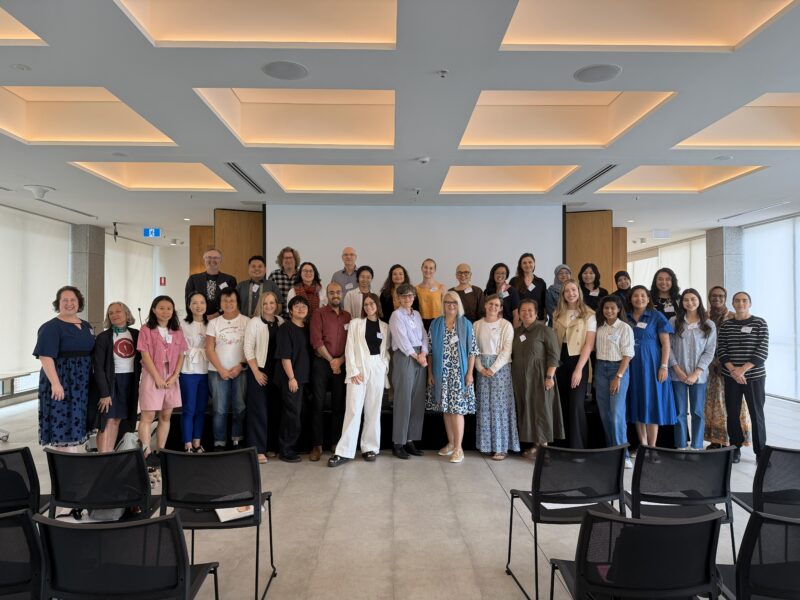
Group photo, New Technologies in Intercultural Communication Symposium (Image credit: Language on the Move)
On a crack-of-dawn flight early Monday morning last week, I flew to Sydney for the day to attend “New Technologies in Intercultural Communication“, a symposium hosted by the Language on the Move Team at Macquarie University.
The presentations explored intercultural communication ranging from the use of digital technologies by elderly migrants and their families (Dr Earvin Charles B. Cabalquinto), GenAI as digital shadow care support by international students (Dr Julia Kantek and Dr Thilakshi Mallawa Arachchi), language learning tools by transnational parents for heritage language maintenance (Dr Ana Sofia Bruzon), learning technologies in primary science classrooms in Australia and Korea (Dr Hye-Eun Chu), and social media in language learning (Dr Yeong-Ju Lee). And to think the new technology promising proficiency and fluency “back in my day” (I find myself relating to a joke Professor Piller made about technological development) relied on cassette tapes at the language lab!
The symposium showcased a fascinating catalogue of digital technologies enabling intercultural communication. We heard about high school students in an Australian classroom connecting with Korean students to hypothesize why the seasons differ between their two countries. We heard of transnational parents employing creative ways to encourage their children to connect to their heritage languages, especially to communicate with family members. It was also intriguing to hear how social media platforms such as Tiktok offer features such as “duet”, creating opportunities for speakers of different languages to collaborate and co-construct meaning.
While we heard of these novel and exciting ways technology can be used to enhance intercultural communication, each presenter emphasized the human element in communication. I could not help but think about how language learning tends to be marketed as fun, brain-boosting, or career-enhancing. And yet, language in human relationships is messy, and missteps happen! Even so, whether you already speak the language or are learning an additional one, I believe empathy and deeper understanding are borne out of the struggle to communicate and truly connect with each other.
The most striking point for me was that some uses of technology actually stem from institutional failures or social exclusion, leaving the vulnerable members of our society even more marginalized. Earvin reminded us that although much of the discussion seems to be on the importance of digital literacy skills, many still lack basic access to technological infrastructure that we often take for granted in urban Australia. Julia and Thilakshi’s presentation highlighted the isolation that international students experience, turning to GenAI for immediate advice on legal matters, polishing their resumes, or easing homesickness. Ana pointed to multilingual parents’ struggles of heritage language maintenance in the face of pervasive monolingual mindset across Australian schooling and public discourse.
As I flew back to Brisbane that evening, reflecting on the presentations, discussion questions, and conversations I had with fellow attendees strengthened my resolve to keep pushing for equity in language learning and digital access.
We need to keep asking: How do we use technology for intercultural communication? Who gets left out? And how can we keep working towards digital and social inclusion?
I want to thank UQ School of Education for making it possible for me to attend the symposium, and to Distinguished Professor Ingrid Piller, Dr Loy Lising, Dr Ana Sofia Bruzon and the Language on the Move team for bringing together a rich program and creating the opportunity to hear from and exchange ideas with other scholars.

 This work is licensed under a