
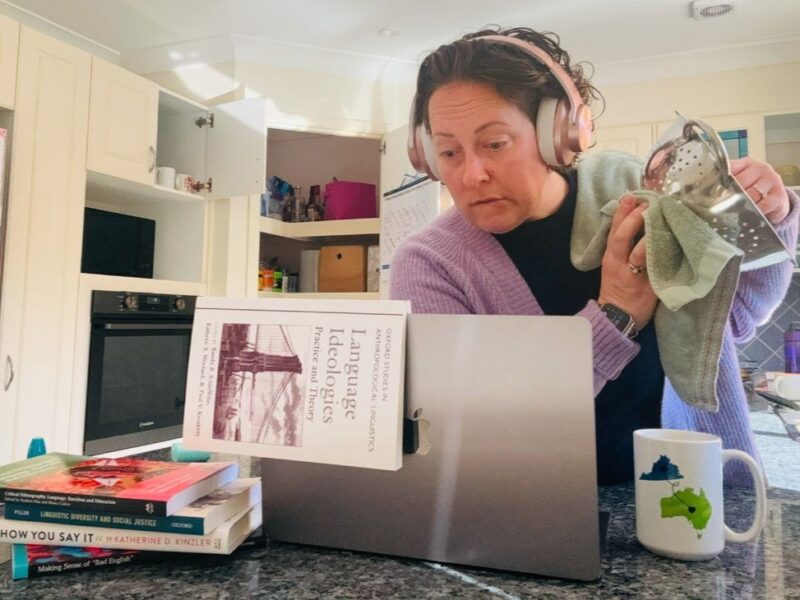
Being an academic mom has given Brynn a huge head start when it comes to managing her supervisors (Image credit: Brynn Quick)
You know that feeling you get in your stomach when you’ve climbed to the top of a rollercoaster, and you look down to see that first huge drop that’s rapidly approaching? That’s exactly what it can feel like to be at the beginning of your PhD. You have a vague idea about the direction that the rollercoaster track will take, but you also know that there will probably be twists, turns and loops (plus some screams and tears) that you can’t anticipate yet.
So, let’s talk about how to make that PhD rollercoaster ride as smooth as possible while also acknowledging that some upside-down moments are inevitable.
One of the most crucial elements of your PhD is your relationship with your supervisor. We’ve all heard the horror stories (The Thesis Whisperer Professor Inger Mewburn has compiled many!). Some PhD students experience bullying, harassment and outright abuse from their supervisors. We all want to avoid a toxic supervisor/student relationship, so it’s vital that every PhD student has a firm idea of how to build and maintain a partnership of trust with their supervisor.
I’m very lucky to have three fabulous supervisors on my team (Distinguished Professor Ingrid Piller is my primary supervisor, and Dr. Hanna Torsh and Dr. Loy Lising are my associates). Recently, Ingrid asked me to talk to other members of our research group about how I “manage” my supervisors while I conduct my research.
In response, I created a slideshow with key principles. What I realised by examining my own management processes was that I hold two principles to be most important:
- Explicitly discuss your expectations of your supervisor, and your supervisor’s expectations of you.
- Honour your supervisor’s time, and they will honour yours.
Let’s talk about these in more detail.
Setting Expectations
We’ve all heard about how communicating clear and mutually-agreed-upon expectations in marriages can lead to healthy partnerships, but many of these same communication principles also apply to working (and therefore, supervisor/supervisee) relationships.
You might send your supervisor a thesis chapter that you’ve just written, and you may assume that they will be able to email you with feedback within a week. However, what you might not know is that your supervisor is also writing their own research paper, preparing a lecture, working on a grant application and getting ready to present at a conference in two weeks.
Therefore, it’s incredibly important that you ask about expectations when you send that chapter. In your email with your thesis chapter, tell your supervisor how many pages (or words) you are sending. Tell them if it’s a first draft, a ninth draft, which changes you have highlighted, what uncertainties you have, etc. Explicitly tell them what task you will work on while you are waiting for their feedback (supervisors love productivity!).
Ask them what date will work with their busy schedules for you to expect feedback by, then trust that they will get back to you by that date. In clearly and explicitly communicating an expectation, you both avoid assuming that the other person has the same expectation that you do, and that reduces the chances of a big misunderstanding down the track.
Another element of setting expectations includes setting and managing expectations of yourself as the PhD student. During our undergraduate and even master’s by coursework degrees, it is often the professor or lecturer who is acting in the role of “manager”. They set reading tasks, and we do them. They assign a 4,000-word essay, and we write it. They tell us to be in class at 8:00am for a final exam, and we sleepily show up with an extra-large coffee. In these degrees, we get used to being told how to successfully be a student. As long as we follow directions, we will probably succeed.
During a research-based degree like a PhD, however, suddenly we become the managers, and this can be whiplash-inducing. Many of us have never had that type of teacher/student relationship before, so we have to learn quickly how to take the lead. This means acting as our own boss in one way – setting daily tasks for ourselves, tracking our own progress, troubleshooting, working towards both external and self-imposed deadlines, etc.
But at the same time, we have to be ready to adapt to expectations that our supervisor has of us and our work. This can be tough when we do eventually get used to being our own boss and managing our own work by ourselves for weeks at a time. This is exactly where clear communication comes into play. Begin and maintain your working relationship with your supervisor from a foundation of honesty and open conversations. If you both respectfully and clearly communicate expectations with each other, the PhD rollercoaster ride will have far fewer stomach-turning drops.
Honouring Time
Time is simultaneously something that we feel like we have far too much of and far too little of during a PhD. The idea of writing for literal years sometimes makes me want to curl into a ball, but also having “only” a few years to complete a PhD feels like a panic attack-inducing Herculean task. But do you know who else has a rough relationship with time? Your supervisor.
Like I said before, they might be teaching/researching/writing/lecturing while supervising. I myself teach every other semester, and doing that while researching (and let’s not even talk about trying to balance family life and parenting in that schedule somewhere!) can be exhausting. So, I honestly don’t know how my supervisors do all that they do in the limited time they have.
Therefore, I try as best I can to honour their time. This means that I keep my emails to them as organised and concise as possible. I come up with agendas for our supervision meetings and take notes during said meetings. Then I make sure to highlight any actionable items that we discussed, and I send the meeting notes to them with a summary of what actions each person has agreed to take by the next time we meet. I also try to figure out as much of the bureaucratic work that is involved in a PhD that I can before involving them (no but seriously, there is SO MUCH bureaucracy).
I have found that by taking these steps to be as proactive as possible and be mindful of my supervisors’ time constraints, they have been reciprocally mindful of mine.
Conclusion: We Can Make the PhD Rollercoaster Ride an Enjoyable One
I’m what we euphemistically call a “mature age student” (I just turned 40 a few weeks ago!). That is to say that this isn’t my first rodeo – I completed my bachelor’s degree in 2007 and was in the workforce and busy raising kids until re-entering academia in 2019. I think that, because of my age and life experiences, I have a unique perspective on the PhD process and working relationships. I truly believe that mutual respect and open communication between supervisors and supervisees is what will make this rollercoaster ride as easy as possible.
If you are on your own PhD rollercoaster, I hope that reading this post will give you the confidence to put “managing up” policies into practice. May your rollercoaster ride be as smooth as possible, and I hope you get to eat some fairy floss after it’s over.



 This work is licensed under a
Thanks Brynn! I’ve loved this post since you first published it and have now added it is a learning resource for the LLM research topic and Law Honours programmes that I coordinate at the University of New England.
So well put, Brynn. Clear communication and respect for time — you got those two essentials spot on! This piece is worth sharing to graduate students across the globe. It’s true everywhere!