

“Read – Learn – Grow – Be Kind” – this street library says it all (Image credit: Language on the Move)
The Language-on-the-Move Reading Challenge 2026 is out!
Now in its ninth year, the goals of our reading challenge have remained broadly unchanged since 2018: to encourage reading in the discipline and beyond, and to make linguistics reading fun.
These goals have become even more relevant, due to two converging trends:
On the one hand, book reading is in freefall internationally while, on the other hand, screen time is rising exponentially.
If you think this is just a case of one medium replacing another, you are unfortunately mistaken.
In its most prevalent form – social media use – screen time has negative effects on our ability to concentrate, to think deeply and critically, and to develop empathy. These negative effects are now so widely felt that their popular designation “brain rot” was selected as the Oxford Word of the Year 2024.
Book reading, by contrast, is the antidote to brain rot. Book reading challenges us to concentrate and to deeply engage with an extended argument or a narrative universe.
To train your brain you need to read long form. You can’t outsource your reading to AI-generated summaries, either.
Furthermore, many of our readers are (aspiring) researchers and Stephen King’s advice in On Writing is valid in our profession, too:
If you don’t have time to read, you don’t have the time (or the tools) to write. Simple as that.
The Language-on-the-Move Reading Challenge is here for you develop, enjoy and extend the habits and pleasures of reading, particularly in the field of linguistic diversity and social participation. For each month of 2026, we are suggesting a category and one of our team members offers a recommendation in that category.
Enjoy and feel free to add your own recommendations in the “Comments” section below.
And don’t forget that, in addition to the categories and recommendations suggested here, the Language-on-the-Move Podcast will also continue to bring you regular reading ideas in 2026.
 Happy Reading!
Previous Language-on-the-Move Reading Challenges
- Language on the Move Reading Challenge 2025
- Language on the Move Reading Challenge 2024
- Language on the Move Reading Challenge 2023
- Language on the Move Reading Challenge 2022
- Language on the Move Reading Challenge 2021
- Language on the Move Reading Challenge 2020
- Language on the Move Reading Challenge 2019
- Language on the Move Reading Challenge 2018
January: a book about new technologies in intercultural communication
Recommendation: Cabalquinto, E. C. B. (2022). (Im)mobile Homes: Family Life at a Distance in the Age of Mobile Media. Oxford University Press.
Earvin’s presentation about the myth of digital inclusion of older migrants in Australia was one of the highlights of our recent symposium devoted to “New technologies in intercultural communication.”
Whether you missed out on the symposium or want to deepen your engagement with Earvin’s work, (Im)mobile Homes offers a gripping exploration of the use of smartphones, social media, and apps in the family and care practices of transnational families. (Ingrid Piller)
February: a book about settler colonialism
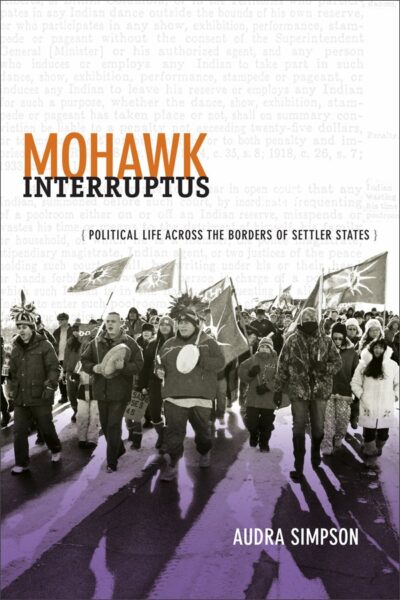 Recommendation: Simpson, A. (2014). Mohawk Interruptus: Political Life Across the Borders of Settler States. Duke University Press.
This book completely reshaped my understanding of Indigenous politics, border, nation, and sovereignty in North America. It also made me reflect on my reliance on the extensive literature on Indigenous cultures and languages – ritual speech, performances, tales, or beliefs – produced over the last century by anthropologists and linguists, most of which are dismissive of the scene of dispossession, the complicated history of places, or simply what people say about themselves and their struggles. (Gegentuul Baioud)
March: a book stirs that your social imagination
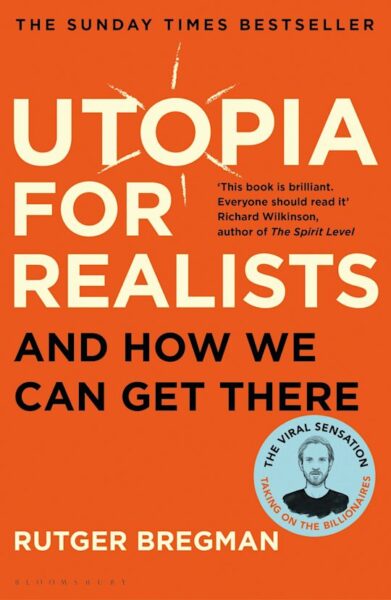
Recommendation: Bregman, R. (2017). Utopia for realists. Bloomsbury.
In this book, Rutger Bregman stirs our imagination by inviting us to re-think the way modern society is organized and by offering us a glimpse into a potentially better future for all. He calls for a new vision that would more effectively address current global challenges such as increasing inequalities or the progressing automation of labor.
But what does he exactly propose?
In short, a 15-hour work week, universal basic income and open borders. The author invites you on a journey between time and spaces with real examples of communities that have taken utopia seriously and have started to experiment with it. (Olga Vlasova)
April: A book about the philosophy of language
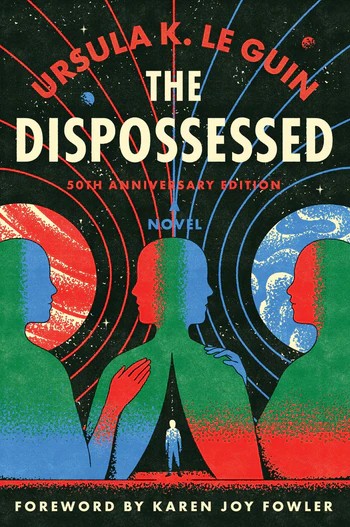 Recommendation: Le Guin, U. (1974). The Dispossessed. HarperCollins.
Le Guin constantly fluctuates the reader´s receptors between the old and the new, roots and progress, personal and professional, politics and philosophy. We follow the life and work of a physicist who travels back and forth between two historically connected but contrasting planets and political systems.
The protagonist commits to seeking the truth not only by understanding his own context of origin but also by defying it; how do we find our truth? And is it ever objective? The novel is considered a post-feminist utopian fiction raising discussions on whether linguistic innovation is necessary for conceptual change.
A story of intergalactic migration trying to answer the long-standing question: to whom does knowledge belong? (Mara Kyrou)
May: A book about the experience of growing up as the child of a migrant
Recommendation 1: Vuong, O. (2019). On Earth We’re Briefly Gorgeous. Penguin.
Vietnamese-American history, language, and generational trauma come together in the form of a poetic letter with utterances such as “I am writing you from inside a body that used to be yours. Which is to say, I am writing as a son.” Dedicated to someone who will never see it: the author’s mother, who never learned how to read.
Through the eyes of a young man named Little Dog discovering his homosexuality in a space for undocumented immigrants, this book tells the story of a Vietnamese immigrant family in the US and their complex relationship with the English language. It chronicles their migration history escaping the atrocities of war, the fragile family dynamics that emerged from that experience, and the love for words that connects the writer with himself, while ironically separating him from his mother. (Juan Felipe Sánchez Guzmán)
 Recommendation 2: Toxische Pommes. (2024). Ein schönes Ausländerkind. Zsolnay.
Ein Schönes Ausländerkind is a fictionalised autobiography of the author’s childhood, after her family fled to Austria due to the Yugoslav Wars. The book made me laugh a lot, as the author (who writes under the pseudonym she uses to post satirical sketches online) pokes fun at the many absurdities of migrant life. But I also found it very powerful in its depiction of a messy, painful, but loving father-daughter relationship where the adult struggles to learn the local language, leading to child language brokering. (Jenia Yudytska)
June: A book about narrative research in a migration context
Recommendation: Stevenson, Patrick (2017). Language and migration in a multilingual metropolis: Berlin Lives. Palgrave Macmillan.
This book offers a highly engaging and innovative exploration of Berlin’s multilingualism through personal migration narratives. Working ethnographically, the researcher situates his analysis in a single shared apartment in Neukölln, using the linguistic repertoires and biographical trajectories of its five residents—a Russian-speaking woman, two Polish-speakers, a Kurdish-speaking man, and a Vietnamese-speaking woman—to demonstrate how migration, identity and sociolinguistic practice intersect in everyday life.
The book portrays the apartment as a microcosm of the city’s wider linguistic landscape, tracing how individuals navigate language ideologies, negotiate belonging, and construct social relations within a complex metropolitan environment. (Martin Serif Derince)
July: A book exploring linguistic diversity from multiple perspectives
 Recommendation: Aguilar Gil, Y. E. (2020). Ää: manifiestos sobre la diversidad lingüística. Almadia.
Language loss, resistance, indigenous literature(s), prejudice, identity, autonyms and exonyms – these are just some of the topics discussed in this collection of essays by Yásnaya Elena Aguilar Gil, an Ayuujk linguist, writer, translator, and activist. An interactive work edited by the author’s colleagues, this book presents texts written for an online magazine over several years alongside links to related social media posts, as well as a speech given by Yásnaya Elena Aguilar Gil at the Mexican Chamber of Deputies and a closing epilogue by herself. A great read – refreshing and profoundly reflexive – for anyone interested in linguistic diversity in Mexico and beyond. (Nicole Marinaro)
August: A book about translation and interpreting
Recommendation: Shuttleworth, M., & Daghigh, A. J. (Eds.). (2024). Translation and Neoliberalism. Springer.
This book examines how neoliberalism shapes translation and interpreting across diverse regions, focusing on four themes: market-driven translation and interpreting curricula, policy impacts on language services, technology’s role in translation and interpreting markets, and intersections of translation and neoliberalism at a discourse level. It offers critical insights for scholars, practitioners, and policymakers into the socio-economic forces transforming translation studies, industries and curricula. (Jinhyun Cho)
September: A book about digital migration studies
Recommendation: Leurs, Koen, & Ponzanesi, Sandra (Eds.). (2025). Doing Digital Migration Studies: Theories and practices of the everyday. Routledge.
This open-access edited volume serves as an introduction to ‘digital migration studies’, an umbrella term for research on migration in relation to digital technologies. The articles examine topics ranging from migrant agency on TikTok to the use of automatic dialect recognition during the asylum procedure.
Although most contributions don’t explicitly focus on language, the breadth of topics and methodologies covered still sparked ideas for new research directions for me as a linguist. (Jenia Yudytska)
October: A book about an under-recognized diaspora
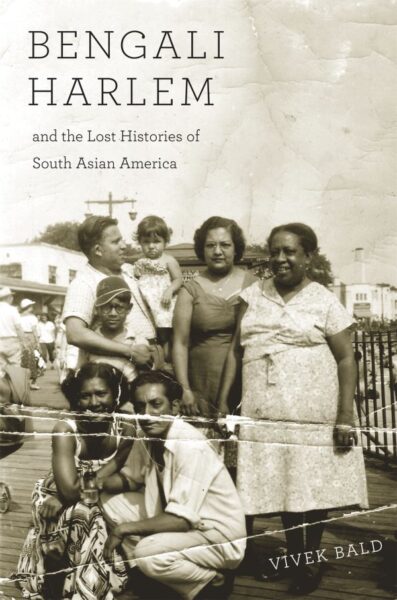 Recommendation: Bald, V. (2013). Bengali Harlem and the lost histories of South Asian America. Harvard University Press.
Film and other information: http://bengaliharlem.com
Historical Harlem, New York does not conjure up images of South Asians going about their daily lives, but Bengali Harlem tells us the story of immigrants who arrived from the 1800s onwards from the Indian subcontinent.
This book focuses on migrants who were ethnolinguistically Bengalis (from what was known as Bengal) and came as merchants, seamen, or laborers to be absorbed into working class America. In the face of racism and discrimination, they built homes and lives, leaving behind generations of Americans with Bengali cultural and linguistic heritage. (Tazin Abdullah)
November: A book of migrant poetry
Recommendation: Saleh, S. M., Syed, Z., & Younus, M. (Eds.). (2025). Ritual: A Collection of Muslim Australian Poetry. Sweatshop Literacy Movement.
Billed as “evocative, unsettling, and unafraid,” this rich collection of Muslim Australian poetry offers a rich treasure trove of poems to come back to and savour again and again. The poems invite the reader to not only reflect on the diversity of Muslim identities but what it means to live on Indigenous land as a designated migrant within a White settler colony. (Ingrid Piller)
December: Cozy fiction for when you need a break from your research
 Recommendation: Arden, K. (2019). The Winternight Trilogy. Del Rey.
I’m now 1.5 years into my PhD and I find that, now more than ever, I need good fiction to read after a long day of academic reading/writing. The Winternight Trilogy is set in the harsh winters of a folkloric version of medieval Russia and follows Vasya, a young woman whose difficult peasant life collides with those of chyerti, the demons and devils of Slavic folklore.
The settings and creatures described in this trilogy are nothing short of magical, and reading the prose makes me feel like I am tucked away snug in a winter cabin with a roaring fire and hot chocolate.
A lesson that I am learning along my PhD journey is that it is imperative to nourish myself while I work so hard, and reading these books is part of that nourishment for me. Knowing that I have the winter snows and rich folklore of these books to look forward to at the end of the day helps me to persevere through the daily ups and downs of PhD life. (Brynn Quick)

 This work is licensed under a