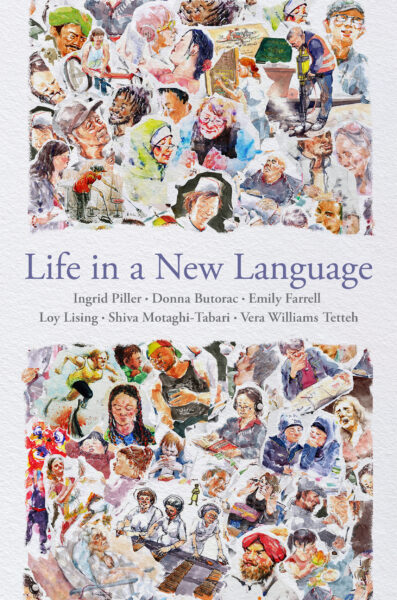
Life in a New Language is a new book co-authored by Ingrid Piller, Donna Butorac, Emily Farrell, Loy Lising, Shiva Motaghi Tabari, and Vera Williams Tetteh, and published by Oxford University Press in 2024. Use promo code AAFLYG6 for a discount when you purchase directly from Oxford University Press.

To read a free chapter – about migrants’ job search – head over to the Oxford University Press website.

If you are teaching a course related to language and migration, consider adopting the book. It includes a “How to use this book in teaching” section, which will make it easy to adopt. Contact Oxford University Press for an inspection copy. Book review editors can also request a review copy through the same link.

About the book

Cover art by Sadami Konchi

International migration is at an all-time high as ever more people move across national borders for work or study, in search of refuge or adventure. Regardless of their motivations and whether they intend their moves to be temporary or permanent, all transnational migrants face the challenge of re-building their lives in a different cultural and linguistic context, far away from family and friends, and the everyday routines of their previous lives. Established populations in destination countries may treat migrants with benign neglect at best and outright hostility at worst.

How then do migrants make a new life?

To answer that question, Life in a New Language examines the language learning and settlement experiences of 130 migrants to Australia from 34 different countries in Africa, Asia, Europe, and Latin America over a period of 20 years. Reusing data shared from six separate sociolinguistic ethnographies, the book illuminates participants’ lived experience of learning and communicating in a new language, finding work, and doing family. Additionally, participants’ experiences with racism and identity making in a new context are explored. The research uncovers significant hardship but also migrants’ courage and resilience. The book has implications for language service provision, migration policy, open science, and social justice movements.

Acknowledgments: Or, the Story of This Book
Note on Pseudonyms, Transcription, and Translation
List of Participants
List of Abbreviations

  1. Doing things with words in a new language

Adult Language Learning in Real Life
Migrant Speakers in Australia
English as a Migrant Language
English as a Legal Instrument of Migration Management
English as Human Capital
The Lived Experience of Life in a New Language

  1. Arriving in a new language

Bringing English to Australia
Arrival Shocks
English as a Diverse Language
Bringing Tested English
Bringing Street English

  1. Looking for work in a new language

“Without a Job You Are Nothing”
Creating the Migrant English Language Deficit
Internalizing the English Language Deficit
Human Capital Deficit Made in Australia
The Value of Social Networks

  1. Finding a voice in a new language

Facing the Growing Pains
Making Friends and Finding Common Ground
Dealing with Misunderstandings and Managing Emotions
Gaining Recognition

  1. Doing family in a new language

Families on the Move
Changing Families
Making Language Choices
Supporting English and Academic Development
Supporting the Heritage Language and Family Connections
Transforming Parent-Child Relationships

  1. Facing discrimination in a new language

Encountering Difference in Australia
Being Made to Feel out of Place
Between Language and Race
Coping in White- English Spaces

  1. Self- making in a new language

Home is Where the Heart is
Losing and Shedding Old Selves
Finding and Crafting New Selves
Building Community

  1. Rethinking language and migration

The Challenge of Migrant Language Learning Revisited
Sharing Data, Pooling Resources
Migration and Decent Work
Migration Across the Lifespan
Building Inclusive Communication

How to Use This Book in Teaching
Notes
References
Index

Additional resources

  1. Scholarly sisterhood: Collaboration is our academic superpowerLanguage on the Move (07/03/2023)
  2. Meet the people behind Life in a New LanguageLanguage on the Move (06/09/2023)
  3. 新语言生活, 语言治理 (13/06/2024)
  4. Life in a New Language: how migrants face the challenge, The Lighthouse (11/07/2024)
  5. Being treated as a migrant in AustraliaAustralian Academy of the Humanities Five Minutes Friday Read (12/07/2024)
  6. Ethnographic data sharing as community building, OUPBlog: Oxford University Press’s Academic Insights for the Thinking World (12/07/2024)
  7. Kontextinformationen sind bei der Sekundäranalyse qualitativer Forschungsdaten entscheidend. (“On the importance of context in the secondary analysis of qualitative research data.”) BildungsServerBlog (18/02/2025; in German)
  1. Ingrid Piller chats with James McElvenny about key findingsHistory and Philosophy of the Language Sciences Podcast (01/05/2024)
  2. Donna Butorac chats with Brynn Quick about migrant identity makingLanguage on the Move Podcast (12/06/2024)
  3. Ingrid Piller chats with Brynn Quick about migrants’ experiences with finding workLanguage on the Move Podcast (19/06/2024)
  4. Vera Williams Tetteh chats with Brynn Quick about African migrants, Language on the Move Podcast (27/06/2024)
  5. Shiva Motaghi-Tabari chats with Brynn Quick about migrant parenting, Language on the Move Podcast (03/07/2024)
  6. Loy Lising chats with Brynn Quick about how the monolingual mindset creates barriers for migrants, Language on the Move Podcast (11/07/2024)
  7. Emily Farrell chats with Brynn Quick about migrant citizenship, Language on the Move Podcast (18/07/2024)

“This volume breaks new ground by focusing on Doings: a group of diverse researchers collaboratively doing close listening and looking over 20 years, as adult immigrants to Australia engage in doing life, things, words, family, and work in a new language. The result is not only new understandings of the participants’ self-making, but also the making of a new research trajectory that focuses not simply on the learning of a language, but on humanity doing life in language.” (Ofelia García, The Graduate Center, City University of New York)

“This is a moving book that represents the voices of migrants on their challenges and successes across different kinds of boundaries. It embodies impersonal structural and geopolitical pressures as negotiated in the dreams and aspirations of migrants. The authors share findings from decades-long separate research projects to develop richer insights, as a model for data sharing and ethical research.” (Suresh Canagarajah, Pennsylvania State University)

“Without any exaggeration this is one of the best books I’ve read in a long time. I am blown away by not only the variety of stories, but also how they are analyzed with keen insight and clear links to policy/planning, all without ever getting bogged down in academia-ese. I was even able to see myself in many of the stories, despite that I obviously came to Australia with both English background proficiency and the “non-immigrant” image you discuss in the text. Noting how others dealt with their experiences was eye-opening, and made me appreciate even further the hard work that goes in to joining a new community who speak a different language than you, or even a different English than the one you expect.” (Wes Robertson, Macquarie University)

“I wanted to congratulate the whole writing team for the fantastic book that you have written, that I enjoyed thoroughly! I loved the content, the structure, the style, and the new approach of data sharing, a real breakthrough. It is truly inspiring and has given me lots of food for thought for what I am currently working on.” (Antonia Rubino, Sydney University)

“The richness and comprehensiveness of the data and the use of longitudinal approach of the study, are particularly noteworthy. […] these achievements rely on the integration of data across six previous sociolinguistic ethnographies, which represent a significant methodological innovation for future ethnographic and anthropological studies. This data-sharing approach is not only adventurous and bold, but it also offers a valuable reference for researchers in cross-project, cross-field, and even cross-disciplinary collaborations, while also paving the way for the humanization and personalization of immigrant research.” (Changchun Li, Universitat Autònoma de Barcelona, Bellaterra Journal of Teaching and Learning Languages and Literature)

“Piller et al. show that giving participants a greater role in determining the concepts and categories emphasized in research can give voice and texture to the lived experiences of language learners. […] empowering language communities to maintain their heritage language and giving participants a greater voice in research can help to subvert language hierarchies and lead to more harmonious relationships between language speakers.” (Michelle Tourbier, Journal of Multicultural Discourses)

“The book not only accomplishes what the authors aimed to achieve; to me, it is also exemplary on several grounds. First, it demonstrates how to bring together findings from multiple projects to construct a holistic picture of the research problem. Second, the book serves as a model for disseminating research findings to the public in a language field. Each chapter is written in simple, lucid, and everyday language, avoiding the typical academic practice of using in-text citations. The authors have broken the barriers in reaching policymakers and the public by presenting research findings in a way so people can enjoy and reflect on their reading and consider how they could facilitate the integration of migrants into the host society. Third, the team of researchers working under the leadership of Ingrid Piller provides an example of what can be called an ‘epistemic dwelling’ for nurturing knowledge and knowledge making. This dwelling shows not only how to cultivate knowledge in a particular field involving new and emerging researchers but also how to take knowledge out to the public. Finally, as noted by the authors, the book provides an innovative example of data sharing, reusing, and constructing big data in qualitative research following Open Science principles. Such practices of knowledge making and knowledge sharing can work towards addressing global divides in knowledge construction.” (M. Obaidul Hamid, University of Queensland, Language Policy)

“Together, these eight chapters provide a comprehensive and nuanced exploration of migrants’ experiences with language learning in Australia. By structuring the book around key themes – language learning, employment, family dynamics, discrimination, and sense of belonging – the authors effectively illustrate the multifaceted challenges migrants face. The book’s greatest strength is its use of rich, personal stories that humanise the participants – an impressive feat given that the data come from academic research work. The authors show an ability to balance individual narratives with critical analysis, highlighting systematic barriers while also acknowledging migrants’ agency and resilience. As the authors point out, this is a key advantage of ethnographic research as it brings personal narratives to the forefront. As ethnographers, we have a great responsibility to handle the stories entrusted to us with care and integrity. This book demonstrates that commitment.” (Nora Duggan, Stockholm University, Revista de Llengua i Dret/Journal of Language and Law)


Snaps and vibes from the launch

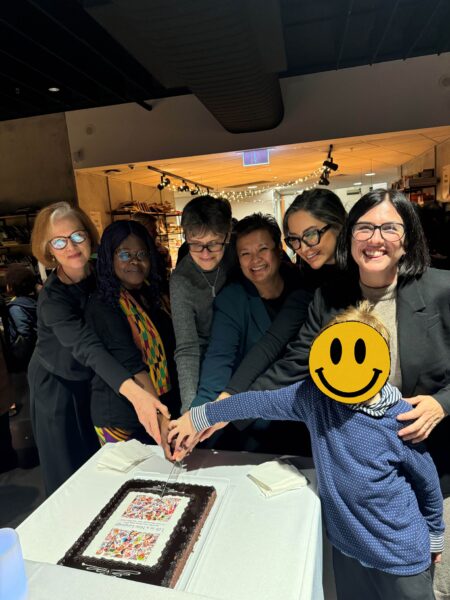
Although the actual book did not quite make it to Australia on time, we launched with a big party at Macquarie University on July 12, 2024.

Program

Three distinguished speakers helped us launch the book:

Professor Sakkie Pretorius, Deputy Vice-Chancellor for Research, Macquarie University
Professor Lucy Taksa, Deputy Director of the Deakin Centre for Refugee Employment, Advocacy, Training and Education (CREATE)
Juliana Nkrumah AM, President and Founder of African Women Australia

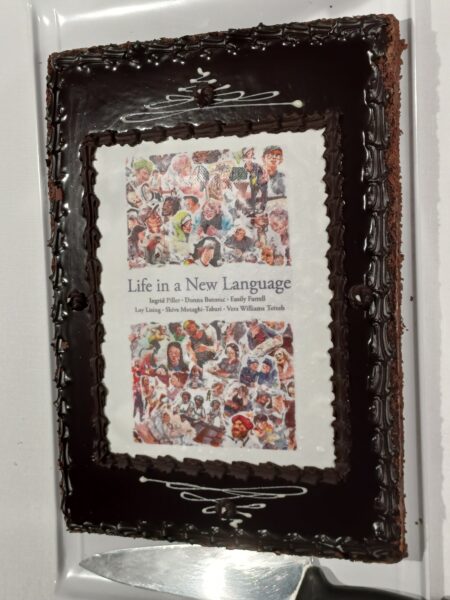
We also had a reading from the freely available chapter entitled “’In My World, No One’s Got a Job with an Australian Company’: Looking for Work in a New Language”, a raffle, a reception with a book-themed cake, and a lot of fun.

The sound track to the launch was the “Global Footprints” selection curated by George Boafo.

Photos by Ana Sofia Bruzon and Brynn Quick.