
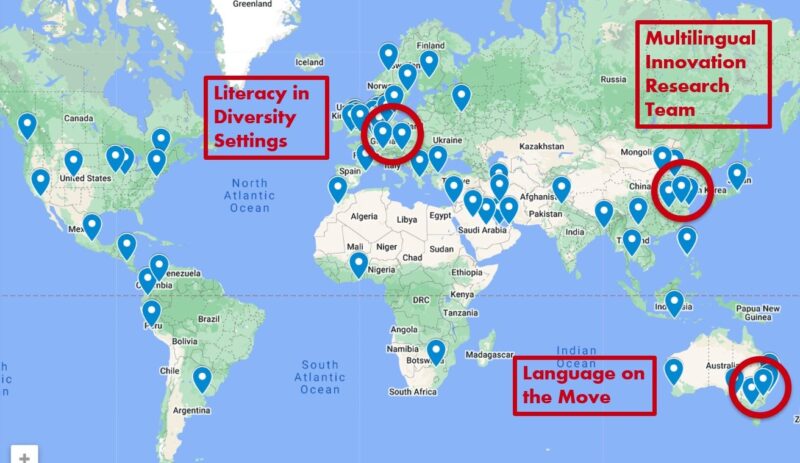
The international research network “Literacy in Multilingual Contexts” builds on the “Next Generation Literacies” network
The World Education Research Association (WERA) recently announced the launch of seven new International Research Networks (IRNs) and we are pleased to share that “Literacy in Multilingual Contexts” is one of them.
What is a WERA IRN?
The WERA IRN initiative brings together global teams of researchers through virtual communication and other channels to collaborate in specific areas of international importance. “Literacy in Multilingual Contexts” joins a growing list of IRNs, contributing to the vision of WERA. The purpose of IRNs is to synthesize knowledge, examine the state of research, and stimulate collaborations or otherwise identify promising directions in research areas of worldwide significance. IRNs are expected to produce substantive reports that integrate the state of the knowledge worldwide and set forth promising research directions.
What does the IRN “Literacy in Multilingual Contexts” do?
The IRN “Literacy in Multilingual Contexts” aims to initiate and extend international collaborative research on literacy in the context of language diversity and migration. The joint focus is on literacy development and practice in multiple languages. Drawing on varied and complementary expertise from Europe, Australasia, Africa and North America, the objectives are:
- to enhance knowledge on literacy and student diversity
- to trace tendencies that go beyond one national, regional or local context
- to examine literacy development across the life-course
- to critically discuss the implications of research findings for policy and practice
Literacy is a foundation for participation in complex societies. The proposed research therefore also contributes to pathways to equity. The network’s activities will reach fundamental theoretical insights, which may be transferred to concepts of teaching/learning in educational institutions. This intervention research will attempt to generalise characteristics of successful multilingual literacy development to be adapted to specific contexts. The proposed IRN comprises senior, experienced and early career scholars (incl. PhD students), aimed towards international and intergenerational knowledge generation.
Literacy as a resource
At the heart of our network is the idea that multilingual literacy is a resource to be celebrated. Literacies across languages and scripts empower learners to create knowledge, to navigate education systems, and to participate fully in social and cultural life.
Members of the network bring expertise from early childhood to higher education, from family and community contexts to digital and AI-mediated literacies. Our shared vision is to develop research that responds to the multilingual realities of migration, mobility, and global diversity.
Building on the “Next Generation Literacies” network
The “Literacy in Multilingual Contexts” network has grown out of the Next Generation Literacies initiative, an international network of researchers working at the intersection of social participation and linguistic diversity.
Based on the trilateral partnership of Fudan University (China), Hamburg University (Germany) and Macquarie University (Australia), Next Generation Literacies brought together an interdisciplinary group of established and emerging researchers to build a truly global network.
After funding for the Next Generation Literacies network ended in 2024, the IRN “Literacy in Multilingual Contexts” keeps that spirit of collaboration alive, while also widening the circle: we are now connected with colleagues from the Network on Language and Education (LeD) in the European Educational Research Association (EERA) and with other WERA initiatives. Under this new umbrella, we will scale up our efforts and make a stronger impact together.
Network Conveners
The network is convened by
- Irina Usanova (University of Hamburg; Lead Convenor)
- Francis M. Hult (UMBC)
- Ingrid Piller (University of Hamburg & Macquarie University)
- Yongyan Zheng (Fudan University)
- Harkaitz Zubiri-Esnaola (University of the Basque Country)
Together with network members, we bring expertise spanning literacy research across continents and research traditions.
Kick-off meeting
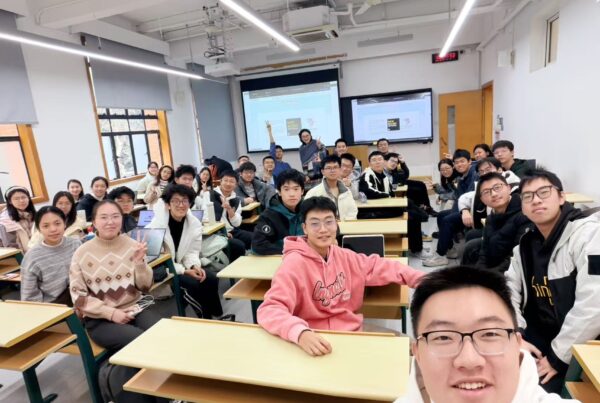
On September 24, 2025, we came together on Zoom across many different time zones and continents to virtually celebrate the official launch of the Literacy in Multilingual Contexts IRN.
The kick-off meeting felt like both a reunion and a new beginning: familiar faces from the Next Generation Literacies network reconnecting, and new colleagues from around the world joining the conversation. Together, we are building a vibrant global community of researchers committed to understanding how literacy develops and thrives in multilingual settings. For all of us, it was a reminder of how much we can achieve when we put our multilingual realities at the center of literacy research.
What’s next?
Over the next three years (2025–2028), we will:
- review the state of research on multilingual literacies
- analyze existing datasets across different contexts
- share our work in joint events and publications
- build a sustainable international community dedicated to literacy in diversity
To make this vision concrete, members are invited to join thematic working groups. Topics include multilingual literacy in early childhood, in higher education, in Indigenous contexts, CLIL, multilingual writing and AI, and multilingual policy. Sounds interesting?
An open invitation
The energy of our first meeting showed just how much can be achieved when we bring our different perspectives together. The IRN “Literacy in Multilingual Contexts” is open to any researcher working in these areas. If you are interested in joining, please send your inquiry to Dr Irina Usanova.


 This work is licensed under a
Like to be part
Thank you for your interest! The IRN “Literacy in Multilingual Contexts” is open to any researcher working in these areas. If you are interested in joining, please send your inquiry to Dr Irina Usanova (see above under “An open invitation”)
Very interested
I am willing to join this team of researchers
I am interested in joining this team of researchers
Thank you for your interest! The IRN “Literacy in Multilingual Contexts” is open to any researcher working in these areas. If you are interested in joining, please send your inquiry to Dr Irina Usanova (see above under “An open invitation”)
This so informative and empowering linguistically and embracing diversity.
Literacy in multilingual contexts is an important aspect of language learning and thorough research is needed to see how best literacy can be taught in multilingual contexts