
In this podcast, Dr Alexandra Grey speaks with Zoe Avery, a Worimi woman and a Research Officer at the Centre for Australian Languages within the Australian Institute for Aboriginal and Torres Strait Islander Studies (AIATSIS). Zoe and her teammates are preparing the upcoming 4th National Indigenous Languages Survey (NILS4). This time around, the AIATSIS team have made some really important changes to the survey design through a co-design process which we will discuss. The co-design process has been going since March 2025 and included eight in-person workshops around Australia, eight online workshops, consultations with over 100 Aboriginal and Torres Strait Islander peoples from a whole range of language renewal, language maintenance, language teaching and language custodial positions, and the government and non-government stakeholder organisations in the Languages Policy Partnership.
NILS4 will be conducted in late 2025 to 2026 and reported upon in 2026.
There’s currently a national target in Australia about strengthening Aboriginal and Torres Strait Islander languages by 2031. This is Target 16 in a policy framework called Closing the Gap. Zoe and I talk about how language strength can be measured in different ways and how the team have chosen to ask about language strength in this survey in ways that show clearly that the questions are informed by the voices in the co-design process.
Then we discuss the parts of the survey which ask about how languages can be better supported, for example in terms of government funding, government infrastructure, access to ‘spaces for languages’ and access to language materials, or through community support. The latest draft of the survey also mentions legislation about languages as a possible form of support. This is great; the data should encourage policy makers not to intuit or impose solutions, but rather to listen to what language authorities are saying they need. What I especially noticed in this part of the survey was the question about racism affecting the strength of a language – or reducing racism as a form of supporting languages – so I ask Zoe to tell me what led the team to include it.
We go on to discuss the enormous efforts and progress underway, and the love which many Aboriginal and Torres Strait Islander communities around Australia have for language maintenance or renewal. People may get the impression that language renewal is all hardship and bad news because a focus on language ‘loss’, ‘death’, or oppression pervades so much of the academic and media commentary. But Zoe and I both recently met in person at a fabulous, Indigenous-led conference in Darwin called PULiiMA in which delegates from 196 Aboriginal or Torres Strait Islander languages participated. That’s just one indication of the enormous effort and progress around Australia, mainly initiated by language communities themselves rather than by governments. We talk about why, in this context, it’s important that this survey also has section about languages ‘flourishing’ and being learnt.
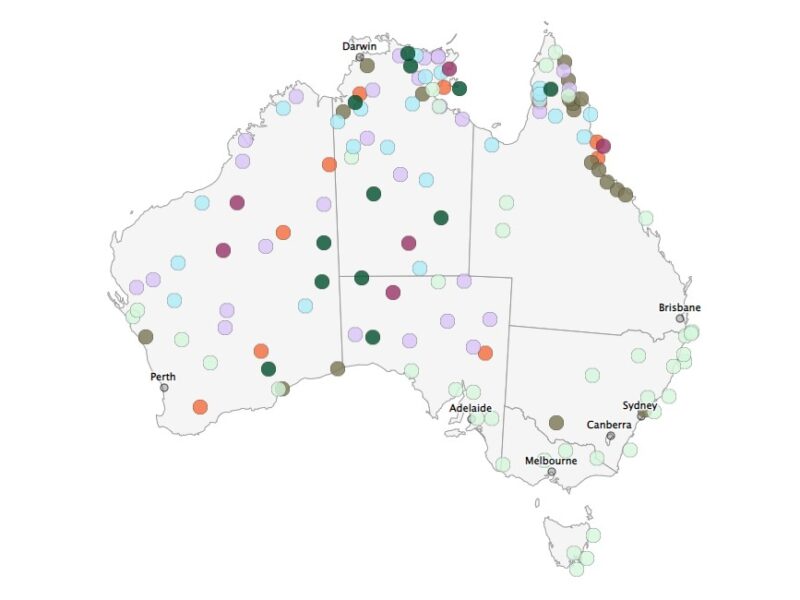
Language groups that participated in NILS3
We discuss the plans for reporting on the survey; incorporating the idea of ‘language ecologies’ was one of the biggest innovations in the National Indigenous Languages Report (2020) about the 3rd NILS and continues to inform NILS4. Finally, we talk about providing Language Respondents and communities access to the data after this survey is completed, in line with data sovereignty principles.
The survey should be available for Language Respondents to complete, on behalf of each language, in late 2025. AIATSIS will facilitate responses online, by phone, on paper and in person. If you would like to nominate a person or organisation to tell us about an Aboriginal or Torres Strait Islander language, please contact the team at [email protected]. Respondents will have the option of talking in greater depth about their language in case studies which AIATSIS will then include as a chapters in the report, as part of responding to calls in the co-design process to enable more access to qualitative data and data in respondents’ own words.
If you liked this episode, support us by subscribing to the Language on the Move Podcast on your podcast app of choice, leaving a 5-star review, and recommending the Language on the Move Podcast and our partner the New Books Network to your students, colleagues, and friends.
Transcript
Alex: Welcome to the Language on the Move Podcast, a channel on the New Books Network.
My name is Alex Grey, and I’m a research fellow and senior lecturer at the University of Technology in Sydney in Australia. This university stands on what has long been unceded land of the Gadi people, so I’ll just acknowledge, in the way that we do often these days in Australia, where we are. Ngyini ngalawa-ngun, mari budjari Gadi-nura-da and I’d really like to thank
Ngarigo woman, Professor Jaky Troy, who, in her professional work as a linguist, is an expert on the Sydney Language, and has helped develop that particular acknowledgement.
My guest today is Zoe Avery, a Worimi woman and a research officer at the Centre for Australian Languages. That centre is part of the Australian Institute for Aboriginal and Torres Strait Islander Studies, which we’ll call AIATSIS. Zoe, welcome to the show!
Zoe: Thank you! I’m really excited to be here and talking about my work that I’m doing at AIATSIS.
Alex: Yeah, so in this work at AIATSIS, you’re one of the people involved in preparing the upcoming National Indigenous Languages Survey. This will be the fourth National Indigenous Languages Survey in Australia. The first one came out now over 20 years ago, in 2005.
This time around, you and your team have made some really important changes to the survey design through the co-design process. Let’s talk about that. Can you tell us, please, what is the National Indigenous Languages Survey, what’s it used for, and how this fourth iteration was co-designed?
Zoe: Yeah, so, the National Indigenous Languages Surveys, or I’ll be calling it NILS throughout the podcast, they’re used to report the status and situation of Indigenous languages in Australia, as you mentioned. This is the fourth one. The first one was done all the way back in 2004 and, the third NILS was done about 6 years ago, in 2019. So it’s been a while, and it’s kind of just to show the progress of how, languages in Australia are being spoken and used, and I suppose the strength of the languages, which we’ll kind of go into a bit more detail. But the data is really important, because it can be used by the government to develop, appropriate language revitalisation programs or understand the areas that require the most support, but it can also be used by communities, which is really important as well.
And so, NILS4 has been a little bit different from the start compared to previous NILS, because the government has asked us to run this survey in order to measure Target 16 of Closing the Gap, which is that by 2031, languages, sorry, by 2031, there is a sustained increase in the number and strength of Aboriginal and Torres Strait Islander languages being spoken.
So, the scope for this project is much bigger than the past NILS, and AIATSIS has really prioritised Indigenous leadership in the design, and will be continuing to prioritise Indigenous voices in the rollout and reporting of the results of the survey.
So, because this is a national-level database, and we want to make sure as many languages as possible are represented, including previously under-recognized and under-reported languages, including sign languages, new languages, dialects. It’s really important that we have Indigenous voices, prioritized throughout this entire research process. And we want to make sure that the questions that are being asked in the survey are questions that the community want answers to, whether or not to advocate, to the government that these are the areas that need the most support, the most funding, or whether or not the community want that data for themselves to help develop, appropriate, culturally safe programs.
So what we did is we had this big co-design process, this year to design the survey. We had 16 co-design workshops with Indigenous language stakeholders across Australia, and this was, these workshops were facilitated by co-design specialists Yamagigu Consulting. We had, in total, about 150 people participate in the co-design process, and of these 150 people, about 107 of these were Indigenous. And so these Indigenous language stakeholders included elders, language centre staff members, teachers, interpreters, sign language users, language workers, government stakeholders, all sorts of different people that have a stake in Indigenous languages, for whatever reason. And we had 8 on-country workshops, which were held in cities around Australia, and 8 online workshops as well, which helps make it easier for, people that kind of came from different places, and weren’t able to come to an in-person workshop.
Alex: That’s a huge… sorry, just congratulations, that sounds like it’s been a huge undertaking. So many people, so many, so many workshops, well done.
Zoe: Yeah, it has been huge, and we’ve had so many different people from a variety of different language contexts, participate as well. So, the diversity of language experiences that were kind of showcased at these workshops was immense and has had a huge impact on drafting the survey, which is obviously the whole point of the workshops, but yeah … We took all the insights from the co-design workshops, we analysed them, thematically coded everything, and started incorporating everything into the survey. And then we went back to the people who participated in the co-design workshops and held these validation workshops so we could show them the draft of the survey, show them how we had planned on incorporating all of their insights, you know, that we weren’t just doing it for the sake of ticking a box to say, yes, we’ve had Indigenous engagement, but we were actually really wanting to have Indigenous input from the start, and right until the end of the project. And we had really good feedback from the validation workshops, and it is, you know, not just a massive task running these workshops, but also, making sure that everybody’s listened to, and sometimes they were kind of contrasting views about how things should be done, and yeah, we wanted to make sure that we had as much of a balance as possible.
We also consulted with the Languages Policy Partnership, which are kind of key workers in Indigenous languages policy and, advocacy. They’re kind of leaders in the Closing the Gap Target 16 that I was just talking about, so their input and advice has been really important to us, as have consultations with the Australian Bureau of Statistics and the Mayi Kuwayu Study of Aboriginal and Torres Strait Islander Wellbeing. So yeah, there’s been a lot of input, and we’re really excited that we’re at the point now where we’re finishing the survey! Dotting all the I’s, crossing all the T’s and getting ready to start rollout soon.
Alex: Yeah, well, I mean, one would hope good input, good output! You know, such a huge process of designing it. You should get really well-targeted, really informative, useful results.
And you’ve mentioned a few things there that I’ll just explain for listeners, because not all our listeners will be familiar with the Australian context. It’s coming through that there’s enormous diversity of Indigenous peoples and languages in Australia, so to explain a little bit, because we won’t go into this in much detail in this interview, Zoe’s mentioned new languages like, contact languages, Aboriginal Englishes, Creoles, like Yumplatok, which comes from the place called the Torres Strait. If you’re not familiar with Australia, that area is between Australia, the Australian mainland, and Papua New Guinea, in the northeast. And then there’s an enormous diversity of what are sometimes called traditional languages across Australia, both on the mainland and the Tiwi Islands as well. So we have a lot of Aboriginal language diversity, and then in addition, Torres Strait Islander languages, and then in addition, new or contact varieties.
Zoe: Sign languages.
Alex: And sign… of course, yes, and sign languages. Thank you, Zoe. And then you’ve mentioned Target 16. So we have in Australia a policy framework called Closing the Gap. For the first time ever, the current Closing the Gap framework includes a target on language strength.
But as the survey goes in to, language strength can be measured in different ways. So how have you chosen to ask about language strength in this survey, and why have you chosen these ways of asking?
Zoe: Yeah, so, along with, kind of, Target 16 of Closing the Gap, there’s an Outcome 16, which is that Aboriginal and Torres Strait Islander cultures and languages are strong, supported, and flourishing. So it’s important for us in the survey to, kind of, address those kind of buzzwords, strong, supported, and flourishing. But it is very clear, from co-design, that the widely used measures of language strength don’t necessarily always apply to Australian Indigenous languages. So these kind of widely used and recognised measures of how many speakers of a language are there, and is the language still being learned by children as a first language? These are not the only ways of measuring language strength, and we really wanted to make sure that we kind of redefined language strength in the survey based off Indigenous worldviews. So, language is independent [interdependent] with things like community, identity, country, ceremony, and self-determination.
How do we incorporate that into the survey? So we’re still going to be asking questions, like, how many speakers of the language are there? What age are the people who are speaking the language, but we’re also going to be asking questions on how many people understand the language, because people may not be able to speak a language due to disability, cultural protocol reasons, or due to revitalisation, for example. But they can still understand the language, and that can still be an indication of language strength. We’re also asking questions about how and where it’s used. So, do people use the language while practicing cultural activities, in ceremony, in storytelling, in writing, just to name a few? We know that Indigenous languages are so strongly entangled with culture and country, and it’s difficult to measure the strength of culture and country. But we can acknowledge the interdependencies of language, culture, and country, and by asking these kinds of questions, we can get some culturally appropriate and community-led ways of defining language strength.
Alex: And that’s just going to be so useful for, then, the raft of policies that one hopes will follow not just the survey, but follow the Target 16, and even once we get to 2031, will continue in the wake of, you know, supporting that revitalisation.
Zoe: Yeah, absolutely, and I think that, another thing that we heard from co-design, but just also from Indigenous people, in research and advocacy, that language is such a huge part of culture and identity, that by, you know, developing these programs and policies to help address, language strength, all the other Closing the Gap targets, like health and justice and education, those outcomes will all be improved as well.
Alex: Yeah, I guess that’s why, in the policy speak, language is part of one of the priority response areas for the Closing the Gap. And I noticed this round of the survey in particular is different from what I’ve seen in the earlier NILS in the way it asks questions, which also appears to reflect the co-design. So, for example, these questions about language strength, they start with the phrase, ‘we heard that’ and then a particular kind of way of thinking about strength. And then another way of thinking about strength might be presented in the next question: ‘We also heard that…’. So on, so on. So, is this so people trust the survey more, or are you conscious of phrasing the survey questions really differently compared to, say, the 2019 version of the survey?
Zoe: Yeah, absolutely we want people to trust the survey, and understand that we respect each individual response. Like, as much as it’s true, we’re a government agency, and we’ve been asked to do this to get data for Closing the Gap, we want language communities to also be able to use this data for their own self-determination, and we want to try and break down these barriers for communities and reduce the burden as much as possible. So, making sure that the survey was phrased in accessible language, and the questions were as consistent as possible.
But yeah, we wanted to make sure that we were implementing insights from co-design, but making it clear in the survey that we didn’t just kind of come up with these questions out of nowhere, that these were co-designed with community and represent the different priorities of different language organisations, workers, and communities across Australia. So, we want the community to know why we’re asking these questions. And also, why they should answer the questions. Because ultimately, that’s why we’re asking the survey questions, because we want people to answer the questions.
Alex: Yeah, yeah, and I think that also comes through in the next part of the survey as well, which is about how languages can be better supported, which again gives a lot of, sort of co-designed ideas of different ways of support that people can then talk to and expand on, so that what comes through in your data, hopefully, is really community-led ideas of what government support or community support would look like, rather than top-down approaches.
So, for example, the survey asks about forms of government funding, reform to government infrastructure, access to what the survey calls ‘spaces for languages’. I really like this idea as a sociolinguist, I really get that. Access to language materials through community support. The survey also mentions legislation about languages as a possible form of support. So this should encourage policymakers not to intuit or impose solutions, but rather to listen to the survey language respondents and what they say they need.
What I especially noticed in this part of the survey was the question about racism affecting the strength of language. Or, if you like, reducing racism as a way of supporting language renewal. I don’t think this question was asked in previous versions of the survey, right? Can you tell us what led your team to include this one?
Zoe: Yeah, so, this idea of a supported language, as I measured… as I explained before, is one of the measures in, Outcome 16 of Closing the Gap, and that we want policymakers to listen to what the language communities want and need in regards of support, because, you know, in Australia, there’s so much language diversity, it’s not a one-size-fits-all approach. Funding was something that all language communities had in common, whether it was language revitalisation they needed funding for, resources and language workers, but also languages that, one could say are in maintenance, so languages considered strong languages, that have a lot of speakers, they also need funding to make sure that their language, isn’t at risk of being lost, and that, it can stay a strong language.
So, there are other kinds of ways that a language can be supported, and if we’re talking about, kind of racism and discrimination as a way that a language isn’t supported. It was important for us to kind of ask that question, because in co-design it was clear that racism and discrimination are still massively impacting language revitalisation and strengthening efforts. The unfortunate reality of the situation of Australian languages, Indigenous languages, is that due to colonisation, Indigenous languages have been actively suppressed.
We want to make sure that respondents of the survey have the opportunity to, kind of, participate in this truth-telling. It is an optional question. We understand it can be somewhat distressing to talk about language loss and the impacts of racism and things like that, but if respondents feel comfortable to answer this question, it does give communities the opportunity to share their stories about how their language has been impacted by racism. So, yeah.
Alex: I really think that’s important, not just to inform future policy, but the act of responding itself, as you say, is a form of truth-telling, and the act of asking, and having an institute that will then combine all those responses and tell other people. That’s an act of what we might call truth-listening, which is really important in confronting the social setting of language use and renewal. This goes back then, I guess, to strength. It’s not just how many people learn a language, or how many children exist who grow up in households speaking a language. There has to be a social world in which that language is not discriminated against, and those people don’t feel discriminated against for wanting to learn that language or wanting to use it.
Now, people may get the impression that language renewal is all hardship and bad news because of a focus on ‘language loss’, in quotes, or language ‘death’, or oppression. This pervades so much of the academic and media commentary. But you and I, Zoe, we met recently in person at a fabulous Indigenous-led conference in Darwin called PULiiMA and there, there were delegates from 196 Aboriginal or Torres Strait Islander languages participating. So, that’s just one indication of the enormous effort and progress in this space around Australia, and mainly progress and effort initiated by language communities themselves, rather than governments.
So in that context, it’s important, I think, that this survey also has a section about languages flourishing, the positive focus. Languages are being learnt and taught and used and revived and loved. Tell us more about the design and purpose of the ‘flourishing’ sections of the survey.
Zoe: Yeah, I just want to say that how awesome PULiiMA was, and to see all the different communities all there, and there was so much language and love and support in the room, and everyone had a story to tell about how their language was flourishing, which was so awesome to hear. A flourishing language in terms of designing a survey and asking questions about, is a language flourishing, is a tricky thing to unpack, because in co-design, we kind of heard that a flourishing language can be put down to two things, and that’s visibility and growth of a language. And so growth of a language is something that you can understand, based off the questions that we’ve already asked, in kind of the strength of a language, how many speakers, is this number more or less compared to last time, the last survey? We’re also asking questions about, ‘has this number grown?’ in case it kind of sits within the same bracket as it did in the last survey.
And visibility is, kind of the other factor, which can be misleading sometimes as well. We’re asking questions about you know, is it being used in place names, public signage, films and media. Just to name a few. But a language that is highly visible in public maybe assumed to be strong, but isn’t strong where it matters, so, being used within families and communities. So, this section is a little bit smaller, because it kind of builds on the questions in previous sections.
It will be interesting to see, kind of, the idea of a flourishing language, and we do have the opportunity for people to kind of expand on their, responses in, kind of, long form answers, so people can explain, in their own words, in detail, if they choose to, kind of, how they see their language as being flourishing,
But, yeah, for a language to be strong and flourishing, it needs to be supported, and that’s something that was very clear in co-design, and people wanting things like language legislation, and funding, and how these things can be used to support the language strength, and to allow it to flourish. So in this section, we also have, kind of, an opportunity for people to give us their top 3 language goals. So whether that’s, they want to increase the number of speakers, or they want to improve community well-being. All sorts of different language goals and the opportunity for people to put their own language goals and the supports needed to achieve those language goals. So, the people who would benefit from the data from this survey, the government, policy makers, communities, they can see what community has actually said are their priorities for their language, and what they believe is the best way to address those language goals. So, encouraging self-determination, within this survey.
Alex: And following on from that point, I have a question in a second about, sort of, how you report the information, and also data sovereignty, how communities have access to, in a self-determined way, use this resource. But I just wanted to ask one more procedural question first. So, you shared a complete draft with me, and we’ve spoken about the redrafting process, so I know the survey’s close to ready, but where are you at the team at AIATIS is up to now – and now, actually, for those listening in the future, is October 2025. Do you have an idea of when it will be released for people to answer, and who will you be asking to answer this survey?
[brief muted interruption]Zoe: Yeah, so we’ve just hit a huge milestone in the research project where we’re in the middle of our ethics application. So, we’ve kind of finished drafting the survey, and it’s getting ready for review from the Ethics Committee at AIATSIS. And hopefully, if all goes well, we’ll be able to start rolling out the survey in November [2025].
So yes, it’s been a long time coming. This survey’s been in the works for many years. I’ve only personally been working on this project for a little under 12 months, but there have been many people before me working towards this milestone.
And the people that we want to be completing this survey are what we’re calling language respondents. So we don’t necessarily want every Indigenous person in Australia to talk about their language, but rather have one response per language by a language respondent who can kind of speak on the whole situation and status of their language, and can answer questions like how many speakers speak the language. So that could be anyone from an elder to a language centre staff member, maybe a teacher or staff member at a bilingual school. We’re not defining language respondent and who can be a language respondent because we understand that that’s different, depending on the language community, and if there are thousands of speakers of a language, or very few speakers of a language. We also understand that there could be multiple people within one language group that are considered language respondents, so we’re not limiting the survey to one response per language, but that’s kind of the underlying goal that we can get as many responses from the different languages in Australia, but at least one per language.
Alex: That makes sense. So, it’s sort of at least one per speaker group, or one per language community.
Zoe: Yeah.
Alex: Yep. Yeah. Yep. And then… so the questions I foreshadowed just before, one is about the reporting. So, I noticed last time around the National Indigenous Languages Report, which came out after the last survey – so the report came out in 2020 – that incorporated this really important idea of language ecologies, and that was one of the biggest innovations of that round of the survey. And that was, I think, directed at presenting the results in a way that better contextualized what support actually looks like on the ground, rather than this very abstracted notion of each language being very distinct and sort of just recorded in government metrics, but [rather] embedding it in a sense of lots of dynamic language practices, from people who use more than one variety.
So do you want to tell us a little bit more about how you’ve understood that language ecologies idea? Because I see that comes up in a question as well, this time around in the survey, and is it in the survey because you’re hoping to use that in the framing of the report as well?
Zoe: Yeah, so the third NILS, which produced the National Indigenous Languages Report in 2020, contributed massively to increasing awareness of language ecologies, and this idea that a language doesn’t exist within a bubble. It has contextual influences, particularly when it comes to multilingualism and other languages that incorporate, are incorporated into the community. So NILS4 aims to build on this work, in collecting interconnected data about what languages are being used. Who are they being used by? In what ways? Where are they being used at schools? At the shops, in the home. Different languages, as you mentioned before, different varieties of English, so that could be Aboriginal English, for example, or Standard Australian English. It could be other Indigenous, traditional Indigenous languages, so some communities are highly multilingual and can speak many different traditional languages. Some communities may use sign languages, whether that’s traditional sign languages or new sign languages, like Black Auslan. And kind of knowing how communities use not only the language that the survey is being responded to about, but also other languages, which will help with things like interpreting and translating services, education services, all sorts of different, things that, by understanding the language ecology better and the environment that the language exists in, yeah —
Alex: That makes sense, and there you’ve mentioned a few things that I didn’t really ask you about, but I’ll just flag they’re there in the survey too, translation and interpreting services, education, government services, and more broadly, workforce participation through a particular Aboriginal or Torres Strait Islander language. That’s important data to collect. But the last sort of pressing question I have for you in this podcast is not about language work but about data sovereignty. This is a really big issue in Australia, not just for this survey, but for all research, by and with Indigenous peoples, and particularly looking at older research that was done without the involvement of Indigenous people, where there’s been problems with who controls and accesses data. So, what happens to the data that AIATSIS collects through this survey?
Zoe: Yeah, so data sovereignty is obviously one of our priorities and communities fundamentally will own the data that they input into the survey. And there will be different ways that, this information will be shared or published, depending on what the respondent consents to. So, part of the survey includes this consent form, where they basically, can decide how their data will be used and shared. And so the kind of three primary ways that the data will be used is: it will be sent to the Productivity Commission for Closing the Gap data, as I mentioned before, we have been funded in order to produce data for Closing the Gap Target 16, and so the data that’s sent to the Productivity Commission will be all de-identified. And this will be all the, kind of, quantitative responses, so nothing that can kind of be identified will be sent to the Productivity Commission. And this kind of data is kind of the baseline of what people are consenting to by participating in the survey. If they don’t consent to this, then, they don’t have to do the survey, their response won’t be recorded.
And then the other kind of two ways that AIATSIS will be reporting on the data is through the NILS4 report that will be published next year [2026], and also this kind of interactive dashboard on our website. So people will be able to kind of look at some of the responses. And communities will have the option on whether this data is identified or de-identified, so some communities may wish to have their responses identifiable, and people will be able to search through and see kind of data that relates to their communities, or communities of interest, or they might choose to kind of remain anonymous and de-identified, and so these are going to be mostly quantitative responses as well.
However, we are interested in, kind of publishing these case studies in the NILS report, which will be opportunities for communities to tell their language journey in their own words. And so this is a co-opt, sorry, an opt-in co-authored chapter in the NILS report, that, yeah, language communities can not just have data, or their responses, but have the context provided, the story of their language and their data. And that was something that was really evident in co-design, that the qualitative data needs to exist alongside the quantitative data, and that’s a huge part of data sovereignty as well, like, how communities want to be able to share their data. So, we’re really excited about this kind of, co-authored case study chapter in the report, because community are excited about it as well. They want to be able to tell their story in, in their own words.
And so, that’s kind of how the data will be used and published, but, there are other ways that the community will be able to kind of access their data that they provide in the survey. So, that’s also really important to us, and we’re following the kind of definitions of Indigenous data sovereignty from the Maiam Nayri Wingara data sovereignty principles. So, making sure that, yeah, community have ownership of their data, and they can have access to it, are able to interpret it, analyse it. And this is kind of being done from the beginning of co-design all the way up to the reporting, and that, yeah, community have control over their data at all points of this process.
Alex: It sounded like just such a thoughtfully managed and thoughtfully designed survey, so thanks again, Zoe, for talking us through it, and all the best for a successful rollout. The next phase should be really interesting for you to actually get people reading and responding, and I’ll be looking out for the survey results when you publish them later in 2026. Is there anything else about the survey that you’d like to tell our listeners?
Zoe: I think that we’ve had a really, productive conversation about our survey. We’re really excited to start rolling it out, and we’re really excited for people to look out for the results as they start to be published and shared next year. So, yeah, if anybody has any questions, or would like more information, I encourage everyone to kind of check out our website and send us an email. But yeah, thank you for having me, and for letting me chat about this project. It’s been a huge part of my life for the past few months, and excited for the rest of the world to get to experience this data, which is hopefully going to have such a big impact on communities having this accurate, reliable, comprehensive national database, that can be used for, yeah, major strides in Indigenous languages in Australia.
Alex: Well, we’ll definitely put the AIATSIS website, which is AIATSIS.gov.au, in the show notes, and then when the particular survey is out for people to respond to, we’ll put that in the notes on the Language on the Move blog that embeds this interview as well. And then people will be able to, as I understand it, respond online to the survey, or over the phone, or in person, and in a written form as well. So, as that information is available, we’ll share that with this interview.
So, for now, thanks so much again, Zoe, for talking me through this survey, and thanks everyone for listening. If you enjoyed the show, please subscribe to our channel, leave a 5-star review on your podcast app of choice, and of course, please recommend the Language on the Move podcast and our partner, The New Books Network, to your students, your colleagues, your friends. Speak to you next time!
Zoe: Thank you.


 This work is licensed under a