
In this episode of Language on the Move Podcast, Dr Agnes Bodis talks to Cindy Valdez, an English as an Additional Language or Dialect (EAL/D) specialist, and Founder & CEO of Teach To Learn, an international education exchange program.
Cindy is passionate about inclusion, helping other educators develop leadership in EAL/D and cater for the academic and wellbeing needs of multilingual learners, including students from refugee backgrounds. She is an author of professional publications, served as President of the Association for Teaching English to Speakers of Other Languages (ATESOL) NSW and is Member of the Board of Directors of Primary English Teaching Association of Australia known as PETAA.
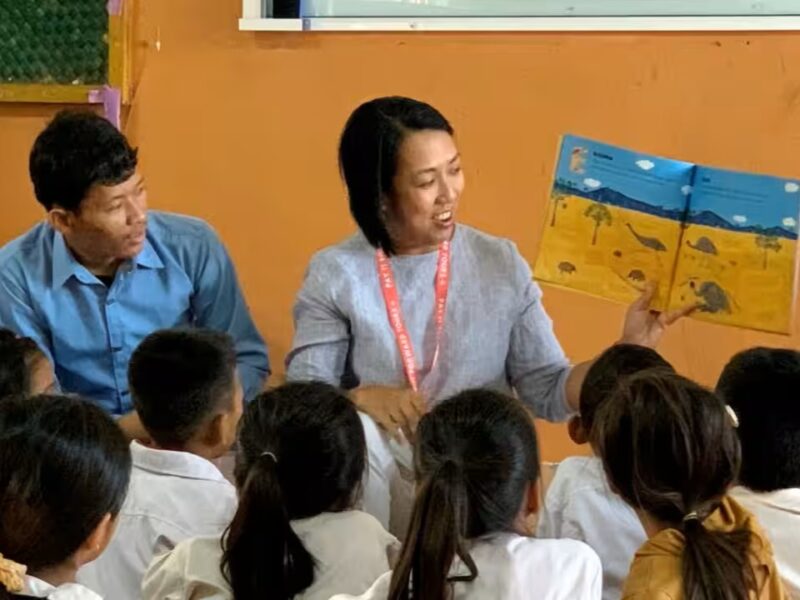
Cindy Valdez teaching in Cambodia (Image credit: Cindy Valdez via SBS)
Additional materials
- “They changed me”: Filipina educator on helping refugee students survive peace, SBS Filipino (2023)
- Valdez Adams, C. (2022) “Including” English as and Additional Language or Dialect (EAL/D) Learners in Your Classroom. Journal of Professional Learning 2
If you liked this episode, support us by subscribing to the Language on the Move Podcast on your podcast app of choice, leaving a 5-star review, and recommending the Language on the Move Podcast and our partner the New Books Network to your students, colleagues, and friends.


 This work is licensed under a
I feel fortunate that I did not have to experience an English-only policy in school, especially after hearing about how such policies can affect a child’s co. Growing up in a multilingual household, I have always seen multilingualism as an asset rather than a deterrent to learning. For me, multilingualism is indeed a superpower, since it allows me to connect to a wider audience. This is why I really appreciate this advocacy since this creates an educational environment where students do not have to hide his/her identity tot to succeed.
Thank you, Dr. Agnes and Ms. Cindy, for this very relatable topic. I really love how Ms. Cindy mentioned about the teachers pointing out what the students lack and not what the student has also the English Only Policy in the classroom where students are restricted to use their first language where their ability to communicate are reduced, since using English most of the time made them somehow question themselves on whether it is the right way of using it or not i would also like to highlight what ms. Cindy said, “Learning is being you,” and that not exercising your first language restrains students from being themselves.
I found this podcast very insightful and I do agree that multilingualism and its encouragement should be more prevalent in classrooms to foster an inclusive and united community through the students. With this, students and teachers can be able to learn from one another in language as time continues to move.
This episode is such a meaningful reminder that enriching your mother tongue should be encouraged, as learning English should not lead to losing a part of your own identity. Being multilingual is actually a great strength in nurturing relationships, intellect, and growth. Therefore, struggles of multilingual learners in expressing an idea in English shall never be unfairly judged and made as a basis of language proficiency. English, as a universal language, highly contributes to accessibility and success but it should not be prioritized over culture and identity. As Filipinos, we often get treated differently as others claim that other forms of English are more prestigious. However, language is never measured by how close people speak to the standard English. Multilingualism, as a representation of our identity, culture, and belonging, deserves to be recognized as a strength rather than a deficiency.
I think it’s important to emphasize the statement, “multilingualism is a superpower,” because the ability to speak and understand multiple languages is indeed powerful. Not only can they converse in multiple languages, but they can also reach the audiences within those languages. So it can be frustrating when institutions try to limit a student’s language, who is likely completely unaware of the power they hold as an individual who can speak multiple languages. Thus, I believe it is important to have an educator who values multilingualism, and to avoid limiting phrases like “English, please” as much as possible 😅, which can be quite frequent.
Listening to Ms. Cindy Valdez’s story took me back to my elementary days. Before, we had an “English-only speaking policy,” and I always asked, “Why may I not be allowed to speak my language?” Honestly, that kind of language teaching is uncomfortable and ineffective because, just like many others, it only traumatizes the child. Instead of learning the language, they become more reserved, and they cannot truly express themselves. That is why I appreciate Ms. Cindy Valdez’s efforts to promote bilingualism and multilingualism. Indeed, our language is our superpower. As a student and aspiring educator, I am always more motivated whenever I encounter educators with whom I share the same advocacy. I am glad that the language community has already begun to recognize the need to push for inclusive education, because by doing this, we create a healthier teaching method and education for the new generation of students. Most importantly, I do not want to see another child experience what I experienced before. So, I root for you, Ms. Cindy Valdez! I hope more people will also come to this realization and help you with the advocacy.
I found this topic very timely as almost every classroom today includes students with diverse linguistic backgrounds. As an English Language Studies student in the Philippines, I can attest that multilingualism should be seen as a power that can strengthen culutral ties and individual identity within the society. Inclusion of multilingualism in the classroom is a topic that should be discussed more especially in countries who have more than two languages. Multilingualism is never a threat. It is a vehicle for forging bonds that go beyond classroom learning alone and teachers and educational systems should work together to provide safe and beneficial learning spaces and programs to accommodate the linguistic diversity of students.
Language proficiency is such a controversial topic, especially in English-only classrooms or institutions that enforce such rules, because I have seen it as one’s ability to feel comfortable and confident, and to have flexibility in whichever language they speak. So, being multilingual, why measure their proficiency only by how well they can use one language in isolation, when it should be measured by how well they can use all their languages together and still form an organized, well-functioning way of communicating? And I think that is the beauty of the speaker, Cindy, is trying to make listeners understand that your language is your power, so use it. As a student, though I am quite well-versed in both Filipino and English, there are times when speaking and trying to convey a point can be difficult without using terms that are unique to my native language. And it is during those times that I believe being bilingual or multilingual becomes such a blessing, because I get the chance to show that I am proficient in both languages.
Additionally, when the listeners are foreign or unfamiliar with the native terms or phrases I use, it can be such a beautiful thing to impart new knowledge to them. This call for inclusiveness is such a great thing to make people ponder upon. This has been such a very fun and educational podcast to listen to. Thank you so much for all the knowledge and support you have given through this podcast!
Thank you, Brent! I love how you’ve connected this to your own bilingual experience. Our languages are resources, not barriers.
This episode resonated deeply with me! As an English Language Studies student, I fully assent that multilingualism is a strength, not a deficiency, in language learning. Our classrooms are rich with cultural and linguistic diversity, but creating genuine inclusion takes intentional effort. Thus, building a sense of safety and empathy is key to helping multilingual learners unlock their full potential.
Thank you, Celita! Absolutely. Genuine inclusion takes intentional effort, and seeing multilingualism as a strength is such an important starting point. Salamat!
This podcast episode is such an enjoyable discussion I relate to. It is already given that in the Philippines, English is part of the curriculum that everyone must be skilled in. Hence, classroom borders play a significant role in shaping students’ perceptions of language use, which is a double-edged sword. It helped Filipinos prepare for the “real world” and use English effectively in different situations. However, there are instances in which English-language learning restricts identity expression, such as paying a peso when one accidentally utters a Filipino expression, a completely English-only rule in classrooms, and the like. I do understand the importance of English, but it is also important to take note of World Englishes. For me, English is one language that can be conveyed uniquely. Just because we do not have the same skills as those defined by the imposed “standard” does not mean they are unacceptable. Everyone grew up with different social and cultural backgrounds that greatly influence how language is shaped. It made me glad that Ms. Cindy acknowledges and embraces inclusive English in her classroom, which, for me, is a huge step toward helping her students understand early on that English is not restrictive of who you really are. Rather than limiting them, this will help students embrace English and slowly dismantle the idea that English is a linear learning process.
Thank you, Maria! I love your point about World Englishes. I do wish we placed greater value on Filipino languages alongside English. A strong foundation in a learner’s first language is an asset when acquiring additional languages, not something that needs to be left behind.
This was something nice to listen to! I like to think that if I were a future teacher, maybe if I am good at it, I can make room for what the students already bring, so the class feels welcoming and worthwhile as the days go by.
Thank you, Jasmine! “Make room for what students already bring” is such an important insight. Hold onto that as a future teacher. Our students’ languages, cultures and experiences are assets in the classroom.
Thank you for the insightful podcast! Listening this through Spotify made the experience even smoother, and the clear audio really highlighted every detail of your discussion. It made me realize that linguistic diversity isn’t just a trait people carry, but a powerful asset that shapes how we connect and build community. I’m amazed by how warmly you explored the human side of multilingualism, showing that honoring someone’s home language directly supports their well-being and sense of self.
Thank you, Cassey! I love this. Honouring a learner’s home language is about so much more than language. It’s about identity, belonging and connection.
Great episode! I appreciate your support for teachers in creating learning programs that support and celebrate bilingualism 🙂
I’m also an aspiring English teacher, and I really like the idea of treating students’ other languages as a strength instead of something that needs to be left outside the classroom. It made me think about how teachers can use students’ existing languages and knowledge to help them learn English while also making them feel valued and included. I think this is an important mindset for future teachers because being bilingual or multilingual should be something we celebrate, not something students should feel they need to hide.
Thank you, Annika! Absolutely. Students should never have to leave their languages at the classroom door. Seeing multilingualism as a strength is such an important mindset to take into your future classroom.
What a very beautiful podcast to listen to! As a student and aspiring educator, I find that recognizing multilingualism within a community of learners makes teaching itself a challenging yet rewarding experience. That, in itself, is a powerful superpower that transforms every individual’s language-learning journey even more profoundly when we seek out the issues and overcome them through collaborative efforts. In every classroom, we are greeted by students from diverse backgrounds, and thus being able to appreciate and respect such differences is a testament to a fruitful outcome.
Thank you very much, Shannen! It was such fun to record this podcast with Cindy, indeed!! 🙂 As you say, it all starts with awareness and in my Australian context, little steps like learning to say hello in your students’ first languages means a lot. In a context where teacher and students speak the same first language, it could also start with some valuable discussions and co-created language rules as to when it’s best to use L1 in class. I would actually start with a language portrait and discuss what relationships each student has with their languages – and activity that can create good rapport with students.
Link to more info on language portraits: https://www.multilingualism-in-schools.net/language-portraits/
Thank you, Shannen! Absolutely. Linguistic diversity can challenge us as educators, but it also enriches our classrooms. Our role is to recognise what every learner brings and create the conditions for them to thrive.
Thanks for letting us listen to your interesting conversation, Agi and Cindy! Returning to teaching soon, I find it helpful to be reminded that students’ multilingualism is a gift, an asset, a rich resource that teachers should recognize and welcome in the classroom. Cindy, I admire your desire to give back to the community that gifted you with your first language, to keep learning, and to find joy in both. Mabuhay ka!
Maraming, maraming Salamat, Pia! ‘Appreciate the kind words. ”…students’ multilingualism is a gift, an asset, a rich resource that teachers should recognize and welcome in the classroom.” That’s pretty much my life’s work distilled into one sentence! I’m so glad our conversation resonated with you. Wishing you all the best as you return to teaching. Mabuhay, talaga (indeed)! Feel free to reach out, too, if you need anything. Cheers!