
In this episode of the Language on the Move Podcast, Ingrid Piller chats with Professor Anne Reath Warren. Anne is an Associate Professor in Education at Uppsala Universitet, with a focus on multilingualism and newcomers’ education. She works to provide professional development for mother tongue teachers, tutors and municipalities in Sweden, to improve the learning experiences of multilingual and newcomer students.
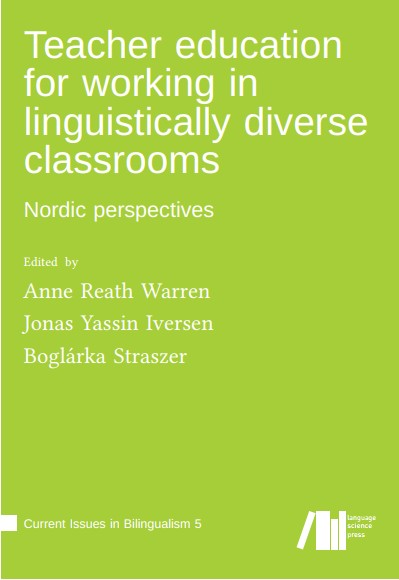
In this conversation, we talk about Anne’s new book Teacher education for working in linguistically diverse classrooms: Nordic Perspectives. The book was published by Language Science Press in 2025 and was co-edited with Jonas Yassin Iversen and Boglárka Straszer. Like all Language Science Press books, Teacher education for working in linguistically diverse classrooms is available open access.
Teacher education for working in linguistically diverse classrooms presents studies on aspects of teacher education that prepare teachers for working in linguistically diverse classrooms and schools in five Nordic countries; Denmark, Finland, Iceland, Norway and Sweden. This twin focus (teacher education in linguistically diverse contexts; and Nordic perspectives) makes the volume unique in its field, and contributes to international discussions on how teacher education can prepare preservice and in-service teachers for working with linguistically diverse student groups.
The volume includes contributions on:
- Teacher education policies
- Teacher educators’ perspectives on teacher education
- Pre-service teacher perspectives on teacher education
The ways in which teacher education prepares educators for working with newcomers and multilingual students has attracted considerable attention in recent years. This reflects the increasingly linguistically diverse nature of classrooms that teachers around the world meet, that is in turn, a direct result of intensified globalization and transnational migration. Clearly, teacher education is crucial for successful implementation of educational provisions for multilingual students. Teacher knowledge, gained partly through teacher education, plays a central role in creating educational environments where multilingual students can thrive.
This volume focuses specifically on teacher education in a Nordic context, a region traditionally associated with progressive approaches in education based on principles of inclusivity, social justice and equal opportunity. In the twenty-first century, most Nordic countries have experienced increasing levels of migration. While neither multilingualism nor transnational migration are new phenomena in the region, geographical and social factors, as well as the ways humans communicate have helped make multilingualism more visible in the twenty-first century. Schools in the Nordic countries have had to act quickly and think flexibly to meet the needs of an increasingly linguistically and culturally heterogeneous group of students. The ability of the Nordic countries to provide these students with “inclusive, equal education and a fair chance to start a new life” constitutes in some ways the ultimate test of the “Nordic model” of education. Investigating how this challenge is addressed in different forms of teacher education is the topic to which this volume turns its attention.
 If you enjoy the show, support us by subscribing to the Language on the Move Podcast on your podcast app of choice, leaving a 5-star review, and recommending the Language on the Move Podcast and our partner the New Books Network to your students, colleagues, and friends.
Reference
Reath Warren, A., Straszer, B., & Iversen, J. Y. (Eds.). (2025). Teacher education for working in linguistically diverse classrooms: Nordic perspectives. Language Science Press.
Transcript
INGRID PILLER: Welcome to the Language on the Move podcast, a channel on the New Books Network. My name is Ingrid Piller, and my guest today is Professor Anne Reath Warren. Anne is an Associate Professor in Education at Uppsala University, with a focus on multilingualism and newcomers’ education. She works to provide professional development for mother-tongue teachers, tutors, and municipalities in Sweden to improve the learning experiences of multilingual and newcomer students. Today, we want to talk about Anne’s new book, Teacher Education for Working in Linguistically Diverse Classrooms: Nordic Perspectives. The book was published by Language Science Press in 2025 and was co-edited with Jonas Yassin Iversen and Boglárka Straszer. Like all Language Science Press books, Teacher Education for Working in Linguistically Diverse Classrooms is available open access.
Welcome to the show, Anne!
ANNE REATH WARREN: Thanks, Ingrid. Very nice to be here.
INGRID PILLER: Anne, can you start us off by telling us about yourself and how you got to write this book?
ANNE REATH WARREN: Sure. Well, I should be open about this. I was born and I was educated up to master’s level in Australia, and I moved to Sweden as an adult, and that’s where I still live now. I worked for more than 15 years as an English teacher and an ESL and an EFL teacher before I ended up applying to PhD studies at Stockholm University in Sweden to research what we’d call, in English, community or heritage language education, in both Sweden and in Australia. I got curious about this because the way this is arranged in Sweden is different from the way that it is arranged in Australia. So, I wanted to know more about that, and today I work at the Department of Education at Uppsala University in Sweden.
And I think you said that in the intro, most of my teaching is in professional development. So, I do kind of tailor-made courses, but also courses that are included in teacher education programs for mother tongue teachers who work in the mainstream system in Sweden, which is a little different from the way things are in Australia. So, in terms of the book, it partly goes back to an extremely frequent comment or question that I get from teachers in these professional development or courses that I teach on, often they’ll say something like, oh, this has all been very interesting and thank you for coming and yes, we recognize what you’re saying. And so all positive comments, hopefully, most of the time.
And then they’ll say, have you ever thought about talking to teachers about this?
And I would literally be a millionaire if I had gotten a dollar for every time I got that question or perspective that I’ve tried to be polite and say, yes, that’s very interesting and I will try. And I do try to get these perspectives into teacher education at Uppsala, although I’m not actually teaching on the teacher education course, not at this stage, but some of my close colleagues are. Yeah, so like I said, I don’t teach on the teacher education courses in Uppsala. So I can’t comment in detail about them. I know that there are, to some extent, of course- I think I can even say that, multilingual perspectives in teacher education courses in Uppsala and in other Nordic countries. However, I do think from the research and from what people say to me, the teachers that I meet, that
Teachers are still graduating without feeling confident that they’ve got the knowledge and the pedagogical didactic tools they need to work with multilingual students.
So, yeah, I’ve been curious about this question and together with my co-editors, Jonas Yassin Iversen and Boglárka Straszer, it provided a really good opportunity to kind of explore this question, not only in the Swedish context, but in a broader Nordic context and try to disseminate knowledge about this for an international audience.
INGRID PILLER: Yeah, that’s right. So you talk about Nordic perspectives and that’s the subtitle of the book. So I was wondering, maybe can you tell us a bit more about what that actually means or what the educational and migration context in the Nordic countries is?
ANNE REATH WARREN: Yeah, sure. I mean, we wanted to have this Nordic perspective for different kinds of reasons. I think that I wouldn’t be entirely wrong if I said that for quite a lot of researchers, but even for a broader, more general audience, that the Nordic region could be regarded as, or is regarded as some kind of, if not a haven, but a place where these progressive approaches, social approaches exist and there’s with a big focus on social justice, equal opportunity, and also an education system that reflects these values and is more overt this education system, I mean, in promoting high levels of knowledge.
Here, I guess, I’m thinking a little bit about the Finnish school, which people were very, very interested in for a long time because they performed so well in Pisa. Now it’s Estonia that’s performing very well in Pisa. That’s a Baltic state, not a Nordic state, but it’s not far from here.
And, you know, part of this certainly in policy is valid.
Multilingual students, and, well, the definition of what a multilingual student is, could be the topic of another podcast. But if we, we talk about these, this group of students that, that perhaps don’t have Swedish as their only mother tongue, that has expanded a lot, grown a lot in recent years, as it has done in the rest of the world as well. So now, approximately 30% of pupils in the compulsory school in Sweden, at least, speak languages in addition to Swedish at home. The figures in the other Nordic countries, we’ve, we’ve got them all in the book. And I’d say that Sweden has the, the largest proportion of multilingual students, but there are increasing numbers of multilingual students in all Nordic countries, even Iceland, which some people used to think was, you know, basically a monolingual country. That’s certainly not the case.
What we thought was interesting was this intersection between a school that’s thought to be very progressive and aiming at equal opportunity and social justice, and to put that together with this increasing multilingual population.
In the introductory chapter we reflect on this intersection, saying that this will be the ultimate challenge for the Swedish system of education: incorporating, integrating, welcoming these students with diverse multilingual backgrounds. So we wanted to look at how teacher education was preparing teachers to meet these students and educate them.
INGRID PILLER: I really enjoyed learning so much. And as you mentioned, the Icelandic case studies are really fascinating because like, who knew that Iceland has a whole lot of linguistic diversity and migration, too. So, you’ve said already in the introduction that teacher education really hasn’t kept up with linguistic diversity in the Nordic countries. But I mean that’s true around the globe. Linguistic diversity in schools is a reality but teacher education continues to have a bit of a monolingual habitus. In the introduction, you set the scene by broadening out the vision and telling us about teacher education for linguistic diversity globally. So can you maybe sum up the state of play in that field for us?
ANNE REATH WARREN: That’s a pretty big question. The research that we quote in the introduction has got a few years on it now. I would say that since this volume has been published, there continue to be articles and different kinds of volumes published on this topic. And I think that it’s fair to say that the research on translanguaging and the importance that’s being placed by researchers and translated into schools, policy documents anyway, on viewing and also leveraging multilingualism as a resource, I think that has gained a lot of traction.
And I think it’s a lot of teachers have kind of heard about this and wanting to know more about it. We see that in our contract education department at Uppsala. How it is around the world I can only really gauge by reflecting on the research. Um, and of course, translating that research and the kind of theories underpinning them into teacher education is another issue. So, and of course, context matters to, so, you know, each country, and I mean, even to some degree, each continent, I’d say, has got its own very specific socio-cultural, socio-linguistic, socio-political setting which impacts, of course, on the way that kind of the research, the current research, the impact that it can have on the actual organization of teacher education.
I see that there’s still a lot of work to do in terms of understanding how teacher education is reacting and addressing the needs of linguistically diverse students.
The world just doesn’t stand still either. And, um, other issues come up, which grab the attention of, of researchers and teacher educators, not least AI, generative AI now is occupying a big space in the minds of people who organize teacher education. So it’s, you know, I feel that we have an ongoing job to keep these questions relevant and on the table, so they don’t kind of get knocked off for the next issue.
INGRID PILLER: Yeah, for sure. And I mean, it’s one thing to sort of have like policies on the books or sort of discursively valorize linguistic diversity, but then practically actually changing structures, getting things into teacher training, getting, you know, attention to linguistic diversity, into workflows, into actual school rooms. So I think that’s really where the challenge is.
So let’s maybe now home in on the Nordic context. Can you tell us a bit how teacher education is organized there and how linguistic diversity comes into teacher education in the Nordic countries?
ANNE REATH WARREN: Hmm. Oh, that’s, that’s the whole volume, isn’t it?
INGRID PILLER: Yeah.
ANNE REATH WARREN: Yeah. No, good question. Because, you know, this is actually, this goes back to the very first question you asked about, about how, how I came to write this book, because, you know, we really, we don’t know much for people who work in teacher education, even, even we who work with these issues, don’t know an awful lot about what goes on outside of our own context. And I think that it’s fair to say that not many people know about the different kind of forms of multilingual education or forms of education for multilingual students that exist in the Nordic country. So, yeah, and having said that, each of the Nordic countries represented in the volume, and there are five countries with researchers that have contributed to the volume. It’s Denmark, Finland, Iceland, Norway, and Sweden. Each of these five countries has got its own structure and approach to teacher education. They’re always, of course, I mean, it’s fairly clear that there would be different pathways for becoming a primary school or a lower secondary or an upper secondary school teacher. Also, preschool teacher programs exist as well. But in Finland, Norway, Iceland, and Sweden, teacher education is organized at universities. It’s a five-year master’s program, whilst in Denmark, Denmark is, in fact, the only Nordic country that organizes teacher education in a four-year program in teachers’ colleges. So, Denmark stands out a little bit there. But there are, of course, lots of other differences as well, depending on the different countries, depending on, you know, if you focus on your subject studies first and the educational aspects after or, yeah, in what order you do things. In Finland, just to bring up Finland again, they, the teachers there, the pre-service teachers there, they complete their teacher education program, which is a year-long program, after they’ve studied the subjects that they’ll be teaching at the master’s level. So, that’s, you know, the way that they do it in Finland, but it is different in each of the countries.
INGRID PILLER: Yeah, so, I mean, you’ve pointed out the differences now, but at the same time, you show in the book that there are a number of key themes that emerge from the studies that you bring together in the book. So, could you tell us about what those key themes are?

Teacher trainees (Image credit: Department of Education, Uppsala Universitet)
ANNE REATH WARREN: Yeah, well, that was really interesting, because we didn’t know where these contributions would end up, or, you know, we didn’t, we really didn’t know how the volume would end up when we started work on it during the pandemic years, in fact, was when the idea started up. But we could see quite clearly that there were overlaps between the contexts. So, one of these themes was the tension regarding, or the questions, perhaps, rather than tension, the uncertainty as to how to integrate multilingual perspectives. And, um, I mean, just organizationally. So should you, should all pre-service teachers study one subject, something like the Danish model. They, all teachers there, regardless of their level, there’s a course called Teaching Bilingual Students, and all teachers do that. And in fact, it’s a study on that which is analyzed in the volume.
Whereas in other contexts, including my own, in Uppsala, we tend to have more like a multilingual strand in different subjects, so that it’s, on paper, it’s a constant through all subject teaching.
The second theme connects to this, and that is which pre-service teachers, should be educated about teaching linguistic diversity, is this something that language teachers should be informed about? We can see in the volume, and in the research generally, that it’s, it’s a responsibility, which is frequently given to language teachers, often the second language teachers, if there are second language teachers in the context. But, you know, is this reasonable, or should it be something that all teachers, science teachers, teachers of geography, religion, maths, uh, other languages should, should get input in? So that was another tension, which pre-service teachers.
The third tension is very well known in other issues as well, and that’s this, the tension between theory and practice. Because I mean, steering documents, at least in Sweden, and I speak from my Swedish perspective there, but it does seem to be the same in other Nordic countries as well. The steering documents are really impressive, and great formulations and validation of multilingualism as a resource.
Teachers do not always know what to do with the theoretical knowledge that they’ve gained in teacher ed.
Yeah, which leads us to believe that we need to also work on, as teacher educators and, you know, providers of professional development as well, make sure that we don’t only focus on the theory, but also on how that can be enacted.
INGRID PILLER: Yeah, so, to take you up on that one, what actually needs to happen to better prepare pre-service teachers for the multilingual realities they’re inevitably going to face in contemporary classrooms?
ANNE REATH WARREN: Yeah, well, I just said one of them, the one about enacting multilingual pedagogies. You need to have practical application, you need to have theoretical knowledge, to really thoughtfully enact multilingual pedagogies. I think it would be interesting also, just in terms of knowing what to do, I would like to see more kind of fine-grained analysis of the content of teacher education in different contexts to see what is actually being offered. So, what I mean here is not just the policy or looking at what the teacher educators or the pre-service teachers, looking at their beliefs or thoughts about it, but looking in a lot of detail at the documents, the content driving teacher education. And I think there’s also a very strong argument for working with pre-service teachers, but also in-service teachers, exploring their beliefs. Because we know the strength of what people think about things. And I mean, if we can talk to teachers and reach, like I say, both the pre-service, but also the in-service teachers and, and discuss these students and multilingual development and what is helpful in supporting multilingual development and development of majority language knowledge and majority languages. I think we can do a lot by engaging \with these teachers about those issues as well.
INGRID PILLER: Yeah, and I think Teacher Education for Working in Linguistically Diverse Classrooms really makes a really good start in just giving us these very contextualized case studies and a lot of informative research about specific classrooms and specific policies. So, before we go, Anne, what’s next for your research?
ANNE REATH WARREN: Thank you for asking, Ingrid. I got some very exciting news last week. There’s an independent foundation in Sweden that promotes and supports research in humanities and social sciences. They’re called Riksbankens Jubileumsfond. And I was awarded funding from them for a sabbatical year. So next year and into 2028, I’m going to be collaborating with researchers who also look into community language education in Australia and writing a book for community or heritage language teacher education. So this is a really exciting and amazing opportunity that I’ve been given to develop a book that I hope will support teacher education, potentially even in different countries, to develop programs that will work, teacher education programs for heritage language teachers and help them in their own particular context.
INGRID PILLER: Congratulations, Anne, this is such amazing news. And I’m so happy for you and for all of us, because I’m sure it’s going to be amazing research. And I’m really looking forward to hearing what’s coming out of that and reading the book and having you back on the show. So thank you so much for this conversation, Anne. And thanks for listening, everyone. The book we’ve been discussing, Teacher Education for Working in Linguistically Diverse Classrooms, is a really important book for anyone interested in education. And it is highly relevant not only in Scandinavia, but wherever teachers meet multilingual students, so essentially everywhere on this globe. I hope this conversation has whetted your appetite, and I recommend you go and read the book. It’s available open access through Language Science Press.
If you enjoyed the show, please subscribe to our channel, leave a five-star review on your podcast app of choice, and recommend the Language on the Move podcast and our partner, the New Books Network, to your students, colleagues, and friends. Till next time!





 This work is licensed under a