
In this episode of the Language on the Move Podcast, Dr Agi Bodis speaks with Dr Carly Steele (Curtin University, Perth) about researching education with Aboriginal and Torres Strait Islander communities and how to enable culturally and linguistically responsive teaching. They discuss the importance of positionality when working in Aboriginal and Torres Strait Islander contexts, and why it matters in collaborative work with communities.
Through her professional experience in the On-Country Teacher Education program in Western Australia, Carly reflects on the way educational scholarship is rooted in community engagement. The conversation provides insights into the needs of teacher education to better prepare graduate teachers and an example for an innovative pedagogical approach co-created with community and one that reflects the local language, culture and Country.
If you enjoy the show, support us by subscribing to the Language on the Move Podcast on your podcast app of choice, leaving a 5-star review, and recommending the Language on the Move Podcast and our partner the New Books Network to your students, colleagues, and friends.
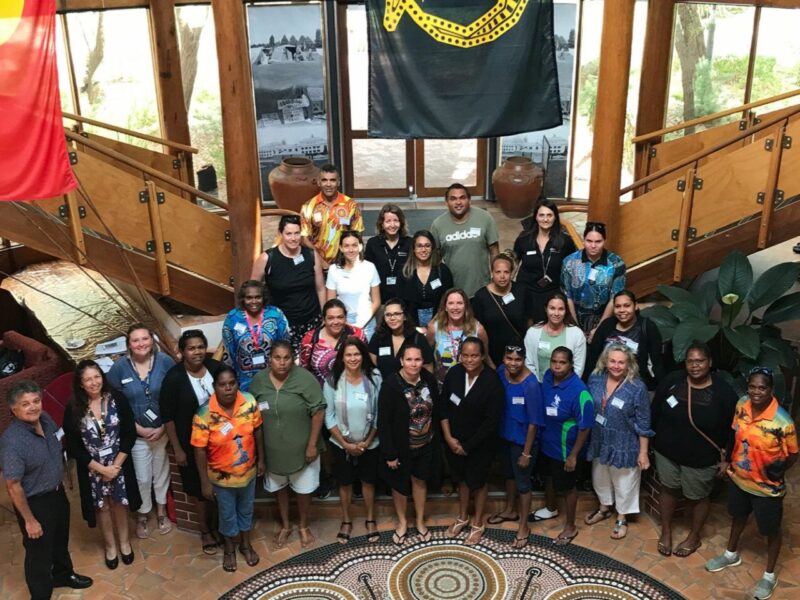
Image credit: Curtin University On Country Teacher Education)
References
Ober, R., Steele, C., Harvey, A. (2026). Strengthening Aboriginal and Torres Strait Islander Language Learning: For the next generation of language learners. Australian Review of Applied Linguistics, 49(3). https://doi.org/10.1075/aral.00049.obe
Ober, R., Steele, C., Harvey, A. (2026). Working together for stronger Aboriginal and Torres Strait Islander languages: In the Decade of Indigenous Languages. Australian Review of Applied Linguistics, 49(2), 153–167. https://doi.org/10.1075/aral.00048.obe
Steele, C., Dobinson, T., Dovchin, S., Robinson, C., Oakley, G., Cumming-Potvin, W., Gower, G., Grace, K., & Manado, S. (2026). Exploring land, language and culture through playworld translanguaging: one child’s meaning-making practices. Language, Culture, and Curriculum, 1–21. https://doi.org/10.1080/07908318.2026.2666552
Steele, C., Chen, J., Andreassen, K., Dobinson, T., Dryden, S., Veliz, L., Partridge, D., Michell, M., Turnbull, M., Schiavi, M., & Stewart, B. (2025). To what extent do Australian universities offer dedicated units to prepare pre-service teachers to support EAL/D learners? TESOL in Context, 33(2). https://doi.org/10.21153/tesol2025vol33no2art2108
Steele, C., Gower, G., & Bogachenko, T. (2024). Creating and enacting culturally responsive assessment for First Nations students in higher education settings. Australian Journal of Education, 68(2), pp. 84–102. https://doi.org/10.1177/00049441241258496
Related content
- Taking the scenic route to high-quality education for Indigenous students
- Your languages are your superpower!


 This work is licensed under a
Chaná is worth putting next to this episode.
The books declared it extinct long before Blas Wilfredo Omar Jaime was found. He had learned it at home, from his mother, quietly, because the world outside the house had already buried it. He kept it until he died in September, at 92. No curriculum saved Chaná. A household did. Now his daughter Evangelina is learning it and teaching it, and the programs can help her, but they did not start it.
That is the order of operations I would want graduate teachers to hear. A program can support a language a family is already carrying. It cannot substitute for the family carrying it. Teachers who arrive expecting to be the first door usually find out they are the only one.
Thank you for your important comment! And thanks for the reference to Blas Wilfredo Omar Jaime and Chaná. May he rest in peace and may his memory be a blessing!
Thank you, Ingrid. It is the household part I cannot shake. He learned it in a whisper because the street outside had already buried it, and still it reached his daughter. A program can hold a door open. It cannot be the first one through. May his memory be a blessing.