
The Language-on-the-Move team is delighted to host our annual research symposium at Macquarie University on December 07. This year we’ll explore “Literacies in crisis: speeding up, making do, caring.”
Abstract: The headlines blare, “Cost of living crisis. Mental health crisis. Climate crisis.” And the list could go on. We find ourselves in a world where a state of crisis has become normalized and where individuals, institutions, and whole societies are besieged by internal and external threats. Literacies are deeply enmeshed in these crises, as they simultaneously are the cause of crisis (e.g., algorithmic discourses feeding the crisis of democracy), a coping tool (e.g., digital help seeking and service provision), and a means of overcoming crises (e.g., individual learning and collective organizing).
In this year’s Language-on-the-Move Symposium we will explore these intersections and tensions in contexts of linguistic diversity.
This is a free event but places are strictly limited. Please register your attendance here.
Please consider your registration as binding. If you register and your plans change, please withdraw your registration so that your spot can be allocated to someone on the waiting list.
 Program
10:30-11:00 Arrive for an 11am start
11:00-11:30 Welcome addresses
-
-
- Simon Handley, Pro Vice Chancellor, Graduate Research, MQ
- Distinguished Professor Ingrid Piller, MQ & UHH
- Dr Loy Lising, MQ
-
11:30-13:00 Keynote
“I turn to it for anything that a person can’t explain; it’s my great helper”: Exploring forced migrants’ making-do with language technologies (Dr Jenia Yudytska, UHH)
13:00:13:30 Lunch break
13:30-15:00 Lightning Talks
-
-
- How GenAI creates new burdens for international students seeking linguistic and academic support (Dr Ana Sofia Bruzon, UNSW & MQ)
- Caring for multilingual students in higher education (Dr Agi Bodis, MQ)
- How women with limited English find domestic violence support information (Tazin Abdullah, MQ)
- When “getting by” becomes the norm: Medical receptionists and language support for patients with limited English proficiency (Brynn Quick, MQ)
- Emotions, Digital Literacies and Care in Bengali Transnational Families in Australia (Dr Priyanka Bose, WSU)
- Encounters in Intercultural Communication (Dr Robyn Moloney)
-
15:00-15:15 Short Break
15:15-16:00 Group work
Student perspectives on AI in higher education (Co-designed by Dr Agi Bodis with Master of Applied Linguistics and TESOL students, MQ: Man Nhi Chung, Berkehan Davran, Cheng-Yu Hunaf, Faranak Jalali, Vanessa Florencia Leiva Salas, Claire Livesey, Mahiat Lubaba, Hoai Ngoc Pham, Thi Ha Anh Phan, Kateryna Radmanovich, Ha Phuong Tran, Thu An Tran)
16:00-16:45 Panel
Centering people (Panelists: Dr Ana Sofia Bruzon; Dr Jenia Yudytska; Dr Hanna Torsh; Moderator: Brynn Quick)
16:45-17:00 Close-out
17:00-18:30 Reception and networking
Organizing committee
Ingrid Piller, Loy Lising, Agi Bodis, Brynn Quick, Emily Pacheco, Tazin Abdullah, Hanna Torsh, Ana Sofia Bruzon
Abstract
“I turn to it for anything that a person can’t explain; it’s my great helper”: Exploring forced migrants’ making-do with language technologies (Dr Jenia Yudystka)
For migrants who face language barriers in the country of destination, meeting informational and communicative needs can be highly challenging. This is particularly true for forced migrants, whose language learning may be impeded by the precarity of their situation. Many turn to language technologies as a resource for, for instance, dealing with housing matters or accessing healthcare; these technologies include machine translation, language learning apps and, more recently, generative artificial intelligence (genAI). This paper draws on de Certeau’s concept of ‘making-do’ (1984) – the creative, everyday tactics people employ to get things done while lacking institutional power – to explore how migrants make do with imperfect technological affordances to reach everyday communicative goals.
This topic is investigated through an ethnographic study with Ukrainian forced migrants in Austria. The data includes semi-structured interviews with six Ukrainian women in 2024, four of whom were re-interviewed in 2026; the paper also draws on participant observation from two Ukrainian-Austrian mutual aid communities on Telegram. Overall, the technologies are found to be employed for three major functions: language learning, translation and interpretation, and information gathering. Creative and at times critical usage can support forced migrants’ agency, as in the case of a participant teaching herself work-specific vocabulary with genAI. At the same time, the necessity for participants to make do with technologies in high-stakes contexts, such as relying on machine translation to discuss a cancer diagnosis with medical staff, only highlights the insufficiency of institutional support. The broader implications of forced migrants making do with language technologies are ambiguous, as effective digital tactics help individuals cope with precarity while papering over structural gaps that remain unresolved.
How GenAI creates new burdens for international students seeking linguistic and academic support (Dr Ana Sofia Bruzon)
Over the past few years, the use of GenAI tools has become rampant in higher education and international students are particularly keen adopters. Yet, the contexts, constraints and affordances of GenAI use for language and content learning as well as social integration remain poorly understood. This paper draws on a set of reflective writings by a group of international teacher trainees to examine (a) how students use GenAI; (b) how they evaluate their use of GenAI; and (c) how they envision GenAI to affect their future professional practice. Using thematic analysis, we find, first, that a majority of students report using GenAI regularly for language and content learning purposes, including working on their assessment tasks, while a minority resist the use of GenAI for academic and other purposes. Second, both groups report significant negative feelings, such as fear of inadvertently engaging in academic dishonesty, of stunting their own learning, or of missing out. Third, students fall back on widely used tropes related to AI inevitability or critical AI literacy when they consider GenAI in their future teaching practice. We conclude that the ready availability of GenAI tools in higher education coupled with the ubiquitous injunction to use GenAI “critically” is disempowering to students in the absence of open debates about students’ lived experience of AI use within the broader context of their learning and settlement. The study has implications for education service providers: without adequate supports, the rapid and widespread rollout of new technologies creates yet another burden for already marginalized students.
Caring for multilingual students in higher education (Dr Agi Bodis)
Australian universities are characterized by high levels of linguistic diversity; however, they operate through monolingual structures and processes. Research shows that international student experience is often racialized: through linguistic racism, or microaggressions, student face discrimination based on their communication styles and skills, especially if these do not overlap with “standard norms”. These dynamics can undermine students’ sense of belonging and raise questions about providing the care students are entitled to. This talk reports on international students’ linguistic experiences in Australia based on 107 survey responses and 20 semi-structured interviews. Drawing on Baker and Burke’s (2023) work reimagining care in higher education, it examines multilingual students’ linguistic experiences along three dimensions: (1) purpose, (2) power dynamics and (3) plurality and particularity of care. It calls for a co-created dialogic approach for care that views multilingualism and multilingual knowledge production as a resource.
How women with limited English find domestic violence support information (Tazin Abdullah)
In Australia, headlines frequently speak of the domestic violence (DV) crisis, with women experiencing DV at alarming rates. Women who have low English language proficiency (ELP) are particularly vulnerable in relation to a combination of their literacy needs and social circumstances. While digital spaces are inundated with DV support and service information, is this information meaningfully accessible in languages other than English (LOTEs) for vulnerable low ELP women seeking support? To investigate this question, this paper analyzes LOTE DV information provided by institutions using the 4-A standard (availability, accessibility, acceptability, and adaptability) of language support. Triangulating data from institutional websites, survey results, and interviews with DV case workers, this study finds that availability, accessibility, acceptability, and adaptability are affected by a) complex website features, b) lack of socio-cultural context and, c) limited understanding of the diverse needs of low ELP women in DV situations. The findings demonstrate that the convergence of collected online data, multilingual participant input, and diverse practitioner perspectives generate more inclusive, context-sensitive understandings of language access while amplifying the voices and experiences of linguistically marginalized communities. This presentation closes with implications for more inclusive design of vital DV support information.
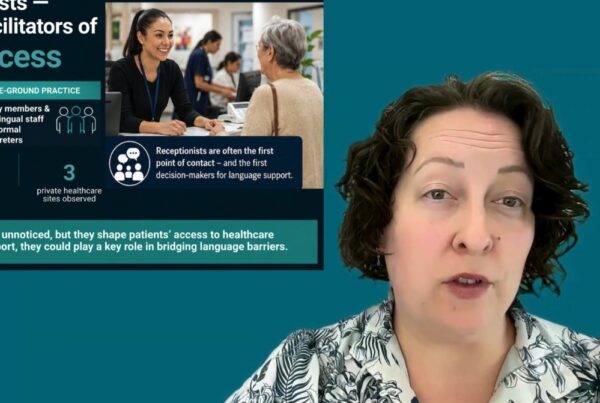
When “getting by” becomes the norm: Medical receptionists and language support for patients with limited English proficiency (Brynn Quick)
Patients with limited English proficiency frequently encounter English-based healthcare systems in which communication depends on decisions about whether and how language support should be provided to them. Previous research has described healthcare providers’ practices of “getting by” with these patients, whereby providers use strategies such as simplifying language, relying on bilingual family members, or proceeding without professional interpreters. Such practices have generally been understood as pragmatic responses to time pressures, competing clinical priorities, and organizational constraints, with providers often recognizing them as compromises that may affect the quality and equity of care.
This study extends the concept of “getting by” by examining how medical receptionists make decisions about language support for patients with limited English proficiency. Drawing on semi-structured interviews with 15 medical receptionists working in an Australian healthcare system, the study examines how receptionists make decisions around facilitating access to professional interpreting services. Participants described routinely “getting by” with patients (rather than calling for a professional interpreter) by speaking slowly, using simpler vocabulary, writing information in English rather than communicating orally, and, when other strategies failed, using Google Translate.
Unlike previous research with healthcare providers, however, receptionists did not necessarily characterize these practices as problematic or as a compromise in care. This finding reflects their distinctive institutional position. Receptionists reported receiving little or no training in linguistic diversity and described no clear institutional expectations concerning the importance of professional interpreting for patients. Consequently, the additional communicative work involved in assessing the need for and securing professional interpreters remained largely invisible as a distinct component of their role. This led to receptionists deciding to “get by” in their communication with patients with limited English proficiency as a strategy that would be less taxing on their own workflows – workflows that had never been designed to include this language support work.
The findings suggest that language access is not simply a matter of individual decisions about whether to use an interpreter. Rather, organizational workflows shape what kinds of communicative work are recognized, anticipated, and resourced. When receptionists’ additional time and effort are not incorporated into institutional understandings of their work, “getting by” can become normalized rather than recognized as necessary labor required to provide patients with limited English proficiency with communication comparable to that available to English-proficient patients.
Emotions, Digital Literacies and Care in Bengali Transnational Families in Australia (Dr Priyanka Bose)
In transnational families, digital communication provides an important space to sustain relationships, emotional connection, and heritage language (HL) practices across geographical distance. This presentation explores how Bengali immigrant families in Australia use multimodal digital communication to maintain intergenerational connections with grandparents living overseas. Drawing on data from three Bengali immigrant families in Australia, including video conversations, screenshots of online interactions and interviews, the study examines the role of emotions in digitally mediated HL practices through multimodal (inter)action analysis. The findings demonstrate how emotional contagion and digitally mediated affective communication are expressed through speech, gestures, images, emojis and other multimodal resources. These interactions show that HL is embedded within everyday acts of family bonding, with maintaining emotional connection emerging as a primary purpose of digital communication. Connecting with the symposium theme “Literacies in crisis: speeding up, making do, caring,” the presentation considers these everyday digital practices as literacies of care, through which geographically dispersed immigrant transnational families sustain emotional and linguistic connections across generations.
Encounters in Intercultural Communication (Dr Robyn Moloney)
This presentation introduces Robyn’s new book Encounters in Intercultural Communication, which examines lived experiences across diverse global workplaces. The book offers an engaging, personal approach that moves beyond traditional academic abstractions toward dynamic relational understanding. Through 30 compelling interviews with individuals from Asia, Europe, Australia and Papua New Guinea, including First Nations participants, readers encounter intercultural communication across varied professional contexts: business management, law, architecture, mining, education, healthcare, journalism, community work and creative arts. This diversity makes the book applicable across multiple academic disciplines without requiring context adaptation. Using reflexive ethnography, the work analyses key concepts while examining assumptions, beliefs, power structures, and language and social inequities that shape intercultural communication.



 This work is licensed under a