
In this episode of the Language on the Move podcast Ingrid Piller speaks with Professor Sandra Issel-Dombert. Sandra is Professor of Spanish Linguistics at Universität Duisburg-Essen in Germany. Her research focus is on everyday multilingualism, in the workplace, in healthcare, and in the family.
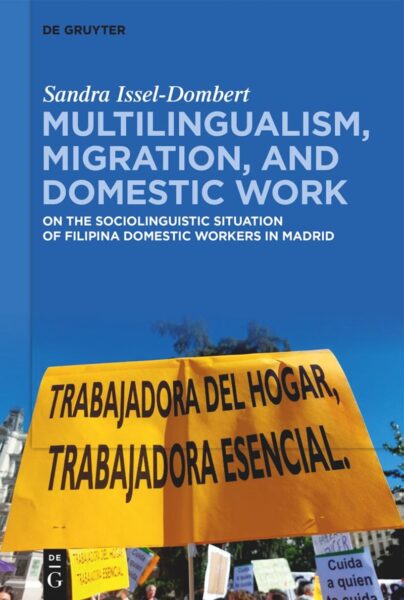
We talk about Sandra’s new book Multilingualism, Migration, and Domestic Work: On the Sociolinguistic Situation of Filipina Domestic Migrant Workers in Madrid. The book was published by de Gruyter in 2025 and is available open access through UPL Open.
The book explores the intersection of multilingualism and transnational migration in the global sector of domestic work in Spain, the second largest labor market in the EU. Over the course of three years, a corpus of field notes, narrative interviews, focus groups, language portraits and language maps was built with 25 Filipina domestic workers (FDWs) in Madrid, partly collected through participatory approaches. The analysis focuses on three main aspects: first, spatial repertoires; second, the multilingual everyday life and lived experiences of languages; and third, the agency of FDWs. The aim of this study is to better understand the dynamics that emerge from inequalities of multilingualism in the feminized sector of transnational domestic work.
The book expands our understanding of multilingualism and transnational migration in the feminized sector of paid domestic work. It is a pioneering contribution to the growing field of language and migration, offering new insights into the sociolinguistic aspects of migration from Spain’s only former colony in Asia to Spain. Theoretically, the study adds a postcolonial and critical approach to language and migration, using a variety of methodological techniques.
If you enjoy the show, support us by subscribing to the Language on the Move Podcast on your podcast app of choice, leaving a 5-star review, and recommending the Language on the Move Podcast and our partner the New Books Network to your students, colleagues, and friends.
 Reference
Issel-Dombert, S. (2025). Multilingualism, Migration, and Domestic Work: On the Sociolinguistic Situation of Filipina Domestic Migrant Workers in Madrid. De Gruyter. https://doi.org/10.1515/9783111714288
Transcript
INGRID PILLER: Welcome to the Language on the Move podcast, a channel on the New Books Network. My name is Ingrid Piller, and my guest today is Professor Sandra Issel-Dombert. Sandra is a professor of Spanish linguistics at Universität Duisburg-Essen in Germany. Her research focuses on everyday multilingualism in the workplace, in healthcare, and in the family. Today, we want to talk about Sandra’s new book, Multilingualism, Migration, and Domestic Work: On the sociolinguistic situation of Filipina domestic migrant workers in Madrid. The book was published by De Gruyter in 2025 and is available open access through UPL Open.
Welcome to the show, Sandra.
Can you maybe start us off by telling us about yourself and how you got to write this book?
SANDRA ISSEL-DOMBERT: Yeah, I’m a Romance linguist. I’m interested in the Spanish-speaking world, and I have a strong interest in multilingualism, migration, and social injustice. Well, my grandmother, she was born in the 1920s, and please don’t get me wrong, of course, that’s really different compared to Filipina domestic migrant workers, of course. My grandmother, she shared a lot of memories, and decades later, I was for the first time in Hong Kong, and I noticed that Hong Kong is really different on Sundays because in some parts of the city, there are women gathering in parks, on bridges. And first of all, I wasn’t sure what I was observing. A couple of months later, I was in Madrid, and once again, I became aware of this phenomenon because I spotted a campaign from a transnational agency, and they were looking for Filipina domestic migrant workers, and I was wondering why they are specifically looking for Filipina women, and that’s how it started, because I was curious.
INGRID PILLER: Yeah, I was also interested that sometimes, you said in the book that sometimes, when you did your research that people actually thought, like, you were looking for a live-in maid, or they didn’t quite get that you were a researcher or your interest, and thought you were actually trying to recruit someone. And so your book is, or the research in the book is based on ethnographic fieldwork over three years from 2021 to 2023. And you did what you call a yo-yo ethnography. Can you tell us what that means, and what did you actually do? How did you collect your data, and how did you conduct your research?
SANDRA ISSEL-DOMBERT: Well, the concept of yo-yo ethnography was coined by Helena Wulff in 2002, and she used this metaphor to refer to the fact that it isn’t always possible to stay for a longer period in the field. And it was also, in my case, I couldn’t stay there for three years. And the idea of yo-yo ethnography refers also to the fact that you would like to protect the limited time of your participants, because in the case of domestic workers in Madrid, their time is really limited, because they have only 36 hours of free time per week.
Yeah, I mean, that’s so generous, actually, to then share time for research.
INGRID PILLER: And you also talk about how you met them at church, and in various places where they’re hanging out. So, let’s maybe start with the context a bit more. And that’s also how the book is organized. So, you start with the research problem and outline the methodology. And then you have two chapters where you talk about the different contexts, the country of origin and the destination country. Let’s start by taking a closer look at the first of these contextual chapters, Chapter Three, where you provide an overview of language and colonialism in the Philippines. Can you explain to us why your participants left and what the specific context is from which they left?
SANDRA ISSEL-DOMBERT: Very often the participants described the Philippines as a beautiful country with a beautiful landscape. And they shared a lot of memories of their childhood with their families growing up in the Philippines. But the problem was that it was really difficult to find a job there, in the Philippines. And that’s why they left the Philippines. And one of the participants said, we’re looking for a greener pasture also for our families, for our children.
INGRID PILLER: It’s such a migrant-sending country. And then they arrive in Spain. And before I read your book, I have to admit, I wasn’t even quite aware that domestic migration to Spain is a thing. So maybe can you tell us a bit about Spain’s transformation into an immigration destination?
SANDRA ISSEL-DOMBERT: Yes. Spain has a long tradition as a country of emigration. And that changed in the late 20th century. There was a growing economy. And lots of the participants also told me that they had networks in Europe when other family members came to Spain. And they could also use these networks to come to Spain. And today, Spain is among the most important destination countries all over the world. It’s in the top 10. So this situation really changed profoundly in the last two decades.
INGRID PILLER: Yeah, it’s amazing. Because at the same time, Spain does remain a migrant-sending country, too. So yeah, that was really fascinating to read. Let’s now go a bit deeper and just meet your participants. I personally was particularly struck. I mean, they’re all amazing, touching, fascinating stories. But let’s pick out Beatriz, who I really was struck by. So this woman was just about to embark on a sciences PhD back home in the Philippines when marriage and childbirth set her on a different trajectory. And she became a live-in maid in Spain. Can you tell us a bit more with her example or another example about the linguistic repertoires and the professional trajectories and the aspirations of your participants?
SANDRA ISSEL-DOMBERT: Yes, Beatriz. It’s a pseudonym, of course. All names are pseudonyms except mine. I met Beatriz in the church where I met the majority of the participants and Beatriz told me a lot about her life, how it was for her growing up in the Philippines. Her father was a university professor. Her mother was a teacher. And the first thing that I remember was when she told me that at home, her parents tried- always spoke English with her. And she has a lot of practices to use or to protect also her verbal hygiene of English. And yeah, she studied and she got the opportunity to pursue a PhD. But she got married and she had four daughters. And her husband left the Philippines to work abroad in Spain. And he became ill. And that’s why Beatriz decided to care for him. And she left also the Philippines. And her four daughters stayed in the Philippines while she was living and working in the Spanish capital with her husband. Yeah, that was the life trajectory of Beatriz. And they worked together, she and her husband, they worked together in a private home for several years. And it was really hard because she couldn’t use her qualification in Madrid until today. She lives and works in Madrid in a private household as live-in. And she also told me one of her daughters later joined her. She came also to Madrid. But Beatriz did everything to make sure that her daughter could find another job. And that’s why she sent her daughter to a language course to acquire Spanish. Because, as Beatriz told me, this is what you really need. To speak Spanish to secure a job position in another field.
INGRID PILLER: It’s so interesting how the value of language resources changes across the life course and the trajectories of these women. And in terms of language repertoires, we essentially have like three big resources in play. There are the various languages from the Philippines and then there is Spanish. And as you’ve already said, and there is English. And maybe you can tell us a bit about the role of each of these languages or sets of languages in the lives of your participants and particularly in their professional experiences and their aspirations, as you’ve just done for Beatriz. Her parents taught her English to give her, you know, more opportunities. And now she’s trying to ensure that her daughter learns Spanish to have more opportunities. Can you illuminate that a bit?
SANDRA ISSEL-DOMBERT: Yes. Well, the other participants told me that at home, when they were growing up in the Philippines, they speak different languages, different local languages. And the situation changed when they attended school. Because in school, the instruction was in English and in Tagalog. A lot of them have told me also that they consume mass media, like television and so on, to learn English. And when they went abroad to work in other countries, communication with the employers is in English all over the world. In Spain, there was a big surprise, because for the majority of the participants, they observed that the role of English is different compared to other countries.
This has changed in the last few years. Nowadays, we can observe a phenomenon that is referred to as English frenzy or English fever, which means that the status of English has changed a lot in Spain. And there are a lot of families with children in school, they try to hire tutors or live-ins to teach English to the children or other family members. That was the first surprise. Even if you’re capable of speaking English, it would be really difficult to use this part of your multilingual repertoire when you’re, for example, in a restaurant or in a hospital, for instance. And that’s why the participants also agreed that it is necessary to learn Spanish. And of course, the languages from the Philippines also play a pivotal role, but mostly in private situations, speaking with friends, speaking with friends in the church, for example, or on other events with the Filipino community in Spain. Or, of course, when they were talking to their families in the Philippines or all over the world.
INGRID PILLER: I thought that was really well brought out. You bring that out so well, these contradictory roles that languages have, like English, for instance. On the one hand, it kind of is an additional bonus, if you will, in their job search. And it’s like value added, that they can teach English to the children of their employers. So it becomes like, you know, a bonus, added value because they’re seen as native speakers of English. So that brings economic opportunities. But on the other hand, English alone is not enough and can be quite exclusionary in terms of social participation outside of their narrow workplace. So maybe you can talk a bit about learning Spanish too? How did that go?
SANDRA ISSEL-DOMBERT: That was really challenging. Because as I already mentioned, domestic workers have only 36 hours free time in a week. And with other words, you have to organize your whole life, your whole private life in these 36 hours. Some of them hired a tutor, for instance, in a group or also individual lessons. Also, the churches. There are different Filipino churches in Madrid. They also offer language courses on Saturdays or Sundays with volunteers. And, yeah, it’s really difficult to learn a language in this limited timeframe.
INGRID PILLER: Yeah, for sure. And I mean, that flies so in the face of this ideology that we often have, you know, you’re in the country and you should be, you know, immersed in the language and it becomes really easy. But at the same time, you show quite clearly that actually the circumstances of these women preclude essentially mostly Spanish language opportunities, Spanish language learning opportunities.
SANDRA ISSEL-DOMBERT: Also in the workplace, in the private homes, it was often really hard for them to learn or to practice Spanish. Sometimes, they speak Spanish with the children, but the parents, try to install a monolingual English language regime at home.
INGRID PILLER: Yeah. So the various interests really conflict in terms of language policies and language desires, for sure. Um, another question I wanted to ask you. So in your final main chapter, you talk about, you show that, um, or throughout the book, we actually see that like, in Beatriz’s case, most of your participants, have a huge discrepancy between their educational and professional qualifications from back home and then the domestic work that they are undertaking in Spain. And at the same time, in this final chapter or this pre-final chapter, you describe domestic work as an “automatic pathway” for these women. Can you explain how this works, how they get from being highly educated and, and having professional qualifications, to this automatic pathway to domesticity?
SANDRA ISSEL-DOMBERT: Well, the Philippines are one of the biggest countries that sends live-ins all over the world. And it’s part of the campaign or the commodification of Filipina domestic migrant workers. They are commodified as highly versatile. They can easily adapt, learn foreign languages, and they are also cheap. So that’s the main idea of this commodification. A lot of participants had experiences with other family members, the mothers, sisters, for example, who were already working abroad and due to these familial ties and transnational networks, it became an opportunity to find a job. That’s the automatic pathway.
One of the participants, I called her Kate. She also tried to find another job in the cleaning service of a hotel, but it was so difficult for her because her perception was that she couldn’t speak Spanish. She could understand it, but she couldn’t talk with the employers. She couldn’t talk with guests, for instance. So that’s why she wasn’t able to secure another job position.
INGRID PILLER: It’s all embedded in these global inequalities, of course.
SANDRA ISSEL-DOMBERT: Exactly.
INGRID PILLER: Before we go, what’s next for your research, Sandra?
SANDRA ISSEL-DOMBERT: Well, I’m interested in the care sector and all over the world. We can observe that there is a huge demand for personnel who works, for example, in hospitals, but also in homes for the elderly. And here in Germany, we have several programs. We try to hire personnel from different countries in Latin America. And I’m interested in their sociolinguistic situation in the migration process and also in questions of language learning, participation, discrimination as well. And the use of artificial intelligence – is it really helpful or what are the challenges? And I’m also interested in multilingual families. What happens when one of the family members is affected by dementia?
INGRID PILLER: Well, we’ll be looking forward to your next book, or two books with these kinds of projects. Thanks so much, Sandra. And thanks for listening, everyone. Sandra’s book, Multilingualism, Migration and Domestic Work, is an incredibly rich book for anyone interested in language and migration. And I hope that this conversation has whetted your appetite, and I recommend you go and read the book. As I said, it’s available open access through UPL Open. If you enjoyed the show, please subscribe to our channel, leave a five-star review on your podcast app of choice, and recommend the Language on the Move podcast and our partner, the New Books Network, to your students, colleagues, and friends. Till next time.




 This work is licensed under a