
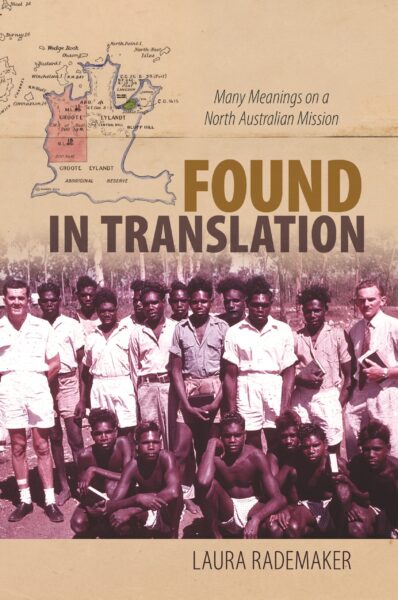
In this episode of Language on the Move Podcast, Tazin Abdullah talks to Dr. Laura Rademaker (Australian National University), the author of Found in Translation: Many Meanings on a North Australian Mission.
The conversation explores the distinctive historical context of Australia’s Northern Territory as a location for Christian missionary activity. Tazin and Laura talk about the multiple tensions and elements involved in language interactions between monolingual English-speaking missionaries and multilingual Indigenous communities, against the background of settler colonialism.
Found in Translation: Many Meanings on a North Australian Mission was published by University of Hawai’i Press in 2018.
About the book
Found in Translation
is a rich account of language and shifting cross-cultural relations on a Christian mission in northern Australia during the mid-twentieth century. It explores how translation shaped interactions between missionaries and the Anindilyakwa-speaking people of the Groote Eylandt archipelago and how each group used language to influence, evade, or engage with the other in a series of selective “mistranslations.”
In particular, this work traces the Angurugu mission from its establishment by the Church Missionary Society in 1943, through Australia’s era of assimilation policy in the 1950s and 1960s, to the introduction of a self-determination policy and bilingual education in 1973. While translation has typically been an instrument of colonization, this book shows that the ambiguities it creates have given Indigenous people opportunities to reinterpret colonization’s position in their lives.
Laura Rademaker combines oral history interviews with careful archival research and innovative interdisciplinary findings to present a fresh, cross-cultural perspective on Angurugu mission life. Exploring spoken language and sound, the translation of Christian scripture and songs, the imposition of English literacy, and Aboriginal singing traditions, she reveals the complexities of the encounters between the missionaries and Aboriginal people in a subtle and sophisticated analysis.
 Rademaker uses language as a lens, delving into issues of identity and the competition to name, own, and control. In its efforts to shape the Anindilyakwa people’s beliefs, the Church Missionary Society utilized language both by teaching English and by translating Biblical texts into the native tongue. Yet missionaries relied heavily on Anindilyakwa interpreters, whose varied translation styles and choices resulted in an unforeseen Indigenous impact on how the mission’s messages were received. From Groote Eylandt and the peculiarities of the Australian settler-colonial context, Found in Translation broadens its scope to cast light on themes common throughout Pacific mission history such as assimilation policies, cultural exchanges, and the phenomenon of colonization itself.
This book will appeal to Indigenous studies scholars across the Pacific as well as scholars of Australian history, religion, linguistics, anthropology, and missiology.
Related content
- Grey, A. (2025a). Podcast Episode 63: Australia’s National Indigenous Languages Survey: Alexandra Grey in conversation with Zoe Avery
- Grey, A. (2025b). Making linguistic diversity visible in Parliament
- Jacobsen, B. (2017). Aboriginal languages matter – but to who?
- Kavanagh, B. (2018). Are Aboriginal languages really useless in the workplace?
Transcript
Tazin:
Welcome to the Language on the Move podcast, a channel on the New Books Network. My name is Tazin Abdullah, and I’m a PhD candidate in linguistics at Macquarie University in Sydney, Australia.
My guest today is Dr. Dr. Laura Rademaker. Laura is a DECRA research fellow at the School of History at the Australian National University in Canberra. She works in the areas of interdisciplinary histories as well as oral history and memories, with a special interest in ‘cross-culturalising’ history. Her interests include religion, gender, secularisation, and ‘deep history’. She is an editor of History Australia, monographs editor for Aboriginal history Monographs and secretary of the Religious History Association.
On this episode, we will find out about Laura’s work, with a special focus on her 2018 book Found in Translation: Many Meanings on a North Australian Mission. Laura’s work in this book provides a highly engaging exploration of the intersection between English, Christianity, and Australian citizenship. Set against the interactions between Christian missionaries and Indigenous Australians, we learn about the deep intricacies of the relationship between language and place.
I’m very excited about this podcast, and Laura, welcome to the show. Thank you so much for joining us today!
Dr. Laura Rademaker: Thank you so much for having me. It’s a real honour.
Tazin: To begin with, could you tell us a little bit about yourself, your research, and how you came to be interested in historical language contact?
Dr. Laura Rademaker: Sure, so I’m a historian down at ANU, as you said. I’m not an Indigenous person myself. I became interested in, I guess, the interactions that happened at Christian missions in Australia, particularly after I – so, I did an honours thesis way back when in the day. It was soon after the apology to the Stolen Generation, by Prime Minister Kevin Rudd, and I learned from this that. So, I come from a church background. I learned from this that my own church had been part of, had been complicit in the removal of children.
And I did a thesis looking at the white women who, I mean, you could say looked after, you could say, were guardians who were the, you know who I mean. Looking after isn’t the right term, really. Like, these are kidnapped children, but the women who took in these children in a remote mission on Groote Eylandt. But doing that thesis, it was increasingly led to question, how did how did these people from completely different cultural backgrounds – how did they communicate with each other? How did they understand each other? What did they make of each other? You know, had these children from remote communities who didn’t speak English, maybe spoke a little bit of pidgin and later Creole, and these white women coming up from Sydney and Melbourne who only spoke English and had very fixed ideas about what they wanted to impart to these children. I wondered, what did these children make of all of that, and what did the Aboriginal communities who surrounded them, and who were sort of looking on to the mission, what did they make of that?
Also, way back, you know, even longer before this Honours thesis, I was a rotary exchange student, in Denmark.
Tazin: Oh, wow!
Dr. Laura Rademaker: And I learnt to speak Danish when I was there. Well, you know, imperfectly, and my Danish is rubbish today, don’t ask me to speak Danish. But something that I really took out of that experience was the significance for people, especially people who speak a language which is not, you know, not widely spoken. It really mattered to the Danes that I was that I was learning their language, and they were really excited that someone would learn Danish, which they thought was of no use, apart from, to have better relationships with Danish people. And so that’s kind of stuck in my mind, that, the significance of languages for smaller communities.
Tazin: That’s amazing, especially in the context of today, when people learn language from apps The difference between what you described – learning a language while interacting with people, as opposed to learning a language from an app. It’s amazing that that’s what inspired you.
Dr. Laura Rademaker: Yeah, and it’s actually something that came up in the research. I mean, we’ll talk about this later, but I was interested in why some missionaries learned Aboriginal languages and why others didn’t, and the relational dynamic is really what’s important.
I think teaching someone your language is an act of hospitality, is an act of generosity, it’s relational, and you can’t barge into a language community without an invitation or a welcome. Or at least that’s the way I see it. And so having these unique and precious languages as a way for Indigenous people to control who entered their worlds, and to exclude people who are not welcome.
Tazin: Wow! Well, turning to your book, I would like to ask you about a quote from the preface, and I use this because I found it very meaningful, personally, and, you know, I felt like it is the basic philosophical question about translation. So in the preface, you say: “Whether translation – and all the ambiguities that might attend it – was a blessing or a curse is a matter of interpretation.” Could you tell us about this?
Dr. Laura Rademaker: Yeah, I mean, this was really the, you know, my core interest that was driving this. I’m interested in the way that translation you know, of languages, but also more broadly in a sort of a metaphorical sense of cultures. Well, the way it creates something new in the encounter. You can say, you can say all translation is imperfect, but even the label imperfect kind of puts a value judgment on it, that it’s deficient.
But it’s those so-called imperfections, that actually – where there’s something creative in this cross-cultural encounter that can come out, and there can be learning from different peoples. And I think in my research, what I was really interested in exploring was the way that First Nations people were able to take what missionaries brought and create something new on their own terms because of the ambiguities of translation.
Yeah, but we tend I mean, you tend to put those terms like imperfect or unfaithful and things like this that really do have that value judgment, and I wanted to really push back on this.
But in the – sorry, I’m going on.
Tazin: Go on, please. This is very interesting.
Dr. Laura Rademaker: In the context of colonialism and imperialism and these missions which were really trying to form people into being a particular kind of person and a particular kind of Christian, there was the desire to have a so-called perfect translation and convey this unchanging message that would be received in a, you know, in a predictable way. But that’s because of the ambiguities of translation, that wasn’t possible. And that’s happened again and again, not just in Australia.
Tazin: Yes, of course.
Dr. Laura Rademaker: In many contexts.
Tazin: Yeah, and then the way that, I guess, it was received, and whether it was beneficial to the people receiving it, is, as you say, a matter of interpretation.
Dr. Laura Rademaker: Yes, exactly, exactly. And the communities have different, you know, individual members and communities have different views on this as well.
Tazin: Yes, of course, yeah, that’s amazing. You write about the Northern Territory – that’s your research site – as iconic, being Australia’s settler colonial frontier. What is unique about the context that you have written about? And why were language and translation so significant in this context?
Dr. Laura Rademaker: Sure. Look, I, as a kid, my family did a lot of. We did a lot of road trips and camping trips and stuff, and, I travelled to the Northern Territory quite a bit as a child. And I guess for me, it has this nostalgic, you know, it’s still that, you know, I kind of had bought into that almost frontier romantic mindset. This wild landscape that was, you know, somehow represented the true, the real Australia.
I hope that I’ve been able to mature from that and become a bit more critical of the way that those visions actually sort of reinforce a settler colonial, a colonial ideology that the country is naturally belonging to white people, And anyway, this romantic vision of empty space ready to be sort of civilized or tamed or something. Anyway, so that, you know, I came to it with that background.
But, in terms of, as a researcher and as an historian, what’s really exciting is I guess the way for many communities in the Northern Territory, colonization, the beginning of colonization is still such recent history. You know, when I was doing oral histories up on Groote Eylandt. the people I spoke with, it was their parents who had first encountered white people in their country, and they remember as children the missions first being set up. This was the first non-Indigenous community setting up on their country, you know, in the1920s, 30s, 40s. That was a living memory. So it’s really, really recent history, and as an historian, this is, you know. Being able to sit down and talk with people about what that experience was like and, what it meant to their communities is fascinating and sheds light on earlier periods for which we can’t do oral histories. The mission encounter in Australia, the Christian missions, and happens so much later in Australia.
One of the stats that I sort of throw around is, in the 1950s and the 1960s, Aboriginal people in the Northern Territory were the most missionized people in the entire world. There was, I think there was one missionary for every, sort of, five to six Aboriginal people in the Territory. Like, it was crazy.
Tazin: Wow!
Dr. Laura Rademaker: The level of intensity of this, civilizing, Christianising project that was going on up there. So, it was a really intense encounter, as well as a really recent history that then can help us understand, sort of, much more global experiences, that happened in other places.
I mean, I can go on. The other thing about the Northern Territory is so many Aboriginal languages in the Territory are still so strong. They’re spoken by children, they’re, you know, they’re still people’s first languages. And one thing that I think is really helpful for me as a researcher is to have that experience of being the outsider and being unsettled as the English speaker. It reminds me that English is not naturally the language of this country. But I as an English speaker, English doesn’t necessarily belong, and I have to be the learner. I have to sometimes make a fool of myself because I don’t understand, or I’m trying to say something that, you know, is pronounced the wrong way, or means something different.
But that, I think I mean, I hope that comes through in my writing, having that experience, and seeing – unsettling how natural English feels in this place.
Tazin: Yeah, well, I mean, I from what you just said, I guess I’m taking away again how recent the history is, as you said, because sometimes we get this idea that all of these things happened in the past.
Dr. Laura Rademaker: No, no, no.
Tazin: And it’s way back there, but it’s not, and the impacts, as you have written in your book, actually last till today.
Dr. Laura Rademaker: I mean, colonization is still continuing, I would say,. But also, yeah, there’s people, you know, in living memory who can speak about massacres, knowing about massacres and things like that, really not very long ago at all.
Tazin: Much of that knowledge would also be in their languages, in their original, in their native languages. Wow!
I understand that the early missionary ventures in Australia were not very successful. How did the Christian missionaries attempt to engage with Aboriginal communities? What were the, you know, the tensions, the multiple elements that influenced their language use and interactions?
Dr. Laura Rademaker: Yep. Yeah, so this is something I’ve puzzled over for a while, and I’m still, still thinking through trying to understand as an historian.
So, the Christian missions in Australia were quite famously unsuccessful at the time. I’m talking about the early 19th century, and this was often blamed on Aboriginal people themselves, especially as you move through the 19th century, there was the argument that Aboriginal people lacked the cognitive ability to understand Christianity. That they maybe had, didn’t even have souls, that they were not, you know, religious beings, they couldn’t have, they weren’t, you know, their culture was supposedly so backwards. Things like this, you know, really horrifically racist, ideas.
But it is, I mean, when you look to the, you know, to the nearby Pacific at the same time, in the early 19th century, Christianity and demand for translated Bibles was really expanding quite quickly. So what, you know, what could possibly explain this?
One thing, sort of, structurally about Australia is that the Christian missions arrived more or less simultaneously, or just after settler colonisers who were claiming Aboriginal land. And so, the massacres, the displacement, the dispossession of land, the disease, all of this proceeds or is concurrent with missionaries. And I think in that context, I mean, Aboriginal people could see the contradiction, right? And the missionaries were ultimately, as much as many of them were quite critical of the violence and, you know, supported humanitarian causes – they were ultimately allied with the British Empire, which was responsible for all of this that was taking place.
And so to convert to Christianity in that context is a capitulation to this such a, this devastating destruction. At the same time, there was there wasn’t much I mean, in terms of Protestant tradition, translating the Bible is kind of the number one thing you do when you arrive in a new culture because you want the Christian message to be taken up in the culture of the people that you’re trying to convert. And this didn’t, I mean, there were there were small attempts in Australia, but there was no translated Bible until I think it wasn’t a full Bible in an Aboriginal language until 2002, or maybe it was 2005. Anyway, it was in the 2000s – very, very recent.
There were early missionaries who translated segments of scriptures, but there wasn’t, sort of large-scale Bible translation work in Australia. And this, I would say, was due to the belief that Aboriginal people were were destined to extinction. Or that if they were to survive, their future was going to be in English, and they were going to assimilate into white Australia. And so we have these sorts of colonising assumptions about the naturalness of English, the dominance of English, the naturalness of British possession of Australian soil right there from the beginning in these decisions not to translate, and the belief in the universality of English.
Tazin: And do you think the other aspect may have been the multiplicity of Aboriginal languages as well? Because there wasn’t just one language.
Dr. Laura Rademaker: Yes, that’s true, and I should have said that, yes, I mean, there’s many Aboriginal languages are closely related and mutually intelligible, but there’s so many languages.
But I would also say that was used as an excuse. It was there was sort of often the, well, well, there’s this language and that language, which language do we do? But it’s better that everybody just speak English. And so, it sort of cuts both ways.
Tazin: That’s so interesting, and I’ll pick up on that with you a bit later, because, you know, there’s so many parallels with language, in the use of English in Australia even now. But before that, I actually wanted to say that I learned a lot from reading your book. And one of the most interesting things I learned was that the Anindilyakwa speakers had, for centuries, already been engaging in the translation and interpretation of language and culture. So there was language contact between tribes, and with those from other lands, such as the Makassans.
And I was reading, I pictured, you know, people who were multilingual in a society where there already existed a sophisticated exchange between languages. And in this setting came the missionaries with English, a language, as you said, tied to settler colonialism and to citizenship in, you know, in Australia. Would you please tell us about this?
Dr. Laura Rademaker: Yeah, so this is, I mean, again, I’m not a First Nations person. I don’t speak for First Nations people, but this is all across, you know, the top end of the Northern Territory, multilingualism in Indigenous communities is the norm, and has been the norm for centuries for Indigenous communities. Marriage is often exogamous. You marry outside your clan, which is also normally, often, means that you marry outside your language group, and so there’s multilingualism within the family. Your mother and your father and your grandmother and your grandfather might all speak different languages, and this idea that you would be confined to just one language would be completely bizarre and unusual.
And, as you, as you mentioned, the Makassan traders, so they came from Sulawesi, from Indonesia. They’ve been coming for hundreds of years across the top end, and there’s, and they were multilingual as well. Their crews spoke sort of a Malay pidgin, but there was multiple languages on board these ships. And they exchanged with Anindilyakwa people on Groote Eylandt, about Yolngu people, Tiwi people as well, and you can find, like, words.
You probably know this, you can find words from their languages in these Aboriginal languages, and the one that I talk about in my book is Jura, which is common across the Northern Territory, a word that means paper, or book, or writing. Comes from Arabic originally. It has made its way into Aboriginal languages.
So there’s this really intense cross-cultural exchange around the idea of language communication, writing books. So Aboriginal people were aware of this long before the colonisers came, and had traditions of translating and interpreting, had norms about who would speak for whom, people were esteemed as interpreters, and linguistic expertise were recognized and valued. But there’s also sort of an embedded reciprocity and interdependence in when you have this inbuilt multilingualism in your community. When you become dependent on each other in a way that you might not, where you have a monolingual community. People have particular language expertise and are used to translating and interpreting, singing for different countries in ceremony. That would require someone who’s an expert in this or that language, so they can sing the right song for that song line. It all requires, you know, this incredible linguistic expertise, which is seen as a strength.
But for the English speakers, of course, all this is seen as a little bit messy and complicated, and wouldn’t it be much more efficient if everyone just spoke the one language. I think it was hard for the colonisers, for the missionaries, to see that this multilingualism might be a strength rather than an obstacle to overcome. And the Commonwealth’s government introduced a syllabus for Aboriginal schools in the 1950s that was very explicitly about introducing English. And they did say, oh, there’s so many languages, what are we going to do? It’s too hard to learn all the languages. We just need one language, and that language should be English, because this is the language of Australian citizenship.
Now I feel like I’ve rabbited on for quite a bit!
Tazin: Please, please go on. This is very interesting!
Dr. Laura Rademaker: Yeah, yeah, I guess in the work, I wanted to challenge the assumption that those who people who don’t primarily speak English as their first language or primary language were necessarily victims or vulnerable, that this multilingualism was a real strength. And that the assertion that English is, should be a universal language. And that we are stronger by all speaking the same language. Yeah, that’s a cultural assumption, and it’s also an imperial assumption in this context as well.
Tazin: And yeah, and this particular aspect of your work, you know, is particularly interesting for me and our team at Language on the Move, because a lot of our research strongly focuses on the implications for contemporary, multilingual or linguistically diverse communities in places like Australia, where English is, you know, remains a dominant language. English in Australia continues to relate to citizenship. And speakers of other languages, they have different identities assigned to them, depending on the language, often very negative identities, right? And there are high-status languages and low-status languages. There’s all those things, and perhaps we sideline what other languages have to offer. We lose what could be meaningful exchanges.
What can we learn from your work, and what can readers take from this very insightful historical account to inform our research in contemporary Australia?
Dr. Laura Rademaker: Yeah, I guess it’s what you were saying, that, that English doesn’t need to be the only or the dominant language. That there is great strengths and creativity and resources in being a multilingual community. And Australia historically has always been multilingual. You know, this English is not the language that is connected to this land. It’s not the language of the country. It’s the language that we, you know, it’s the dominant language at the moment, but it’s not the language of country. And I wanted to recover that and recapture that.
I also, as I said, I guess I wanted to challenge assumptions that, those who don’t speak English as their primary language are necessarily victims or vulnerable, that language. It can be a tool, it can be a weapon. There’s a way that evading English can be a choice, an assertion, a reclaiming of identity, a form of resistance.
I don’t know, you would have seen in the book, I opened this story about the first missionaries arriving on Groote Eylandt, and they wanted to translate the, the Sunday School song, Jesus Loves Me. And so, they approach the old man at the camp, and this missionary says, you know, “Jesus loves me, this I know” [Laura sings the line] and he wants to know the word for ‘me’. And the way he tells it is that he pointed to his chest and said, you know, me, how do you say me? And the old man gave him the word for chest hair. And so, the missionary started singing in Anindilyakwa, Jesus loves my chest hair.
Now, the missionary, he told this story many times, and he used it in his fundraising as kind of an amusing story about how these poor, ignorant, you know, ignorant First Nations people, supposedly, you know, were so naive or gullible or silly that they didn’t understand what he was getting at, and isn’t it a great story! But the way that I read it, and the way that I think makes sense, having met with the old people of this community, and I brought this interpretation to them and said, oh, yes, this is probably what happened is that the First Nations community, the old people were playing a joke on the missionary.
They used their language to set him up to make a fool of themselves and to assert themselves as the knowledge holders. Anyway, so I guess this is a long roundabout way of saying I want to, yeah, recover the agency of groups that are outside the dominant language community, and show how they’ve shaped Australian history as well, and show how their languages have been a source of strength.
Tazin: Yes, and I did find that story very amusing as well. So glad you began with that story. It was hilarious, and what you know, what a great way to understand what happened in that interaction, the way you described it. Tell us what is next for you and your work. What other research projects are you working on now?
Dr. Laura Rademaker: Sure, well, I’m continuing that work, with the same community up on Groote Eylandt, but also with some other Northern Territory communities on the Tiwi Islands, and Gunbalanya in West Arnhem, and I’m looking at a broader project on First Nations self-determination. But I’m also, I guess I’m really interested in the history of Christianity and Aboriginal land. The ways that religion has been used to deny Aboriginal land and
enable dispossession, but also the way that First Nations people have drawn on their spiritual resources and spiritual claims to make claims to land as well. So I’m very much in the thick of religious thinking at the moment, but, this work on translation is still very much on my mind and informing what I’m doing, the ways that concepts get translated across cultures, and then can be turned back against the dominant culture. I’m really interested in the ways that First Nations people have done that throughout history.
Tazin: And it’s wonderful for us to have this knowledge of history of languages in Australia. So,thank you very much for your work, Laura, and we really look forward to reading more of it.
Dr. Laura Rademaker: Oh, thank you so much. It’s been a pleasure.
Tazin: And thank you for listening, everyone. If you enjoyed the show, please subscribe to our channel, leave a 5-star review on your podcast app of choice, and recommend the Language on the Move podcast and our partner, The New Books Network, to your students, colleagues, and friends. Till next time!



 This work is licensed under a