
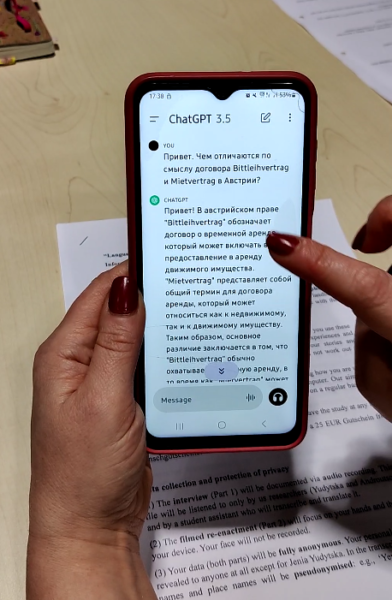
Ukrainian migrant asking ChatGPT to explain different types of rental contracts in Austria (still from Yudytska & Androutsopoulos 2025)
For nearly four years now, I’ve been heavily involved in online (Telegram-based) communities for Ukrainian forced migrants in Austria. Such communities sprang up all across Europe after Russia’s full-scale invasion of Ukraine in early 2022, serving as grassroots digital info-points. In those early, chaotic days, the groups focused on a Ukrainian’s first steps upon getting off the train in their new country. They have since expanded to cover everything from where to buy buckwheat (a very pressing question!) to the fine details of the local education system, health insurance, job market, etc.
The communities are run for Ukrainian refugees, by Ukrainian- and Russian-speakers, that is, overwhelmingly by migrants – forced, labour, student; first-gen, second-gen; etc. It truly is mutual aid: those who migrated earlier answer questions on integration, those who left recently give tips on how best to reach relatives in occupied territory. My family left in 1999, when I was five; I co-admin one group for Ukrainians in my home state of Upper Austria (ca. 3,700 members) and one group focused on how to change from the Temporary Protection status to a longer-term work/residence permit (ca. 8,300 members), plus I occasionally help out in other groups.
In 2025, our communities gained one more, less welcome, “member”: ChatGPT.
Migrants’ search for information
Understanding the role of ChatGPT in these communities requires understanding the complex informational space newly arrived migrants are in. There is an avalanche of info to take in. Some involves the everyday differences: when your child has a fever, at what temperature can you call the ambulance without getting in trouble for wasting their time? Other aspects are specific to the (forced) migrant status, and would stump a local too. Language barriers make accessing information difficult. Even with machine translation, it’s hard to know what term to google or how to interpret a bureaucrat’s answer.
This is where the Telegram communities come in, providing an easy place to ask for help and discuss problems.
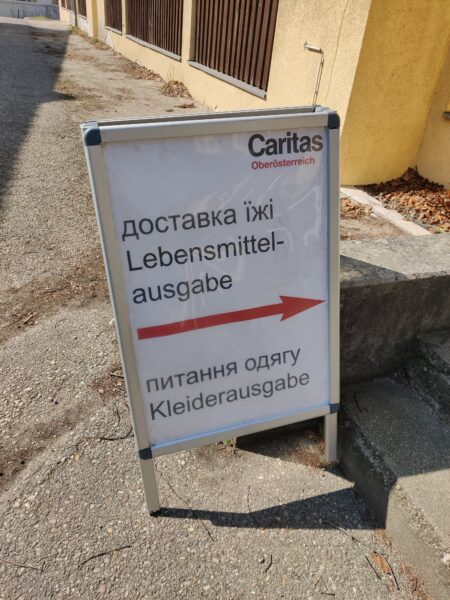
An NGO’s German-Ukrainian sign about food and clothing distribution; the understandable but incorrect Ukrainian suggests machine translation (photo taken by author)
Still, they’re not a panacea. Us volunteers learned only on the fly the ins-and-outs of the Austrian asylum system in all its kafkaesque glory: we sometimes misremember, misunderstand, and mistranslate. Grasping a question can take real detective work, especially when there’s a dozen ways to translate a single German term. Official Austrian sources give a lot of information orally; this leads to bewildering discussions where one person informs the chat their social worker said X, another says it was Y, and the third Z. Maybe it’s miscommunication, maybe the official sources have no clue either.
Above everything loom the rumours, best illustrated by the (admittedly pretty sexist) Russian acronym, ОБС – одна бабка сказала, lit. “some old lady said”. It’s used in the sense of, “Uh-huh, riiight, you got that info from your cousin’s friend’s mom’s neighbour”. In 2027 all Ukrainians in the EU will be put on the next train home, even if the war is still ongoing. Truth or ОБС? Great (unanswerable) question!
Enter ChatGPT
Into all this chaos slams the iron certainty of ChatGPT. If it worked as advertised, it would be an invaluable resource for migrants. You ask a question, it searches for and provides a summary of official information. No linguistic barriers, no mistranslations, no complex legalese; no petty online fights to wade through. The appeal is clear.
The only tiny problem is that it doesn’t work as advertised.
The biggest issue is in how ChatGPT functions: it doesn’t search for and copy-paste information from a database, but rather generates a statistically likely sequence of tokens (words) based on the data it was trained on. This is why it can “hallucinate”, that is, make up answers which are linguistically coherent but factually untrue. It has also obviously been fed more data (law databases, official websites, forum discussions, etc.) from Germany than Austria. For example, it has confidently explained to a Ukrainian that she’s legally obligated to have health insurance – true in Germany, not so in Austria.

Linz Castle on the Danube, Upper Austria, lit up in the colours of the Ukrainian flag (photo taken by author)
The AI technique ‘Retrieval Augmented Generation’ (RAG) is meant to resolve this: ChatGPT first searches for and pulls relevant information from a website, then incorporates it into the answer. (ChatGPT uses RAG sometimes, but not constantly. It costs more energy, thus more money.) But the answer is still generated, so hallucination is still possible. This leads to ChatGPT claiming, for example, “According to the City of Vienna website, Ukrainians have to hand in their old refugee ID card. [Link to website]” Except its generated summary missed a negation: the website explicitly states Ukrainians do not have to hand in their old refugee ID card. RAG can thus lead to even greater misinformation, as it implies a direct source.
The other huge problem is the limited information actually available on migrant issues; even if hallucination was somehow solved, the adage of ‘garbage in, garbage out’ for machine learning remains. For example, to switch to a longer-term residence permit requires the migrant to have an ortsübliche Unterkunft (“housing according to local standards”). ChatGPT physically cannot answer what these local standards are. I know this because, according to my old-fashioned research techniques of searching law databases, skimming court cases, and asking lawyer friends, neither can anybody else! Unfortunately, it is too often the case that there is too little concrete info for ChatGPT to be trained on.
In short, using ChatGPT for information is a gamble. Sometimes it works great, sometimes it generates nonsense. To know which is which, the migrant is left with the same problem of surmounting the language barrier they started with.
Mutual aid with and against machines
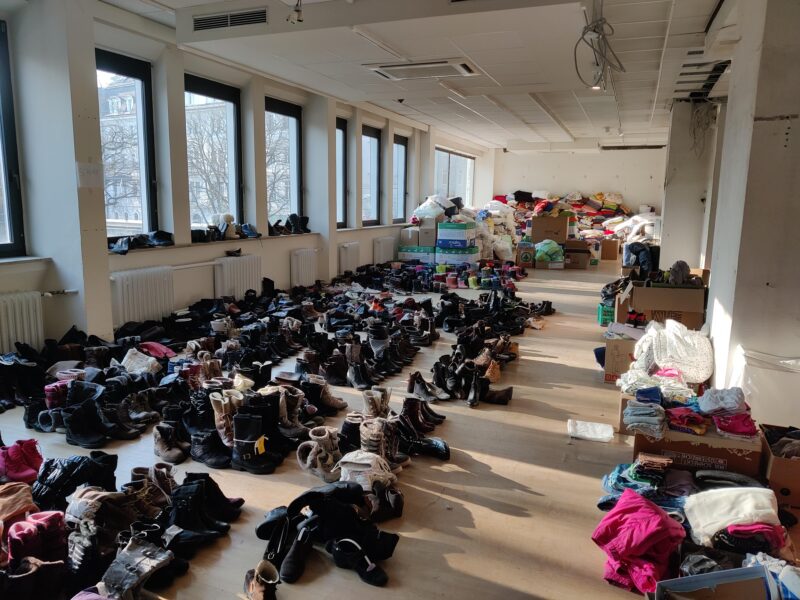
Rows of donated women’s shoes at SUNUA, a grassroots organisation supporting Ukrainians in Upper Austria, 3 weeks post-invasion (photo taken by author)
I don’t consider myself a techno-pessimist – actually, I rely on language technologies heavily in my online volunteer work. My phone’s autocorrect is a life-saver. While I can read and write in Russian, I left Ukraine before starting formal education, and find it slow and frustrating to spell without autocorrect. Similarly, machine translation is a great help. I occasionally need it to double-check my understanding of more complex Ukrainian-language questions; I also machine translate German-language official updates for the sake of speed, then post-edit the Russian text to correct mistakes and stilted phrasing before posting.
That is, due to my background as a child migrant from a primarily Russian-speaking area of Ukraine, I have varying levels of competencies in the three languages I need: Russian, Ukrainian, German. For all their faults, language technologies are an invaluable resource for stuffing the gaps so I can help people successfully. And efficiently, as this has always been 100% unpaid labour in my free time, next to my full-time uni work.
But all this is why I find the intrusion of ChatGPT into our spaces so infuriating on a personal level. In the midst of a horrible situation, between fear, grieving, trauma, burnout, we’re all trying to use the linguistic and technological resources available to us to help each other. I accept arguing against a community member’s cousin’s friend’s mom’s neighbour’s experience as part of that – that connection is also a resource, and it’s human to trust an acquaintance over a fuzzily written law in a language you don’t speak yet. I’m willing to spend my free time picking apart where the confusion lies.
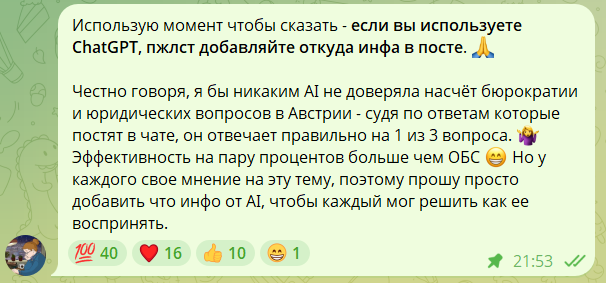
The author’s post in a Telegram group explaining that AI as a source must be clearly stated, with over 60 users leaving reaction emoji of agreement (screenshot taken by author)
I don’t accept arguing with ChatGPT screenshots.
ChatGPT adds beautiful formatting, with eye-catching emoji as bulletpoints. ChatGPT switches between Cyrillic and Latin easily, writing out German acronyms and translating them to Russian in brackets: ÖGK (Österreichische Gesundheitskasse – Австрийская касса медицинского страхования), wow. ChatGPT cites laws using a fancy § paragraph sign I have to copy-paste each time.
Sure, the actual information may or may not be correct, but that’s less important than the style, which so neatly mimics that of official sources. It simply looks trustworthy – the complete opposite of my own messages, written one-handed on a moving bus, with at least one butchered case suffix apiece. It’s unsurprising that people cling to ChatGPT’s information more stubbornly than to the usual ОБС.
Arguing against it is thus extra tedious and, frustratingly, requires me to do additional work. “Wait, no, where did you get that information from, is that an official source?” “Uh, nope, that website ChatGPT cited says the opposite.” “Dude, did you actually read the law ChatGPT ‘references’ – it’s about industrial chemicals, not document translation.” Most unsatisfactorily for all involved, having to prove a negative: “I’m sorry, but there’s no information on that. I don’t know why ChatGPT says there is, maybe it exists for Germany, but not for Austria.”
As a migrant who’s also stared at bureaucratic German in confusion and anxious despair, I don’t blame people for turning to AI. As a volunteer, it’s genuinely made me want to quit: in anger, in exhaustion, with a childishly vindictive, “Well, if they prefer machine over human, so long and thanks for all the fish.”
Where to next?
In principle, the issues explored here are no different from those we’re facing in other areas: education, academia, news, etc. Misinformation is rife everywhere; so is a lack of digital literacy on what current AI can and can’t do. For me, the crucial point is how vulnerable forced migrants are. Misuse of ChatGPT can lead not to a failed homework assignment but to problems on an existential level: with the legal status, with housing, with having enough money for food. Similarly, to put it bluntly, I’m paid to deal with students’ AI use; in volunteer work, it’s just one more weight tipping the scales in favour of finally quitting. It’s also important to add that not all my fellow admins share my worries. Some eagerly embrace ChatGPT answers themselves, which of course save time and energy for volunteers who have little of either to spare.
Our current ‘solution’ is that people must state openly that the information they’re posting is AI-generated. Then other members can decide themselves to what extent they trust it. In this, I would say, we’re ahead of the curve compared to many organisations, and for now, this will have to be enough.
Reference
Yudytska, J. & Androutsopoulos, J. (2025). The use of language technologies in forced migration: An explorative study of Ukrainian women in Austria. In M. Mendes de Oliveira & L. Conti (eds.), Explorations in Digital Interculturality: Language, Culture, and Postdigital Practices (pp. 135-166). Transcript. https://doi.org/10.1515/9783839476291-007




 This work is licensed under a
I searched online for an English bilingual public school near Hamburg Niendorf that would provide a good education, support my children in learning German and ideally offer Arabic classes. My research was quite difficult. The results I found were international or private schools, which were expensive and not was I was looking for. Furthermore the information about public schools was often only available in German language and it wasn’t easy to find details about language support, so I had to visit many different school websites and try to compare information which didn’t really lead to a successful finding in the end. I couldn’t find a school that provide lessons in Arabic.
The experience supports the argument that language can be a barrier for migrant parents as well as it is difficult to depend on digital tools to navigate through an unfamiliar school system.
Although we don’t face the same migrant issues, in the Chinese internet space, some people use information provided by Doubao (a widely used AI agent in China for simple daily life questions) to argue with you.☹️ Even though Doubao makes many silly mistakes, such as agreeing when you ask “Is 400+160=440 right?”, those people blindly trust AI and take this unverified information to debate you.😭 The thing I fear the most is that, when discussing a question with a netizen, you find their views are paranoid and terribly wrong. 🙁Since you happen to have a good grasp of this knowledge, you patiently try to correct him with a “mentor” mindset. But in the end, he throws out a screenshot of his chat with Doubao to prove you wrong. At this moment, you are left both laughing and crying, feeling a deep sense of powerlessness toward the current internet environment.🤐😵💫😮💨
As an IT professional from the UK, I recently received a job offer from Hamburg, Germany. Since I’ve got 2 kids I needed to find a suitable public school first before even considering that offer. Let me tell you that my search was incredibly frustrating. I googled ‘public schools in Hamburg’ and instantly hit a wall: what on earth is a ‘Stadtteilschule’? Even Google Translate couldn’t help with that.
I changed my search to ‘bilingual public school Hamburg Niendorf’ and found Phorms Hamburg. Their English website was a huge relief. It seemed great: staff are native speakers, helpful FAQs for families from abroad, and a place where both my 5 and 10 year old could stay together and learn German at that school. The problem is it’s a private school and super pricey: 250€ monthly fees, 100€ per month for healthy meals for lunch, 30€ per hour for after school care (which I would need as a full time worker in a high position). And it’s too far from Niendorf where we would live.
Using the ‘International Schools Database’, I found the Moderne Schule Hamburg close to Niendorf. It had an English site and room for both kids, but again expensive fees and their bilingual focus was actually English/Chinese, not German.
At last I found ‘gymnasien-hamburg.net’, a collection of bilingual schools, but it was 100% in German. The language barrier was massive and I had no clue what a ‘Gymnasium’ even was.
Overall it was extremely frustrating. All the information seemed to be in German only and there were no explanations of technical terms and no help for foreigners to navigate the school system of Hamburg.
Thanks, Henrik! Quite an eye-opener, right?
I thought that finding a multilingual school in Hamburg would be easy, because of the multicultural structure of the city. Especially one that could support English and would have the opportunity for Arabic classes. There are schools that offer bilingual education and those where you can prepare for the bilingual Abitur.
But the research surprised me. Most of the results were expensive private schools and it was difficult to find any public alternatives. Most official websites were only available in German, which creates a big barrier.
During my research I came across a PDF from the University of Hamburg which seemed helping at first. But it was only partially available in English, difficult to follow and it didn’t help me to find a school. The information was too general and bilingual options were mentioned but weren´t clarified enough. There was also no clear information about Arabic programs or where to find them. I only got links to private lessons after school but not integrated into the German school system.
Without any German skills, it’s challenging to even find information about schools that aren’t private and cost a lot of money. The process made very clear that without speaking German it’s very difficult to get access to the public school system.
With the language background that many families in Hamburg have, I can’t imagine how hard it is to find a school for their children. Especially without English Skills it seems almost impossible to find anything without translation.
Thanks, Luana_HH! It really is a surprisingly challenging exercise that clearly demonstrate how difficult it can be for newcomers to even just get basic information.
I am searching for a bilingual school for my kids in Hamburg Germany, because I probably gonna move there. I approached the task by starting with a simple Google search using the term “bilingual school Hamburg.” This quickly led me to the website of the school named “Phorms”, which offers bilingual education in English and German. While the school seemed promising, I noticed that its locations are not particularly close to Niendorf, which is too far away for my 5 year old kid. It has also no arab language programme.
To broaden my search, I then used the website “International Schools Database”, which provides an overview of international schools in different cities. Through this platform, I discovered the International School of Hamburg. It offers high-quality English-language education, making it a suitable option in principle. However, similar to my previous findings, I could not find any indication of an arabic language programme. So i probably have to find a evening school for my kids.
The International Schools Database looks like a good find, but have you looked at the school fees of the International School of Hamburg? €13,300-€26,450 pa …
Reading Yudytska’s post really reflected my own experience during this task. I started by searching for schools in Niendorf, since that is where my job would be located. If I didn’t speak German, I would first need to look up how to search for basic words like “school,” and other key terms, which already shows how difficult the process can be.
I would likely feel confused by the different types of schools in Germany, such as Grundschule, Gymnasium, and Stadtteilschule, because it is not immediately clear how they differ or which one would suit my children. Even when I found schools online, most websites were only in German, making it hard to understand whether they offered English support, German language learning, or heritage language programs like Arabic. I also feel that school websites do not provide enough information for migrant parents. A personal exchange seems very important, and I would probably try to visit a school and speak to someone directly. However, because of the language barrier, it would not be easy to find the right person or ask the right questions.
I think tools like ChatGPT could help explain the school system and reduce some confusion. However, I agree with Yudytska that the most helpful source of information would probably be other migrants who have already gone through this experience, struggled at first, and then became more familiar with the system. Their advice would feel more practical and trustworthy.
Thanks, Jasmin! For sure, one of the findings of this exercise clearly is that online sources are not enough to find a suitable school or make a considered decision.
First I used google maps to limit my search area to niendorf or to see how well the school I’m looking for might be connected to the place I live.
I searched for “international school” and “multilingual school” which did not give me any results in Niendorf nor down the U2 line into Eimsbüttel. So I went to the general approach of searching “secondary school” and hoping for the website to have an English version.
I got a result, the “Anna Warburg Schule” lies in central Niendorf. On the website there is no button to switch to English, but under the tab of “Schule” there is an about us in English. Only after navigating through that you can read that this school is a “Berufliche Schule”. Cause I thought other school websites might be built in the same stupid way I went to a general google search.
Trying it like this I found some results, most of them missing the term “Niendorf”. So I figured to even get some results that fit partly, I need to spend like half a day on going through school websites. So using an AI to conduct this tedious search got very appealing.
Thanks, Tim! Was the AI tool any more helpful?
The first thing I googled was: “public school hamburg niendorf for immigrant students”. One of the things that came up was this website https://www.hamburg.com/publicservice/info/11934300/ . The city of Hamburg apparently offers a consultation for parents and it seems like it would be available in English. I personally would probably set up a call with them to discuss my needs and ask for their recommendations. I think other than that it is quite difficult to find a public school online through Google since they only schools really advertising their programs online are private schools. What actually worked for me was going on google maps and looking for schools in the area. The websites of public schools that I found were only available in German but I used the automatic translation feature of my browser to translate the schools website. A school that might work for the requirements is the Grundschule Bindfeldweg. It’s a primary school that offers language training for students that learn German as additive language.
Thanks, Hanna! Good idea to go through Google maps!
First, I get links to various private tutoring services for English, which I have to decipher (they are in German). Then I stumble onto a blog entry. Mumabroad is an organisation specifically for families who navigate living abroad and gives information about all aspects of family life, including a list of schools in Hamburg with bilingual or trilingual curricula, naming also the degrees a student can obtain. There I find the Helene Lange Gymnasium, a state run middle and high school that teaches classes in English and German. Using google maps I discover that my oldest would take 45 min. one way to reach the school with public transport, if I drive them it would take half of the time. I continue my search for a suitable primary school for my youngest and stumble upon the Hamburg Welcome Center website, that gives general information about the German education system. The website provides a link for more detailed information and counselling services. However, this information is only available in German. It also names the School Information Center (SIZ) with address, phone number and email. I feel unsure if the recipient of my phone call will be able to speak English with me, so I divert to writing an email, explaining my situation. I can imagine that non-german speaking parents all share the same anxiety and will opt for the email option as well, therefore whether I get a reply in a timely manner depends on whether the SIZ anticipated this and has many employees working on answering emails. Continuing my search I find out more about Hamburg´s pre-school concept and the obligatory interview at your child´s primary school when they are between 4 and 5 years old to decide whether the child should enroll in pre-school before entering primary school. I find out via a blog called The Red Relocators that these interviews are conducted in German and are school specific. With this in mind, I now search for both pre-schools and primary schools that meet my criteria, and have already said good-bye to the idea that both my children can go to the same (state) school near our home in Niendorf. I really hope that the SIZ can shed some light on all this information I have obtained online, as I would prefer information from a reliable, government resource, rather than relying on blog posts. Regarding the option of a language programme in Arabic, I could not find one at schools. There were some private Arabic language institutes, but the websites were in German and I could not find out if they offer after-school classes for kids. (Side note: If you search for Arabic language programmes for children in German, you can find the website of the ebdaa center (Zentrum für Bildung und integration). The website has an Arabic and german version, so perhaps if one would search for it in Arabic, one may get it as a result in google.)
Thank you for sharing this detailed search journey – your frustration and anxiety are palpable, even if it’s just a fictonal scenario 🙁
My research on a bilingual primary school in Niendorf, Hamburg was pretty unsuccessful. When I searched on google for a “bilingual primary school niendorf, hamburg”, the first hit was Phorms Hamburg. I clicked their website without exactly knowing what Phorms was, as it only said “Willkommen & Welcome am Phorms Campus Hamburg.” Their website offered an English translation, but unfortunately their school was located in Hammerbrook.
Scrolling down the google hits, I found “The Red Relocators” website, which listed a few international schools and kindergartens in Hamburg, but again no Arabic school. I guess the best way to find a school for my two children is to call the School Information Center (SIZ) I came across. I hope that they can help me, because searching on google couldn’t wasn’t successful at all.
Thanks, Linus! Out of interest, I looked up the School Information Center (SIZ), which you found because it sounds highly relevant. On the landing page, it has a really promising download link to something called “Hamburg’s secondary schools / Choosing the right path.” Frustratingly, when you click on it, you see this:
The German version works, though, and is actually really informative …
I started my search online using keywords like “international schools Hamburg English”, “schools Hamburg Niendorf English speaking”, and “bilingual schools Hamburg”. I also looked at school websites and checked if they had information in English, because I do not speak German.
I found some international schools, like the International School of Hamburg (ISH). It seems to be a very good school with a strong academic level and English as the main language. However, it is a bit far from Niendorf, so daily travel could be difficult.
I also searched for bilingual schools and found schools like Moderne Schule Hamburg and Helene Lange Gymnasium. These schools offer both English and German, which could help my children learn German while still using English. I also checked if the schools have both primary and secondary levels, so both of my children can go to the same school. However, many of these schools are private and expensive if they teach in English.
I tried to find Arabic programs using keywords like “Arabic lessons Hamburg school”, but it was difficult to find schools that offer this. Most Arabic classes are outside of school, like weekend classes.
Overall, it was easy to find English-speaking or bilingual schools, but hard to find one that meets all my needs. I was also surprised that many school websites have very little information in English, which makes the search more difficult. Also, most bilingual schools are private and very expensive, which could be a problem.
Thanks, Jonathan! Did you find it easy to distinguish between private and public schools in your search results?
Yes, it was mostly easy, but sometimes it was not very clear. I can often tell if a school is public or private from its name
If I had children at the age of 5 and 10, and the conditions were described as in the assignment, I would proceed as follows:
I entered the following keywords into the Google search engine: „multilingual school offering English and Arabic in Niendorf“. The top result was the school website from „Phorms Hamburg“. The positive aspects were that the school system includes preschool, elementary school and high school. It focuses primarily on German and English, with well educated staff. This sounded perfect for both my kids, as they can attend the same school and receive a lot of language support. Furthermore, the website is available in German and English, meaning that multilingualism is taken into account and is already established on the website. Therefore English-speaking parents can easily access the scholl content. There was nothing mentioned about Arabic though. Upon closer inspection I noticed this is a private school – I was searching for a public school.
This was the reason why I narrowed down my search and typed: „public multilingual school offering English and Arabic in Niendorf“. This way, I found the „WABE International School“ in Pinneberg. It was not actually near Niendorf.
While doing my research I noticed many difficult aspects, which made navigating these kind of websites quite hard. I quickly realized that without clear instructions on how to conduct research, I would get completely bogged down. It is difficult to find out which are the primary languages at a school and I had to look very carefully to see if a website was available in other languages. I do have the advantage of understanding German and being able to process the content (where is which content located). And also out of this perspective I still have trouble figuring out where to find what and how.
It’s interesting that you find that even with your German knowledge (which the hypothetical parent in the scenario doesn’t have) you find this a hard task. Understanding how a new school system works is not only a matter of language …
I started my online search by googling “Niendorf school” and the first school that came up was the Stadtteilschule Niendorf. I clicked on their homepage and looked for a “translate” icon, but couldn’t find one. Instead, I tried to find words that I could understand as an English speaker, and one of these words was “Service”. There, I found two different telephone numbers, but because i don’t know what “Krankmeldung” meansin this hypothetical situation, I might have accidentally called the wrong number. At least I found an email-adress and a number, so I can ask the school directly if it fits my requirements, but that’s assuming that whoever is responsible for answering these calls speaks English. I decided to call the schoolmon Monday and decided to continue my search for other potential schools. I googled “school niendorf bilingual” and the Phorms School came up. Luckily, their homepage can be translated, but I found out that it is private school and I couldn’t find any Arabic courses.
Surprisingly difficult problem, right?
I searched for “bilingual public schools” near Niendorf and found Gymnasium Ohmoor. It’s prestigious and has a bilingual English track, which is perfect for my 10-year-old. But for my 5-year-old, I hit a wall: they have to go to a separate Grundschule (primary school), as they don’t usually share campuses.
The biggest challenge was the Arabic heritage program. I found that Hamburg does offer Herkunftssprachlicher Unterricht (Heritage Language Teaching), but it’s often held at specific “hub” schools in the afternoons. It’s unlikely to be right there on the Niendorf campus.
Thanks, Vanessa! I’d be curious what your search path to Gymnasium Ohmoor was and how many clicks it took you to get there, as no one else seems to have found it under the scenario.
I just moved from the UK to Hamburg and needed a bilingual school for my two children. I started by simply Googling things like “public schools Hamburg bilingual”, “international school” and “bilingual schools Hamburg Niendorf.” Very quickly, I noticed a major problem: many school websites were only in German! This made it hard to understand important information, even when I used Google Translate.
I did find some bilingual or international schools, but most of them were private, not public. Also, it was difficult to find a school where both children (primary and secondary level) could attend together. Information about support for learning German was sometimes mentioned, but not clearly explained. I also could not find clear information about Arabic language programs at schools. I want my kids to maintain their heritage language (my parents originally came from Lebanon), but this seems harder than I thought.
Overall, the search was frustrating and took a lot of time. I often felt unsure whether I had understood everything correctly. I also realized something important: I probably won’t be able to get everything I want for my kids.
Thanks, Ann! Even if you cut out the Arabic, are you confident you’ve found the right school for the children in the scenario?
Finding a perfect school that matches the needs of my children was really hard and frustrating. As my company is located in Niendorf, I started looking for “Public school Hamburg Niendorf”. Stadtteilschule Niendorf and Schule Sethweg Hamburg Niendorf sounded promising, but the websites were exclusively in German, which made it hard to understand and I couln’t find a translation plug-in. So I continued looking for “Public school Hamburg”. This led me to a website called “Understanding the School System in Hamburg” from the city of Hamburg, where I could find a lot of useful information as it was only in English. I found out about grammar schools, bilingual schools and that learning Arabic is possible at some schools in Hamburg. When I looked for “Grammar school Hamburg” all I could find were German websites again. So I tried a different approach and typed in “Which school in Hamburg teaches Arabic for children”. This led me to Phorms Hamburg, which looked really promising. The website was completely written in English. This school consists of a primary and secondary school with both promoting bilingual education, where teachers speak either German or English. Given the information on the website, I decided to take this school into consideration.
Thanks, Lara! “Understanding the School System in Hamburg” is a really useful website – how many clicks did it take you to get there?
What is the school fee for two children at Phorms?
My Research:
First, I began looking for a primary school for my 5 year old by searching for “multilingual primary schools in Hamburg”. The first result was Phorms Hamburg and I noticed the website offered an Englisch language version. Keywords like “international” and “different nations” caught my eye directely. I also saw that the school includes both a primary and a secondary level, which sounded perfect for my older child too. But upon closer inspection I realized it is a private school and does not offer the specific heritage language program I was looking for.
Continuing my search, I found the “International Schools Database”, which indicated that there are only three international schools in the city and all of them are private.
So I searched for “public multilingual schools Hamburg” and found the School Information Center (SIZ). I tried calling the provided phone number but no one answered.* I aspect they might think it is a spam call because I’m calling from an international number. Aditionally, calling from a non-EU country to the EU is becoming quite expensive.
It feels like my lack of knowledge is preventing me from finding the right school. After all this effort I’m not even closer to find a school that fits our needs and my budget.
*Information for Prof. Piller: I did not tried to call the number but I tried to imagine myself in that position.
Thanks, Eva! Even without making the actual call you’ve uncovered lots of barriers, even for someone as privileged as the person in the scenario …
Searching for a school for my kids.
Google prompt: English bilingual school for 5th and 10th grade in Hamburg near Niendorf with Arabic as a third language. I’ll write a step by step.
1: I clicked on the first link. I scan through and think “The website looks too professional: Is it for free?” – Search says: The ISH is not for free. It costs 13-25k per year per student.
2: I read some of the suggested questions from google, i.e. “Can a foreign child go to public school in Germany” Yes, most public universities in Germany offer tuition-free education for both domestic and international students, “What is the best international school in Germany” one in Munich, “can foreigners get free education in Germany?” answer: university is free for everyone (misleading, because you do have to pay semester fees, and not specific to my question about school instead of university), etc. So the google questions were not really targeted to my group of interest: school students.
3: I adapt my prompt adding “public”.
4: First link: “Phorms Hamburg” – Right corner “EN” – First line: “… private school”. – Frustration – Go back
5: Third link “List of every international school in Hamburg”. There is a search table. I select English, British (department) and Euro – I wonder: so does it always cost money if its bilingual? I go back.
6: I scroll down and see a link from hamburg.com. This seems official. “School Information Center SIZ Bilingual schools – Hamburg. The downloads and links for the information’s brochures don’t open “Seite nicht gefunden”. Not found. – I see the address and a “send email” button. I click there. It doesn’t work. I go down to see if I find the email address on the bottom. I don’t. It says the site has been updated yesterday. How can that be!? It gives me this: Keywords: Bilingual schools Bilingual primary schools Bilingual district schools Bilingual high schools Bilingual high school English based on the principle of immersive learning. I will try that but to be honest I’m extremely frustrated and annoyed that it is so hard to find information. I will ask chatgpt first.
7: chatgpt recommended the same schools, with the only difference of already telling me ahead that they are private and also recommended Gymnasium Farmsen with the note that it’s a long way to commute (1h 8 min).
I’m amazed, that it didn’t tell me anything about IKG or Stadtteilschule Stellingen, which through work or university I know that they offer bilingual classes in geography, history or biology. And the last one is even reachable with the U2, making a 22min way to school which is, maybe not the closest but definitely makable. And all this didn’t give me any results for Arabic as a third or heritage language; which again, through work I know that Friedrich-Ebert-Gymnasium offers it.
Thanks, Valencia, for this detailed description! Pretty shocking, right? That it’s near impossible to find good information online, and just also shows how Google now prioritizes commercial results to a degree that wasn’t true even a few years ago 🙁
For our readers who are no part of our Research Lab devoted to “Home-School Communication” at University of Hamburg, the task was:
Imagine you are a highly-qualified professional from the UK who has just been offered a lead IT role in a major Hamburg-based company. You are keen to accept the offer and are excited about the career opportunity. You do not speak any German but have been assured that that is not a problem because the company language is English and the use of English is widespread in Hamburg.
Whether you will be able to accept the position now depends on finding a good public school for your two children, aged 5 and 10. You are keen to find a school that has a strong academic reputation, where both your children can attend the same school, and where the children can use English but will be supported to learn German. Ideally, you’d also like a school that has a heritage language program in Arabic on the premises, as your parents are originally from Lebanon and you’d like to maintain their heritage language into the next generation.
You don’t know the geography of the city well but expect to settle in or around Niendorf, where your company is based.
Conduct an online search to try and find a school that meets your requirements.
Try not to use your local knowledge of Hamburg and its school system and try to approach this task naively based on the scenario.
In your comment, report how you went about your search, what you found, and what your experience with the search was.
Thank you for this powerful and painfully honest piece, Jenia. As you point out, “the issues explored here are no different from those we’re facing in other areas: education, academia, news, etc. … AI ‘errors’ are not abstract risks but existential ones, while for volunteers they become yet another invisible layer of emotional and cognitive labour.” When teaching an academic writing course, I sense a related tension, in which fleeting ideas and learning opportunities embedded in the revision process of language choices can easily be overshadowed by the authority of AI outputs. A timely and important contribution!
Thank you very much Yixi! I taught a course on language technologies (chatbots, machine translation, etc.) last semester and I’m still ruminating on the students’ input on their own AI use. My main conclusion right now is that simply improving digital literacy on the topic is really important. For example, the fact that ChatGPT *generates* and doesn’t actually “search” for info was quite surprising for most students; their honest surprise in turn made me understand why they trust AI answers in a way I don’t.
Thank you, Jenia; a wonderful piece to read and a powerful reminder to look beyond the fluff of AI-generated texts, and why source checking and talking to humans (when possible) are so important for getting more accurate information. Thank you for the work you do for refugees; it’s so needed.
Ana
Thank you so much Ana! Source checking really is one of those absolutely crucial but extremely difficult everyday issues, in all alreas of life.. A few years ago Germany used to have a project called “Migration Counselling 4.0” where EU workers were offered counselling re labour rights within already existing online communities (https://minor-kontor.de/migration-counselling-4-0/). I think it was a really interesting idea and I wish the EU would really build on it – I would *love* to have a legal professional drop by our Telegram groups once every few months.