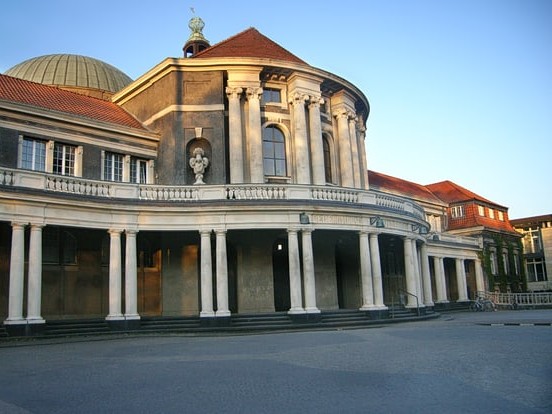
University of Hamburg (Image credit: UHH/Ohme)
The Literacy in Diversity Settings Research Center (LiDS) at the University of Hamburg will host a summer school and conference devoted to “Literacies for Social Participation” in July this year.
The summer school dates are July 20-31, and the conference dates are July 27-28. The summer school includes the conference but the conference can be attended separately.
Readers are cordially invited to attend and/or alert their students and colleagues to these exciting events (for details how to apply, scroll down to the end of this post)
About the Summer School “Literacies for Social Participation” (July 20-31, 2026)
Literacy is an individual competence that is critical for social participation. It is key to education, employment, health, rights and well-being. Yet, this key is not a singular entity, not least in contemporary differentiated societies marked by migration; it is complex as it involves multiple languages, registers, modalities, as well as different technologies and formats. In a highly mobile and interconnected world, migration and digitalization have collided to fundamentally transform what it means to be literate.
These emerging complex multilingual, multilectal, and multimodal literacies may be poorly matched to the literacy requirements of institutions with a monolingual habitus (Gogolin, 1994), where literacy practices in one dominant, standard language prevail. The resulting communication gaps can threaten access, equity, inclusion, and cost-effectiveness, and hence constitute a real barrier to social justice (Piller, 2016).
As all contemporary societies are affected by migration and digitalization, with individuals facing the barriers and opportunities associated with multilingualism, this summer school offers an internationally oriented curriculum to outstanding masters and doctoral students.
The core learning aims are:
1) to enhance knowledge on literacy and learner diversity;
2) to trace tendencies that go beyond one national, regional or local context;
3) to examine literacy development across the life-course;
4) to critically discuss the implications of research findings for policy and practice.
The learning goals will be achieved across five core modules with required readings:
1) Literacy across the lifespan;
2) Institutional settings;
3) Research methods in social literacies;
4) Academic skills;
5) Independent course work.
About the conference “Literacies for Social Participation” (July 27-28, 2026)
Are you a PhD student researching in the field of multilingual literacy development and social participation? If so, you are cordially invited to submit an abstract to participate in the doctoral symposium Literacies for Social Participation at the University of Hamburg on 27-28 July 2026. Successful applicants will present their research to an international audience of their peers and receive in-depth feedback from renowned experts in the field, including:
- Prof Dr Dr h.c. mult. Ingrid Gogolin, University of Hamburg
- Prof Yanli Meng, University of the Chinese Academy of Sciences
- Humboldt-Professor Ingrid Piller, University of Hamburg and Macquarie University
- Prof Yixi (Isabella) Qiu, Tongji University
- Prof Vera Williams Tetteh, University of Ghana and Macquarie University
- Prof Yufang Ruan, Zhejiang University
The doctoral symposium is a constituent event within the Hamburg International Summer School, Literacies for Social Participation, which runs from 20-31 July 2026. We invite you to also apply to participate in the summer school, however this is not a requirement to present at the doctoral symposium. The summer school and the doctoral symposium provide an exceptional combination of high-level academic engagement and networking opportunities related to linguistic diversity and social participation. Participants will have the opportunity to both showcase their expertise and deepen their knowledge of cutting-edge research in the field.
How to apply
- Find out how to apply to attend the summer school here. (Application deadline: April 06, 2026)
- Find out how to apply to present at the doctoral conference here. (Application deadline: April 06, 2026)
Attendance at the summer school and conference is free thanks to sponsorship from the Alexander-von-Humboldt-Foundation and the University of Hamburg.
]]>The conversation explores the distinctive historical context of Australia’s Northern Territory as a location for Christian missionary activity. Tazin and Laura talk about the multiple tensions and elements involved in language interactions between monolingual English-speaking missionaries and multilingual Indigenous communities, against the background of settler colonialism.
Found in Translation: Many Meanings on a North Australian Mission was published by University of Hawai’i Press in 2018.
About the book
Found in Translation is a rich account of language and shifting cross-cultural relations on a Christian mission in northern Australia during the mid-twentieth century. It explores how translation shaped interactions between missionaries and the Anindilyakwa-speaking people of the Groote Eylandt archipelago and how each group used language to influence, evade, or engage with the other in a series of selective “mistranslations.”
In particular, this work traces the Angurugu mission from its establishment by the Church Missionary Society in 1943, through Australia’s era of assimilation policy in the 1950s and 1960s, to the introduction of a self-determination policy and bilingual education in 1973. While translation has typically been an instrument of colonization, this book shows that the ambiguities it creates have given Indigenous people opportunities to reinterpret colonization’s position in their lives.
Laura Rademaker combines oral history interviews with careful archival research and innovative interdisciplinary findings to present a fresh, cross-cultural perspective on Angurugu mission life. Exploring spoken language and sound, the translation of Christian scripture and songs, the imposition of English literacy, and Aboriginal singing traditions, she reveals the complexities of the encounters between the missionaries and Aboriginal people in a subtle and sophisticated analysis.
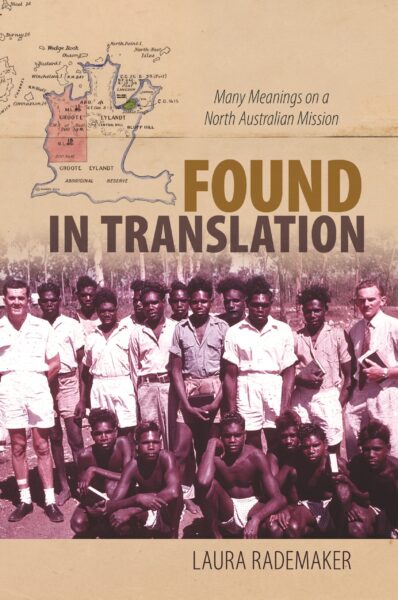 Rademaker uses language as a lens, delving into issues of identity and the competition to name, own, and control. In its efforts to shape the Anindilyakwa people’s beliefs, the Church Missionary Society utilized language both by teaching English and by translating Biblical texts into the native tongue. Yet missionaries relied heavily on Anindilyakwa interpreters, whose varied translation styles and choices resulted in an unforeseen Indigenous impact on how the mission’s messages were received. From Groote Eylandt and the peculiarities of the Australian settler-colonial context, Found in Translation broadens its scope to cast light on themes common throughout Pacific mission history such as assimilation policies, cultural exchanges, and the phenomenon of colonization itself.
This book will appeal to Indigenous studies scholars across the Pacific as well as scholars of Australian history, religion, linguistics, anthropology, and missiology.
Related content
- Grey, A. (2025a). Podcast Episode 63: Australia’s National Indigenous Languages Survey: Alexandra Grey in conversation with Zoe Avery
- Grey, A. (2025b). Making linguistic diversity visible in Parliament
- Jacobsen, B. (2017). Aboriginal languages matter – but to who?
- Kavanagh, B. (2018). Are Aboriginal languages really useless in the workplace?
Transcript
Tazin: Welcome to the Language on the Move podcast, a channel on the New Books Network. My name is Tazin Abdullah, and I’m a PhD candidate in linguistics at Macquarie University in Sydney, Australia.
My guest today is Dr. Dr. Laura Rademaker. Laura is a DECRA research fellow at the School of History at the Australian National University in Canberra. She works in the areas of interdisciplinary histories as well as oral history and memories, with a special interest in ‘cross-culturalising’ history. Her interests include religion, gender, secularisation, and ‘deep history’. She is an editor of History Australia, monographs editor for Aboriginal history Monographs and secretary of the Religious History Association.
On this episode, we will find out about Laura’s work, with a special focus on her 2018 book Found in Translation: Many Meanings on a North Australian Mission. Laura’s work in this book provides a highly engaging exploration of the intersection between English, Christianity, and Australian citizenship. Set against the interactions between Christian missionaries and Indigenous Australians, we learn about the deep intricacies of the relationship between language and place.
I’m very excited about this podcast, and Laura, welcome to the show. Thank you so much for joining us today!
Dr. Laura Rademaker: Thank you so much for having me. It’s a real honour.
Tazin: To begin with, could you tell us a little bit about yourself, your research, and how you came to be interested in historical language contact?
Dr. Laura Rademaker: Sure, so I’m a historian down at ANU, as you said. I’m not an Indigenous person myself. I became interested in, I guess, the interactions that happened at Christian missions in Australia, particularly after I – so, I did an honours thesis way back when in the day. It was soon after the apology to the Stolen Generation, by Prime Minister Kevin Rudd, and I learned from this that. So, I come from a church background. I learned from this that my own church had been part of, had been complicit in the removal of children.
And I did a thesis looking at the white women who, I mean, you could say looked after, you could say, were guardians who were the, you know who I mean. Looking after isn’t the right term, really. Like, these are kidnapped children, but the women who took in these children in a remote mission on Groote Eylandt. But doing that thesis, it was increasingly led to question, how did how did these people from completely different cultural backgrounds – how did they communicate with each other? How did they understand each other? What did they make of each other? You know, had these children from remote communities who didn’t speak English, maybe spoke a little bit of pidgin and later Creole, and these white women coming up from Sydney and Melbourne who only spoke English and had very fixed ideas about what they wanted to impart to these children. I wondered, what did these children make of all of that, and what did the Aboriginal communities who surrounded them, and who were sort of looking on to the mission, what did they make of that?
Also, way back, you know, even longer before this Honours thesis, I was a rotary exchange student, in Denmark.
Tazin: Oh, wow!
Dr. Laura Rademaker: And I learnt to speak Danish when I was there. Well, you know, imperfectly, and my Danish is rubbish today, don’t ask me to speak Danish. But something that I really took out of that experience was the significance for people, especially people who speak a language which is not, you know, not widely spoken. It really mattered to the Danes that I was that I was learning their language, and they were really excited that someone would learn Danish, which they thought was of no use, apart from, to have better relationships with Danish people. And so that’s kind of stuck in my mind, that, the significance of languages for smaller communities.
Tazin: That’s amazing, especially in the context of today, when people learn language from apps The difference between what you described – learning a language while interacting with people, as opposed to learning a language from an app. It’s amazing that that’s what inspired you.
Dr. Laura Rademaker: Yeah, and it’s actually something that came up in the research. I mean, we’ll talk about this later, but I was interested in why some missionaries learned Aboriginal languages and why others didn’t, and the relational dynamic is really what’s important.
I think teaching someone your language is an act of hospitality, is an act of generosity, it’s relational, and you can’t barge into a language community without an invitation or a welcome. Or at least that’s the way I see it. And so having these unique and precious languages as a way for Indigenous people to control who entered their worlds, and to exclude people who are not welcome.
Tazin: Wow! Well, turning to your book, I would like to ask you about a quote from the preface, and I use this because I found it very meaningful, personally, and, you know, I felt like it is the basic philosophical question about translation. So in the preface, you say: “Whether translation – and all the ambiguities that might attend it – was a blessing or a curse is a matter of interpretation.” Could you tell us about this?
Dr. Laura Rademaker: Yeah, I mean, this was really the, you know, my core interest that was driving this. I’m interested in the way that translation you know, of languages, but also more broadly in a sort of a metaphorical sense of cultures. Well, the way it creates something new in the encounter. You can say, you can say all translation is imperfect, but even the label imperfect kind of puts a value judgment on it, that it’s deficient.
But it’s those so-called imperfections, that actually – where there’s something creative in this cross-cultural encounter that can come out, and there can be learning from different peoples. And I think in my research, what I was really interested in exploring was the way that First Nations people were able to take what missionaries brought and create something new on their own terms because of the ambiguities of translation.
Yeah, but we tend I mean, you tend to put those terms like imperfect or unfaithful and things like this that really do have that value judgment, and I wanted to really push back on this.
But in the – sorry, I’m going on.
Tazin: Go on, please. This is very interesting.
Dr. Laura Rademaker: In the context of colonialism and imperialism and these missions which were really trying to form people into being a particular kind of person and a particular kind of Christian, there was the desire to have a so-called perfect translation and convey this unchanging message that would be received in a, you know, in a predictable way. But that’s because of the ambiguities of translation, that wasn’t possible. And that’s happened again and again, not just in Australia.
Tazin: Yes, of course.
Dr. Laura Rademaker: In many contexts.
Tazin: Yeah, and then the way that, I guess, it was received, and whether it was beneficial to the people receiving it, is, as you say, a matter of interpretation.
Dr. Laura Rademaker: Yes, exactly, exactly. And the communities have different, you know, individual members and communities have different views on this as well.
Tazin: Yes, of course, yeah, that’s amazing. You write about the Northern Territory – that’s your research site – as iconic, being Australia’s settler colonial frontier. What is unique about the context that you have written about? And why were language and translation so significant in this context?
Dr. Laura Rademaker: Sure. Look, I, as a kid, my family did a lot of. We did a lot of road trips and camping trips and stuff, and, I travelled to the Northern Territory quite a bit as a child. And I guess for me, it has this nostalgic, you know, it’s still that, you know, I kind of had bought into that almost frontier romantic mindset. This wild landscape that was, you know, somehow represented the true, the real Australia.
I hope that I’ve been able to mature from that and become a bit more critical of the way that those visions actually sort of reinforce a settler colonial, a colonial ideology that the country is naturally belonging to white people, And anyway, this romantic vision of empty space ready to be sort of civilized or tamed or something. Anyway, so that, you know, I came to it with that background.
But, in terms of, as a researcher and as an historian, what’s really exciting is I guess the way for many communities in the Northern Territory, colonization, the beginning of colonization is still such recent history. You know, when I was doing oral histories up on Groote Eylandt. the people I spoke with, it was their parents who had first encountered white people in their country, and they remember as children the missions first being set up. This was the first non-Indigenous community setting up on their country, you know, in the1920s, 30s, 40s. That was a living memory. So it’s really, really recent history, and as an historian, this is, you know. Being able to sit down and talk with people about what that experience was like and, what it meant to their communities is fascinating and sheds light on earlier periods for which we can’t do oral histories. The mission encounter in Australia, the Christian missions, and happens so much later in Australia.
One of the stats that I sort of throw around is, in the 1950s and the 1960s, Aboriginal people in the Northern Territory were the most missionized people in the entire world. There was, I think there was one missionary for every, sort of, five to six Aboriginal people in the Territory. Like, it was crazy.
Tazin: Wow!
Dr. Laura Rademaker: The level of intensity of this, civilizing, Christianising project that was going on up there. So, it was a really intense encounter, as well as a really recent history that then can help us understand, sort of, much more global experiences, that happened in other places.
I mean, I can go on. The other thing about the Northern Territory is so many Aboriginal languages in the Territory are still so strong. They’re spoken by children, they’re, you know, they’re still people’s first languages. And one thing that I think is really helpful for me as a researcher is to have that experience of being the outsider and being unsettled as the English speaker. It reminds me that English is not naturally the language of this country. But I as an English speaker, English doesn’t necessarily belong, and I have to be the learner. I have to sometimes make a fool of myself because I don’t understand, or I’m trying to say something that, you know, is pronounced the wrong way, or means something different.
But that, I think I mean, I hope that comes through in my writing, having that experience, and seeing – unsettling how natural English feels in this place.
Tazin: Yeah, well, I mean, I from what you just said, I guess I’m taking away again how recent the history is, as you said, because sometimes we get this idea that all of these things happened in the past.
Dr. Laura Rademaker: No, no, no.
Tazin: And it’s way back there, but it’s not, and the impacts, as you have written in your book, actually last till today.
Dr. Laura Rademaker: I mean, colonization is still continuing, I would say,. But also, yeah, there’s people, you know, in living memory who can speak about massacres, knowing about massacres and things like that, really not very long ago at all.
Tazin: Much of that knowledge would also be in their languages, in their original, in their native languages. Wow!
I understand that the early missionary ventures in Australia were not very successful. How did the Christian missionaries attempt to engage with Aboriginal communities? What were the, you know, the tensions, the multiple elements that influenced their language use and interactions?
Dr. Laura Rademaker: Yep. Yeah, so this is something I’ve puzzled over for a while, and I’m still, still thinking through trying to understand as an historian.
So, the Christian missions in Australia were quite famously unsuccessful at the time. I’m talking about the early 19th century, and this was often blamed on Aboriginal people themselves, especially as you move through the 19th century, there was the argument that Aboriginal people lacked the cognitive ability to understand Christianity. That they maybe had, didn’t even have souls, that they were not, you know, religious beings, they couldn’t have, they weren’t, you know, their culture was supposedly so backwards. Things like this, you know, really horrifically racist, ideas.
But it is, I mean, when you look to the, you know, to the nearby Pacific at the same time, in the early 19th century, Christianity and demand for translated Bibles was really expanding quite quickly. So what, you know, what could possibly explain this?
One thing, sort of, structurally about Australia is that the Christian missions arrived more or less simultaneously, or just after settler colonisers who were claiming Aboriginal land. And so, the massacres, the displacement, the dispossession of land, the disease, all of this proceeds or is concurrent with missionaries. And I think in that context, I mean, Aboriginal people could see the contradiction, right? And the missionaries were ultimately, as much as many of them were quite critical of the violence and, you know, supported humanitarian causes – they were ultimately allied with the British Empire, which was responsible for all of this that was taking place.
And so to convert to Christianity in that context is a capitulation to this such a, this devastating destruction. At the same time, there was there wasn’t much I mean, in terms of Protestant tradition, translating the Bible is kind of the number one thing you do when you arrive in a new culture because you want the Christian message to be taken up in the culture of the people that you’re trying to convert. And this didn’t, I mean, there were there were small attempts in Australia, but there was no translated Bible until I think it wasn’t a full Bible in an Aboriginal language until 2002, or maybe it was 2005. Anyway, it was in the 2000s – very, very recent.
There were early missionaries who translated segments of scriptures, but there wasn’t, sort of large-scale Bible translation work in Australia. And this, I would say, was due to the belief that Aboriginal people were were destined to extinction. Or that if they were to survive, their future was going to be in English, and they were going to assimilate into white Australia. And so we have these sorts of colonising assumptions about the naturalness of English, the dominance of English, the naturalness of British possession of Australian soil right there from the beginning in these decisions not to translate, and the belief in the universality of English.
Tazin: And do you think the other aspect may have been the multiplicity of Aboriginal languages as well? Because there wasn’t just one language.
Dr. Laura Rademaker: Yes, that’s true, and I should have said that, yes, I mean, there’s many Aboriginal languages are closely related and mutually intelligible, but there’s so many languages.
But I would also say that was used as an excuse. It was there was sort of often the, well, well, there’s this language and that language, which language do we do? But it’s better that everybody just speak English. And so, it sort of cuts both ways.
Tazin: That’s so interesting, and I’ll pick up on that with you a bit later, because, you know, there’s so many parallels with language, in the use of English in Australia even now. But before that, I actually wanted to say that I learned a lot from reading your book. And one of the most interesting things I learned was that the Anindilyakwa speakers had, for centuries, already been engaging in the translation and interpretation of language and culture. So there was language contact between tribes, and with those from other lands, such as the Makassans.
And I was reading, I pictured, you know, people who were multilingual in a society where there already existed a sophisticated exchange between languages. And in this setting came the missionaries with English, a language, as you said, tied to settler colonialism and to citizenship in, you know, in Australia. Would you please tell us about this?
Dr. Laura Rademaker: Yeah, so this is, I mean, again, I’m not a First Nations person. I don’t speak for First Nations people, but this is all across, you know, the top end of the Northern Territory, multilingualism in Indigenous communities is the norm, and has been the norm for centuries for Indigenous communities. Marriage is often exogamous. You marry outside your clan, which is also normally, often, means that you marry outside your language group, and so there’s multilingualism within the family. Your mother and your father and your grandmother and your grandfather might all speak different languages, and this idea that you would be confined to just one language would be completely bizarre and unusual.
And, as you, as you mentioned, the Makassan traders, so they came from Sulawesi, from Indonesia. They’ve been coming for hundreds of years across the top end, and there’s, and they were multilingual as well. Their crews spoke sort of a Malay pidgin, but there was multiple languages on board these ships. And they exchanged with Anindilyakwa people on Groote Eylandt, about Yolngu people, Tiwi people as well, and you can find, like, words.
You probably know this, you can find words from their languages in these Aboriginal languages, and the one that I talk about in my book is Jura, which is common across the Northern Territory, a word that means paper, or book, or writing. Comes from Arabic originally. It has made its way into Aboriginal languages.
So there’s this really intense cross-cultural exchange around the idea of language communication, writing books. So Aboriginal people were aware of this long before the colonisers came, and had traditions of translating and interpreting, had norms about who would speak for whom, people were esteemed as interpreters, and linguistic expertise were recognized and valued. But there’s also sort of an embedded reciprocity and interdependence in when you have this inbuilt multilingualism in your community. When you become dependent on each other in a way that you might not, where you have a monolingual community. People have particular language expertise and are used to translating and interpreting, singing for different countries in ceremony. That would require someone who’s an expert in this or that language, so they can sing the right song for that song line. It all requires, you know, this incredible linguistic expertise, which is seen as a strength.
But for the English speakers, of course, all this is seen as a little bit messy and complicated, and wouldn’t it be much more efficient if everyone just spoke the one language. I think it was hard for the colonisers, for the missionaries, to see that this multilingualism might be a strength rather than an obstacle to overcome. And the Commonwealth’s government introduced a syllabus for Aboriginal schools in the 1950s that was very explicitly about introducing English. And they did say, oh, there’s so many languages, what are we going to do? It’s too hard to learn all the languages. We just need one language, and that language should be English, because this is the language of Australian citizenship.
Now I feel like I’ve rabbited on for quite a bit!
Tazin: Please, please go on. This is very interesting!
Dr. Laura Rademaker: Yeah, yeah, I guess in the work, I wanted to challenge the assumption that those who people who don’t primarily speak English as their first language or primary language were necessarily victims or vulnerable, that this multilingualism was a real strength. And that the assertion that English is, should be a universal language. And that we are stronger by all speaking the same language. Yeah, that’s a cultural assumption, and it’s also an imperial assumption in this context as well.
Tazin: And yeah, and this particular aspect of your work, you know, is particularly interesting for me and our team at Language on the Move, because a lot of our research strongly focuses on the implications for contemporary, multilingual or linguistically diverse communities in places like Australia, where English is, you know, remains a dominant language. English in Australia continues to relate to citizenship. And speakers of other languages, they have different identities assigned to them, depending on the language, often very negative identities, right? And there are high-status languages and low-status languages. There’s all those things, and perhaps we sideline what other languages have to offer. We lose what could be meaningful exchanges.
What can we learn from your work, and what can readers take from this very insightful historical account to inform our research in contemporary Australia?
Dr. Laura Rademaker: Yeah, I guess it’s what you were saying, that, that English doesn’t need to be the only or the dominant language. That there is great strengths and creativity and resources in being a multilingual community. And Australia historically has always been multilingual. You know, this English is not the language that is connected to this land. It’s not the language of the country. It’s the language that we, you know, it’s the dominant language at the moment, but it’s not the language of country. And I wanted to recover that and recapture that.
I also, as I said, I guess I wanted to challenge assumptions that, those who don’t speak English as their primary language are necessarily victims or vulnerable, that language. It can be a tool, it can be a weapon. There’s a way that evading English can be a choice, an assertion, a reclaiming of identity, a form of resistance.
I don’t know, you would have seen in the book, I opened this story about the first missionaries arriving on Groote Eylandt, and they wanted to translate the, the Sunday School song, Jesus Loves Me. And so, they approach the old man at the camp, and this missionary says, you know, “Jesus loves me, this I know” [Laura sings the line] and he wants to know the word for ‘me’. And the way he tells it is that he pointed to his chest and said, you know, me, how do you say me? And the old man gave him the word for chest hair. And so, the missionary started singing in Anindilyakwa, Jesus loves my chest hair.
Now, the missionary, he told this story many times, and he used it in his fundraising as kind of an amusing story about how these poor, ignorant, you know, ignorant First Nations people, supposedly, you know, were so naive or gullible or silly that they didn’t understand what he was getting at, and isn’t it a great story! But the way that I read it, and the way that I think makes sense, having met with the old people of this community, and I brought this interpretation to them and said, oh, yes, this is probably what happened is that the First Nations community, the old people were playing a joke on the missionary.
They used their language to set him up to make a fool of themselves and to assert themselves as the knowledge holders. Anyway, so I guess this is a long roundabout way of saying I want to, yeah, recover the agency of groups that are outside the dominant language community, and show how they’ve shaped Australian history as well, and show how their languages have been a source of strength.
Tazin: Yes, and I did find that story very amusing as well. So glad you began with that story. It was hilarious, and what you know, what a great way to understand what happened in that interaction, the way you described it. Tell us what is next for you and your work. What other research projects are you working on now?
Dr. Laura Rademaker: Sure, well, I’m continuing that work, with the same community up on Groote Eylandt, but also with some other Northern Territory communities on the Tiwi Islands, and Gunbalanya in West Arnhem, and I’m looking at a broader project on First Nations self-determination. But I’m also, I guess I’m really interested in the history of Christianity and Aboriginal land. The ways that religion has been used to deny Aboriginal land and
enable dispossession, but also the way that First Nations people have drawn on their spiritual resources and spiritual claims to make claims to land as well. So I’m very much in the thick of religious thinking at the moment, but, this work on translation is still very much on my mind and informing what I’m doing, the ways that concepts get translated across cultures, and then can be turned back against the dominant culture. I’m really interested in the ways that First Nations people have done that throughout history.
Tazin: And it’s wonderful for us to have this knowledge of history of languages in Australia. So,thank you very much for your work, Laura, and we really look forward to reading more of it.
Dr. Laura Rademaker: Oh, thank you so much. It’s been a pleasure.
Tazin: And thank you for listening, everyone. If you enjoyed the show, please subscribe to our channel, leave a 5-star review on your podcast app of choice, and recommend the Language on the Move podcast and our partner, The New Books Network, to your students, colleagues, and friends. Till next time!
]]>I have always been fascinated by the human voice. When you speak on the phone with a stranger, it can reveal so much about them. You can often tell whether it’s a man or a woman, estimate their age, and sense their attitudes and emotional state — whether they sound polite, distant, nervous, happy, or sad.
And, importantly, you can almost immediately recognize whether the person speaking has a foreign accent or not. Pronunciation is never just about sounds: it reflects the social meanings attached to language.
A different kind of accent training
In my phonetics and phonology classes, I usually deal with a familiar scenario: students ask me how they can improve their pronunciation in their L2 Italian or L2 Spanish and sound more “natural”. How to avoid a foreign accent — or at least minimize it.
Of course, there is nothing wrong with having a foreign accent. It simply shows that you grew up speaking another language. But many students want to refine their pronunciation, and I am a happy companion on that journey.
This time, however, it was different. A friend asked me to do a favor for one of her friends — an actress. In her new movie production, she had to play a German woman speaking Spanish with a strong German accent.
She told me: “Well, I know I have to do the German R sound, which is very different from Spanish. But I feel there’s more.”
Exactly. There are even native Spanish speakers who have difficulty pronouncing the rolled R — this phenomenon has a name: «rhotacism» or «the French R» (la erre francesa). But even speakers who don’t “roll” the R can still sound perfectly native-like.

(Image credit: Andrea Pešková)
So, what is it all about?
What makes Spanish sound German
Let’s take a closer look at some of the most distinctive features of “German” Spanish.
German speakers don’t only struggle with R sounds. One of the most noticeable characteristics is the aspiration of the voiceless stops /p t k/: pala ‘shovel’ may sound like [ˈphala], tono ‘tone’ like [ˈthono], and cosa ‘thing’ like [ˈkhosa]. The aspiration should remain subtle and light — otherwise it may begin to sound more “English” than “German”.
Another typical feature is that the final [o] may sound overly close, almost like [u], turning perro ‘dog’ or loco ‘crazy’ into perru or locu in Spanish ears.
German speakers also tend to pronounce the Spanish approximants [β ð ɣ] between vowels as full stops, so la bodega ‘the wine cellar’ [laβoˈðeɣa] becomes something like [laboˈdeɡa] rather than the softer Spanish version.
They also often insert a glottal stop before vowel-initial syllables or words. El auto ‘the car’ becomes [elˈʔawto], and otra ‘other’ turns into [ˈʔotɾa]. This gives Spanish a slightly “choppy”, segmented rhythm.
Orthographic influence plays its role too. Speakers may pronounce the normally silent h, voice the s between vowels as z (casa ‘house’ [ˈkaza]), or mispronounce <eu> as [ɔɪ̯] instead of [ew]. And the infinitive ending -er may shift towards something like -a in the word comer [komˈea] ‘to eat’.
Prosody contributes as well. Stressed open syllables may sound unusually long, unstressed vowels may be reduced, stress placement may shift, and intonation patterns often diverge. For example, the end of neutral statements may sound exaggeratedly emphasized, lacking the subtle falling contour typical of Spanish.
Making the accent sound real
We worked on all these phonetic features, and my student did an excellent job. We wanted the accent to sound authentic and recognizable, but never exaggerated or comical.
While we focused mainly on pronunciation, I also pointed out that in real-life speech, grammatical transfer phenomena often accompany a foreign accent. In many movies, accented speech is portrayed with perfect grammar but an overdone pronunciation, which feels unnatural.
In reality, small deviations are common in second-language speech — for instance, occasional omission of articles (Me gusta pizza ‘I like pizza’ instead of Me gusta la pizza ‘I like the pizza’), overuse of subject pronouns that are usually dropped in Spanish, or transfer of verbal tense and aspect.
These subtle grammatical influences, combined with pronunciation, shape the overall impression of an accent and make speech sound more believable.
From correction to creation
What we both found most fascinating in this experience was the shift in perspective: instead of trying to eliminate a foreign accent, we tried to recreate one. It was a playful reminder that accents are not errors but expressions of our identity, multilingual experience and authenticity.
We often see how accent becomes a marker of belonging — or of difference.
But when we learn to listen closely, every accent tells a fascinating story about who we are, where we come from, and the paths our languages have taken.
Additional resources
If you want to explore more accents in Spanish, visit this page that my students in Osnabrück (Germany) created: https://andrea-peskova.com/archivo-de-los-acentos-l2/. There you will find examples of Czech, Italian, Slovak, Greek, and American English accents in Spanish.
]]>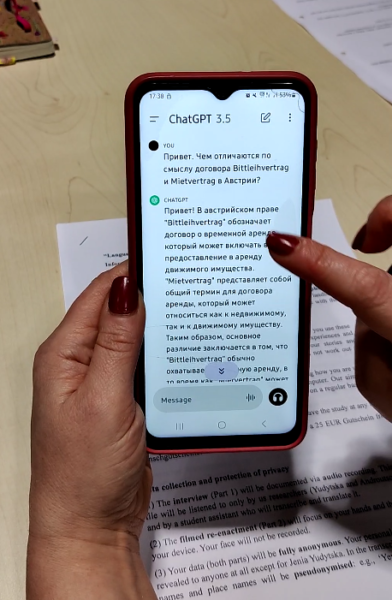
Ukrainian migrant asking ChatGPT to explain different types of rental contracts in Austria (still from Yudytska & Androutsopoulos 2025)
For nearly four years now, I’ve been heavily involved in online (Telegram-based) communities for Ukrainian forced migrants in Austria. Such communities sprang up all across Europe after Russia’s full-scale invasion of Ukraine in early 2022, serving as grassroots digital info-points. In those early, chaotic days, the groups focused on a Ukrainian’s first steps upon getting off the train in their new country. They have since expanded to cover everything from where to buy buckwheat (a very pressing question!) to the fine details of the local education system, health insurance, job market, etc.
The communities are run for Ukrainian refugees, by Ukrainian- and Russian-speakers, that is, overwhelmingly by migrants – forced, labour, student; first-gen, second-gen; etc. It truly is mutual aid: those who migrated earlier answer questions on integration, those who left recently give tips on how best to reach relatives in occupied territory. My family left in 1999, when I was five; I co-admin one group for Ukrainians in my home state of Upper Austria (ca. 3,700 members) and one group focused on how to change from the Temporary Protection status to a longer-term work/residence permit (ca. 8,300 members), plus I occasionally help out in other groups.
In 2025, our communities gained one more, less welcome, “member”: ChatGPT.
Migrants’ search for information
Understanding the role of ChatGPT in these communities requires understanding the complex informational space newly arrived migrants are in. There is an avalanche of info to take in. Some involves the everyday differences: when your child has a fever, at what temperature can you call the ambulance without getting in trouble for wasting their time? Other aspects are specific to the (forced) migrant status, and would stump a local too. Language barriers make accessing information difficult. Even with machine translation, it’s hard to know what term to google or how to interpret a bureaucrat’s answer.
This is where the Telegram communities come in, providing an easy place to ask for help and discuss problems.
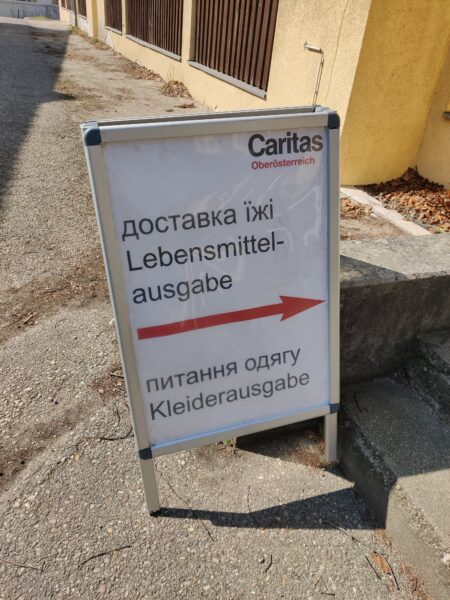
An NGO’s German-Ukrainian sign about food and clothing distribution; the understandable but incorrect Ukrainian suggests machine translation (photo taken by author)
Still, they’re not a panacea. Us volunteers learned only on the fly the ins-and-outs of the Austrian asylum system in all its kafkaesque glory: we sometimes misremember, misunderstand, and mistranslate. Grasping a question can take real detective work, especially when there’s a dozen ways to translate a single German term. Official Austrian sources give a lot of information orally; this leads to bewildering discussions where one person informs the chat their social worker said X, another says it was Y, and the third Z. Maybe it’s miscommunication, maybe the official sources have no clue either.
Above everything loom the rumours, best illustrated by the (admittedly pretty sexist) Russian acronym, ОБС – одна бабка сказала, lit. “some old lady said”. It’s used in the sense of, “Uh-huh, riiight, you got that info from your cousin’s friend’s mom’s neighbour”. In 2027 all Ukrainians in the EU will be put on the next train home, even if the war is still ongoing. Truth or ОБС? Great (unanswerable) question!
Enter ChatGPT
Into all this chaos slams the iron certainty of ChatGPT. If it worked as advertised, it would be an invaluable resource for migrants. You ask a question, it searches for and provides a summary of official information. No linguistic barriers, no mistranslations, no complex legalese; no petty online fights to wade through. The appeal is clear.
The only tiny problem is that it doesn’t work as advertised.
The biggest issue is in how ChatGPT functions: it doesn’t search for and copy-paste information from a database, but rather generates a statistically likely sequence of tokens (words) based on the data it was trained on. This is why it can “hallucinate”, that is, make up answers which are linguistically coherent but factually untrue. It has also obviously been fed more data (law databases, official websites, forum discussions, etc.) from Germany than Austria. For example, it has confidently explained to a Ukrainian that she’s legally obligated to have health insurance – true in Germany, not so in Austria.

Linz Castle on the Danube, Upper Austria, lit up in the colours of the Ukrainian flag (photo taken by author)
The AI technique ‘Retrieval Augmented Generation’ (RAG) is meant to resolve this: ChatGPT first searches for and pulls relevant information from a website, then incorporates it into the answer. (ChatGPT uses RAG sometimes, but not constantly. It costs more energy, thus more money.) But the answer is still generated, so hallucination is still possible. This leads to ChatGPT claiming, for example, “According to the City of Vienna website, Ukrainians have to hand in their old refugee ID card. [Link to website]” Except its generated summary missed a negation: the website explicitly states Ukrainians do not have to hand in their old refugee ID card. RAG can thus lead to even greater misinformation, as it implies a direct source.
The other huge problem is the limited information actually available on migrant issues; even if hallucination was somehow solved, the adage of ‘garbage in, garbage out’ for machine learning remains. For example, to switch to a longer-term residence permit requires the migrant to have an ortsübliche Unterkunft (“housing according to local standards”). ChatGPT physically cannot answer what these local standards are. I know this because, according to my old-fashioned research techniques of searching law databases, skimming court cases, and asking lawyer friends, neither can anybody else! Unfortunately, it is too often the case that there is too little concrete info for ChatGPT to be trained on.
In short, using ChatGPT for information is a gamble. Sometimes it works great, sometimes it generates nonsense. To know which is which, the migrant is left with the same problem of surmounting the language barrier they started with.
Mutual aid with and against machines
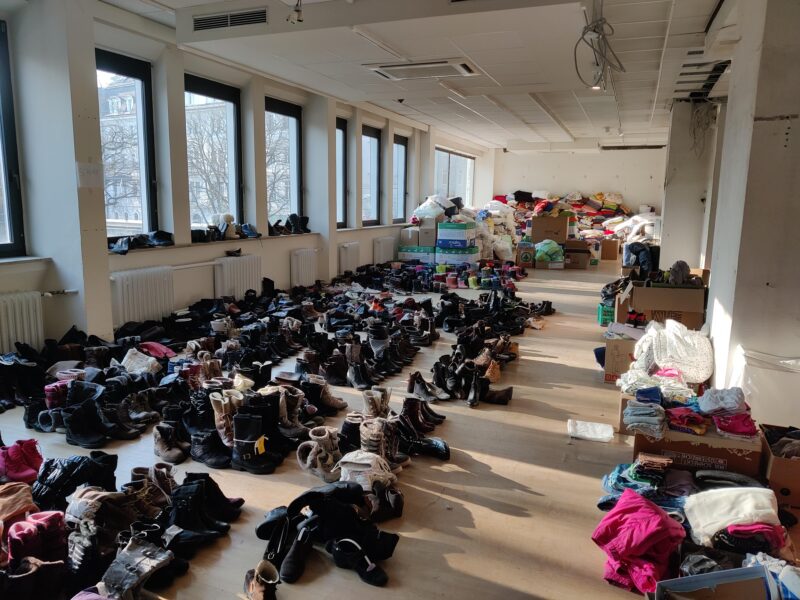
Rows of donated women’s shoes at SUNUA, a grassroots organisation supporting Ukrainians in Upper Austria, 3 weeks post-invasion (photo taken by author)
I don’t consider myself a techno-pessimist – actually, I rely on language technologies heavily in my online volunteer work. My phone’s autocorrect is a life-saver. While I can read and write in Russian, I left Ukraine before starting formal education, and find it slow and frustrating to spell without autocorrect. Similarly, machine translation is a great help. I occasionally need it to double-check my understanding of more complex Ukrainian-language questions; I also machine translate German-language official updates for the sake of speed, then post-edit the Russian text to correct mistakes and stilted phrasing before posting.
That is, due to my background as a child migrant from a primarily Russian-speaking area of Ukraine, I have varying levels of competencies in the three languages I need: Russian, Ukrainian, German. For all their faults, language technologies are an invaluable resource for stuffing the gaps so I can help people successfully. And efficiently, as this has always been 100% unpaid labour in my free time, next to my full-time uni work.
But all this is why I find the intrusion of ChatGPT into our spaces so infuriating on a personal level. In the midst of a horrible situation, between fear, grieving, trauma, burnout, we’re all trying to use the linguistic and technological resources available to us to help each other. I accept arguing against a community member’s cousin’s friend’s mom’s neighbour’s experience as part of that – that connection is also a resource, and it’s human to trust an acquaintance over a fuzzily written law in a language you don’t speak yet. I’m willing to spend my free time picking apart where the confusion lies.
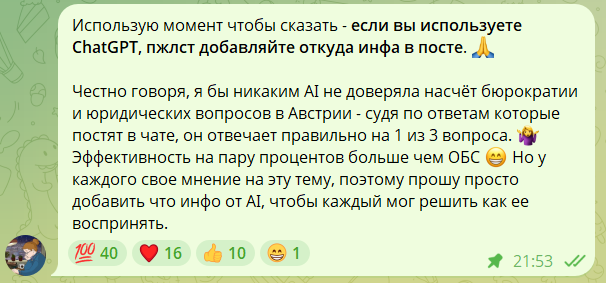
The author’s post in a Telegram group explaining that AI as a source must be clearly stated, with over 60 users leaving reaction emoji of agreement (screenshot taken by author)
I don’t accept arguing with ChatGPT screenshots.
ChatGPT adds beautiful formatting, with eye-catching emoji as bulletpoints. ChatGPT switches between Cyrillic and Latin easily, writing out German acronyms and translating them to Russian in brackets: ÖGK (Österreichische Gesundheitskasse – Австрийская касса медицинского страхования), wow. ChatGPT cites laws using a fancy § paragraph sign I have to copy-paste each time.
Sure, the actual information may or may not be correct, but that’s less important than the style, which so neatly mimics that of official sources. It simply looks trustworthy – the complete opposite of my own messages, written one-handed on a moving bus, with at least one butchered case suffix apiece. It’s unsurprising that people cling to ChatGPT’s information more stubbornly than to the usual ОБС.
Arguing against it is thus extra tedious and, frustratingly, requires me to do additional work. “Wait, no, where did you get that information from, is that an official source?” “Uh, nope, that website ChatGPT cited says the opposite.” “Dude, did you actually read the law ChatGPT ‘references’ – it’s about industrial chemicals, not document translation.” Most unsatisfactorily for all involved, having to prove a negative: “I’m sorry, but there’s no information on that. I don’t know why ChatGPT says there is, maybe it exists for Germany, but not for Austria.”
As a migrant who’s also stared at bureaucratic German in confusion and anxious despair, I don’t blame people for turning to AI. As a volunteer, it’s genuinely made me want to quit: in anger, in exhaustion, with a childishly vindictive, “Well, if they prefer machine over human, so long and thanks for all the fish.”
Where to next?
In principle, the issues explored here are no different from those we’re facing in other areas: education, academia, news, etc. Misinformation is rife everywhere; so is a lack of digital literacy on what current AI can and can’t do. For me, the crucial point is how vulnerable forced migrants are. Misuse of ChatGPT can lead not to a failed homework assignment but to problems on an existential level: with the legal status, with housing, with having enough money for food. Similarly, to put it bluntly, I’m paid to deal with students’ AI use; in volunteer work, it’s just one more weight tipping the scales in favour of finally quitting. It’s also important to add that not all my fellow admins share my worries. Some eagerly embrace ChatGPT answers themselves, which of course save time and energy for volunteers who have little of either to spare.
Our current ‘solution’ is that people must state openly that the information they’re posting is AI-generated. Then other members can decide themselves to what extent they trust it. In this, I would say, we’re ahead of the curve compared to many organisations, and for now, this will have to be enough.
Reference
Yudytska, J. & Androutsopoulos, J. (2025). The use of language technologies in forced migration: An explorative study of Ukrainian women in Austria. In M. Mendes de Oliveira & L. Conti (eds.), Explorations in Digital Interculturality: Language, Culture, and Postdigital Practices (pp. 135-166). Transcript. https://doi.org/10.1515/9783839476291-007
]]>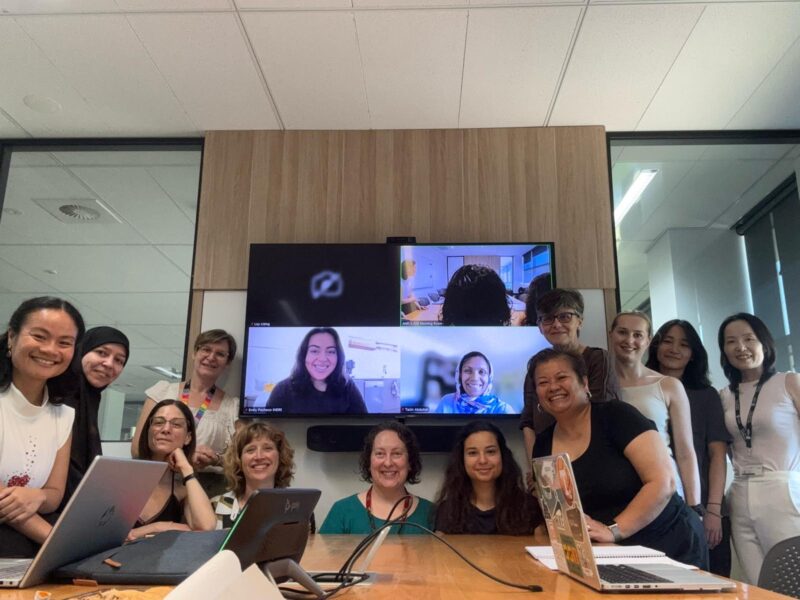
The team behind the Language-on-the-Move Podcast (Image credit: Language on the Move)
Final piece of good news for the year before we head into a publishing break over January: we’ve just heard that the Language-on-the-Move Podcast has won the 2025 Talkley Award 


The Talkley Award is issued by the Australian Linguistic Society (ALS) and “celebrates the best piece or collection of linguistics communication produced in the previous year by current ALS members. The Award acknowledges that the discipline of linguistics needs champions to promote linguistics in the public sphere and explain how linguistic evidence can be used to solve real-life language problems.”
This is a wonderful end-of-year present for our team in recognition of the work and care we’re putting into creating the podcast. Special thanks and congratulations also to our podcast publishing partner, the New Books Network.
After the 2012 Talkley Award went to Ingrid Piller for the Language on the Move website, this is the second time the award goes to our team – an amazing recognition of the long-term impact Language on the Move has had on public communications about linguistic diversity and social justice.
Thank you to all our supporters who nominated us for the award! Special thanks to Dr Yixi (Isabella) Qiu and her students in the Guohao College Future Technology Program at Tongji University. After using the Language-on-the-Move Podcast as a learning resource, they have been among our biggest fans 


To celebrate with us, listen to an episode today! You an find your list of choice below.
As always, please support us by subscribing to the Language on the Move Podcast on your podcast app of choice, leaving a 5-star review, and recommending the Language on the Move Podcast and our partner the New Books Network to your students, colleagues, and friends.
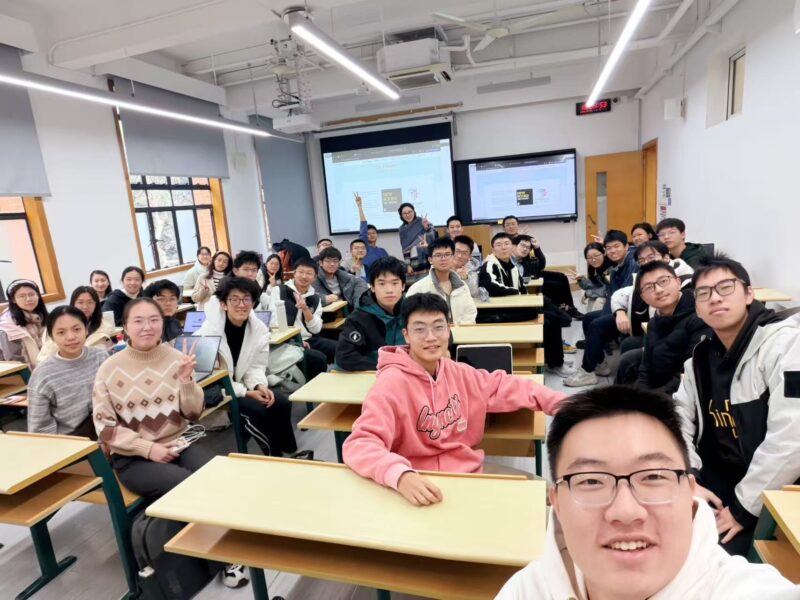
Students of the Guohao College Future Technology Program at Tongji University in Shanghai are among the fans of the Language-on-the-Move Podcast (Image credit: Dr Yixi (Isabella) Qiu)
List of episodes to date
- Episode 64: Your Languages are your superpower! Agnes Bodis in conversation with Cindy Valdez (17/11/2025)
- Episode 63: Australia’s National Indigenous Languages Survey: Alexandra Grey in conversation with Zoe Avery (28/10/2025)
- Episode 62: Migration is about every human challenge you can have: Brynn Quick in conversation with Shaun Tan (17/09/2025)
- Episode 61: Cold Rush: Ingrid Piller in conversation with Sari Pietikainen (09/09/2025)
- Episode 60: Sexual predation and English language teaching: Hanna Torsh in conversation with Vaughan Rapatahana (02/09/2025)
- Episode 59: Intercultural Communication – Now in the 3rd edition: Loy Lising in conversation with Ingrid Piller (26/08/2025)
- Episode 58: Erased voices and unspoken heritage: Alexandra Grey in conversation with Zozan Balci (20/08/2025)
- Episode 57: The Social Impact of Automating Translation: Tazin Abdullah in conversation with Ester Monzó-Nebot (03/08/2025)
- Episode 56: Multilingual practices and monolingual mindsets: Brynn Quick in conversation with Jinhyun Cho (18/07/2025)
- Episode 55: Improving quality of care for patients with limited English: Brynn Quick in conversation with Leah Karliner (26/06/2025)
- Episode 54: Chinese in Qatar: Tazin Abdullah in conversation with Sara Hillman (19/06/2025)
- Episode 53: Accents, complex identities, and politics: Brynn Quick in conversation with Nicole Holliday (12/06/2025)
- Episode 52: Is beach safety signage fit for purpose? Agnes Bodis in conversation with Masaki Shibata (05/06/2025)
- Episode 51: The case for ASL instruction for hearing heritage signers: Emily Pacheco in conversation with Su Kyong Isakson (28/04/2025)
- Episode 50: Researching language and digital communication: Brynn Quick in conversation with Christian Ilbury (22/04/2025)
- Episode 49: Gestures and emblems: Brynn Quick in conversation with Lauren Gawne (14/04/2025)
- Episode 48: Lingua Napoletana and language oppression: Tazin Abdullah in conversation with Massimiliano Canzanella (07/04/2025)
- Episode 47: Teaching international students: Brynn Quick in conversation with Agnes Bodis and Jing Fan (31/03/2025)
- Episode 46: Intercultural competence in the digital age: Brynn Quick in conversation with Amy McHugh (12/03/2025)
- Episode 45: How does multilingual law-making work: Alexandra Grey in conversation with Karen McAuliffe (05/03/2025)
- Episode 44: Educational inequality in Fijian higher education: Hanna Torsh in conversation with Prashneel Goundar (25/02/2025)
- Episode 43: Multilingual crisis communication: Tazin Abdullah in conversation with Li Jia (22/01/2025)
- Episode 42: Politics of language oppression in Tibet: Tazin Abdullah in conversation with Gerald Roche (14/01/2025)
- Episode 41: Why teachers turn to AI: Brynn Quick in conversation with Sue Ollerhead (09/01/2025)
- Episode 40: Language Rights in a Changing China: Brynn Quick in conversation with Alexandra Grey (01/01/2025)
- Episode 39: Whiteness, Accents, and Children’s Media: Brynn Quick in conversation with Laura Smith-Khan (24/12/2024)
- Episode 38: Creaky Voice in Australian English: Brynn Quick in conversation with Hannah White (18/12/2024)
- Episode 37: Supporting multilingual families to engage with schools: Agi Bodis in conversation with Margaret Kettle (20/11/2024)
- Episode 36: Linguistic diversity as a bureaucratic challenge: Ingrid Piller in conversation with Clara Holzinger (17/11/2024)
- Episode 35: Judging refugees: Laura Smith-Khan in conversation with Anthea Vogl (02/11/2024)
- Episode 34: How did Arabic get on that sign? Tazin Abdullah in conversation with Rizwan Ahmad (30/10/2024)
- Episode 33: Migration, constraints and suffering: Ingrid Piller in conversation with Marco Santello (14/10/2024)
- Episode 32: Living together across borders: Hanna Torsh in conversation with Lynnette Arnold (07/10/2024)
- Episode 31: Police first responders interacting with domestic violence victims: Tazin Abdullah in conversation with Kate Steel (29/09/2024)
- Episode 30: Remembering Barbara Horvath: Livia Gerber in conversation with Barbara Horvath (10/09/2024)
- Episode 29: English Language Ideologies in Korea: Brynn Quick in conversation with Jinhyun Cho (08/09/2024)
- Episode 28: Sign Language Brokering: Emily Pacheco in conversation with Jemina Napier (30/07/2024)
- Episode 27: Muslim Literacies in China: Tazin Abdullah in conversation with Ibrar Bhatt (24/07/2024)
- Episode 26: Life in a New Language, Pt 6 – Citizenship: Brynn Quick in conversation with Emily Farrell (17/07/2024)
- Episode 25: Life in a New Language, Pt 5 – Monolingual Mindset: Brynn Quick in conversation with Loy Lising (11/07/2024)
- Episode 24: Language policy at an abortion clinic: Brynn Quick in conversation with Ella van Hest (05/07/2024)
- Episode 23: Life in a New Language, Pt 4 – Parenting: Brynn Quick in conversation with Shiva Motaghi-Tabari (03/07/2024)
- Episode 22: Life in a New Language, Pt 3 – African migrants: Brynn Quick in conversation with Vera Williams Tetteh (27/06/2024)
- Episode 21: Life in a New Language, Pt 2 –Work: Brynn Quick in conversation with Ingrid Piller (19/06/2024)
- Episode 20: Life in a New Language, Pt 1 – Identities: Brynn Quick in conversation with Donna Butorac (12/06/2024)
- Episode 19: Because Internet: Brynn Quick in conversation with Gretchen McCulloch (03/06/2024)
- Episode 18: Between Deaf and hearing cultures: Emily Pacheco in conversation with Jessica Kirkness (01/06/2024)
- Episode 17: The Rise of English: Ingrid Piller in conversation with Rosemary Salomone (21/05/2024)
- Episode 16: Community Languages Schools Transforming Education: Hanna Torsh in conversation with Joe Lo Bianco (07/05/2024)
- Episode 15: Shanghai Multilingualism Alliance: Yixi (Isabella) Qiu in conversation with Yongyan Zheng (02/05/2024)
- Episode 14: Multilingual Commanding Urgency from Garbage to COVID-19: Brynn Quick in conversation with Michael Chestnut (27/04/2024)
- Episode 13: Making sense of “Bad English:” Brynn Quick in conversation with Elizabeth Peterson (13/04/2024)
- Episode 12: History of Modern Linguistics: Ingrid Piller in conversation with James McElvenny (10/04/2024)
- Episode 11: 40 Years of Croatian Studies at Macquarie University: Ingrid Piller in conversation with Jasna Novak Milić (08/04/2024
- Episode 10: Reducing Barriers to Language Assistance in Hospital: Brynn Quick in conversation with Erin Mulpur, Houston Methodist Hospital (26/03/2024)
- Episode 9: Interpreting service provision is good value for money. Ingrid Piller in conversation with Jim Hlavac (19/03/2024)
- Episode 8: What does it mean to govern a multilingual society well? Hanna Torsh in conversation with Alexandra Grey (22/02/2024)
- Episode 7: What can Australian Message Sticks teach us about literacy? Ingrid Piller in conversation with Piers Kelly (21/02/2024; originally published 2020)
- Episode 6: How to teach TESOL ethically in an English-dominant world. Carla Chamberlin and Mak Khan in conversation with Ingrid Piller (20/02/2024; originally published 2020)
- Episode 5: Can we ever unthink linguistic nationalism? Ingrid Piller in conversation with Aneta Pavlenko (19/02/2024; originally published 2021)
- Episode 4: Language makes the place. Ingrid Piller in conversation with Adam Jaworski (18/02/2024; originally published 2022)
- Episode 3: Linguistic diversity in education: Hanna Torsh in conversation with Ingrid Gogolin (17/02/2024; originally published 2023)
- Episode 2: Translanguaging: Loy Lising in conversation with Ofelia García (16/02/2024; originally published 2023)
- Episode 1: Lies we tell ourselves about multilingualism. Ingrid Piller in conversation with Aneta Pavlenko (15/02/2024)
2025 has been incredibly busy for us. Apart from everything we do in the real world, we’ve published 64 blog posts in 2025 – that’s more than one post per week. Twenty-four of these were podcast episodes – that’s one podcast episode per fortnight.
A lot of hard work goes into running Language on the Move at this level, and I am so grateful to the team who keep this indie publication project going: the contributors, the readers, the behind-the-scenes support from our webmaster, and the financial and administrative support from the Humboldt Foundation, the University of Hamburg, and Macquarie University.
At a time when the wider world seems to get darker and darker, having so much to be thankful for is an amazing gift; and the best way to express gratitude is to pay it forward, as I reflected in May when I accepted an Alexander-von-Humboldt Professorship Award:
Language on the Move 2025 in numbers
As every year, we share a list of all our Language on the Move publications below. We start with the highlights followed by the full list.
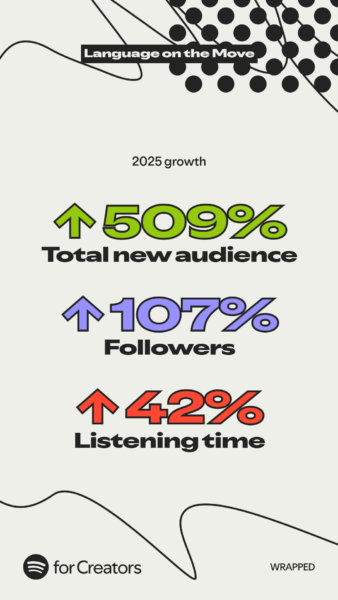
This is what Spotify tells us about the Language-on-the-Move Podcast
Top 10 most read blog posts
- Alexander-von-Humboldt-Professorship Awards 2025
- New Year’s Visit
- Hiring a dream team in linguistic diversity and social participation
- Alexandra Grey, Making linguistic diversity visible in Parliament
- Gerald Roche, Language access rights are vital
- Laura Smith-Khan, What’s new in Language and Law in Education and Training
- Allegra Holmes à Court, How judges think about language
- Rosemary Salomone, English in the crossfire of US immigration
- Nashid Nigar and Alex Kostogriz, Immigrant Teachers are reshaping English education
- Laura Smith-Khan, Learning to speak like a lawyer
Top 10 most downloaded podcast episodes
- Podcast Episode 42: Politics of language oppression in Tibet: Tazin Abdullah in conversation with Gerald Roche (14/01/2025)
- Podcast Episode 57: The Social Impact of Automating Translation: Tazin Abdullah in conversation with Ester Monzó-Nebot (03/08/2025)
- Podcast Episode 58: Erased voices and unspoken heritage: Alexandra Grey in conversation with Zozan Balci (20/08/2025)
- Podcast Episode 61: Cold Rush: Ingrid Piller in conversation with Sari Pietikainen (09/09/2025)
- Podcast Episode 63: Australia’s National Indigenous Languages Survey: Alexandra Grey in conversation with Zoe Avery (28/10/2025)
- Podcast Episode 53: Accents, complex identities, and politics: Brynn Quick in conversation with Nicole Holliday (12/06/2025)
- Podcast Episode 41: Why teachers turn to AI: Brynn Quick in conversation with Sue Ollerhead (09/01/2025)
- Podcast Episode 56: Multilingual practices and monolingual mindsets: Brynn Quick in conversation with Jinhyun Cho (18/07/2025)
- Podcast Episode 54: Chinese in Qatar: Tazin Abdullah in conversation with Sara Hillman (19/06/2025)
- Podcast Episode 59: Intercultural Communication – Now in the 3rd edition: Loy Lising in conversation with Ingrid Piller (26/08/2025)
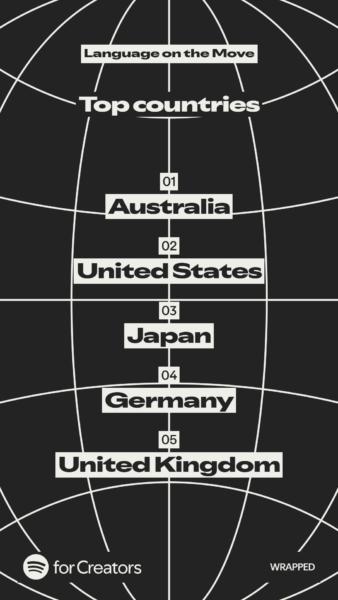
This is what Spotify tells us about the Language-on-the-Move Podcast
Please make sure to subscribe!
As search engines and social media continue to erode as drivers of Internet traffic, having a solid subscriber base has become ever more important. Please support us by encouraging your students, colleagues and friends to subscribe to Language on the Move in the ‘Newsletter subscription’ box in the footer below.
You can also follow us on BlueSky, connect with individual member of the Language-on-the-Move team on LinkedIn, and subscribe to the Language on the Move Podcast in the podcast app of your choice.
December
- Language on the Move Podcast wins Talkley Award 2025 [added on Dec 30, 2025]
- Jemima Rillera Kempster, Centering people in technology-mediated communication – a report about a fantastic symposium dedicated to new technologies in intercultural communication, which we hosted at Macquarie University on December 8.
- Language on the Move Reading Challenge 2026 – now in its ninth year! Make sure to join us in this reading challenge!
- Sophie Munte, ALAA 2025 at Charles Darwin University
Highlight
Brynn Quick had her first academic article published. This is part of Brynn’s PhD research, which investigates how medical receptionists deal with patients who have little or no English. This first publication is a policy analysis but the findings from the ethnographic study are bound to be even more exciting – watch this space!
First publication is always so sweet. Congratulations, Brynn!
Quick, B., Piller, I., & Lising, L. (2025). The (un)imagined work of determining patients’ English language proficiency. Journal of Multilingual and Multicultural Development, 1-18. https://doi.org/10.1080/01434632.2025.2594462
This is what Spotify tells us about the Language-on-the-Move Podcast
November
- Sara Hillman, Aishwaryaa Kannan, and Tim Tizon, From “Howdy” to “Hayakom”: A shifting university linguascape
- Larissa Cosyns, Shared Reading Day 2025
- Podcast Episode 64: Your Languages are your superpower! Agnes Bodis in conversation with Cindy Valdez (17/11/2025)
- A major task of 2025 was to assemble the Humboldt Professorship team of three doctoral and three postdoctoral researchers: meet them here.
- Andrea Pešková, Native listening and learning new sounds
October
- Podcast Episode 63: Australia’s National Indigenous Languages Survey: Alexandra Grey in conversation with Zoe Avery (28/10/2025)
- In this post, we introduced the newly established World Education Research Association (WERA) International Research Network (IRN) “Literacy in Multilingual Contexts” – please consider joining if you are conducting research in this area.
- We are still looking for Sydney-based teachers to participate in a research survey about “Language brokering in schools.”
- Event: New technologies in Intercultural Communication – pre-event program and abstract; the post-event report is here.
Highlight
Ana Sofia Bruzon finished her PhD this year. Graduation will be in April next year when you will hear more about her work on “Technology and Transnational Bilingual Parenting: A Double-Edged Sword.” For now, congratulations, Dr Bruzon!
September
- Ana Sofia Bruzon, Why “critical” use of AI in education might mean refusal
- Podcast Episode 62: Migration is about every human challenge you can have: Brynn Quick in conversation with Shaun Tan (17/09/2025)
- Podcast Episode 61: Cold Rush: Ingrid Piller in conversation with Sari Pietikainen (09/09/2025)
- Podcast Episode 60: Sexual predation and English language teaching: Hanna Torsh in conversation with Vaughan Rapatahana (02/09/2025)
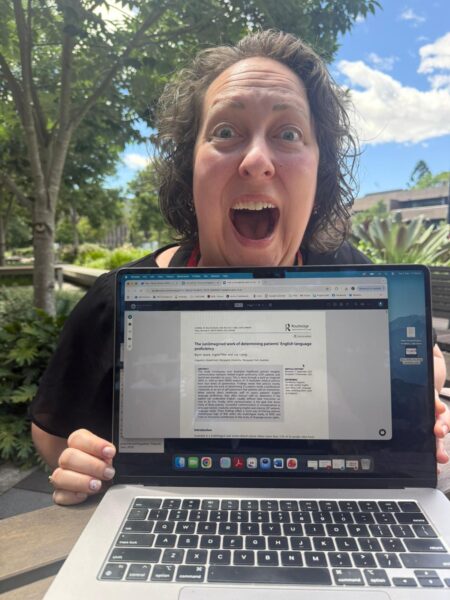
Brynn Quick published her first academic article this year (Image credit: Language on the Move)
August
- Podcast Episode 59: Intercultural Communication – Now in the 3rd edition: Loy Lising in conversation with Ingrid Piller (26/08/2025)
- Podcast Episode 58: Erased voices and unspoken heritage: Alexandra Grey in conversation with Zozan Balci (20/08/2025)
- Brynn Quick, How to manage your supervisor
- Podcast Episode 57: The Social Impact of Automating Translation: Tazin Abdullah in conversation with Ester Monzó-Nebot (03/08/2025)
Highlight
Our team is making a growing contribution to multilingual healthcare, including these two new publications:
Marinaro, N. (2025). Operationalising linguistic unease for the evaluation of language policies in healthcare. Revista de Llengua i Dret(84), 73-93. https://doi.org/10.58992/rld.i84.2025.4492
Li, J., Luo, M., Cho, J., & Zhang, J. (2025). The double-edged sword of language: empowerment and precarity for interpreters in a Chinese border hospital. Multilingua. https://doi.org/doi:10.1515/multi-2025-0168
July
- Alexandra Grey, Who’s new in Law and Language?
- Kristen Martin, LLIRN 6th Anniversary Workshop – our partner, the “Law and Linguistics Interdisciplinary Research Network” turned 6 this year. We celebrate with them the power of networking!
- Podcast Episode 56: Multilingual practices and monolingual mindsets: Brynn Quick in conversation with Jinhyun Cho (18/07/2025)
- Larissa Cosyns, Dr Loy Lising spreads a multilingual mindset
- Humanities’ cuts pose existential threat to Australia’s capabilities
-
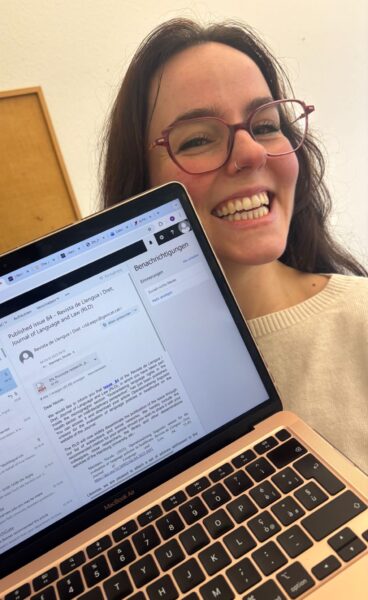
Nicole Marinaro sharing news of her latest publication (Image credit: Language on the Move)
- Alexandra Grey, Making linguistic diversity visible in Parliament
Highlight
The recruitment process for the fellows on the Humboldt Professorship team “Linguistic Diversity and Social Participation Across the Lifespan” took up much of 2025.
The interviews with 20 shortlisted candidates were one of the highlights of the year. We wish we could have hired all these talented young researchers. It was such a privilege to get to know them and we wish to acknowledge them, too, and wish them well!
June
- Podcast Episode 55: Improving quality of care for patients with limited English: Brynn Quick in conversation with Leah Karliner (26/06/2025)
- Podcast Episode 54: Chinese in Qatar: Tazin Abdullah in conversation with Sara Hillman (19/06/2025)
- Emily Pacheco, Children of Migrant Deaf Adults
- Podcast Episode 53: Accents, complex identities, and politics: Brynn Quick in conversation with Nicole Holliday (12/06/2025)
- Podcast Episode 52: Is beach safety signage fit for purpose? Agnes Bodis in conversation with Masaki Shibata (05/06/2025)
May
- Alexandra Grey, Legal Corpus Linguistics
- Tazin Abdullah, Research participants needed to evaluate online multilingual communications
- Allegra Holmes à Court, How judges think about language
- Hiring a dream team in linguistic diversity and social participation
- Alexander-von-Humboldt-Professorship Awards 2025
-
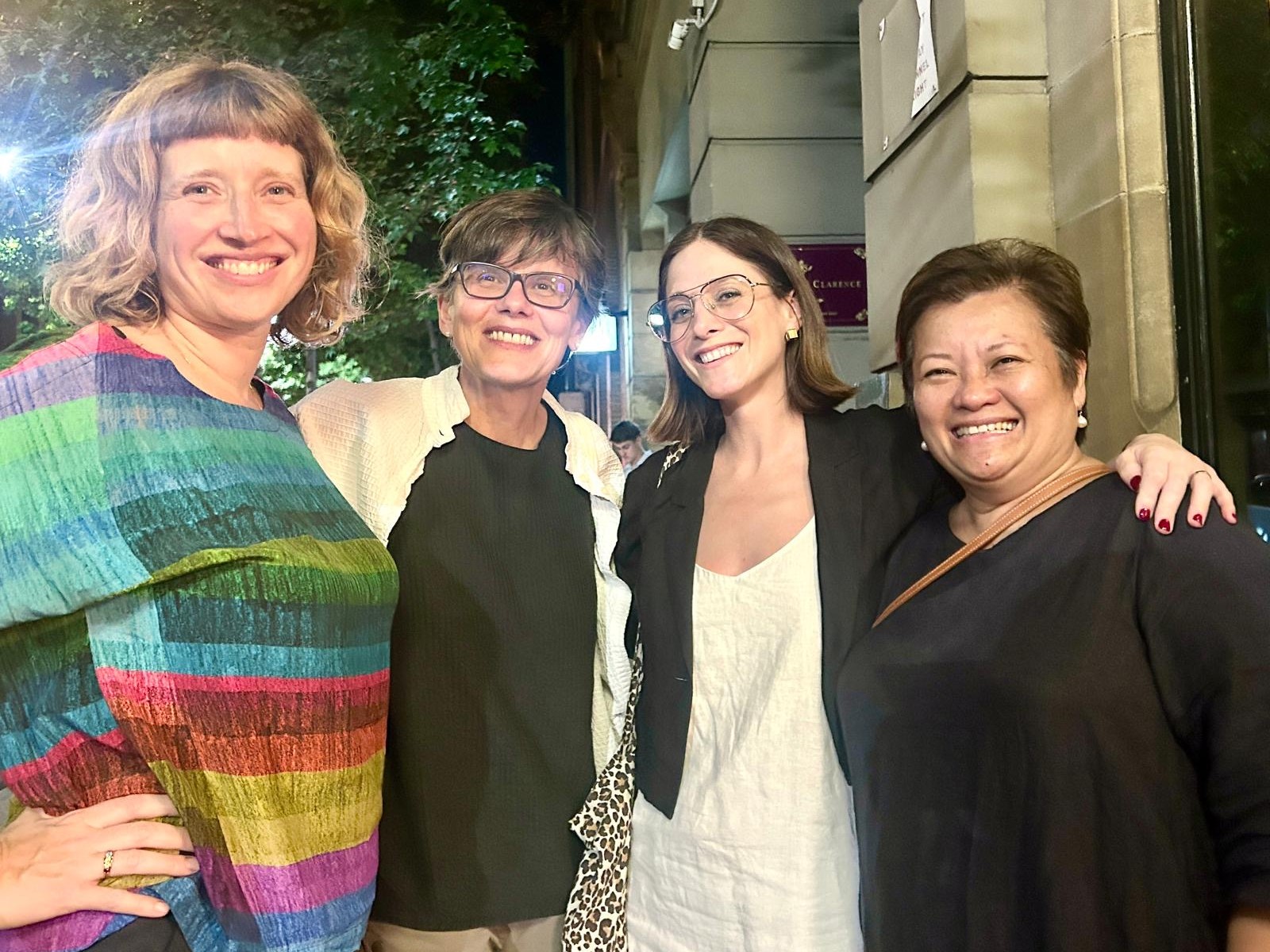
Ana was awarded her doctorate this year and is now Dr Bruzon. An occasion to celebrate with her supervision team (Image credit: Language on the Move)
Laura Smith-Khan, What’s new in Language and Law in Education and Training
Highlight
In May we had much to celebrate: The Humboldt-Professorship Award Ceremony in Berlin was complemented with an inspiring “Welcome Symposium” hosted the Literacy in Diversity Settings (LiDS) Research Center.
April
- Podcast Episode 51: The case for ASL instruction for hearing heritage signers: Emily Pacheco in conversation with Su Kyong Isakson (28/04/2025)
- Podcast Episode 50: Researching language and digital communication: Brynn Quick in conversation with Christian Ilbury (22/04/2025)
- Podcast Episode 49: Gestures and emblems: Brynn Quick in conversation with Lauren Gawne (14/04/2025)
- Podcast Episode 48: Lingua Napoletana and language oppression: Tazin Abdullah in conversation with Massimiliano Canzanella (07/04/2025)
-
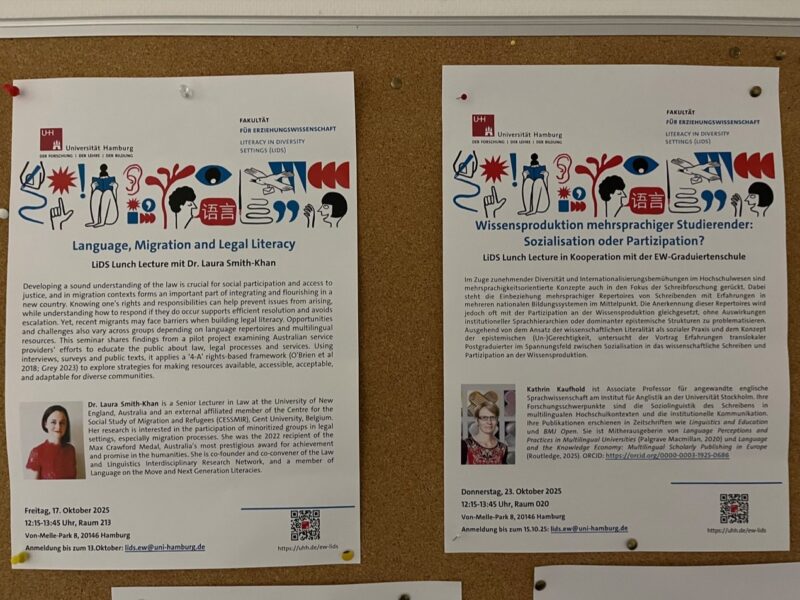
The bulletin board of the Literacy in Diversity Settings (LiDS) Research Center was filled with announcements for guest lectures throughout the year (Image credit: Language on the Move)
Laura Smith-Khan, Learning to speak like a lawyer
Highlight
Throughout the year, we welcomed an amazing group of visitors to the University of Hamburg, as part of two lecture series: the Lunch Lectures of the Literacy in Diversity Settings (LiDS) Research Center and as part of the public lecture series “Everyday Multilingualism.”
March
- Podcast Episode 47: Teaching international students: Brynn Quick in conversation with Agnes Bodis and Jing Fan (31/03/2025)
- Gerald Roche, Language access rights are vital
- Rosemary Salomone, English in the crossfire of US immigration
- Nashid Nigar and Alex Kostogriz, Immigrant Teachers are reshaping English education
- Podcast Episode 46: Intercultural competence in the digital age: Brynn Quick in conversation with Amy McHugh (12/03/2025)
- Podcast Episode 45: How does multilingual law-making work: Alexandra Grey in conversation with Karen McAuliffe (05/03/2025)
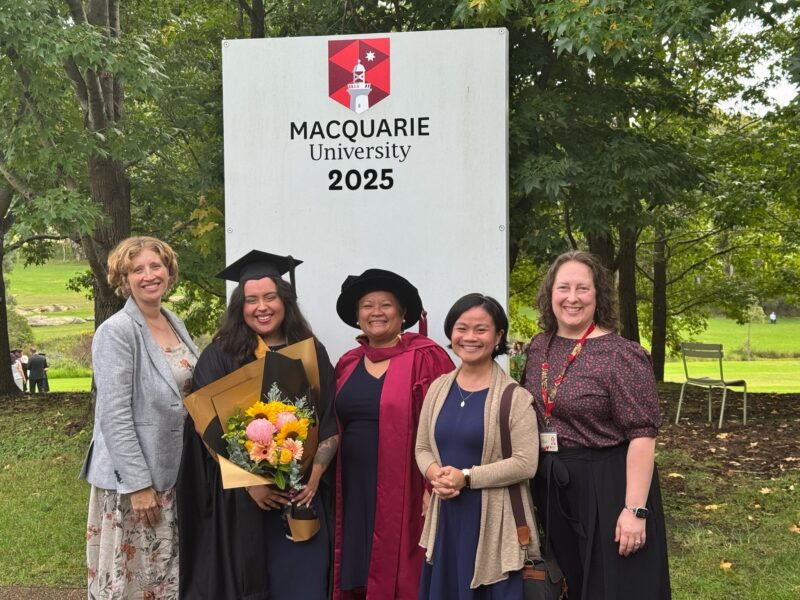
Emily Pacheco graduated from her MRes with a thesis about the language brokering experiences of the hearing children of migrant Deaf adults (Image credit: Language on the Move)
February
- Alexandra Grey, Making Zhuang language visible
- Podcast Episode 44: Educational inequality in Fijian higher education: Hanna Torsh in conversation with Prashneel Goundar (25/02/2025)
- Tazin Abdullah, Lifelong learning from academic mentorship
- Brynn Quick and Tazin Abdullah, Seven reasons why we love hosting podcasts
- Kristen Martin: Closing the Gap Languages Target: An update
- Emma Genovese, Language and inclusion in law
- Sunjoo Kim, More than meets the eye
- Celeste Rodriguez Louro, Automating silence?
Highlight
The 3rd edition of Ingrid Piller’s textbook Intercultural Communication (Edinburgh University Press, 1st ed. 2011) was published this year. The 3rd edition includes a new chapter in intercultural crisis communication based on our team’s research on multilingual communications during the Covid-19 pandemic.
January
-
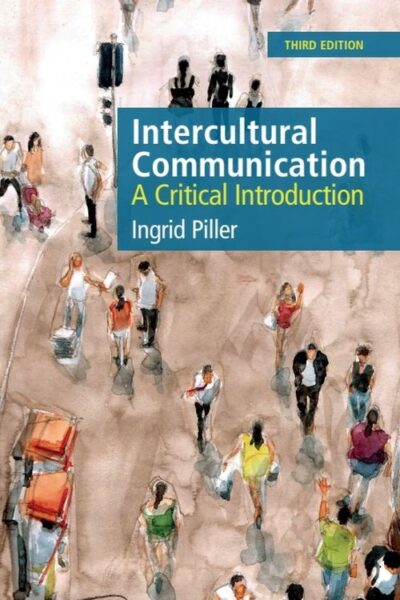
“Intercultural Communication” is now out in the 3rd edition – with a new chapter on crisis communication in a linguistically and culturally diverse world
Ingrid Piller, New Year’s Visit
- Rami Luisto, Local culture mirrored in dog signs
- Podcast Episode 43: Multilingual crisis communication: Tazin Abdullah in conversation with Li Jia (22/01/2025)
- Anna Dillon and Sarah Hopkyns, Visit to Abrahamic Family House
- Podcast Episode 42: Politics of language oppression in Tibet: Tazin Abdullah in conversation with Gerald Roche (14/01/2025)
- Podcast Episode 41: Why teachers turn to AI: Brynn Quick in conversation with Sue Ollerhead (09/01/2025)
- Podcast Episode 40: Language Rights in a Changing China: Brynn Quick in conversation with Alexandra Grey (01/01/2025)
Language-on-the-Move Podcast episodes 1-39
A full list of pre-2025 Language-on-the-Move podcast episodes is available here.
Previous annual reports
- Language on the Move 2024
- Language on the Move 2023
- Language on the Move 2022
- Language on the Move 2021
- Language on the Move 2020
- Language on the Move 2019
- Language on the Move 2018
- Language on the Move 2017
- Language on the Move 2016
- Language on the Move 2015
- Language on the Move 2014
- Language on the Move 2013
- Language on the Move 2012
- Language on the Move 2011
- Language on the Move 2010
- Language on the Move 2009
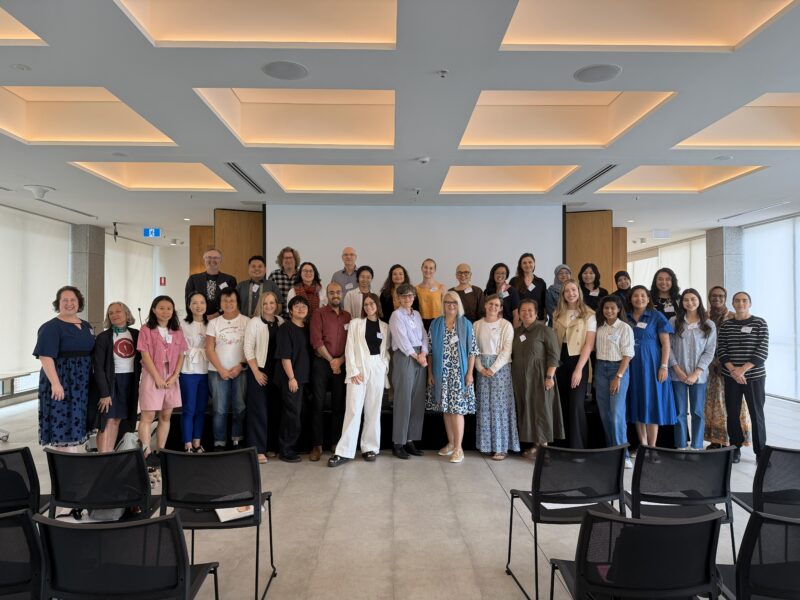
Group photo, New Technologies in Intercultural Communication Symposium (Image credit: Language on the Move)
On a crack-of-dawn flight early Monday morning last week, I flew to Sydney for the day to attend “New Technologies in Intercultural Communication“, a symposium hosted by the Language on the Move Team at Macquarie University.
The presentations explored intercultural communication ranging from the use of digital technologies by elderly migrants and their families (Dr Earvin Charles B. Cabalquinto), GenAI as digital shadow care support by international students (Dr Julia Kantek and Dr Thilakshi Mallawa Arachchi), language learning tools by transnational parents for heritage language maintenance (Dr Ana Sofia Bruzon), learning technologies in primary science classrooms in Australia and Korea (Dr Hye-Eun Chu), and social media in language learning (Dr Yeong-Ju Lee). And to think the new technology promising proficiency and fluency “back in my day” (I find myself relating to a joke Professor Piller made about technological development) relied on cassette tapes at the language lab!
The symposium showcased a fascinating catalogue of digital technologies enabling intercultural communication. We heard about high school students in an Australian classroom connecting with Korean students to hypothesize why the seasons differ between their two countries. We heard of transnational parents employing creative ways to encourage their children to connect to their heritage languages, especially to communicate with family members. It was also intriguing to hear how social media platforms such as Tiktok offer features such as “duet”, creating opportunities for speakers of different languages to collaborate and co-construct meaning.
While we heard of these novel and exciting ways technology can be used to enhance intercultural communication, each presenter emphasized the human element in communication. I could not help but think about how language learning tends to be marketed as fun, brain-boosting, or career-enhancing. And yet, language in human relationships is messy, and missteps happen! Even so, whether you already speak the language or are learning an additional one, I believe empathy and deeper understanding are borne out of the struggle to communicate and truly connect with each other.
The most striking point for me was that some uses of technology actually stem from institutional failures or social exclusion, leaving the vulnerable members of our society even more marginalized. Earvin reminded us that although much of the discussion seems to be on the importance of digital literacy skills, many still lack basic access to technological infrastructure that we often take for granted in urban Australia. Julia and Thilakshi’s presentation highlighted the isolation that international students experience, turning to GenAI for immediate advice on legal matters, polishing their resumes, or easing homesickness. Ana pointed to multilingual parents’ struggles of heritage language maintenance in the face of pervasive monolingual mindset across Australian schooling and public discourse.
As I flew back to Brisbane that evening, reflecting on the presentations, discussion questions, and conversations I had with fellow attendees strengthened my resolve to keep pushing for equity in language learning and digital access.
We need to keep asking: How do we use technology for intercultural communication? Who gets left out? And how can we keep working towards digital and social inclusion?
I want to thank UQ School of Education for making it possible for me to attend the symposium, and to Distinguished Professor Ingrid Piller, Dr Loy Lising, Dr Ana Sofia Bruzon and the Language on the Move team for bringing together a rich program and creating the opportunity to hear from and exchange ideas with other scholars.
]]>
“Read – Learn – Grow – Be Kind” – this street library says it all (Image credit: Language on the Move)
The Language-on-the-Move Reading Challenge 2026 is out!
Now in its ninth year, the goals of our reading challenge have remained broadly unchanged since 2018: to encourage reading in the discipline and beyond, and to make linguistics reading fun.
These goals have become even more relevant, due to two converging trends:
On the one hand, book reading is in freefall internationally while, on the other hand, screen time is rising exponentially.
If you think this is just a case of one medium replacing another, you are unfortunately mistaken.
In its most prevalent form – social media use – screen time has negative effects on our ability to concentrate, to think deeply and critically, and to develop empathy. These negative effects are now so widely felt that their popular designation “brain rot” was selected as the Oxford Word of the Year 2024.
Book reading, by contrast, is the antidote to brain rot. Book reading challenges us to concentrate and to deeply engage with an extended argument or a narrative universe.
To train your brain you need to read long form. You can’t outsource your reading to AI-generated summaries, either.
Furthermore, many of our readers are (aspiring) researchers and Stephen King’s advice in On Writing is valid in our profession, too:
If you don’t have time to read, you don’t have the time (or the tools) to write. Simple as that.
The Language-on-the-Move Reading Challenge is here for you develop, enjoy and extend the habits and pleasures of reading, particularly in the field of linguistic diversity and social participation. For each month of 2026, we are suggesting a category and one of our team members offers a recommendation in that category.
Enjoy and feel free to add your own recommendations in the “Comments” section below.
And don’t forget that, in addition to the categories and recommendations suggested here, the Language-on-the-Move Podcast will also continue to bring you regular reading ideas in 2026.
 Happy Reading!
Previous Language-on-the-Move Reading Challenges
- Language on the Move Reading Challenge 2025
- Language on the Move Reading Challenge 2024
- Language on the Move Reading Challenge 2023
- Language on the Move Reading Challenge 2022
- Language on the Move Reading Challenge 2021
- Language on the Move Reading Challenge 2020
- Language on the Move Reading Challenge 2019
- Language on the Move Reading Challenge 2018
January: a book about new technologies in intercultural communication
Recommendation: Cabalquinto, E. C. B. (2022). (Im)mobile Homes: Family Life at a Distance in the Age of Mobile Media. Oxford University Press.
Earvin’s presentation about the myth of digital inclusion of older migrants in Australia was one of the highlights of our recent symposium devoted to “New technologies in intercultural communication.”
Whether you missed out on the symposium or want to deepen your engagement with Earvin’s work, (Im)mobile Homes offers a gripping exploration of the use of smartphones, social media, and apps in the family and care practices of transnational families. (Ingrid Piller)
February: a book about settler colonialism
 Recommendation: Simpson, A. (2014). Mohawk Interruptus: Political Life Across the Borders of Settler States. Duke University Press.
This book completely reshaped my understanding of Indigenous politics, border, nation, and sovereignty in North America. It also made me reflect on my reliance on the extensive literature on Indigenous cultures and languages – ritual speech, performances, tales, or beliefs – produced over the last century by anthropologists and linguists, most of which are dismissive of the scene of dispossession, the complicated history of places, or simply what people say about themselves and their struggles. (Gegentuul Baioud)
March: a book stirs that your social imagination
Recommendation: Bregman, R. (2017). Utopia for realists. Bloomsbury.
In this book, Rutger Bregman stirs our imagination by inviting us to re-think the way modern society is organized and by offering us a glimpse into a potentially better future for all. He calls for a new vision that would more effectively address current global challenges such as increasing inequalities or the progressing automation of labor.
But what does he exactly propose?
In short, a 15-hour work week, universal basic income and open borders. The author invites you on a journey between time and spaces with real examples of communities that have taken utopia seriously and have started to experiment with it. (Olga Vlasova)
April: A book about the philosophy of language
 Recommendation: Le Guin, U. (1974). The Dispossessed. HarperCollins.
Le Guin constantly fluctuates the reader´s receptors between the old and the new, roots and progress, personal and professional, politics and philosophy. We follow the life and work of a physicist who travels back and forth between two historically connected but contrasting planets and political systems.
The protagonist commits to seeking the truth not only by understanding his own context of origin but also by defying it; how do we find our truth? And is it ever objective? The novel is considered a post-feminist utopian fiction raising discussions on whether linguistic innovation is necessary for conceptual change.
A story of intergalactic migration trying to answer the long-standing question: to whom does knowledge belong? (Mara Kyrou)
May: A book about the experience of growing up as the child of a migrant
Recommendation 1: Vuong, O. (2019). On Earth We’re Briefly Gorgeous. Penguin.
Vietnamese-American history, language, and generational trauma come together in the form of a poetic letter with utterances such as “I am writing you from inside a body that used to be yours. Which is to say, I am writing as a son.” Dedicated to someone who will never see it: the author’s mother, who never learned how to read.
Through the eyes of a young man named Little Dog discovering his homosexuality in a space for undocumented immigrants, this book tells the story of a Vietnamese immigrant family in the US and their complex relationship with the English language. It chronicles their migration history escaping the atrocities of war, the fragile family dynamics that emerged from that experience, and the love for words that connects the writer with himself, while ironically separating him from his mother. (Juan Felipe Sánchez Guzmán)
 Recommendation 2: Toxische Pommes. (2024). Ein schönes Ausländerkind. Zsolnay.
Ein Schönes Ausländerkind is a fictionalised autobiography of the author’s childhood, after her family fled to Austria due to the Yugoslav Wars. The book made me laugh a lot, as the author (who writes under the pseudonym she uses to post satirical sketches online) pokes fun at the many absurdities of migrant life. But I also found it very powerful in its depiction of a messy, painful, but loving father-daughter relationship where the adult struggles to learn the local language, leading to child language brokering. (Jenia Yudytska)
June: A book about narrative research in a migration context
Recommendation: Stevenson, Patrick (2017). Language and migration in a multilingual metropolis: Berlin Lives. Palgrave Macmillan.
This book offers a highly engaging and innovative exploration of Berlin’s multilingualism through personal migration narratives. Working ethnographically, the researcher situates his analysis in a single shared apartment in Neukölln, using the linguistic repertoires and biographical trajectories of its five residents—a Russian-speaking woman, two Polish-speakers, a Kurdish-speaking man, and a Vietnamese-speaking woman—to demonstrate how migration, identity and sociolinguistic practice intersect in everyday life.
The book portrays the apartment as a microcosm of the city’s wider linguistic landscape, tracing how individuals navigate language ideologies, negotiate belonging, and construct social relations within a complex metropolitan environment. (Martin Serif Derince)
July: A book exploring linguistic diversity from multiple perspectives
 Recommendation: Aguilar Gil, Y. E. (2020). Ää: manifiestos sobre la diversidad lingüística. Almadia.
Language loss, resistance, indigenous literature(s), prejudice, identity, autonyms and exonyms – these are just some of the topics discussed in this collection of essays by Yásnaya Elena Aguilar Gil, an Ayuujk linguist, writer, translator, and activist. An interactive work edited by the author’s colleagues, this book presents texts written for an online magazine over several years alongside links to related social media posts, as well as a speech given by Yásnaya Elena Aguilar Gil at the Mexican Chamber of Deputies and a closing epilogue by herself. A great read – refreshing and profoundly reflexive – for anyone interested in linguistic diversity in Mexico and beyond. (Nicole Marinaro)
August: A book about translation and interpreting
Recommendation: Shuttleworth, M., & Daghigh, A. J. (Eds.). (2024). Translation and Neoliberalism. Springer.
This book examines how neoliberalism shapes translation and interpreting across diverse regions, focusing on four themes: market-driven translation and interpreting curricula, policy impacts on language services, technology’s role in translation and interpreting markets, and intersections of translation and neoliberalism at a discourse level. It offers critical insights for scholars, practitioners, and policymakers into the socio-economic forces transforming translation studies, industries and curricula. (Jinhyun Cho)
September: A book about digital migration studies
Recommendation: Leurs, Koen, & Ponzanesi, Sandra (Eds.). (2025). Doing Digital Migration Studies: Theories and practices of the everyday. Routledge.
This open-access edited volume serves as an introduction to ‘digital migration studies’, an umbrella term for research on migration in relation to digital technologies. The articles examine topics ranging from migrant agency on TikTok to the use of automatic dialect recognition during the asylum procedure.
Although most contributions don’t explicitly focus on language, the breadth of topics and methodologies covered still sparked ideas for new research directions for me as a linguist. (Jenia Yudytska)
October: A book about an under-recognized diaspora
 Recommendation: Bald, V. (2013). Bengali Harlem and the lost histories of South Asian America. Harvard University Press.
Film and other information: http://bengaliharlem.com
Historical Harlem, New York does not conjure up images of South Asians going about their daily lives, but Bengali Harlem tells us the story of immigrants who arrived from the 1800s onwards from the Indian subcontinent.
This book focuses on migrants who were ethnolinguistically Bengalis (from what was known as Bengal) and came as merchants, seamen, or laborers to be absorbed into working class America. In the face of racism and discrimination, they built homes and lives, leaving behind generations of Americans with Bengali cultural and linguistic heritage. (Tazin Abdullah)
November: A book of migrant poetry
Recommendation: Saleh, S. M., Syed, Z., & Younus, M. (Eds.). (2025). Ritual: A Collection of Muslim Australian Poetry. Sweatshop Literacy Movement.
Billed as “evocative, unsettling, and unafraid,” this rich collection of Muslim Australian poetry offers a rich treasure trove of poems to come back to and savour again and again. The poems invite the reader to not only reflect on the diversity of Muslim identities but what it means to live on Indigenous land as a designated migrant within a White settler colony. (Ingrid Piller)
December: Cozy fiction for when you need a break from your research
 Recommendation: Arden, K. (2019). The Winternight Trilogy. Del Rey.
]]>I’m now 1.5 years into my PhD and I find that, now more than ever, I need good fiction to read after a long day of academic reading/writing. The Winternight Trilogy is set in the harsh winters of a folkloric version of medieval Russia and follows Vasya, a young woman whose difficult peasant life collides with those of chyerti, the demons and devils of Slavic folklore.
The settings and creatures described in this trilogy are nothing short of magical, and reading the prose makes me feel like I am tucked away snug in a winter cabin with a roaring fire and hot chocolate.
A lesson that I am learning along my PhD journey is that it is imperative to nourish myself while I work so hard, and reading these books is part of that nourishment for me. Knowing that I have the winter snows and rich folklore of these books to look forward to at the end of the day helps me to persevere through the daily ups and downs of PhD life. (Brynn Quick)
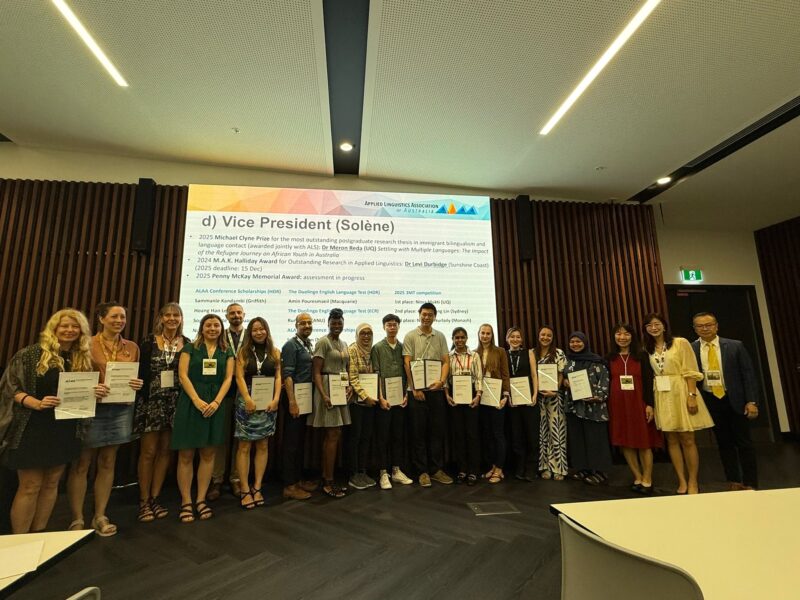
Group photo of all awards recipients at ALAA Conference 2025 (Image credit: ALAA)
Recently, I had the opportunity to attend the 2025 Applied Linguistics Association of Australia (ALAA) Conference, held at Charles Darwin University in Garramilla/Darwin on Larrakia Country from November 17-19. The conference was devoted to the topic ‘Language and the Interface of Mono-, Multi-, and Translingual Mindsets’ and brought together Australian and international scholars.
The 3-day conference in a tropical setting offered many inspiring and new experiences and an excellent platform for networking, collaboration and the exchange of ideas.
Inspiring Keynotes
Keynote lectures delivered by Shoshana Dreyfus (University of Wollongong) and Robyn Ober (Batchelor Institute) left a great impression on me.
Shoshana spoke about linguistic strategies in activism. She presented a positive discourse analysis unraveling effective activist discourse in letters to the minister. Based on such a letter she had written herself, her talk showed how activists rally support. Her compassionate talk shed light on different registers to make change and become an ally for non-verbal people.
Robyn introduced the audience to beautiful metaphors of linguistic diversity and exchange in Indigenous Australian education. Her description of “slipping and sliding” between languages gave insights into multilingual practices.
The audience was particularly touched by the metaphor of language as a guitar: just as an instrument with multiple strings produces more melodious and harmonious tunes, multilingual people have more than one string to their bow, which creates greater harmony when joined.
Encountering Indigenous Languages and Cultures
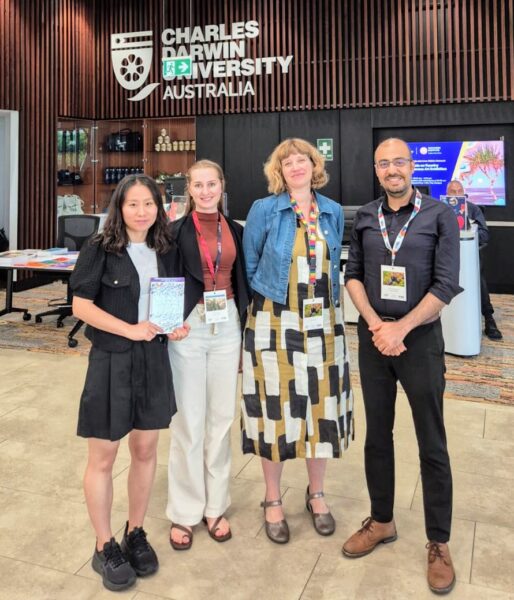
The Macquarie University team at ALAA (Image credit: Sophie Munte)
As a PhD student from the University of Hamburg in Germany who currently spends time at Macquarie University in Sydney as part of my joint PhD degree across the two institutions, the conference offered me the privilege to learn about Indigenous languages and cultures.
Darwin offers a setting where the fact that Australia is Indigenous land is much more palpable than in Sydney. Together with Robyn’s keynote and other talks, this opened my eyes to Australia’s rich diversity of Indigenous cultures and languages.
Presenting my research
The conference provided me with the opportunity to present first results from my PhD research on the governance of parent-school communication in linguistically diverse schools in Hamburg and Sydney.
Employing policy analysis, surveys and interviews, my research explores the use of child language brokering as a way to bridge language barriers between parents and schools. The international comparison will shed light on how institutions in different national contexts deal with their shared responsibility to communicate with parents. Ultimately, the research will contribute to improved policies and teacher training so that all parents can fully participate in the education of their children, regardless of linguistic background.
Grateful to ALAA for the support
Attending the 2025 ALAA conference has been a wonderful opportunity for me. I am particularly grateful for the funding support I received through the ALAA Postgraduate Conference Scholarship. This scholarship, which was awarded to six higher degree research students, including myself, financially supports the conference attendance of HDR researchers.
I also commend the ALAA Higher Degree Research representatives for creating such an inclusive and welcoming event: each evening they organized meet-ups for all HDR candidates at the conference, including a language themed trivia night – all of which helped to establish a supportive community among us HDR students and build connections that will endure beyond the conference.
]]>***
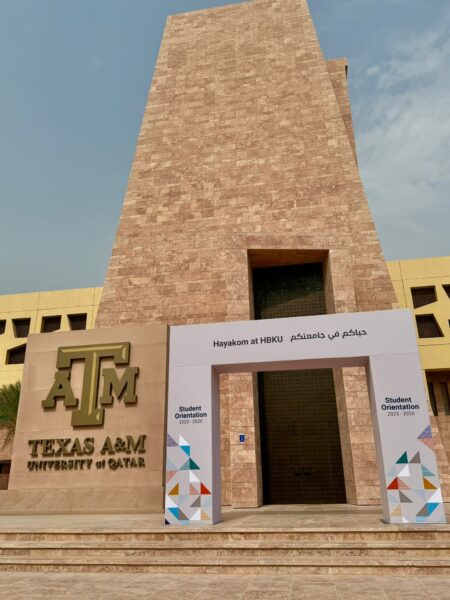
Figure 1: Transitional “Hayakom at HBKU” sign marking HBKU’s presence in the TAMUQ building (picture taken by authors)
Walking into the Texas A&M University at Qatar (TAMUQ) building today feels different from just a year ago. As part of an ongoing project, several students and I (Sara) have been documenting the visual and linguistic changes taking place across the TAMUQ building in Education City, Qatar. The university’s traditional greeting Howdy, its maroon banners, and the familiar Aggie insignia (the shared nickname and identity of Texas A&M students and alumni) are still visible, yet they are beginning to lose their dominance. In their place, visitors are now welcomed by new blue-and-white signs displaying a translingual message: “Hayakom at HBKU.” The Gulf Arabic word hayakom, meaning “welcome,” has become increasingly prominent on posters, banners, and orientation booths. Although much of this signage is not yet permanently installed, the shift is already evident.
This evolving dynamic from Howdy to Hayakom reflects more than just a sudden change in branding. It marks a shift in Qatar’s higher education landscape, as the U.S. branch campus TAMUQ, part of Qatar Foundation (QF) and located in Education City, prepares to close in 2028 while its fellow QF institution, the homegrown Hamad Bin Khalifa University (HBKU), gradually assumes its facilities and students. The closure decision followed a surprise February 2024 vote by the Board of Regents of Texas A&M University’s main campus in College Station, Texas, which cited regional instability and a renewed focus on its U.S. mission. Soon after that announcement, the three of us began photographing every Texas A&M emblem, sign, and display in the building, creating a record to track the changes over time and to preserve a piece of the campus’s history. Over the past year, we have watched the visual culture of the space shift in real time. Through signage, slogans, and colors, the linguistic landscape of the building and the identities it projects tell a story of institutional transformation, cultural localization, and shifting ideologies of belonging.
The educationscape as a site of change
Scholars of linguistic landscapes often remind us that signs do more than convey information; they materialize power, ideology, identity, and values in public space (Ahmad, 2022; Hillman & Ahmad, 2024). The same can be said for educationscapes, where universities use visuals, language, and architecture to communicate identities, values and affiliations (Krompák et al., 2022).
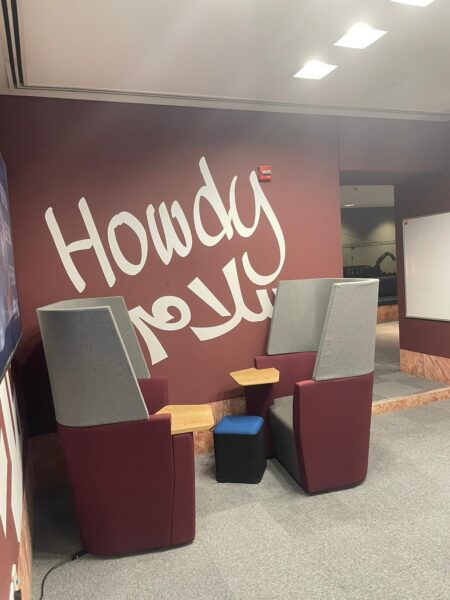
Figure 2: Howdy signage inside the TAMUQ building representing Aggie identity and transnational continuity (picture taken by authors)
At TAMUQ, Howdy has reigned supreme for more than twenty years. As the official greeting of Texas A&M, faculty, staff, and students at the main campus use it to welcome one another and to greet campus visitors as a sign of Aggie hospitality. On the Doha campus, Howdy appears in signage, emails, and posters for Student Affairs events such as “Howdy Week.” Its cheerful informality reinforced continuity between College Station and its branch campus thousands of miles away.
Now, however, Howdy coexists with Hayakom. HBKU has introduced its own greeting, one that foregrounds the local linguistic and cultural context. HBKU Student Affairs has also begun cultivating its own traditions: “Hayakom Tuesday,” echoing TAMUQ’s “Howdy Week,” and “Blue Thursday,” where students are encouraged to “wear blue, show blue, scream blue!”—a parallel to TAMUQ’s maroon-and-white Spirit Thursdays where Aggies are encouraged to “embrace the maroon and white.”
This bilingual, bicultural overlap reflects the liminal moment both institutions currently inhabit. TAMUQ has not yet closed, and many of its students and faculty still identify strongly with Aggie traditions. At the same time, HBKU is asserting itself through new rituals, slogans, and events.
From maroon to blue: Rebranding space and identity
Alongside slogans, colors play an equally prominent role in communicating institutional belonging. TAMUQ’s maroon and white palette linked it visually to its U.S. home campus, reinforcing transnational identity and Aggie pride. Walking through the corridors meant walking through a transplanted Texas brandscape, complete with photos of College Station landmarks.

Figures 3a and 3b: HBKU “Blue Thursday” and TAMUQ “Spirit Thursday” posters on Instagram (screenshots taken by authors)

Today, that palette is fading. Blue and white, the colors of HBKU, now dominate new signage, orientation banners, and student activities. Cushions in the front entrance lobby now feature HBKU’s blue and white geometric logo, and the hallways are lined with images of the Minaretein building (meaning two minarets), HBKU’s signature architectural complex that includes both a mosque and academic colleges, replacing many of the Texas-centric visuals that once dominated the space.
The color shift is more than aesthetic. It signals a deliberate rebranding that seeks to reshape not only institutional identity but also the sense of belonging for students, faculty, and visitors.
Signs of state and leadership
The changes are also visible in the presence of Qatar’s leadership. At the building’s entrance, portraits of the Emir, Sheikh Tamim bin Hamad Al Thani, and his father, Sheikh Hamad bin Khalifa Al Thani, now hang prominently. Such state imagery was absent during the TAMUQ era, when visual emphasis rested on Aggie traditions and the global prestige of Texas A&M. Their presence today highlights HBKU’s identity as QF’s homegrown university and its role in advancing national priorities. The walls themselves remind visitors that HBKU is a Qatari institution, rooted in the state’s vision for education and innovation.
Bilingualism and the Arabic language protection law
Another notable change is that TAMUQ operated under a cross-border partnership agreement with QF and was not required to maintain bilingual signage. As a result, its displays were often inconsistent, with some appearing only in English and others in both English and Arabic. However, HBKU complies more with Qatar’s 2019 Arabic Language Protection Law (Law No. 7 of 2019 on the Protection of the Arabic Language). This law requires Arabic to be the primary language on all public signage.
In practice, this means HBKU’s official signage is almost always bilingual, with Arabic typically placed above or beside the English text. This layout gives prominence to Arabic while reflecting HBKU’s use of English as its official medium of instruction and as a shared language among its diverse student body
Figure 4: Portraits of Qatar’s leadership, including the Emir Sheikh Tamim bin Hamad Al Thani (left) and the Father Emir Sheikh Hamad bin Khalifa Al Thani (right), now displayed at the building’s entrance (picture taken by authors)
The difference is visible, for example, in faculty office nameplates. At TAMUQ, they appeared only in English, whereas at HBKU they are consistently bilingual, with Arabic displayed first. This small but significant shift reflects how language policy is made material in the everyday visual culture of the university.
Belonging and identity in flux
What does it mean for students, faculty, and staff to inhabit this shifting educationscape? This is a question we are currently exploring in our ongoing research about the transition from TAMUQ to HBKU. For Aggies, watching maroon and Howdy fade from view may bring a sense of sadness, as if traditions and ties to the wider Aggie network are slowly being eroded. For new students entering through HBKU, however, Hayakom and the visible presence of Qatari leadership may foster a sense of national belonging and legitimacy that TAMUQ, as a foreign branch campus, could perhaps not fully provide.
The transition also brings into focus broader debates about language, identity, and higher education in Qatar. For years, international branch campuses have stood as symbols of global mobility and English-medium internationalization. HBKU, by contrast, is an explicitly Qatari project, though still English-medium. Its bilingual signage acknowledges the centrality of Arabic in public life while retaining English as the dominant academic language. In this sense, the visual and linguistic rebranding of the building does more than mark institutional change; it materializes Qatar’s ongoing negotiation between global aspiration and national affirmation.
From global brand to national–international project
The TAMUQ-to-HBKU shift can be read as part of a wider trend. Around the world, branch campuses have been praised for providing global exposure but also critiqued for being costly, unsustainable, or disconnected from local needs (Bollag, 2024; Kim, 2025). By 2028, TAMUQ will join the growing list of international branch campuses that have either closed or been absorbed into national institutions. Yet this trajectory is not universal. In the Gulf and parts of Asia, other branch campuses continue to expand, supported by government funding and demand for global higher education pathways.
Figures 5a and 5b: TAMUQ English-only office nameplate and HBKU bilingual Arabic–English office nameplate (photos taken by authors)
In this case, the closure decision was not driven by Qatar’s plans but rather by political currents in the United States, where heightened scrutiny of foreign funding and a turn toward isolationism have reshaped attitudes toward international partnerships. Although HBKU is QF’s homegrown university, it was intentionally designed to be both nationally grounded and internationally oriented—an English-medium institution that continues to attract global faculty and students while advancing Qatar’s local educational priorities. The move from Howdy to Hayakom thus signals more than a greeting. It marks a broader shift from borrowed traditions to localized yet globally connected narratives of identity and belonging.
Reading the signs
As universities, like cities, are built through language and signs, paying attention to the educationscape reveals the symbolic and material contours of change. At TAMUQ/HBKU, the coexistence of Howdy and Hayakom, maroon and blue, photos of Aggie landmarks and Minaretein, encapsulates a moment of transition.
These signs remind us that institutional change is not only about policy or governance. It is lived and seen in everyday spaces: on banners, cushions, doorways, and Instagram posts. They invite us to consider how language, color, and imagery make and remake belonging in higher education. For now, both greetings echo in the same hallways. Yet with each new sign and slogan, the balance tilts, signaling which voice will carry forward for now.
References
Ahmad, R. (2022, October 11). Mal Lawwal: Linguistic landscapes of Qatar [Blog post]. Language on the Move. Mal Lawwal: Linguistic landscapes of Qatar – Language on the Move
Bollag, B. (2024, December 31). International branch campuses spread in Mideast amid concerns about costs, impact. Al-Fanar Media. https://www.al-fanarmedia.org/2024/12/international-branch-campuses-spread-in-mideast-amid-concerns-about-costs-impact/
Hillman, S., & Ahmad, R. (2025). Combatting Islamophobia: English in the linguistic landscape of FIFA World Cup 2022. In K. Gallagher (Ed.), World Englishes in the Arab Gulf States. Routledge.
Kim, K. (2025, July 4). Branch campuses and the mirage of demand. SRHE Blog. https://srheblog.com/2025/07/04/branch-campuses-and-the-mirage-of-demand/
Krompák, E., Fernández-Mallat, V., & Meyer, S. (2022). The symbolic value of educationscapes—Expanding the intersection between linguistic landscape and education. In E. Krompák, V. Fernández-Mallat, & S. Meyer (Eds.), Linguistic Landscapes and Educational Spaces (pp. 1–27). Multilingual Matters.
Law No. (7) of 2019 on the Protection of the Arabic Language. (2019). Al Meezan, Qatar Legal Portal. https://www.almeezan.qa/EnglishLaws/Law%20No.%20(7)%20of%202019%20on%20Protection%20of%20the%20Arabic%20Language.pdf
Author bios
Dr. Sara Hillman is an Associate Professor of Applied Linguistics and English at Hamad Bin Khalifa University (HBKU). Prior to joining HBKU, she spent nearly a decade at Texas A&M University at Qatar. Her research spans emotions, identity, and (un)belonging in English-medium instruction (EMI) and transnational higher education, World Englishes and sociolinguistics, linguistically and culturally responsive teaching and learning, and language and intercultural communication. Her current research explores the visual signage and symbols of Qatar Foundation’s international branch campuses and the homegrown Hamad Bin Khalifa University and how they project identity, values, and belonging.
Aishwaryaa Kannan is a third-year Electrical and Computer Engineering student at Texas A&M University at Qatar (TAMUQ). Alongside her studies, she has been deeply engaged in student leadership and research, serving as the Founding President of the Management & Marketing Association and as a student research partner on the campus closure study led by Dr. Sara Hillman. Having experienced the TAMUQ-to-HBKU transition firsthand, she connects personally with the paper’s themes of identity and belonging. Her interests span technology, education, and human connection, and she is passionate about how innovation and culture shape everyday experiences on campus.
Tim Billy Tizon is a third year Electrical and Computer Engineering undergraduate student at Texas A&M University at Qatar (TAMUQ). In addition to his studies, he has been actively involved in campus life through student leadership and research. He served as Secretary of the Leadership Experience Club for two years and is currently a member of the Management and Marketing Association. He has also participated in research across several disciplines, including communications and machine learning.
]]>
(Image credit: © Gert Albrecht für DIE ZEIT, Stiftung Lesen, Deutsche Bahn Stiftung)
Editor’s note: Shared reading – the practice where adults read to children – has many benefits: it improves children’s language and literacy development, as well as their interactive and communicative skills. Additionally, shared reading can be a lot of fun and, like any joint enjoyable activity, strengthens emotional bonds.
In Germany, shared reading is promoted through a dedicated annual “Vorlesetag” (“Shared Reading Day”). In this post, Larissa Cosyns explains more about the event and shares a reading recommendation.
This post was first published on the Literacy in Diversity Settings (LiDS) Research Center website.
***
This year’s “Vorlesetag” (“Shared Reading Day”) will take place today (November 21) under the motto “Shared Reading Speaks Your Language.” The initiative aims to highlight the unifying power of shared reading and show that every language and every voice counts. Let’s use our voices and read together!
If you’re still looking for a suitable book, you’ll find it in the Global Digital Library. As part of the Global Book Alliance, the digital library wants to provide more reading material in underserved languages. Whether it’s video books in Kenyan sign language or first reader books in Bahasa Indonesian, the digital library offers numerous stories.
I would like to recommend this children’s book from the Global Digital Library: “Making Tormo for the Festival“ by Buddha Yonjan Lama.
Have fun reading together!
Related content
]]>
Cindy is passionate about inclusion, helping other educators develop leadership in EAL/D and cater for the academic and wellbeing needs of multilingual learners, including students from refugee backgrounds. She is an author of professional publications, served as President of the Association for Teaching English to Speakers of Other Languages (ATESOL) NSW and is Member of the Board of Directors of Primary English Teaching Association of Australia known as PETAA.
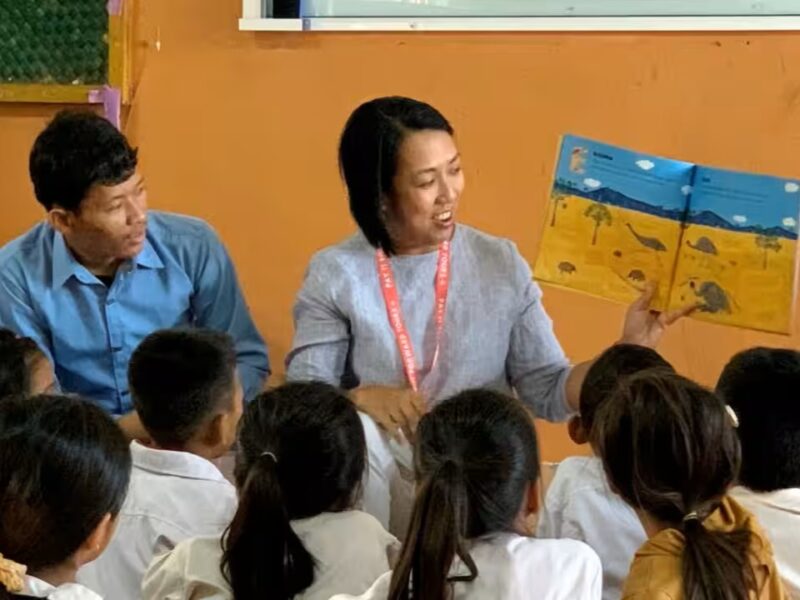
Cindy Valdez teaching in Cambodia (Image credit: Cindy Valdez via SBS)
Additional materials
- “They changed me”: Filipina educator on helping refugee students survive peace, SBS Filipino (2023)
- Valdez Adams, C. (2022) “Including” English as and Additional Language or Dialect (EAL/D) Learners in Your Classroom. Journal of Professional Learning 2
If you liked this episode, support us by subscribing to the Language on the Move Podcast on your podcast app of choice, leaving a 5-star review, and recommending the Language on the Move Podcast and our partner the New Books Network to your students, colleagues, and friends.
Transcript (to follow soon)
]]>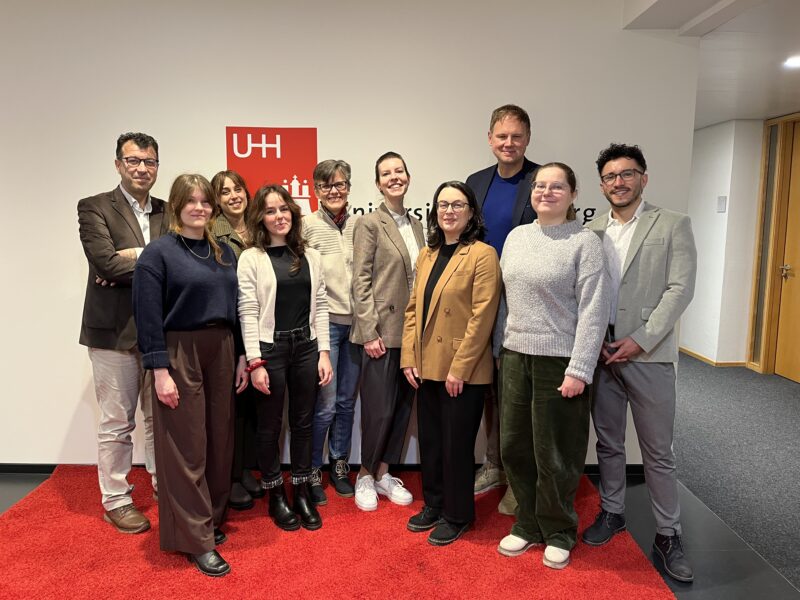
The president of University of Hamburg, Prof Dr Hauke Heekeren, welcomes the new members of Ingrid Piller’s Humboldt Professorship Team
Attentive readers will remember that in May this year we advertised six doctoral and postdoctoral positions to conduct research related to “Linguistic Diversity and Social Participation across the Lifespan” in the Literacy in Diversity Settings (LiDS) Research Center at University of Hamburg, as part of the Alexander-von-Humboldt Professorship awarded to Ingrid Piller.
In response, we received 270 applications. While it was exciting to see that there is so much interest in our work, it was also heart-breaking to have to make so many tough decisions from an amazing pool of highly qualified candidates.
After conducting Zoom and on-campus interviews in July and August, I am now pleased to report that the Dream Team has started their work at the beginning of November. We have six extremely talented and accomplished early career researchers joining the Language-on-the-Move community, and in this post, they are introducing themselves in their own words.
Jenia Yudytska
I’m Jenia Yudytska, a Ukrainian-Austrian postdoc. I did my PhD in computational sociolinguistics at the University of Hamburg, investigating the influence of technological affordances on language in online communication. My current research interest focuses on how migrants use language technologies, particularly machine translation, as a resource in their everyday life. Since 2022, I have also been heavily involved in the organisation of grassroots mutual aid online communities for Ukrainian forced migrants in Austria.
I’m particularly excited for this chance to jump into applied linguistics, and the chance to combine both my love for research and my desire to make a social impact!
Juan Sánchez
¡Hola!
I’m Juan Felipe Sánchez Guzmán, a Colombian student and researcher based in Hamburg. In my home country, I conducted research on gender diversity and language teaching, as well as on the implementation of the Colombian Ministry of Education’s bilingualism programs involving foreign tutors in public institutions within a predominantly monolingual context. Building on my passion for languages, my own migration experience, and those of fellow immigrants, my Master’s research explored the integration of Latinx nurses into the German healthcare system.
I look forward to showcasing through research the values and strengths that multilingual communities bring to education, healthcare, and society as a whole.
Mara Kyrou
My name is Mara Kyrou and I hold an MA degree in Linguistics and Communication from the University of Amsterdam. My Masters research explored language policies, practices and ideologies as perceived by teaching professionals in multilingual non-formal education settings in Greece and the Netherlands. My research interests also include professional and intercultural communication in transnational work contexts, gender theory and theater education. I have also contributed to the design and implementation of language learning programs for students with a (post-)migrant background with international NGOs.
In this research group we are working with (auto-)ethnographies and focusing on globally emerging topics hence we don’t just study things as they are but as we humans are.
Martin Derince
Roj baş!
I am Martin Serif Derince. I carried out my PhD research on Kurdish heritage language education in Germany at the University of Potsdam. I have conducted research and have publications on bilingualism and multilingualism in education, language policy, heritage language education, statelessness, and family multilingualism. After long years of professional work in municipality, non-governmental organizations and community associations dedicated to promoting multilingualism in various contexts, I am excited to explore new terrains in academia, grow together intellectually, and contribute to efforts for social transformation and justice.
Nicole Marinaro
My name is Nicole Marinaro, and I did my PhD at Belfast’s Ulster University’s School of Applied Social and Policy Sciences, focusing on addressing communication difficulties between patients and healthcare professionals. My research interests include language policy, sociolinguistics and linguistic justice, with a focus on the inclusion of linguistically diverse speakers. I am also passionate about language teaching and dissemination of academic knowledge.
I am particularly excited to become part of a diverse and interdisciplinary team, to learn from each other over the next years and to make a real contribution to a more linguistically just society.
Olga Vlasova
My name is Olga Vlasova. My research journey started in Prague at the Charles University where I obtained my BA degree in sociology. Later, I completed my Master’s degree in social policy at the University of Bremen and University of Amsterdam. During these years I have been contributing to research in the fields of migration and labour studies, with a particular focus on solidarity practices with migrant workers in the European labour markets. Apart from that, I’m a passionate volunteer and help newcomers with their integration into Hamburg society.
One thing my life journey has taught me is: “Be brave and follow your ideas and passions!”
What’s next?
Over the next 4 years, our work will be in the following five areas:
- We will conduct a set of interlinked ethnographies to better understand linguistic diversity and social participation across the lifespan
- We will make a novel methodological and epistemological contribution related to qualitative multilingual data sharing
- We will build capacity in international networked education research (see also WERA IRN Literacy in Multilingual Contexts)
- We will work with community stakeholders to help improve language policies and practices and make institutional communication more accessible
- We will share knowledge and contribute to a greater valorization of linguistic diversity
Along the way, we will keep you all posted, of course. Watch this space!
Early next year, we will also advertise another researcher position on our team so that’s another reason to follow our work 
Related content
Alexander-von-Humboldt Professorship Awards 2025
]]>
Have you ever listened to a language you don’t know and thought you recognized a word—only to realize later that you were completely mistaken? Our ears play tricks on us.
A while ago, I ran a small experiment with my German students. I played them two short sentences in Czech, my native language, and asked them to transcribe what they heard. The results were fascinating.
For example, about 90% of the forty students wrote down the Czech word malí [maliː] ‘small’ as mani [maniː]. To me, this seems puzzling—there is no n in the word! But for my students, the Czech l-sound somehow resembled the German n-sound. None of the Czech speakers I consulted ever had this impression.
This little classroom experiment shows something important: we don’t all hear sounds the same way. Our ears—or better said, our brains—are tuned by the language(s) we grow up with.
Why do we hear differently?
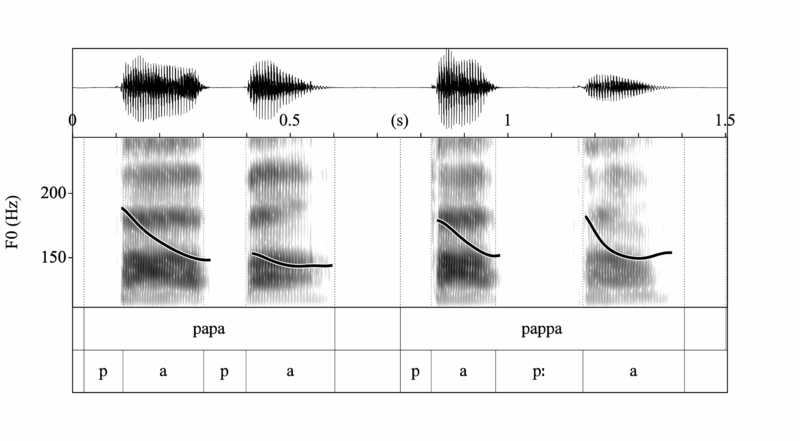
Image 1: Oscillogram and spectrogram of the Italian words papa ‘Pope’ and pappa ‘porridge’
Long before we speak, we are already great language users. Research shows that newborn babies can already distinguish speech sounds from noises. Even more surprisingly, they are able to recognize the rhythm of their native language from a non-native one before birth.
After birth, infants are surrounded daily by an enormous amount of speech input. Step by step, they build categories for the sounds of their native language. Up until around 8 to 12 months they can distinguish nearly all of the world’s speech sounds, even those that never appear in their environment.
A Japanese baby, for example, can hear the difference between r and l just as well as American or German babies can. But this ability does not last. As children grow, their brains focus on the categories that matter in their own language and ignore the rest—like the difference between r and l. This is why many Japanese adults often find it notoriously difficult to distinguish the two consonants in languages like English. What was once easy for the baby can become very challenging for the adult.
We perceive foreign languages through native filters
Learning the sound system of a language doesn’t stop with vowels and consonants. It also includes rhythm and intonation. And even for individual sounds like a or o, it’s not only about how you articulate them but also how long you hold them. This brings us to segmental quantity, or length. It refers to the use of duration (short vs. long) of vowels or consonants to distinguish lexical meaning. Quantity shows remarkable cross-linguistic variation.
The case of long consonants in Italian
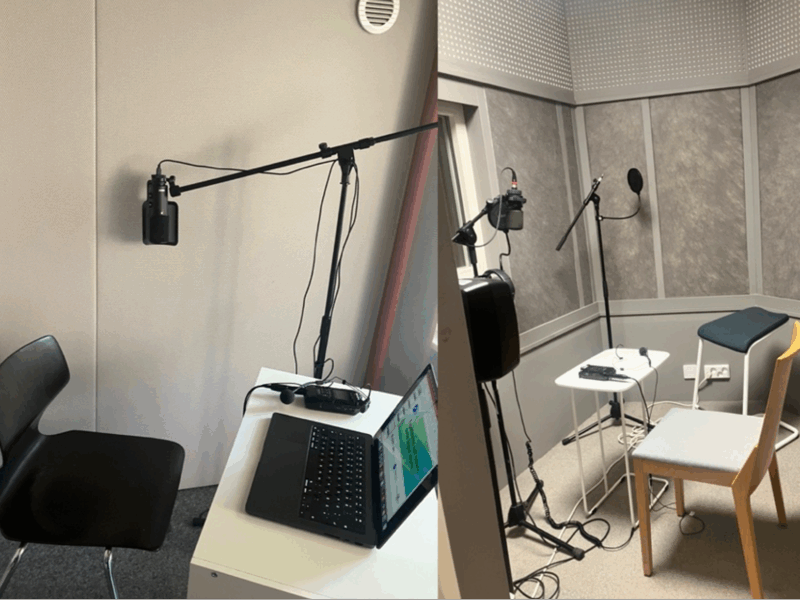
Image 2: Soundproof cabins at the Free University of Berlin (left) and University of Helsinki (right)
What feels natural in one language may not exist in another. Take Italian. It belongs to just 3.3% of the world’s languages that distinguish short from long consonants (Ladefoged & Maddieson 1996).
This contrast appears in more than 1,800 Italian words, such as papa /ˈpapa/ ‘Pope’ versus pappa /ˈpapːa/ ‘porridge’ (Image 1). To be understood and to speak well, learners must get long consonants (called geminates) right—although it can be very challenging (e.g., Altmann et al. 2012).
Cross-linguistic differences in learners
In our project “Production and perception of geminate consonants in Italian as a foreign language”, we examine how Czech, Finnish, German, and Spanish learners acquire this feature.
The selection of these languages is not random. They all handle consonant length differently. German, for example, has no consonant length but contrasts short and long vowels in stressed syllables (e.g., Stadt [ʃtat] ‘city’ vs. Staat [ʃtaːt] ‘state’). Czech, like German, distinguishes vowel length, but unlike German, it does so in both stressed and unstressed syllables (e.g., nosí [ˈnosiː] ‘(s/he) carries’ vs. nosy [ˈnosɪ] ‘noses’). Finnish is the most similar to Italian, since it has both vowel and consonant length (e.g., muta [ˈmutɑ] ‘mud’ vs. mutta [ˈmutːɑ] ‘but’). And finally, Spanish has no length contrasts at all.
This diversity allows us to test how a learner’s native language shapes the way they hear and produce length in Italian.
How good are learners at perceiving length in Italian?
In a laboratory setting (Image 2) and by means of a perception experiment, we tested and compared 20 Czech, 20 Finnish, 20 German, and 20 Spanish learners of Italian.
We used 45 short nonsense words that followed Italian spelling and sound rules but had no meaning. Each word had two versions, differing only in whether a consonant was short or long (e.g., sàpolo vs. sàppolo; milèta vs. millèta).
The words covered different consonants and stress positions and were recorded by a native Italian speaker. In every trial, participants had to answer the question: “Does the audio pair you hear belong to the same or different word?”
What we found
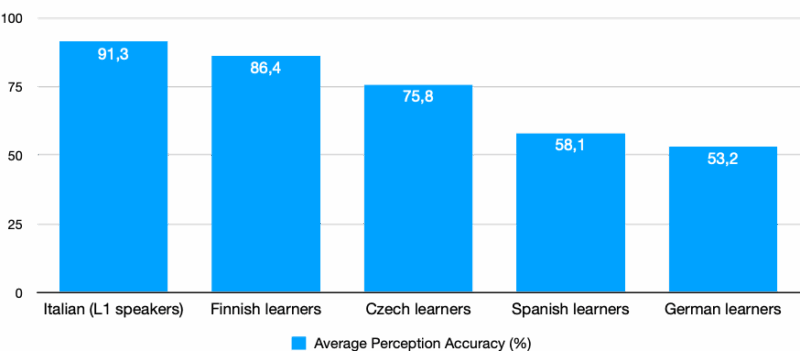
Image 3: Learner accuracy in perceiving Italian consonant length in comparison to native listeners
First language has great impact! Finnish learners, whose native system is closest to Italian, were the most accurate in hearing the difference between short and long consonants.
Czech learners followed, while German and Spanish learners struggled more (Image 3). Other factors also played a role. Learners heard contrasts more easily when the crucial sound appeared in stressed syllables, and some consonants were easier to notice than others.
Proficiency helped too—advanced learners did much better than beginners.
However, it is unexpected that the German group scored lower than the Spanish group—sometimes research simply surprises us!
Many factors could explain this, since every learner has their own story. Things like previous language experience, weekly study time, exposure to Italian, time spent in Italy, Italian friends, motivation, and personal talent can all play a role.
In our case, German learners had spent fewer hours per week learning Italian and had less experience studying or staying in Italy. Immersion—the experience of being surrounded by a language in real-life settings—seems a plausible factor behind their performance.
Why perception matters in language learning?
Why does pappa sometimes turn into papa in the ears of Italian learners? Because we all hear foreign languages through the features we are familiar with.
Our experiment showed that perception is difficult—but it can be improved. The key is to notice what is different and to train your ears. This means: Pronunciation training must start with perception (e.g., Colantoni et al. 2021).
In the end, learning a language is not just about new words—it’s about learning to hear differently.
References
Altmann, H.; Berger, I., & B. Braun (2012). Asymmetries in the perception of non-native consonantal and vocalic contrasts. Second Language Research 28(4), 387–413.
Colantoni, L., Escudero, P., Marrero-Aguiar, V., & J. Steele (2021). Evidence-based design principles for Spanish pronunciation teaching. Frontiers in Communication, 6, 639889.
Ladefoged, P., & I. Maddieson (1996). The sounds of the world’s languages. Oxford: Blackwell.
Acknowledgement
This blog post was written as part of the DFG-project “Production and perception of geminate consonants in Italian as a foreign language: Czech, Finnish, German and Spanish learners in contrast”, funded by the German Research Foundation (Project number 521229214) and executed at the Free University of Berlin. Project website: https://italiangeminates-project.com/
]]>
NILS4 will be conducted in late 2025 to 2026 and reported upon in 2026.
There’s currently a national target in Australia about strengthening Aboriginal and Torres Strait Islander languages by 2031. This is Target 16 in a policy framework called Closing the Gap. Zoe and I talk about how language strength can be measured in different ways and how the team have chosen to ask about language strength in this survey in ways that show clearly that the questions are informed by the voices in the co-design process.
Then we discuss the parts of the survey which ask about how languages can be better supported, for example in terms of government funding, government infrastructure, access to ‘spaces for languages’ and access to language materials, or through community support. The latest draft of the survey also mentions legislation about languages as a possible form of support. This is great; the data should encourage policy makers not to intuit or impose solutions, but rather to listen to what language authorities are saying they need. What I especially noticed in this part of the survey was the question about racism affecting the strength of a language – or reducing racism as a form of supporting languages – so I ask Zoe to tell me what led the team to include it.
We go on to discuss the enormous efforts and progress underway, and the love which many Aboriginal and Torres Strait Islander communities around Australia have for language maintenance or renewal. People may get the impression that language renewal is all hardship and bad news because a focus on language ‘loss’, ‘death’, or oppression pervades so much of the academic and media commentary. But Zoe and I both recently met in person at a fabulous, Indigenous-led conference in Darwin called PULiiMA in which delegates from 196 Aboriginal or Torres Strait Islander languages participated. That’s just one indication of the enormous effort and progress around Australia, mainly initiated by language communities themselves rather than by governments. We talk about why, in this context, it’s important that this survey also has section about languages ‘flourishing’ and being learnt.
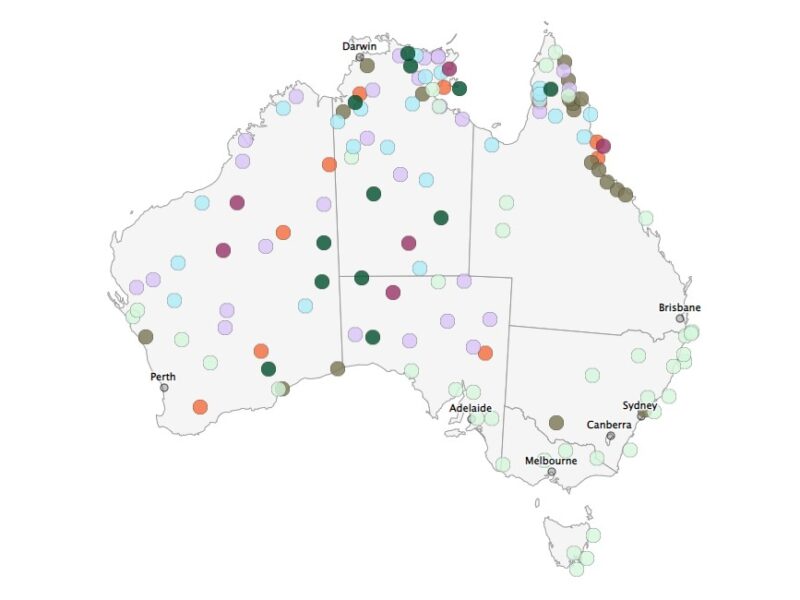
Language groups that participated in NILS3
We discuss the plans for reporting on the survey; incorporating the idea of ‘language ecologies’ was one of the biggest innovations in the National Indigenous Languages Report (2020) about the 3rd NILS and continues to inform NILS4. Finally, we talk about providing Language Respondents and communities access to the data after this survey is completed, in line with data sovereignty principles.
The survey should be available for Language Respondents to complete, on behalf of each language, in late 2025. AIATSIS will facilitate responses online, by phone, on paper and in person. If you would like to nominate a person or organisation to tell us about an Aboriginal or Torres Strait Islander language, please contact the team at [email protected]. Respondents will have the option of talking in greater depth about their language in case studies which AIATSIS will then include as a chapters in the report, as part of responding to calls in the co-design process to enable more access to qualitative data and data in respondents’ own words.
If you liked this episode, support us by subscribing to the Language on the Move Podcast on your podcast app of choice, leaving a 5-star review, and recommending the Language on the Move Podcast and our partner the New Books Network to your students, colleagues, and friends.
Transcript
Alex: Welcome to the Language on the Move Podcast, a channel on the New Books Network.
My name is Alex Grey, and I’m a research fellow and senior lecturer at the University of Technology in Sydney in Australia. This university stands on what has long been unceded land of the Gadi people, so I’ll just acknowledge, in the way that we do often these days in Australia, where we are. Ngyini ngalawa-ngun, mari budjari Gadi-nura-da and I’d really like to thank
Ngarigo woman, Professor Jaky Troy, who, in her professional work as a linguist, is an expert on the Sydney Language, and has helped develop that particular acknowledgement.
My guest today is Zoe Avery, a Worimi woman and a research officer at the Centre for Australian Languages. That centre is part of the Australian Institute for Aboriginal and Torres Strait Islander Studies, which we’ll call AIATSIS. Zoe, welcome to the show!
Zoe: Thank you! I’m really excited to be here and talking about my work that I’m doing at AIATSIS.
Alex: Yeah, so in this work at AIATSIS, you’re one of the people involved in preparing the upcoming National Indigenous Languages Survey. This will be the fourth National Indigenous Languages Survey in Australia. The first one came out now over 20 years ago, in 2005.
This time around, you and your team have made some really important changes to the survey design through the co-design process. Let’s talk about that. Can you tell us, please, what is the National Indigenous Languages Survey, what’s it used for, and how this fourth iteration was co-designed?
Zoe: Yeah, so, the National Indigenous Languages Surveys, or I’ll be calling it NILS throughout the podcast, they’re used to report the status and situation of Indigenous languages in Australia, as you mentioned. This is the fourth one. The first one was done all the way back in 2004 and, the third NILS was done about 6 years ago, in 2019. So it’s been a while, and it’s kind of just to show the progress of how, languages in Australia are being spoken and used, and I suppose the strength of the languages, which we’ll kind of go into a bit more detail. But the data is really important, because it can be used by the government to develop, appropriate language revitalisation programs or understand the areas that require the most support, but it can also be used by communities, which is really important as well.
And so, NILS4 has been a little bit different from the start compared to previous NILS, because the government has asked us to run this survey in order to measure Target 16 of Closing the Gap, which is that by 2031, languages, sorry, by 2031, there is a sustained increase in the number and strength of Aboriginal and Torres Strait Islander languages being spoken.
So, the scope for this project is much bigger than the past NILS, and AIATSIS has really prioritised Indigenous leadership in the design, and will be continuing to prioritise Indigenous voices in the rollout and reporting of the results of the survey.
So, because this is a national-level database, and we want to make sure as many languages as possible are represented, including previously under-recognized and under-reported languages, including sign languages, new languages, dialects. It’s really important that we have Indigenous voices, prioritized throughout this entire research process. And we want to make sure that the questions that are being asked in the survey are questions that the community want answers to, whether or not to advocate, to the government that these are the areas that need the most support, the most funding, or whether or not the community want that data for themselves to help develop, appropriate, culturally safe programs.
So what we did is we had this big co-design process, this year to design the survey. We had 16 co-design workshops with Indigenous language stakeholders across Australia, and this was, these workshops were facilitated by co-design specialists Yamagigu Consulting. We had, in total, about 150 people participate in the co-design process, and of these 150 people, about 107 of these were Indigenous. And so these Indigenous language stakeholders included elders, language centre staff members, teachers, interpreters, sign language users, language workers, government stakeholders, all sorts of different people that have a stake in Indigenous languages, for whatever reason. And we had 8 on-country workshops, which were held in cities around Australia, and 8 online workshops as well, which helps make it easier for, people that kind of came from different places, and weren’t able to come to an in-person workshop.
Alex: That’s a huge… sorry, just congratulations, that sounds like it’s been a huge undertaking. So many people, so many, so many workshops, well done.
Zoe: Yeah, it has been huge, and we’ve had so many different people from a variety of different language contexts, participate as well. So, the diversity of language experiences that were kind of showcased at these workshops was immense and has had a huge impact on drafting the survey, which is obviously the whole point of the workshops, but yeah … We took all the insights from the co-design workshops, we analysed them, thematically coded everything, and started incorporating everything into the survey. And then we went back to the people who participated in the co-design workshops and held these validation workshops so we could show them the draft of the survey, show them how we had planned on incorporating all of their insights, you know, that we weren’t just doing it for the sake of ticking a box to say, yes, we’ve had Indigenous engagement, but we were actually really wanting to have Indigenous input from the start, and right until the end of the project. And we had really good feedback from the validation workshops, and it is, you know, not just a massive task running these workshops, but also, making sure that everybody’s listened to, and sometimes they were kind of contrasting views about how things should be done, and yeah, we wanted to make sure that we had as much of a balance as possible.
We also consulted with the Languages Policy Partnership, which are kind of key workers in Indigenous languages policy and, advocacy. They’re kind of leaders in the Closing the Gap Target 16 that I was just talking about, so their input and advice has been really important to us, as have consultations with the Australian Bureau of Statistics and the Mayi Kuwayu Study of Aboriginal and Torres Strait Islander Wellbeing. So yeah, there’s been a lot of input, and we’re really excited that we’re at the point now where we’re finishing the survey! Dotting all the I’s, crossing all the T’s and getting ready to start rollout soon.
Alex: Yeah, well, I mean, one would hope good input, good output! You know, such a huge process of designing it. You should get really well-targeted, really informative, useful results.
And you’ve mentioned a few things there that I’ll just explain for listeners, because not all our listeners will be familiar with the Australian context. It’s coming through that there’s enormous diversity of Indigenous peoples and languages in Australia, so to explain a little bit, because we won’t go into this in much detail in this interview, Zoe’s mentioned new languages like, contact languages, Aboriginal Englishes, Creoles, like Yumplatok, which comes from the place called the Torres Strait. If you’re not familiar with Australia, that area is between Australia, the Australian mainland, and Papua New Guinea, in the northeast. And then there’s an enormous diversity of what are sometimes called traditional languages across Australia, both on the mainland and the Tiwi Islands as well. So we have a lot of Aboriginal language diversity, and then in addition, Torres Strait Islander languages, and then in addition, new or contact varieties.
Zoe: Sign languages.
Alex: And sign… of course, yes, and sign languages. Thank you, Zoe. And then you’ve mentioned Target 16. So we have in Australia a policy framework called Closing the Gap. For the first time ever, the current Closing the Gap framework includes a target on language strength.
But as the survey goes in to, language strength can be measured in different ways. So how have you chosen to ask about language strength in this survey, and why have you chosen these ways of asking?
Zoe: Yeah, so, along with, kind of, Target 16 of Closing the Gap, there’s an Outcome 16, which is that Aboriginal and Torres Strait Islander cultures and languages are strong, supported, and flourishing. So it’s important for us in the survey to, kind of, address those kind of buzzwords, strong, supported, and flourishing. But it is very clear, from co-design, that the widely used measures of language strength don’t necessarily always apply to Australian Indigenous languages. So these kind of widely used and recognised measures of how many speakers of a language are there, and is the language still being learned by children as a first language? These are not the only ways of measuring language strength, and we really wanted to make sure that we kind of redefined language strength in the survey based off Indigenous worldviews. So, language is independent [interdependent] with things like community, identity, country, ceremony, and self-determination.
How do we incorporate that into the survey? So we’re still going to be asking questions, like, how many speakers of the language are there? What age are the people who are speaking the language, but we’re also going to be asking questions on how many people understand the language, because people may not be able to speak a language due to disability, cultural protocol reasons, or due to revitalisation, for example. But they can still understand the language, and that can still be an indication of language strength. We’re also asking questions about how and where it’s used. So, do people use the language while practicing cultural activities, in ceremony, in storytelling, in writing, just to name a few? We know that Indigenous languages are so strongly entangled with culture and country, and it’s difficult to measure the strength of culture and country. But we can acknowledge the interdependencies of language, culture, and country, and by asking these kinds of questions, we can get some culturally appropriate and community-led ways of defining language strength.
Alex: And that’s just going to be so useful for, then, the raft of policies that one hopes will follow not just the survey, but follow the Target 16, and even once we get to 2031, will continue in the wake of, you know, supporting that revitalisation.
Zoe: Yeah, absolutely, and I think that, another thing that we heard from co-design, but just also from Indigenous people, in research and advocacy, that language is such a huge part of culture and identity, that by, you know, developing these programs and policies to help address, language strength, all the other Closing the Gap targets, like health and justice and education, those outcomes will all be improved as well.
Alex: Yeah, I guess that’s why, in the policy speak, language is part of one of the priority response areas for the Closing the Gap. And I noticed this round of the survey in particular is different from what I’ve seen in the earlier NILS in the way it asks questions, which also appears to reflect the co-design. So, for example, these questions about language strength, they start with the phrase, ‘we heard that’ and then a particular kind of way of thinking about strength. And then another way of thinking about strength might be presented in the next question: ‘We also heard that…’. So on, so on. So, is this so people trust the survey more, or are you conscious of phrasing the survey questions really differently compared to, say, the 2019 version of the survey?
Zoe: Yeah, absolutely we want people to trust the survey, and understand that we respect each individual response. Like, as much as it’s true, we’re a government agency, and we’ve been asked to do this to get data for Closing the Gap, we want language communities to also be able to use this data for their own self-determination, and we want to try and break down these barriers for communities and reduce the burden as much as possible. So, making sure that the survey was phrased in accessible language, and the questions were as consistent as possible.
But yeah, we wanted to make sure that we were implementing insights from co-design, but making it clear in the survey that we didn’t just kind of come up with these questions out of nowhere, that these were co-designed with community and represent the different priorities of different language organisations, workers, and communities across Australia. So, we want the community to know why we’re asking these questions. And also, why they should answer the questions. Because ultimately, that’s why we’re asking the survey questions, because we want people to answer the questions.
Alex: Yeah, yeah, and I think that also comes through in the next part of the survey as well, which is about how languages can be better supported, which again gives a lot of, sort of co-designed ideas of different ways of support that people can then talk to and expand on, so that what comes through in your data, hopefully, is really community-led ideas of what government support or community support would look like, rather than top-down approaches.
So, for example, the survey asks about forms of government funding, reform to government infrastructure, access to what the survey calls ‘spaces for languages’. I really like this idea as a sociolinguist, I really get that. Access to language materials through community support. The survey also mentions legislation about languages as a possible form of support. So this should encourage policymakers not to intuit or impose solutions, but rather to listen to the survey language respondents and what they say they need.
What I especially noticed in this part of the survey was the question about racism affecting the strength of language. Or, if you like, reducing racism as a way of supporting language renewal. I don’t think this question was asked in previous versions of the survey, right? Can you tell us what led your team to include this one?
Zoe: Yeah, so, this idea of a supported language, as I measured… as I explained before, is one of the measures in, Outcome 16 of Closing the Gap, and that we want policymakers to listen to what the language communities want and need in regards of support, because, you know, in Australia, there’s so much language diversity, it’s not a one-size-fits-all approach. Funding was something that all language communities had in common, whether it was language revitalisation they needed funding for, resources and language workers, but also languages that, one could say are in maintenance, so languages considered strong languages, that have a lot of speakers, they also need funding to make sure that their language, isn’t at risk of being lost, and that, it can stay a strong language.
So, there are other kinds of ways that a language can be supported, and if we’re talking about, kind of racism and discrimination as a way that a language isn’t supported. It was important for us to kind of ask that question, because in co-design it was clear that racism and discrimination are still massively impacting language revitalisation and strengthening efforts. The unfortunate reality of the situation of Australian languages, Indigenous languages, is that due to colonisation, Indigenous languages have been actively suppressed.
We want to make sure that respondents of the survey have the opportunity to, kind of, participate in this truth-telling. It is an optional question. We understand it can be somewhat distressing to talk about language loss and the impacts of racism and things like that, but if respondents feel comfortable to answer this question, it does give communities the opportunity to share their stories about how their language has been impacted by racism. So, yeah.
Alex: I really think that’s important, not just to inform future policy, but the act of responding itself, as you say, is a form of truth-telling, and the act of asking, and having an institute that will then combine all those responses and tell other people. That’s an act of what we might call truth-listening, which is really important in confronting the social setting of language use and renewal. This goes back then, I guess, to strength. It’s not just how many people learn a language, or how many children exist who grow up in households speaking a language. There has to be a social world in which that language is not discriminated against, and those people don’t feel discriminated against for wanting to learn that language or wanting to use it.
Now, people may get the impression that language renewal is all hardship and bad news because of a focus on ‘language loss’, in quotes, or language ‘death’, or oppression. This pervades so much of the academic and media commentary. But you and I, Zoe, we met recently in person at a fabulous Indigenous-led conference in Darwin called PULiiMA and there, there were delegates from 196 Aboriginal or Torres Strait Islander languages participating. So, that’s just one indication of the enormous effort and progress in this space around Australia, and mainly progress and effort initiated by language communities themselves, rather than governments.
So in that context, it’s important, I think, that this survey also has a section about languages flourishing, the positive focus. Languages are being learnt and taught and used and revived and loved. Tell us more about the design and purpose of the ‘flourishing’ sections of the survey.
Zoe: Yeah, I just want to say that how awesome PULiiMA was, and to see all the different communities all there, and there was so much language and love and support in the room, and everyone had a story to tell about how their language was flourishing, which was so awesome to hear. A flourishing language in terms of designing a survey and asking questions about, is a language flourishing, is a tricky thing to unpack, because in co-design, we kind of heard that a flourishing language can be put down to two things, and that’s visibility and growth of a language. And so growth of a language is something that you can understand, based off the questions that we’ve already asked, in kind of the strength of a language, how many speakers, is this number more or less compared to last time, the last survey? We’re also asking questions about, ‘has this number grown?’ in case it kind of sits within the same bracket as it did in the last survey.
And visibility is, kind of the other factor, which can be misleading sometimes as well. We’re asking questions about you know, is it being used in place names, public signage, films and media. Just to name a few. But a language that is highly visible in public maybe assumed to be strong, but isn’t strong where it matters, so, being used within families and communities. So, this section is a little bit smaller, because it kind of builds on the questions in previous sections.
It will be interesting to see, kind of, the idea of a flourishing language, and we do have the opportunity for people to kind of expand on their, responses in, kind of, long form answers, so people can explain, in their own words, in detail, if they choose to, kind of, how they see their language as being flourishing,
But, yeah, for a language to be strong and flourishing, it needs to be supported, and that’s something that was very clear in co-design, and people wanting things like language legislation, and funding, and how these things can be used to support the language strength, and to allow it to flourish. So in this section, we also have, kind of, an opportunity for people to give us their top 3 language goals. So whether that’s, they want to increase the number of speakers, or they want to improve community well-being. All sorts of different language goals and the opportunity for people to put their own language goals and the supports needed to achieve those language goals. So, the people who would benefit from the data from this survey, the government, policy makers, communities, they can see what community has actually said are their priorities for their language, and what they believe is the best way to address those language goals. So, encouraging self-determination, within this survey.
Alex: And following on from that point, I have a question in a second about, sort of, how you report the information, and also data sovereignty, how communities have access to, in a self-determined way, use this resource. But I just wanted to ask one more procedural question first. So, you shared a complete draft with me, and we’ve spoken about the redrafting process, so I know the survey’s close to ready, but where are you at the team at AIATIS is up to now – and now, actually, for those listening in the future, is October 2025. Do you have an idea of when it will be released for people to answer, and who will you be asking to answer this survey?
[brief muted interruption]Zoe: Yeah, so we’ve just hit a huge milestone in the research project where we’re in the middle of our ethics application. So, we’ve kind of finished drafting the survey, and it’s getting ready for review from the Ethics Committee at AIATSIS. And hopefully, if all goes well, we’ll be able to start rolling out the survey in November [2025].
So yes, it’s been a long time coming. This survey’s been in the works for many years. I’ve only personally been working on this project for a little under 12 months, but there have been many people before me working towards this milestone.
And the people that we want to be completing this survey are what we’re calling language respondents. So we don’t necessarily want every Indigenous person in Australia to talk about their language, but rather have one response per language by a language respondent who can kind of speak on the whole situation and status of their language, and can answer questions like how many speakers speak the language. So that could be anyone from an elder to a language centre staff member, maybe a teacher or staff member at a bilingual school. We’re not defining language respondent and who can be a language respondent because we understand that that’s different, depending on the language community, and if there are thousands of speakers of a language, or very few speakers of a language. We also understand that there could be multiple people within one language group that are considered language respondents, so we’re not limiting the survey to one response per language, but that’s kind of the underlying goal that we can get as many responses from the different languages in Australia, but at least one per language.
Alex: That makes sense. So, it’s sort of at least one per speaker group, or one per language community.
Zoe: Yeah.
Alex: Yep. Yeah. Yep. And then… so the questions I foreshadowed just before, one is about the reporting. So, I noticed last time around the National Indigenous Languages Report, which came out after the last survey – so the report came out in 2020 – that incorporated this really important idea of language ecologies, and that was one of the biggest innovations of that round of the survey. And that was, I think, directed at presenting the results in a way that better contextualized what support actually looks like on the ground, rather than this very abstracted notion of each language being very distinct and sort of just recorded in government metrics, but [rather] embedding it in a sense of lots of dynamic language practices, from people who use more than one variety.
So do you want to tell us a little bit more about how you’ve understood that language ecologies idea? Because I see that comes up in a question as well, this time around in the survey, and is it in the survey because you’re hoping to use that in the framing of the report as well?
Zoe: Yeah, so the third NILS, which produced the National Indigenous Languages Report in 2020, contributed massively to increasing awareness of language ecologies, and this idea that a language doesn’t exist within a bubble. It has contextual influences, particularly when it comes to multilingualism and other languages that incorporate, are incorporated into the community. So NILS4 aims to build on this work, in collecting interconnected data about what languages are being used. Who are they being used by? In what ways? Where are they being used at schools? At the shops, in the home. Different languages, as you mentioned before, different varieties of English, so that could be Aboriginal English, for example, or Standard Australian English. It could be other Indigenous, traditional Indigenous languages, so some communities are highly multilingual and can speak many different traditional languages. Some communities may use sign languages, whether that’s traditional sign languages or new sign languages, like Black Auslan. And kind of knowing how communities use not only the language that the survey is being responded to about, but also other languages, which will help with things like interpreting and translating services, education services, all sorts of different, things that, by understanding the language ecology better and the environment that the language exists in, yeah —
Alex: That makes sense, and there you’ve mentioned a few things that I didn’t really ask you about, but I’ll just flag they’re there in the survey too, translation and interpreting services, education, government services, and more broadly, workforce participation through a particular Aboriginal or Torres Strait Islander language. That’s important data to collect. But the last sort of pressing question I have for you in this podcast is not about language work but about data sovereignty. This is a really big issue in Australia, not just for this survey, but for all research, by and with Indigenous peoples, and particularly looking at older research that was done without the involvement of Indigenous people, where there’s been problems with who controls and accesses data. So, what happens to the data that AIATSIS collects through this survey?
Zoe: Yeah, so data sovereignty is obviously one of our priorities and communities fundamentally will own the data that they input into the survey. And there will be different ways that, this information will be shared or published, depending on what the respondent consents to. So, part of the survey includes this consent form, where they basically, can decide how their data will be used and shared. And so the kind of three primary ways that the data will be used is: it will be sent to the Productivity Commission for Closing the Gap data, as I mentioned before, we have been funded in order to produce data for Closing the Gap Target 16, and so the data that’s sent to the Productivity Commission will be all de-identified. And this will be all the, kind of, quantitative responses, so nothing that can kind of be identified will be sent to the Productivity Commission. And this kind of data is kind of the baseline of what people are consenting to by participating in the survey. If they don’t consent to this, then, they don’t have to do the survey, their response won’t be recorded.
And then the other kind of two ways that AIATSIS will be reporting on the data is through the NILS4 report that will be published next year [2026], and also this kind of interactive dashboard on our website. So people will be able to kind of look at some of the responses. And communities will have the option on whether this data is identified or de-identified, so some communities may wish to have their responses identifiable, and people will be able to search through and see kind of data that relates to their communities, or communities of interest, or they might choose to kind of remain anonymous and de-identified, and so these are going to be mostly quantitative responses as well.
However, we are interested in, kind of publishing these case studies in the NILS report, which will be opportunities for communities to tell their language journey in their own words. And so this is a co-opt, sorry, an opt-in co-authored chapter in the NILS report, that, yeah, language communities can not just have data, or their responses, but have the context provided, the story of their language and their data. And that was something that was really evident in co-design, that the qualitative data needs to exist alongside the quantitative data, and that’s a huge part of data sovereignty as well, like, how communities want to be able to share their data. So, we’re really excited about this kind of, co-authored case study chapter in the report, because community are excited about it as well. They want to be able to tell their story in, in their own words.
And so, that’s kind of how the data will be used and published, but, there are other ways that the community will be able to kind of access their data that they provide in the survey. So, that’s also really important to us, and we’re following the kind of definitions of Indigenous data sovereignty from the Maiam Nayri Wingara data sovereignty principles. So, making sure that, yeah, community have ownership of their data, and they can have access to it, are able to interpret it, analyse it. And this is kind of being done from the beginning of co-design all the way up to the reporting, and that, yeah, community have control over their data at all points of this process.
Alex: It sounded like just such a thoughtfully managed and thoughtfully designed survey, so thanks again, Zoe, for talking us through it, and all the best for a successful rollout. The next phase should be really interesting for you to actually get people reading and responding, and I’ll be looking out for the survey results when you publish them later in 2026. Is there anything else about the survey that you’d like to tell our listeners?
Zoe: I think that we’ve had a really, productive conversation about our survey. We’re really excited to start rolling it out, and we’re really excited for people to look out for the results as they start to be published and shared next year. So, yeah, if anybody has any questions, or would like more information, I encourage everyone to kind of check out our website and send us an email. But yeah, thank you for having me, and for letting me chat about this project. It’s been a huge part of my life for the past few months, and excited for the rest of the world to get to experience this data, which is hopefully going to have such a big impact on communities having this accurate, reliable, comprehensive national database, that can be used for, yeah, major strides in Indigenous languages in Australia.
Alex: Well, we’ll definitely put the AIATSIS website, which is AIATSIS.gov.au, in the show notes, and then when the particular survey is out for people to respond to, we’ll put that in the notes on the Language on the Move blog that embeds this interview as well. And then people will be able to, as I understand it, respond online to the survey, or over the phone, or in person, and in a written form as well. So, as that information is available, we’ll share that with this interview.
So, for now, thanks so much again, Zoe, for talking me through this survey, and thanks everyone for listening. If you enjoyed the show, please subscribe to our channel, leave a 5-star review on your podcast app of choice, and of course, please recommend the Language on the Move podcast and our partner, The New Books Network, to your students, your colleagues, your friends. Speak to you next time!
Zoe: Thank you.
]]>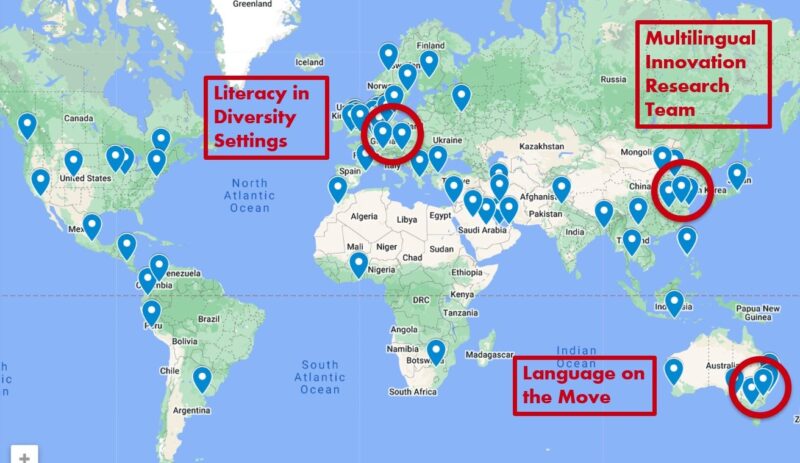
The international research network “Literacy in Multilingual Contexts” builds on the “Next Generation Literacies” network
The World Education Research Association (WERA) recently announced the launch of seven new International Research Networks (IRNs) and we are pleased to share that “Literacy in Multilingual Contexts” is one of them.
What is a WERA IRN?
The WERA IRN initiative brings together global teams of researchers through virtual communication and other channels to collaborate in specific areas of international importance. “Literacy in Multilingual Contexts” joins a growing list of IRNs, contributing to the vision of WERA. The purpose of IRNs is to synthesize knowledge, examine the state of research, and stimulate collaborations or otherwise identify promising directions in research areas of worldwide significance. IRNs are expected to produce substantive reports that integrate the state of the knowledge worldwide and set forth promising research directions.
What does the IRN “Literacy in Multilingual Contexts” do?
The IRN “Literacy in Multilingual Contexts” aims to initiate and extend international collaborative research on literacy in the context of language diversity and migration. The joint focus is on literacy development and practice in multiple languages. Drawing on varied and complementary expertise from Europe, Australasia, Africa and North America, the objectives are:
- to enhance knowledge on literacy and student diversity
- to trace tendencies that go beyond one national, regional or local context
- to examine literacy development across the life-course
- to critically discuss the implications of research findings for policy and practice
Literacy is a foundation for participation in complex societies. The proposed research therefore also contributes to pathways to equity. The network’s activities will reach fundamental theoretical insights, which may be transferred to concepts of teaching/learning in educational institutions. This intervention research will attempt to generalise characteristics of successful multilingual literacy development to be adapted to specific contexts. The proposed IRN comprises senior, experienced and early career scholars (incl. PhD students), aimed towards international and intergenerational knowledge generation.
Literacy as a resource
At the heart of our network is the idea that multilingual literacy is a resource to be celebrated. Literacies across languages and scripts empower learners to create knowledge, to navigate education systems, and to participate fully in social and cultural life.
Members of the network bring expertise from early childhood to higher education, from family and community contexts to digital and AI-mediated literacies. Our shared vision is to develop research that responds to the multilingual realities of migration, mobility, and global diversity.
Building on the “Next Generation Literacies” network
The “Literacy in Multilingual Contexts” network has grown out of the Next Generation Literacies initiative, an international network of researchers working at the intersection of social participation and linguistic diversity.
Based on the trilateral partnership of Fudan University (China), Hamburg University (Germany) and Macquarie University (Australia), Next Generation Literacies brought together an interdisciplinary group of established and emerging researchers to build a truly global network.
After funding for the Next Generation Literacies network ended in 2024, the IRN “Literacy in Multilingual Contexts” keeps that spirit of collaboration alive, while also widening the circle: we are now connected with colleagues from the Network on Language and Education (LeD) in the European Educational Research Association (EERA) and with other WERA initiatives. Under this new umbrella, we will scale up our efforts and make a stronger impact together.
Network Conveners
The network is convened by
- Irina Usanova (University of Hamburg; Lead Convenor)
- Francis M. Hult (UMBC)
- Ingrid Piller (University of Hamburg & Macquarie University)
- Yongyan Zheng (Fudan University)
- Harkaitz Zubiri-Esnaola (University of the Basque Country)
Together with network members, we bring expertise spanning literacy research across continents and research traditions.
Kick-off meeting
On September 24, 2025, we came together on Zoom across many different time zones and continents to virtually celebrate the official launch of the Literacy in Multilingual Contexts IRN.
The kick-off meeting felt like both a reunion and a new beginning: familiar faces from the Next Generation Literacies network reconnecting, and new colleagues from around the world joining the conversation. Together, we are building a vibrant global community of researchers committed to understanding how literacy develops and thrives in multilingual settings. For all of us, it was a reminder of how much we can achieve when we put our multilingual realities at the center of literacy research.
What’s next?
Over the next three years (2025–2028), we will:
- review the state of research on multilingual literacies
- analyze existing datasets across different contexts
- share our work in joint events and publications
- build a sustainable international community dedicated to literacy in diversity
To make this vision concrete, members are invited to join thematic working groups. Topics include multilingual literacy in early childhood, in higher education, in Indigenous contexts, CLIL, multilingual writing and AI, and multilingual policy. Sounds interesting?
An open invitation
The energy of our first meeting showed just how much can be achieved when we bring our different perspectives together. The IRN “Literacy in Multilingual Contexts” is open to any researcher working in these areas. If you are interested in joining, please send your inquiry to Dr Irina Usanova.