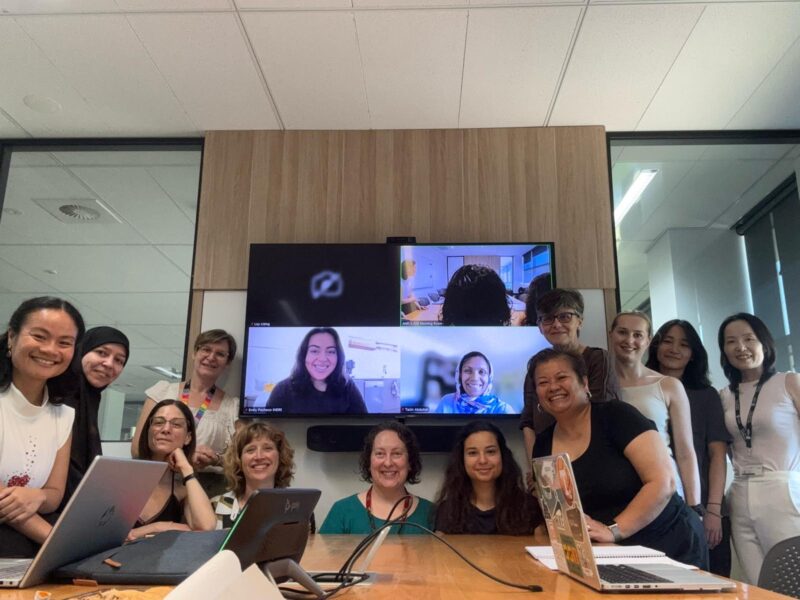
The team behind the Language-on-the-Move Podcast (Image credit: Language on the Move)
Final piece of good news for the year before we head into a publishing break over January: we’ve just heard that the Language-on-the-Move Podcast has won the 2025 Talkley Award 


The Talkley Award is issued by the Australian Linguistic Society (ALS) and “celebrates the best piece or collection of linguistics communication produced in the previous year by current ALS members. The Award acknowledges that the discipline of linguistics needs champions to promote linguistics in the public sphere and explain how linguistic evidence can be used to solve real-life language problems.”
This is a wonderful end-of-year present for our team in recognition of the work and care we’re putting into creating the podcast. Special thanks and congratulations also to our podcast publishing partner, the New Books Network.
After the 2012 Talkley Award went to Ingrid Piller for the Language on the Move website, this is the second time the award goes to our team – an amazing recognition of the long-term impact Language on the Move has had on public communications about linguistic diversity and social justice.
Thank you to all our supporters who nominated us for the award! Special thanks to Dr Yixi (Isabella) Qiu and her students in the Guohao College Future Technology Program at Tongji University. After using the Language-on-the-Move Podcast as a learning resource, they have been among our biggest fans 


To celebrate with us, listen to an episode today! You an find your list of choice below.
As always, please support us by subscribing to the Language on the Move Podcast on your podcast app of choice, leaving a 5-star review, and recommending the Language on the Move Podcast and our partner the New Books Network to your students, colleagues, and friends.
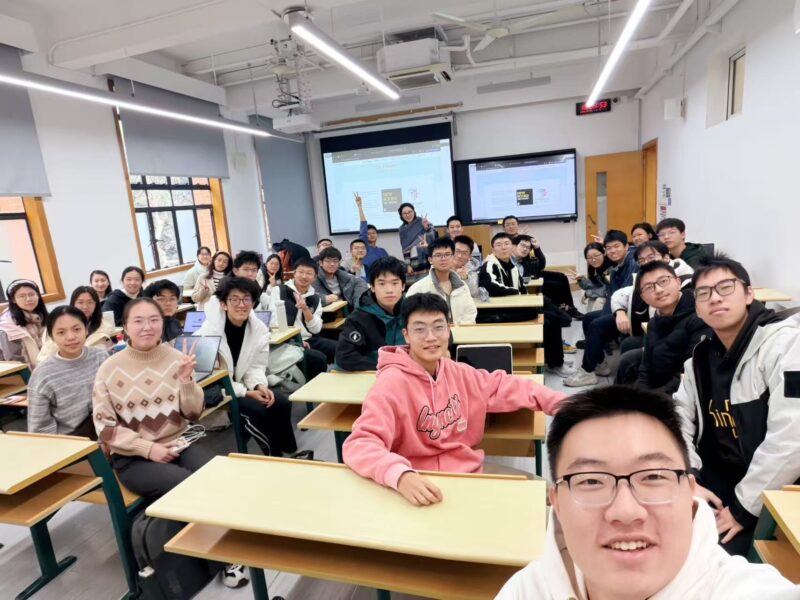
Students of the Guohao College Future Technology Program at Tongji University in Shanghai are among the fans of the Language-on-the-Move Podcast (Image credit: Dr Yixi (Isabella) Qiu)
List of episodes to date
- Episode 64: Your Languages are your superpower! Agnes Bodis in conversation with Cindy Valdez (17/11/2025)
- Episode 63: Australia’s National Indigenous Languages Survey: Alexandra Grey in conversation with Zoe Avery (28/10/2025)
- Episode 62: Migration is about every human challenge you can have: Brynn Quick in conversation with Shaun Tan (17/09/2025)
- Episode 61: Cold Rush: Ingrid Piller in conversation with Sari Pietikainen (09/09/2025)
- Episode 60: Sexual predation and English language teaching: Hanna Torsh in conversation with Vaughan Rapatahana (02/09/2025)
- Episode 59: Intercultural Communication – Now in the 3rd edition: Loy Lising in conversation with Ingrid Piller (26/08/2025)
- Episode 58: Erased voices and unspoken heritage: Alexandra Grey in conversation with Zozan Balci (20/08/2025)
- Episode 57: The Social Impact of Automating Translation: Tazin Abdullah in conversation with Ester Monzó-Nebot (03/08/2025)
- Episode 56: Multilingual practices and monolingual mindsets: Brynn Quick in conversation with Jinhyun Cho (18/07/2025)
- Episode 55: Improving quality of care for patients with limited English: Brynn Quick in conversation with Leah Karliner (26/06/2025)
- Episode 54: Chinese in Qatar: Tazin Abdullah in conversation with Sara Hillman (19/06/2025)
- Episode 53: Accents, complex identities, and politics: Brynn Quick in conversation with Nicole Holliday (12/06/2025)
- Episode 52: Is beach safety signage fit for purpose? Agnes Bodis in conversation with Masaki Shibata (05/06/2025)
- Episode 51: The case for ASL instruction for hearing heritage signers: Emily Pacheco in conversation with Su Kyong Isakson (28/04/2025)
- Episode 50: Researching language and digital communication: Brynn Quick in conversation with Christian Ilbury (22/04/2025)
- Episode 49: Gestures and emblems: Brynn Quick in conversation with Lauren Gawne (14/04/2025)
- Episode 48: Lingua Napoletana and language oppression: Tazin Abdullah in conversation with Massimiliano Canzanella (07/04/2025)
- Episode 47: Teaching international students: Brynn Quick in conversation with Agnes Bodis and Jing Fan (31/03/2025)
- Episode 46: Intercultural competence in the digital age: Brynn Quick in conversation with Amy McHugh (12/03/2025)
- Episode 45: How does multilingual law-making work: Alexandra Grey in conversation with Karen McAuliffe (05/03/2025)
- Episode 44: Educational inequality in Fijian higher education: Hanna Torsh in conversation with Prashneel Goundar (25/02/2025)
- Episode 43: Multilingual crisis communication: Tazin Abdullah in conversation with Li Jia (22/01/2025)
- Episode 42: Politics of language oppression in Tibet: Tazin Abdullah in conversation with Gerald Roche (14/01/2025)
- Episode 41: Why teachers turn to AI: Brynn Quick in conversation with Sue Ollerhead (09/01/2025)
- Episode 40: Language Rights in a Changing China: Brynn Quick in conversation with Alexandra Grey (01/01/2025)
- Episode 39: Whiteness, Accents, and Children’s Media: Brynn Quick in conversation with Laura Smith-Khan (24/12/2024)
- Episode 38: Creaky Voice in Australian English: Brynn Quick in conversation with Hannah White (18/12/2024)
- Episode 37: Supporting multilingual families to engage with schools: Agi Bodis in conversation with Margaret Kettle (20/11/2024)
- Episode 36: Linguistic diversity as a bureaucratic challenge: Ingrid Piller in conversation with Clara Holzinger (17/11/2024)
- Episode 35: Judging refugees: Laura Smith-Khan in conversation with Anthea Vogl (02/11/2024)
- Episode 34: How did Arabic get on that sign? Tazin Abdullah in conversation with Rizwan Ahmad (30/10/2024)
- Episode 33: Migration, constraints and suffering: Ingrid Piller in conversation with Marco Santello (14/10/2024)
- Episode 32: Living together across borders: Hanna Torsh in conversation with Lynnette Arnold (07/10/2024)
- Episode 31: Police first responders interacting with domestic violence victims: Tazin Abdullah in conversation with Kate Steel (29/09/2024)
- Episode 30: Remembering Barbara Horvath: Livia Gerber in conversation with Barbara Horvath (10/09/2024)
- Episode 29: English Language Ideologies in Korea: Brynn Quick in conversation with Jinhyun Cho (08/09/2024)
- Episode 28: Sign Language Brokering: Emily Pacheco in conversation with Jemina Napier (30/07/2024)
- Episode 27: Muslim Literacies in China: Tazin Abdullah in conversation with Ibrar Bhatt (24/07/2024)
- Episode 26: Life in a New Language, Pt 6 – Citizenship: Brynn Quick in conversation with Emily Farrell (17/07/2024)
- Episode 25: Life in a New Language, Pt 5 – Monolingual Mindset: Brynn Quick in conversation with Loy Lising (11/07/2024)
- Episode 24: Language policy at an abortion clinic: Brynn Quick in conversation with Ella van Hest (05/07/2024)
- Episode 23: Life in a New Language, Pt 4 – Parenting: Brynn Quick in conversation with Shiva Motaghi-Tabari (03/07/2024)
- Episode 22: Life in a New Language, Pt 3 – African migrants: Brynn Quick in conversation with Vera Williams Tetteh (27/06/2024)
- Episode 21: Life in a New Language, Pt 2 –Work: Brynn Quick in conversation with Ingrid Piller (19/06/2024)
- Episode 20: Life in a New Language, Pt 1 – Identities: Brynn Quick in conversation with Donna Butorac (12/06/2024)
- Episode 19: Because Internet: Brynn Quick in conversation with Gretchen McCulloch (03/06/2024)
- Episode 18: Between Deaf and hearing cultures: Emily Pacheco in conversation with Jessica Kirkness (01/06/2024)
- Episode 17: The Rise of English: Ingrid Piller in conversation with Rosemary Salomone (21/05/2024)
- Episode 16: Community Languages Schools Transforming Education: Hanna Torsh in conversation with Joe Lo Bianco (07/05/2024)
- Episode 15: Shanghai Multilingualism Alliance: Yixi (Isabella) Qiu in conversation with Yongyan Zheng (02/05/2024)
- Episode 14: Multilingual Commanding Urgency from Garbage to COVID-19: Brynn Quick in conversation with Michael Chestnut (27/04/2024)
- Episode 13: Making sense of “Bad English:” Brynn Quick in conversation with Elizabeth Peterson (13/04/2024)
- Episode 12: History of Modern Linguistics: Ingrid Piller in conversation with James McElvenny (10/04/2024)
- Episode 11: 40 Years of Croatian Studies at Macquarie University: Ingrid Piller in conversation with Jasna Novak Milić (08/04/2024
- Episode 10: Reducing Barriers to Language Assistance in Hospital: Brynn Quick in conversation with Erin Mulpur, Houston Methodist Hospital (26/03/2024)
- Episode 9: Interpreting service provision is good value for money. Ingrid Piller in conversation with Jim Hlavac (19/03/2024)
- Episode 8: What does it mean to govern a multilingual society well? Hanna Torsh in conversation with Alexandra Grey (22/02/2024)
- Episode 7: What can Australian Message Sticks teach us about literacy? Ingrid Piller in conversation with Piers Kelly (21/02/2024; originally published 2020)
- Episode 6: How to teach TESOL ethically in an English-dominant world. Carla Chamberlin and Mak Khan in conversation with Ingrid Piller (20/02/2024; originally published 2020)
- Episode 5: Can we ever unthink linguistic nationalism? Ingrid Piller in conversation with Aneta Pavlenko (19/02/2024; originally published 2021)
- Episode 4: Language makes the place. Ingrid Piller in conversation with Adam Jaworski (18/02/2024; originally published 2022)
- Episode 3: Linguistic diversity in education: Hanna Torsh in conversation with Ingrid Gogolin (17/02/2024; originally published 2023)
- Episode 2: Translanguaging: Loy Lising in conversation with Ofelia García (16/02/2024; originally published 2023)
- Episode 1: Lies we tell ourselves about multilingualism. Ingrid Piller in conversation with Aneta Pavlenko (15/02/2024)
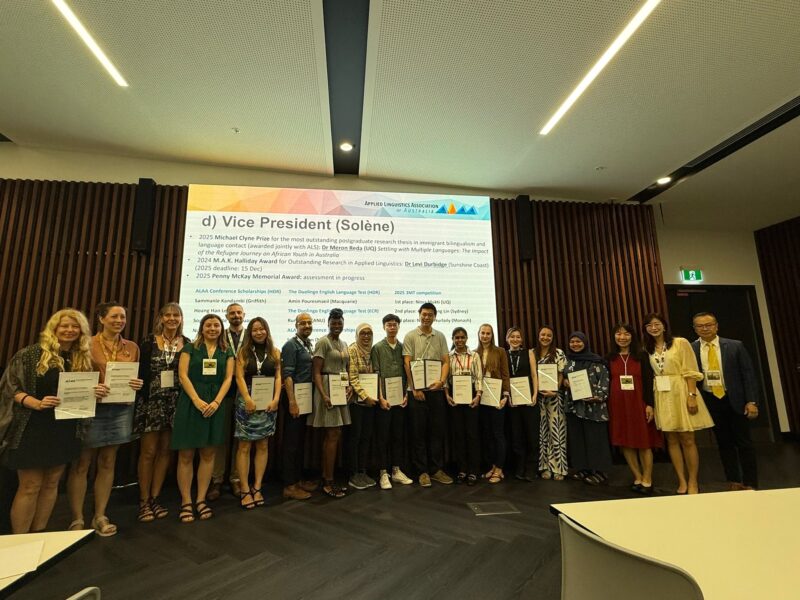
Group photo of all awards recipients at ALAA Conference 2025 (Image credit: ALAA)
Recently, I had the opportunity to attend the 2025 Applied Linguistics Association of Australia (ALAA) Conference, held at Charles Darwin University in Garramilla/Darwin on Larrakia Country from November 17-19. The conference was devoted to the topic ‘Language and the Interface of Mono-, Multi-, and Translingual Mindsets’ and brought together Australian and international scholars.
The 3-day conference in a tropical setting offered many inspiring and new experiences and an excellent platform for networking, collaboration and the exchange of ideas.
Inspiring Keynotes
Keynote lectures delivered by Shoshana Dreyfus (University of Wollongong) and Robyn Ober (Batchelor Institute) left a great impression on me.
Shoshana spoke about linguistic strategies in activism. She presented a positive discourse analysis unraveling effective activist discourse in letters to the minister. Based on such a letter she had written herself, her talk showed how activists rally support. Her compassionate talk shed light on different registers to make change and become an ally for non-verbal people.
Robyn introduced the audience to beautiful metaphors of linguistic diversity and exchange in Indigenous Australian education. Her description of “slipping and sliding” between languages gave insights into multilingual practices.
The audience was particularly touched by the metaphor of language as a guitar: just as an instrument with multiple strings produces more melodious and harmonious tunes, multilingual people have more than one string to their bow, which creates greater harmony when joined.
Encountering Indigenous Languages and Cultures
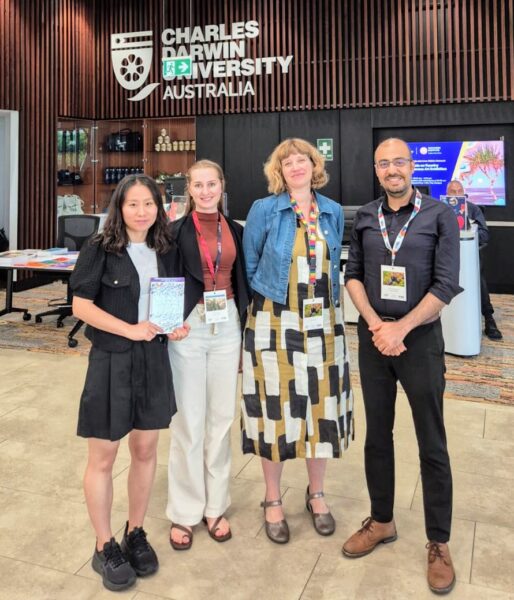
The Macquarie University team at ALAA (Image credit: Sophie Munte)
As a PhD student from the University of Hamburg in Germany who currently spends time at Macquarie University in Sydney as part of my joint PhD degree across the two institutions, the conference offered me the privilege to learn about Indigenous languages and cultures.
Darwin offers a setting where the fact that Australia is Indigenous land is much more palpable than in Sydney. Together with Robyn’s keynote and other talks, this opened my eyes to Australia’s rich diversity of Indigenous cultures and languages.
Presenting my research
The conference provided me with the opportunity to present first results from my PhD research on the governance of parent-school communication in linguistically diverse schools in Hamburg and Sydney.
Employing policy analysis, surveys and interviews, my research explores the use of child language brokering as a way to bridge language barriers between parents and schools. The international comparison will shed light on how institutions in different national contexts deal with their shared responsibility to communicate with parents. Ultimately, the research will contribute to improved policies and teacher training so that all parents can fully participate in the education of their children, regardless of linguistic background.
Grateful to ALAA for the support
Attending the 2025 ALAA conference has been a wonderful opportunity for me. I am particularly grateful for the funding support I received through the ALAA Postgraduate Conference Scholarship. This scholarship, which was awarded to six higher degree research students, including myself, financially supports the conference attendance of HDR researchers.
I also commend the ALAA Higher Degree Research representatives for creating such an inclusive and welcoming event: each evening they organized meet-ups for all HDR candidates at the conference, including a language themed trivia night – all of which helped to establish a supportive community among us HDR students and build connections that will endure beyond the conference.
]]>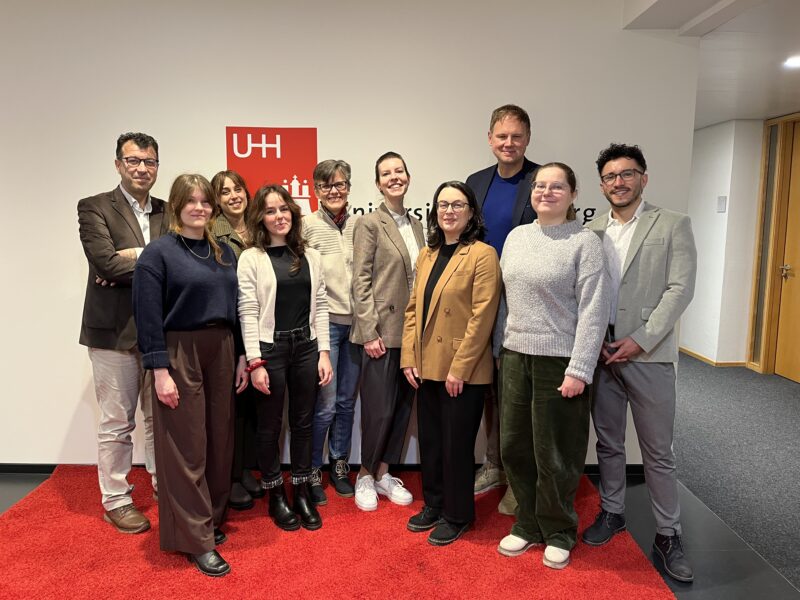
The president of University of Hamburg, Prof Dr Hauke Heekeren, welcomes the new members of Ingrid Piller’s Humboldt Professorship Team
Attentive readers will remember that in May this year we advertised six doctoral and postdoctoral positions to conduct research related to “Linguistic Diversity and Social Participation across the Lifespan” in the Literacy in Diversity Settings (LiDS) Research Center at University of Hamburg, as part of the Alexander-von-Humboldt Professorship awarded to Ingrid Piller.
In response, we received 270 applications. While it was exciting to see that there is so much interest in our work, it was also heart-breaking to have to make so many tough decisions from an amazing pool of highly qualified candidates.
After conducting Zoom and on-campus interviews in July and August, I am now pleased to report that the Dream Team has started their work at the beginning of November. We have six extremely talented and accomplished early career researchers joining the Language-on-the-Move community, and in this post, they are introducing themselves in their own words.
Jenia Yudytska
I’m Jenia Yudytska, a Ukrainian-Austrian postdoc. I did my PhD in computational sociolinguistics at the University of Hamburg, investigating the influence of technological affordances on language in online communication. My current research interest focuses on how migrants use language technologies, particularly machine translation, as a resource in their everyday life. Since 2022, I have also been heavily involved in the organisation of grassroots mutual aid online communities for Ukrainian forced migrants in Austria.
I’m particularly excited for this chance to jump into applied linguistics, and the chance to combine both my love for research and my desire to make a social impact!
Juan Sánchez
¡Hola!
I’m Juan Felipe Sánchez Guzmán, a Colombian student and researcher based in Hamburg. In my home country, I conducted research on gender diversity and language teaching, as well as on the implementation of the Colombian Ministry of Education’s bilingualism programs involving foreign tutors in public institutions within a predominantly monolingual context. Building on my passion for languages, my own migration experience, and those of fellow immigrants, my Master’s research explored the integration of Latinx nurses into the German healthcare system.
I look forward to showcasing through research the values and strengths that multilingual communities bring to education, healthcare, and society as a whole.
Mara Kyrou
My name is Mara Kyrou and I hold an MA degree in Linguistics and Communication from the University of Amsterdam. My Masters research explored language policies, practices and ideologies as perceived by teaching professionals in multilingual non-formal education settings in Greece and the Netherlands. My research interests also include professional and intercultural communication in transnational work contexts, gender theory and theater education. I have also contributed to the design and implementation of language learning programs for students with a (post-)migrant background with international NGOs.
In this research group we are working with (auto-)ethnographies and focusing on globally emerging topics hence we don’t just study things as they are but as we humans are.
Martin Derince
Roj baş!
I am Martin Serif Derince. I carried out my PhD research on Kurdish heritage language education in Germany at the University of Potsdam. I have conducted research and have publications on bilingualism and multilingualism in education, language policy, heritage language education, statelessness, and family multilingualism. After long years of professional work in municipality, non-governmental organizations and community associations dedicated to promoting multilingualism in various contexts, I am excited to explore new terrains in academia, grow together intellectually, and contribute to efforts for social transformation and justice.
Nicole Marinaro
My name is Nicole Marinaro, and I did my PhD at Belfast’s Ulster University’s School of Applied Social and Policy Sciences, focusing on addressing communication difficulties between patients and healthcare professionals. My research interests include language policy, sociolinguistics and linguistic justice, with a focus on the inclusion of linguistically diverse speakers. I am also passionate about language teaching and dissemination of academic knowledge.
I am particularly excited to become part of a diverse and interdisciplinary team, to learn from each other over the next years and to make a real contribution to a more linguistically just society.
Olga Vlasova
My name is Olga Vlasova. My research journey started in Prague at the Charles University where I obtained my BA degree in sociology. Later, I completed my Master’s degree in social policy at the University of Bremen and University of Amsterdam. During these years I have been contributing to research in the fields of migration and labour studies, with a particular focus on solidarity practices with migrant workers in the European labour markets. Apart from that, I’m a passionate volunteer and help newcomers with their integration into Hamburg society.
One thing my life journey has taught me is: “Be brave and follow your ideas and passions!”
What’s next?
Over the next 4 years, our work will be in the following five areas:
- We will conduct a set of interlinked ethnographies to better understand linguistic diversity and social participation across the lifespan
- We will make a novel methodological and epistemological contribution related to qualitative multilingual data sharing
- We will build capacity in international networked education research (see also WERA IRN Literacy in Multilingual Contexts)
- We will work with community stakeholders to help improve language policies and practices and make institutional communication more accessible
- We will share knowledge and contribute to a greater valorization of linguistic diversity
Along the way, we will keep you all posted, of course. Watch this space!
Early next year, we will also advertise another researcher position on our team so that’s another reason to follow our work 
Related content
Alexander-von-Humboldt Professorship Awards 2025
]]>
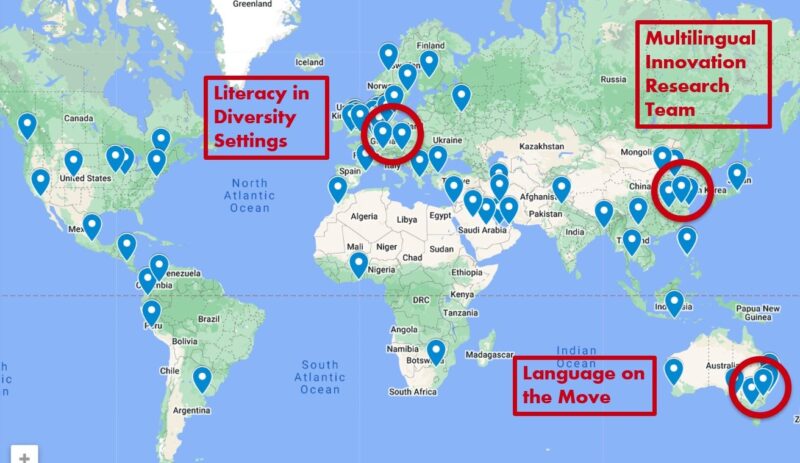
The international research network “Literacy in Multilingual Contexts” builds on the “Next Generation Literacies” network
The World Education Research Association (WERA) recently announced the launch of seven new International Research Networks (IRNs) and we are pleased to share that “Literacy in Multilingual Contexts” is one of them.
What is a WERA IRN?
The WERA IRN initiative brings together global teams of researchers through virtual communication and other channels to collaborate in specific areas of international importance. “Literacy in Multilingual Contexts” joins a growing list of IRNs, contributing to the vision of WERA. The purpose of IRNs is to synthesize knowledge, examine the state of research, and stimulate collaborations or otherwise identify promising directions in research areas of worldwide significance. IRNs are expected to produce substantive reports that integrate the state of the knowledge worldwide and set forth promising research directions.
What does the IRN “Literacy in Multilingual Contexts” do?
The IRN “Literacy in Multilingual Contexts” aims to initiate and extend international collaborative research on literacy in the context of language diversity and migration. The joint focus is on literacy development and practice in multiple languages. Drawing on varied and complementary expertise from Europe, Australasia, Africa and North America, the objectives are:
- to enhance knowledge on literacy and student diversity
- to trace tendencies that go beyond one national, regional or local context
- to examine literacy development across the life-course
- to critically discuss the implications of research findings for policy and practice
Literacy is a foundation for participation in complex societies. The proposed research therefore also contributes to pathways to equity. The network’s activities will reach fundamental theoretical insights, which may be transferred to concepts of teaching/learning in educational institutions. This intervention research will attempt to generalise characteristics of successful multilingual literacy development to be adapted to specific contexts. The proposed IRN comprises senior, experienced and early career scholars (incl. PhD students), aimed towards international and intergenerational knowledge generation.
Literacy as a resource
At the heart of our network is the idea that multilingual literacy is a resource to be celebrated. Literacies across languages and scripts empower learners to create knowledge, to navigate education systems, and to participate fully in social and cultural life.
Members of the network bring expertise from early childhood to higher education, from family and community contexts to digital and AI-mediated literacies. Our shared vision is to develop research that responds to the multilingual realities of migration, mobility, and global diversity.
Building on the “Next Generation Literacies” network
The “Literacy in Multilingual Contexts” network has grown out of the Next Generation Literacies initiative, an international network of researchers working at the intersection of social participation and linguistic diversity.
Based on the trilateral partnership of Fudan University (China), Hamburg University (Germany) and Macquarie University (Australia), Next Generation Literacies brought together an interdisciplinary group of established and emerging researchers to build a truly global network.
After funding for the Next Generation Literacies network ended in 2024, the IRN “Literacy in Multilingual Contexts” keeps that spirit of collaboration alive, while also widening the circle: we are now connected with colleagues from the Network on Language and Education (LeD) in the European Educational Research Association (EERA) and with other WERA initiatives. Under this new umbrella, we will scale up our efforts and make a stronger impact together.
Network Conveners
The network is convened by
- Irina Usanova (University of Hamburg; Lead Convenor)
- Francis M. Hult (UMBC)
- Ingrid Piller (University of Hamburg & Macquarie University)
- Yongyan Zheng (Fudan University)
- Harkaitz Zubiri-Esnaola (University of the Basque Country)
Together with network members, we bring expertise spanning literacy research across continents and research traditions.
Kick-off meeting
On September 24, 2025, we came together on Zoom across many different time zones and continents to virtually celebrate the official launch of the Literacy in Multilingual Contexts IRN.
The kick-off meeting felt like both a reunion and a new beginning: familiar faces from the Next Generation Literacies network reconnecting, and new colleagues from around the world joining the conversation. Together, we are building a vibrant global community of researchers committed to understanding how literacy develops and thrives in multilingual settings. For all of us, it was a reminder of how much we can achieve when we put our multilingual realities at the center of literacy research.
What’s next?
Over the next three years (2025–2028), we will:
- review the state of research on multilingual literacies
- analyze existing datasets across different contexts
- share our work in joint events and publications
- build a sustainable international community dedicated to literacy in diversity
To make this vision concrete, members are invited to join thematic working groups. Topics include multilingual literacy in early childhood, in higher education, in Indigenous contexts, CLIL, multilingual writing and AI, and multilingual policy. Sounds interesting?
An open invitation
The energy of our first meeting showed just how much can be achieved when we bring our different perspectives together. The IRN “Literacy in Multilingual Contexts” is open to any researcher working in these areas. If you are interested in joining, please send your inquiry to Dr Irina Usanova.
Related content
]]>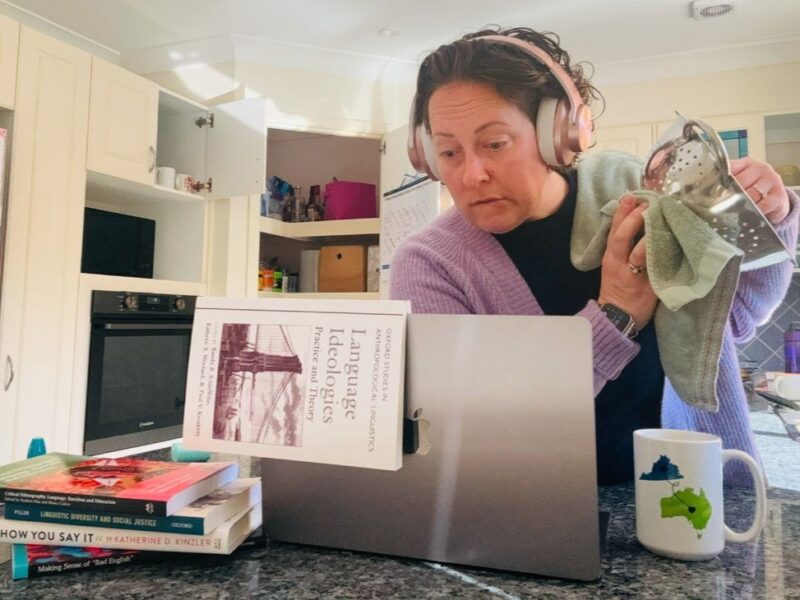
Being an academic mom has given Brynn a huge head start when it comes to managing her supervisors (Image credit: Brynn Quick)
You know that feeling you get in your stomach when you’ve climbed to the top of a rollercoaster, and you look down to see that first huge drop that’s rapidly approaching? That’s exactly what it can feel like to be at the beginning of your PhD. You have a vague idea about the direction that the rollercoaster track will take, but you also know that there will probably be twists, turns and loops (plus some screams and tears) that you can’t anticipate yet.
So, let’s talk about how to make that PhD rollercoaster ride as smooth as possible while also acknowledging that some upside-down moments are inevitable.
One of the most crucial elements of your PhD is your relationship with your supervisor. We’ve all heard the horror stories (The Thesis Whisperer Professor Inger Mewburn has compiled many!). Some PhD students experience bullying, harassment and outright abuse from their supervisors. We all want to avoid a toxic supervisor/student relationship, so it’s vital that every PhD student has a firm idea of how to build and maintain a partnership of trust with their supervisor.
I’m very lucky to have three fabulous supervisors on my team (Distinguished Professor Ingrid Piller is my primary supervisor, and Dr. Hanna Torsh and Dr. Loy Lising are my associates). Recently, Ingrid asked me to talk to other members of our research group about how I “manage” my supervisors while I conduct my research.
In response, I created a slideshow with key principles. What I realised by examining my own management processes was that I hold two principles to be most important:
- Explicitly discuss your expectations of your supervisor, and your supervisor’s expectations of you.
- Honour your supervisor’s time, and they will honour yours.
Let’s talk about these in more detail.
Setting Expectations
We’ve all heard about how communicating clear and mutually-agreed-upon expectations in marriages can lead to healthy partnerships, but many of these same communication principles also apply to working (and therefore, supervisor/supervisee) relationships.
You might send your supervisor a thesis chapter that you’ve just written, and you may assume that they will be able to email you with feedback within a week. However, what you might not know is that your supervisor is also writing their own research paper, preparing a lecture, working on a grant application and getting ready to present at a conference in two weeks.
Therefore, it’s incredibly important that you ask about expectations when you send that chapter. In your email with your thesis chapter, tell your supervisor how many pages (or words) you are sending. Tell them if it’s a first draft, a ninth draft, which changes you have highlighted, what uncertainties you have, etc. Explicitly tell them what task you will work on while you are waiting for their feedback (supervisors love productivity!).
Ask them what date will work with their busy schedules for you to expect feedback by, then trust that they will get back to you by that date. In clearly and explicitly communicating an expectation, you both avoid assuming that the other person has the same expectation that you do, and that reduces the chances of a big misunderstanding down the track.
Another element of setting expectations includes setting and managing expectations of yourself as the PhD student. During our undergraduate and even master’s by coursework degrees, it is often the professor or lecturer who is acting in the role of “manager”. They set reading tasks, and we do them. They assign a 4,000-word essay, and we write it. They tell us to be in class at 8:00am for a final exam, and we sleepily show up with an extra-large coffee. In these degrees, we get used to being told how to successfully be a student. As long as we follow directions, we will probably succeed.
During a research-based degree like a PhD, however, suddenly we become the managers, and this can be whiplash-inducing. Many of us have never had that type of teacher/student relationship before, so we have to learn quickly how to take the lead. This means acting as our own boss in one way – setting daily tasks for ourselves, tracking our own progress, troubleshooting, working towards both external and self-imposed deadlines, etc.
But at the same time, we have to be ready to adapt to expectations that our supervisor has of us and our work. This can be tough when we do eventually get used to being our own boss and managing our own work by ourselves for weeks at a time. This is exactly where clear communication comes into play. Begin and maintain your working relationship with your supervisor from a foundation of honesty and open conversations. If you both respectfully and clearly communicate expectations with each other, the PhD rollercoaster ride will have far fewer stomach-turning drops.
Honouring Time
Time is simultaneously something that we feel like we have far too much of and far too little of during a PhD. The idea of writing for literal years sometimes makes me want to curl into a ball, but also having “only” a few years to complete a PhD feels like a panic attack-inducing Herculean task. But do you know who else has a rough relationship with time? Your supervisor.
Like I said before, they might be teaching/researching/writing/lecturing while supervising. I myself teach every other semester, and doing that while researching (and let’s not even talk about trying to balance family life and parenting in that schedule somewhere!) can be exhausting. So, I honestly don’t know how my supervisors do all that they do in the limited time they have.
Therefore, I try as best I can to honour their time. This means that I keep my emails to them as organised and concise as possible. I come up with agendas for our supervision meetings and take notes during said meetings. Then I make sure to highlight any actionable items that we discussed, and I send the meeting notes to them with a summary of what actions each person has agreed to take by the next time we meet. I also try to figure out as much of the bureaucratic work that is involved in a PhD that I can before involving them (no but seriously, there is SO MUCH bureaucracy).
I have found that by taking these steps to be as proactive as possible and be mindful of my supervisors’ time constraints, they have been reciprocally mindful of mine.
Conclusion: We Can Make the PhD Rollercoaster Ride an Enjoyable One
I’m what we euphemistically call a “mature age student” (I just turned 40 a few weeks ago!). That is to say that this isn’t my first rodeo – I completed my bachelor’s degree in 2007 and was in the workforce and busy raising kids until re-entering academia in 2019. I think that, because of my age and life experiences, I have a unique perspective on the PhD process and working relationships. I truly believe that mutual respect and open communication between supervisors and supervisees is what will make this rollercoaster ride as easy as possible.
If you are on your own PhD rollercoaster, I hope that reading this post will give you the confidence to put “managing up” policies into practice. May your rollercoaster ride be as smooth as possible, and I hope you get to eat some fairy floss after it’s over.
]]>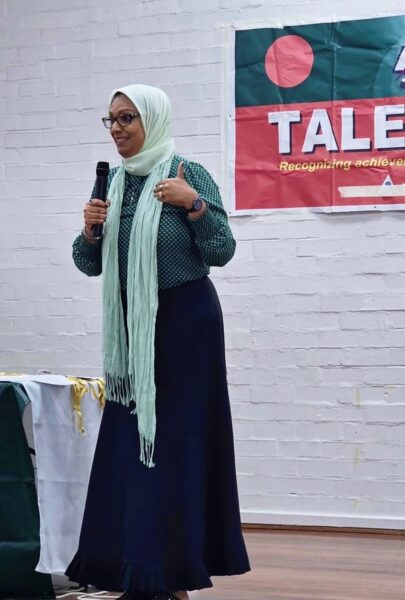
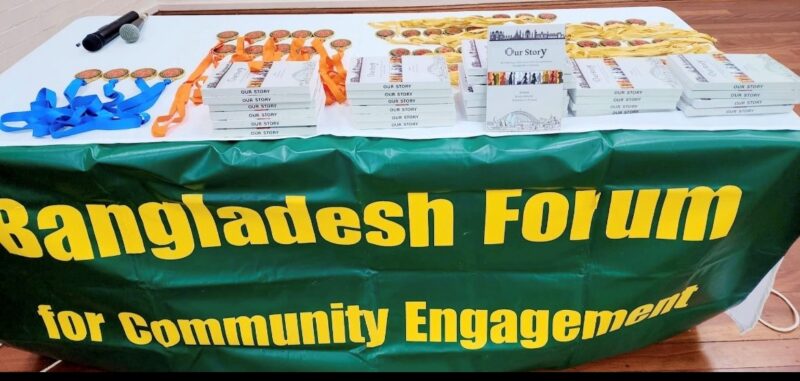
Tazin speaks at Talent Day, Bangladesh Forum for Community Engagement
Every year, the Bangladesh Forum for Community Engagement in Sydney, Australia hosts an event called ‘Talent Day’ to acknowledge the achievements of primary and high school students in the Australian-Bangladeshi community. How does this interest a sociolinguist?
In so many ways – the interaction of multiple languages, the code-switching in the speeches, the expressions of heritage and identity in language use, the living examples of language shift through generations of migrants and so much more.
This year, though, my attention was taken by a request to give a short guest speech to the HSC graduates about to embark on their university journeys. My first dilemma was determining what meaningful contribution, as a second year PhD student, I could make. Which part of my university experience could I share? I decided to talk about my PhD supervisors and share two experiences that, for me, underlined the significance of language itself.
I told them about the lecture that Dr. Loy Lising delivers on the first day of class for our students. In the process of introducing me and the other members of the teaching team, she brings up the slide about communicating with us. But before the technical details, she implores the students to remember our common humanity when communicating with teachers. She explains that the use of our shared courtesies, such as “Dear [teacher’s name]”, “could you”, “thank you” acknowledge that a student and a teacher are two human beings communicating with one another.
From Dr. Lising’s words, I extrapolated that approaching someone more learned with humility confers dignity to both the teacher and the student and if anything, reminds one of the humility that should be cultivated in the pursuit of learning.
I then spoke about my first time as a student of Distinguished Professor Ingrid Piller, when I was doing my Masters of Applied Linguistics. It was time for the final assignment and before giving us the details, she displayed an image of a Persian rug. She directed us to the intricate parts that were woven, bit by bit, to produce something so beautiful.
 Her next request was for us to write her a “beautiful” assignment. To achieve this, she asked us to remember the great privilege of higher education, which so many others have been and continue to be deprived of. We were reminded of our moral obligation to use our learning to contribute to society and the first step was to dedicate our attention to writing a good assignment – to remember the privilege of being able to write one.
I had never had an assignment presented quite like this before!
Conceptualising and expressing the act of learning as a privilege and the production of work as beautiful was yet another exercise in humility, a reminder of the very significant role that our teachers play in shaping our minds, and an acknowledgement of the purpose of higher education.
Towards the end of my speech, I realised I had given the students a series of stories and I wanted to explain why I had done this.
To be meaningful, university and higher education must be a journey of purpose, guided by our teachers and mentors who nurture our potential to contribute to the world. Ultimately, the university journey symbolises the lifelong commitment to learning from those who are more learned and passing it on to those that follow.
]]>
Tazin and Brynn, two of our enthusiastic podcast hosts
Editor’s note: Time flies: the Language-on-the-Move Podcast in collaboration with the New Books Network just turned one! Time to celebrate and reflect!
We celebrate a passionate team of hosts who created 43 insightful episodes about language in social life which have been downloaded 57,000 times across a range of platforms.
By download numbers, our top-5 episodes were:
- Muslim Literacies in China: Tazin Abdullah in conversation with Ibrar Bhatt
- Can we ever unthink linguistic nationalism? Ingrid Piller in conversation with Aneta Pavlenko
- Politics of language oppression in Tibet: Tazin Abdullah in conversation with Gerald Roche
- Making sense of “Bad English:” Brynn Quick in conversation with Elizabeth Peterson
- Lies we tell ourselves about multilingualism. Ingrid Piller in conversation with Aneta Pavlenko
Providing a service to our communities by sharing knowledge about intercultural communication, language learning and multilingualism in the context of migration and globalization is a key benefit of the Language-on-the-Move Podcast.
Another benefit accrues to our hosts who get to chat with key thinkers in our field. In this post, two of our hosts, Brynn Quick and Tazin Abdullah, share their reflections on the occasion of our 1st birthday. Enjoy and here’s to many more milestones!
***
Brynn Quick and Tazin Abdullah
***
Over the past year, many of us on the Language on the Move Team have been excitedly hosting podcasts about a wide range of topics in language and social life! As we dive into recording and producing our podcasts for the year ahead, we would like to share why this continues to be a rich and rewarding experience for us as PhD students at the beginning of our research journeys.
- Wider horizons: Sounds cliché but oh, so true! Each time we host a podcast, we spend a significant amount of time doing background research. We research our guests, their interests, and their work. The opportunity created for reading is amazing. Not only do we dip our toes into the vast ocean that is all things language, we learn new things to enhance our own research and add to our reference lists!
- Bigger networks: We establish relationships with our guests and connect with others in their networks. Our guests are great – they stay in touch! As the podcast is promoted on various platforms, we make connections with linguists around the world and are able to remain updated on developments in our field and directions that different researchers are taking.
- Informal mentors: Did we mention our guests are great? Our guests indulge us in lively and interesting conversations not just during the podcast but also off air. Every guest shares their experiences, offers us advice and stays open to us reaching out if we have any questions on their area of expertise or if we need to understand some part of the academic journey.
- Technical skills: Who knew how much work goes into the editing and production of a podcast episode? But this has also been a great learning experience, dabbling with technology and learning the ins and outs of various platforms – another transferable skill for emerging researchers.
- Successful collaboration: The podcast is just one more example of how collaboration between fellow researchers results in an overall increase in both productivity and learning. Many times, we have reflected amongst ourselves about the way our podcast works. We support, mentor and acknowledge each other and, like a feel-good movie, are left wanting to collaborate some more.
- Future collaborations: And yes, it has opened doors for us to future collaborations, to be able to reach out through our now wider networks and pursue our wide-ranging interests in linguistics and adjacent disciplines.
- Non-traditional research outputs: Finally, what we love looking at – our updated research output lists every time a podcast drops! And an added bonus for those of us who prefer talking about research rather than writing about it, this format speaks right to us! As non-traditional research outputs, podcasts have offered us a practical way for us to engage with our learning in real-world settings, to use and develop our various skills, and contribute to research at the same time.
We give our podcast hosting experience a 5-star rating! If you enjoy the Language on the Move podcasts, please leave us a 5-star review on your podcast app of choice, and recommend the Language-on-the-Move Podcast and our partner the New Books Network to your students, colleagues, and friends.
Full list of episodes published to date
- Episode 43: Multilingual crisis communication: Tazin Abdullah in conversation with Li Jia (22/01/2025)
- Episode 42: Politics of language oppression in Tibet: Tazin Abdullah in conversation with Gerald Roche (14/01/2025)
- Episode 41: Why teachers turn to AI: Brynn Quick in conversation with Sue Ollerhead (09/01/2025)
- Episode 40: Language Rights in a Changing China: Brynn Quick in conversation with Alexandra Grey (01/01/2025)
- Episode 39: Whiteness, Accents, and Children’s Media: Brynn Quick in conversation with Laura Smith-Khan (24/12/2024)
- Episode 38: Creaky Voice in Australian English: Brynn Quick in conversation with Hannah White (18/12/2024)
- Episode 37: Supporting multilingual families to engage with schools: Agi Bodis in conversation with Margaret Kettle (20/11/2024)
- Episode 36: Linguistic diversity as a bureaucratic challenge: Ingrid Piller in conversation with Clara Holzinger (17/11/2024)
- Episode 35: Judging refugees: Laura Smith-Khan in conversation with Anthea Vogl (02/11/2024)
- Episode 34: How did Arabic get on that sign? Tazin Abdullah in conversation with Rizwan Ahmad (30/10/2024)
- Episode 33: Migration, constraints and suffering: Ingrid Piller in conversation with Marco Santello (14/10/2024)
- Episode 32: Living together across borders: Hanna Torsh in conversation with Lynnette Arnold (07/10/2024)
- Episode 31: Police first responders interacting with domestic violence victims: Tazin Abdullah in conversation with Kate Steel (29/09/2024)
- Episode 30: Remembering Barbara Horvath: Livia Gerber in conversation with Barbara Horvath (10/09/2024)
- Episode 29: English Language Ideologies in Korea: Brynn Quick in conversation with Jinhyun Cho (08/09/2024)
- Episode 28: Sign Language Brokering: Emily Pacheco in conversation with Jemina Napier (30/07/2024)
- Episode 27: Muslim Literacies in China: Tazin Abdullah in conversation with Ibrar Bhatt (24/07/2024)
- Episode 26: Life in a New Language, Pt 6 – Citizenship: Brynn Quick in conversation with Emily Farrell (17/07/2024)
- Episode 25: Life in a New Language, Pt 5 – Monolingual Mindset: Brynn Quick in conversation with Loy Lising (11/07/2024)
- Episode 24: Language policy at an abortion clinic: Brynn Quick in conversation with Ella van Hest (05/07/2024)
- Episode 23: Life in a New Language, Pt 4 – Parenting: Brynn Quick in conversation with Shiva Motaghi-Tabari (03/07/2024)
- Episode 22: Life in a New Language, Pt 3 – African migrants: Brynn Quick in conversation with Vera Williams Tetteh (27/06/2024)
- Episode 21: Life in a New Language, Pt 2 –Work: Brynn Quick in conversation with Ingrid Piller (19/06/2024)
- Episode 20: Life in a New Language, Pt 1 – Identities: Brynn Quick in conversation with Donna Butorac (12/06/2024)
- Episode 19: Because Internet: Brynn Quick in conversation with Gretchen McCulloch (03/06/2024)
- Episode 18: Between Deaf and hearing cultures: Emily Pacheco in conversation with Jessica Kirkness (01/06/2024)
- Episode 17: The Rise of English: Ingrid Piller in conversation with Rosemary Salomone (21/05/2024)
- Episode 16: Community Languages Schools Transforming Education: Hanna Torsh in conversation with Joe Lo Bianco (07/05/2024)
- Episode 15: Shanghai Multilingualism Alliance: Yixi (Isabella) Qui in conversation with Yongyan Zheng (02/05/2024)
- Episode 14: Multilingual Commanding Urgency from Garbage to COVID-19: Brynn Quick in conversation with Michael Chestnut (27/04/2024)
- Episode 13: Making sense of “Bad English:” Brynn Quick in conversation with Elizabeth Peterson (13/04/2024)
- Episode 12: History of Modern Linguistics: Ingrid Piller in conversation with James McElvenny (10/04/2024)
- Episode 11: 40 Years of Croatian Studies at Macquarie University: Ingrid Piller in conversation with Jasna Novak Milić (08/04/2024
- Episode 10: Reducing Barriers to Language Assistance in Hospital: Brynn Quick in conversation with Erin Mulpur, Houston Methodist Hospital (26/03/2024)
- Episode 9: Interpreting service provision is good value for money. Ingrid Piller in conversation with Jim Hlavac (19/03/2024)
- Episode 8: What does it mean to govern a multilingual society well? Hanna Torsh in conversation with Alexandra Grey (22/02/2024)
- Episode 7: What can Australian Message Sticks teach us about literacy? Ingrid Piller in conversation with Piers Kelly (21/02/2024; originally published 2020)
- Episode 6: How to teach TESOL ethically in an English-dominant world. Carla Chamberlin and Mak Khan in conversation with Ingrid Piller (20/02/2024; originally published 2020)
- Episode 5: Can we ever unthink linguistic nationalism? Ingrid Piller in conversation with Aneta Pavlenko (19/02/2024; originally published 2021)
- Episode 4: Language makes the place. Ingrid Piller in conversation with Adam Jaworski (18/02/2024; originally published 2022)
- Episode 3: Linguistic diversity in education: Hanna Torsh in conversation with Ingrid Gogolin (17/02/2024; originally published 2023)
- Episode 2: Translanguaging: Loy Lising in conversation with Ofelia García (16/02/2024; originally published 2023)
- Episode 1: Lies we tell ourselves about multilingualism. Ingrid Piller in conversation with Aneta Pavlenko (15/02/2024)
The 3-Minute Thesis (3MT) competition is an opportunity for higher degree research students to present their research in 3 minutes. Normally, symposiums, conferences and seminars are some of the ways research students get to talk about their research. Unlike those presentation formats, the 3MT poses a unique challenge – an entire thesis has to be presented within 3 minutes and not a second over!
This year, the Applied Linguistics Association of Australia (ALAA) held its 3MT competition on 27th September, 2024 and Tazin Abdullah won first prize. She presented on her research on the Linguistic Landscape of Australian mosques titled “Observe overall cleanliness and sound mannerisms at all times!” – Regulating Australian Muslims in mosques and Islamic prayer spaces.
Tazin’s study examined regulatory signs from Australian mosques that gave readers instructions and stated prohibitions regarding behaviour in these places. What do these signs say about the communication practices within Australian Muslim prayer spaces? What languages do these signs use to communicate with readers? What linguistic and visual strategies do they employ to present rules and regulations?
Reference
Abdullah, Tazin. 2024. “Observe overall cleanliness and sound mannerisms at all times!” – Regulating Australian Muslims in mosques and Islamic prayer spaces. (MRes), Macquarie University.
Other 3MT videos by members of the Language on the Move team
- Brynn Quick, Curing Confusion
- Pia Tenedero, Communicating globally while working remotely
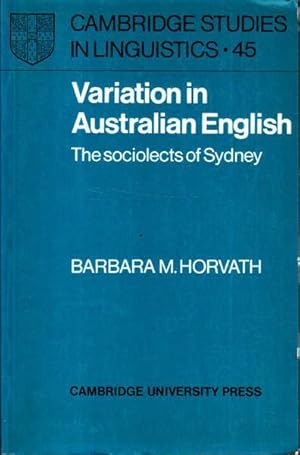
In the interview, Barbara reflects on the early years of her career as an American linguist in Australia in the 1970s, and how linguistics and language in Australia have changed since then.
The transcript was edited by Brynn Quick.
Update 23/09/2024: The audio is now available here or on your podcast app of choice.
***
 Livia: So, you’re very difficult to google and to do background research on!
Barbara: Really?! Whenever I look myself up, I start finding me all over the place (laughs).
Livia: I did find a couple of things about you, like the fact that you had actually studied in Georgetown and Michigan, and that you came over to Sydney in the 1970s. Then I was astounded to find that you were the second linguist at University of Sydney. It was just you and Michael Halliday.
Barbara: Yes, but he only got there a couple of months before me. It was the birth of the Linguistics Department.
Livia: Can you tell me a little bit about what it was like when the field was so young?
Barbara: Well, I guess the answer to the story is that my husband got a job here. He’s a geographer, and we were in Vancouver at the time in Canada. He was teaching at Simon Fraser, and I was teaching at the University of British Columbia. We were both lucky, those were both just jobs for a year or two. I was writing my dissertation at that point.
So, we started applying, and he applied to the University of Sydney, and he got the job! And I applied, and I was told by a number of people at the University of British Columbia, linguists, that I didn’t have a chance. That there was no chance, it was only going to be one other person hired. And Michael, you know had a wife, Ruqaiya Hassan, and everybody was sure that Ruqaiya would get the other job. So, I didn’t have very much hope, but then I got the job!
I was just so amazed that I got the job, and I found out from Michael later that it turned out that the reason I got the job is, he was very interested in starting a department that would combine both systemics and Labovian kinds of sociolinguistics. He thought somehow we’d be able to mesh in an interesting kind of way, having different interests and different ways of configuring what the major issues were.
But we had great overlaps because I was just as interested in applied linguistics, and Michael certainly was and wanted to build a department up as a place for both theoretical and applied interests. So, it was that it was very exciting times for us when we did both get jobs at the same university which didn’t seem like that was going to be possible at all, but it was!
Livia: How long were you at Sydney for?
Barbara: Until I retired. It was my only place until I retired in 1980-something or 1990-something. I know I retired early because in those days women could retire at 55, so it was when I turned 55 that I retired. But after that is when I got more interested in working with a friend of mine in Louisiana, and we worked together for 10 or 12 years after that.
Livia: You’re also a female scholar who migrated to Australia. How did that shape your research or your role as a researcher?
Barbara: I don’t know that being a female shaped my research. I was much more interested in social issues. The time when I was doing my master’s and PhD were times of great upheaval with the anti-Vietnam war situation. I spent some time in my master’s degree working with Mexican children in California. I collected data there, and so it was more an interest in social issues.
I found the linguistics of theoretical people like Chomsky, for instance, very interesting. I found that the kinds of questions and the way he was doing linguistics was so different from writing grammars of language, for instance, which was the main thing that linguists were doing at that point, describing languages that hadn’t been described. I didn’t mind that either, but I was really taken in by the more political sides of things, and so when Labov first published his dissertation which was only when I was still at the master’s level, I just thought, Oh! This is what I want. This brings social issues and linguistics together.
I thought he was asking questions about how language changes, and I was very interested in that as a theoretical question. If it was going on before and it’s going on now, can you observe it changing? And when they came up with these nice statistical means and then the data necessary for using those statistical means to look at language changes, I found that theoretically exciting.
Livia: So, did you have a very big research team helping you when you first did the nearly 200 interviews in the Sydney?
Barbara: No, no, no! Not at all. I mean, that story is kind of funny. When I came here and it was only Michael and me, I had no idea about how the university worked. It was very different from American universities. I didn’t know how different it was. Michael was much more familiar with it I suspect because of his English background.
I came over here thinking, oh my gosh I have to get tenure because in America you have to get tenure within your first six years or else you’re going to go to some other university. And we had moved all around the world, my husband and I and my two little children. When we get to Sydney we thought, we’re just going to stay there. We’re not going to move at all. So, then I thought I’ve got to get busy, so I applied for a grant to do New York City all over again, except in Sydney.
That first year we collected the data from the Anglos. The Italians and the Greeks were in the third year. So, the first year Anne Snell and I collected all the data (chuckles) and made the preliminary transcripts. I think we had money for getting transcripts typed, and we had money for Anne and me to run around all over Sydney trying to get interviews with people. Then Anne and I sat together in my living room at the end of the data collection period just listening to the tapes and checking with each other if we were all hearing the same thing.
Then I found out afterwards that there is no such thing as tenure. If they hire you, they hire you, and they’re not going to think about getting rid of you. Oh! All that work I did! It was very funny.
It was when my supervisor from Georgetown, Roger Shuy, came over for participating in a conference. He said, “Barbara, I’m going to ask Michael how you’re doing.” And I said, “Ok.” He asked Michael did he think I’d get tenure, and Michael said something like, “I don’t know! I don’t think they do tenure here.” (laughs). Oh dear!
So anyway, I was working really hard. I thought I needed to, but I think I would’ve done it anyway. I definitely have no regrets. I’m glad we worked that hard, but it did mean coming home from teaching at the university – because most of the interviews were done at night, they were done after people had dinner – so Anne and I both got home, fed our families, turned around, got in a car and went off somewhere.
Livia: So, let’s talk about your data. You had a lot of data. I read a quote of yours somewhere where you said it was amazing how much variation there was, and that you were really excited about that.
I actually went to the Powerhouse Museum yesterday, and I looked at the Sydney Speaks app. I didn’t get all of the questions right! One of the teaching points in the app was that unless you live and grew up in Sydney, you’re not likely to get a lot of these right. So, for you, who didn’t grow up in Sydney, as an initial outsider, I’m sure the language variation would have been fascinating for you to learn about, as well as all the social aspects behind it. There are differences in society despite the classlessness that Australia prides itself in.
Barbara: Yeah, and again, you know, I came over here totally understanding that what I was seeing was social class. I mean it’s just social class as far as I’m concerned. It wasn’t that much different except certain ethnicities were different and all that sort of thing.
I looked for the sociology in it, and I though ok I’ll do like Labov did. He just found a sociologist, and he just used whatever categories the sociologist did! I found one tiny article from the University of New South Wales, and it just wasn’t that useful, so in a way I kind of had to figure out for myself what I thought. In the book I talk about how you come up against problems, like for example you have somebody who owns a milk bar, you know, in terms of the working class-or the middle class or whatever. So, you know, I think the class thing is fraught, and it’s still fraught today. It’s not well defined, though it’s better defined than it used to be.
Livia: And in general, there are ideas about the categories we imagine that people fall into. There are so many assumptions and myths out there.
Barbara: Absolutely, but then even when you decide that somebody is either Italian, Greek or Anglo, even those titles are complicated. Very many people didn’t like me using the term Anglo because they would rather be called Australians. That’s the way people were talking about it then, that there were Australians, Italians and Greeks.
But I remember one Scottish person said how insulted he was to be put in with the Anglos. I said well I suppose you are, come to think of it. So yeah, it was kind of fraught. It’s not the easiest thing in the world to do, to come in as a real foreigner, and not really knowing very much about Australia at all before we came and then trying to jump in to something like this.
I guess the thing that helped a lot is anybody who I hired were Australians, so they could um tell me when I was really going off the rails. I felt more comfortable with the Greeks and the Italians because they were foreigners like me, so they had different ways of understanding Australia as well.
Livia: That’s fascinating, especially considering in sociolinguistics at the moment that researcher positionality is a very big topic and having to justify your own positionality and reflect on your influence in the interview.
Barbara: Yes, but you know I don’t understand how we would ever do studies of other peoples if we only had ourselves to look at, that is if everybody else was just like you. First of all, I wouldn’t have found very many Americans of my particular background, so I think you have to be cautious about these things.
But what I also think is that when you do a kind of statistical analysis in the way that I did, and when you see the patterns that resolve, you think something is generating those patterns. It’s probably the social aspects as well as the linguistic aspects. You need to always be conscious of what you’re doing, as I was, with class. I knew I had no right to be assigning class to people because not even, you know, Marxists do that. Even though they believe in class, absolutely, they don’t go along classifying people. They talk about members of the working class, but it’s kind of a broad sweeping hand kind of thing.
So, in terms of picking up on the linguistic variable that I looked at, I really depended upon Mitchell and Delbridge and their work before me. So, we knew the vowels were very important in Australian English. If you look at Labov’s work, vowels are the most likely changing features of a language, and then of course certain consonants come up as well.
Livia: You just brought up Arthur Delbridge. Let’s talk a little bit about your colleagues over the years, particularly also the colleagues you’ve met through the Australian Linguistic Society (ALS). Could you maybe tell me a little bit about your involvement with the ALS?
Barbara: I’m sure that I attended some ALS meetings from whenever I got here to whenever I left! But I didn’t attend after I retired. I don’t recall going to too many meetings, but early on it was a small group of people, as you can imagine. It was Delbridge and I’m not sure who else, but Delbridge for sure was a major person in the early stage in getting the whole thing going as far as I know.
It was a small group of people, a very friendly group of people who got together. It was the first time that I saw a group of students or university people who were interested in Aboriginal languages because we didn’t really have that in Sydney at first until Michael Walsh joined the faculty. So, I realised that, at least among young people, there was really the enthusiasm for Australian linguistics.
The meetings were always held at some university. We always lived in the dormitories together, so it was, you know, breakfast, lunch and dinner with a very friendly group of people. And there were good papers. You could listen to papers on Aboriginal languages, for instance, that I wasn’t getting from any other place, so that that was all very interesting.
When I first came here, John Bernard was very helpful to me, and I used his work as well on vowels in Australian English. Those were very fundamental. If I hadn’t had those as a base, I could not have done my work as quickly as I did, but because they’d worked on that for a long time, it was very helpful.
I also remember the systemics people, Jim Martin and Michael (Halliday), coming, and they had a harder time because I think there weren’t a sufficient number of them. There was Ruqaiya and Michael and Jim at first, but eventually, as you know, they got a sufficient number of people, and then they became very, very big.
Then it became the really, the major direction in the department. By the time I left, it was not the only direction. They would go on to certainly hire more people who are in sociolinguistics. Two or three different Americans came over to work, and others like Ingrid (Piller). So yeah, it’s expanded and now it’s a very different department from what it was when I was there.
The department was really small for those first ten or twelve years. We were very close. We used to plan weekends together where, you know, we’d go at the end of the year and we’d go off camping! We’d go somewhere together. The graduate students and the staff just did things together, and that was very nice. So, you made very warm relationships with many people who came from that era. Maybe it’s still the same way. It may still be wonderful.
When Michael Walsh came, it was important for him to come because we were getting to look like we weren’t an “Australian” bunch of people, so when Michael came at least he legitimised us because he was working on Aboriginal languages. He was an Australian, so we all learned how to be Australian from Michael.
Livia: Whatever “Australian” means nowadays, right? (laughs)
Barbara: Yeah, whatever that means. Well, I think of myself as practically Australian now, but nobody else does, so (laughs) that’s just the way it is.
Livia: What’s it like for you walking around, say, Glebe now and hearing all the variation in Australian English? Do you get very excited when you hear people speaking?
Barbara: I don’t think I want to go and do another study, no! No, no. I still like to listen. I feel that there’s some things that I could have pursued, and perhaps I should’ve. I’ve always felt, I keep telling this to every sociolinguist I ever meet in Australia, and that is that somebody needs to study the Lebanese community. The Lebanese community is going to be very, very interesting, and of course if you don’t capture it really soon, you know, it will –
Livia: Has no one done that?
Barbara: No, not really. I know of no major study now. Maybe somebody’s done it a little bit here and there, but I think that would be fascinating to study, so I keep trying to urge people to study the Lebanese community.
Livia: That’s interesting because they’re a fairly recent migrant group but not that recent.
Barbara: No, not that recent. They were when I when I was doing my studies. The Greeks and the Italians were the major groups that anybody ever talked about, so when you were talking about migrants you meant the Greeks and the Italians. But the Lebanese were becoming a force, particularly if you were doing applied linguistic work. If you were working with the schools, the most recent group to migrate in large numbers were the Lebanese. So, I felt even then that I couldn’t face doing another major work like that again. But every time we did get a new sociolinguist, I told them that they should be studying the Lebanese community.
Livia: Too bad I’m nearly finished with my thesis (both laugh). But to take you back to the ALS conference days – what do you remember of those?
Barbara: Bearing in mind I haven’t been to a meeting in many years, what I recall of them is that most of the papers were interesting. I do recall the social aspects of it, getting together with groups of people who are linguists and just talking among yourselves. That, to me, is the best part about meetings all together. Unless it’s somebody who’s absolutely giving a paper right on what you’re interested because then you’re just kind of sitting there absorbing and thinking. But actually talking to people, especially because, as I said, we were a small group at that point, so it was very personal and interactional. That’s the main thing that I think about when I think about the ALS.
Livia: I’m always told when you go to conferences that it’s good to be criticised or challenged in your ideas, or that out of failure come new ideas. I’m just wondering whether you recall a time when that happened to you, that you were maybe challenged in your ideas but that actually ultimately took you in a direction that was more fruitful?
Barbara: I think people treated me very well, so I don’t recall any criticism. No, there was criticism when my book first came out, but it was well-intended. In those days we really didn’t do those things publicly. Everybody was incredibly polite to everyone else, so even if you did think, “oh that was a stupid paper,” you wouldn’t say it, and you wouldn’t embarrass somebody with it. I think you might challenge them later over coffee, but it was a very polite society at that time.
This was unlike some of the American things that you go to where you get somebody in the audience who is just dying to “get you”, you know? That kind of thing was not a nice feeling. People treated me very well, and I know now from looking back that I came over here like a bull in a china shop in the sense of who was I to be coming here and taking on such a big project, and taking it on with the manner and attitude that I had? I know this now because I’ve been here long enough to know how you feel about people who come here, and suddenly they know everything about anything. So, I think I probably stepped on a few toes, partly out of innocence.
One of the reasons I really like Chomsky is that he is argumentative, and I don’t mind a good argument. Not a personal one, not one that’s vindictive or whatever, but I think being strong about what you feel or arguing about what you think is controversial – I think that’s healthy for any field. You need to be able to say, you know, I have a different opinion about that, or I think something else is working here.
I got a really nice letter from John Bernard, for instance, who took me to task for a number of things. He wrote me a very long letter. I appreciated the fact that he had put in all that time to respond. I didn’t necessarily agree with him, but I understood where he was coming from. I guess what I like about John Bernard is that even after that he was always very friendly to me. I never had any problems with him, so I hope he never took whatever I said argumentatively to heart (laughs).
Livia: It’s important to have a good scholarly debate without being personal.
Barbara: Yeah, I think so too. But I can imagine I might have the same reaction if somebody came over and redid my work and they’d only been here three months, and I could say, “What would you know?!” (laughs)
You know, it is true that one of the things was the class issue, that I imposed this class issue. I don’t know that he said I imposed it, but he really did want to make the point that class wasn’t as significant in Australia, and he was still supporting the notion that it was a matter of choice, that you could choose. That was so alien to me, and it is still kind of alien to me.
I think people don’t choose the dialect they speak. I think they speak the dialect they’re brought up in, and that doesn’t mean I don’t think people can’t change their dialect. I think they can if they want to, if they move somewhere else or if they, you know, get a PhD and become professor of Physics or something. I think they can move up and down, up and down. I think that can happen, but it was the word “choose”, I think, that that bothered me a lot. I couldn’t see kids deciding, “oh I’m not going to speak like that anymore,” because they probably haven’t even heard anybody speak any other way except on television, and how much do we get from television? Or radio, or that kind of thing? I don’t think that much. But I just- I came in at that moment, I think, before a lot of people would understand that choosing isn’t probably the right word or the right conception of how dialect changes, that- that you decide to speak a different way. Anyway, that’s my story, and I’m sticking to it! (chuckles)
Livia: Speaking of changes – you’ve been in Australian linguistics for a bit of a while. What are sort of the major changes that you’ve seen happening in the field?
Barbara: I can tell you about my department. There’s much more interest in descriptive language, grammatical description. That’s really very big in the Sydney department. What’s happening in the rest of the department, I’m just not familiar with.
The set up that Michael (Halliday) managed to create in the department is kind of there, but it has a very different flavour. It’s much more anthropological, what I would call anthropological linguistics. So, still interested in people, still interested in culture and language as well, and especially in studying the variety of languages. I think it’s probably a firmer basis for study than sociolinguistics, and even Michael’s kind of sociolinguistics works best, I think, if you’re a native speaker of the language. I mean, why else is it that we get so much work on English? Because it’s kind of an English-based theoretical position. When I go to meetings, I meet lots of people from Europe and various other places who are studying their own languages in a sociolinguistic manner. But anyway, I would be out of place, I think, in the department now because I’d be the only one doing that.
I’ve been going to the seminars this year, and they’re very interesting papers that are being given with a lot of really interesting and new (to me) people in the department. I know this honours student that I was telling you about, that I was mentoring this year. She is so enthusiastic, and yet there isn’t any real place in this department for her to pursue her work. She had to do a lot of work in figuring out how to collect data, how to interpret your own findings after you’ve done the statistical analysis, all that stuff. She had a real task ahead of her, and I’m glad to say that Catherine Travis has picked up some of my work with that.
I don’t know if you know, but I was about to get rid of all my tapes. I downsized about five years ago. I just decided I was going to downsize. I was not going to do any more research, so it was time to just clean up my house, and I came to those tapes that I had saved from all these years ago. I thought, ah I know somebody in the world would like to have these tapes eventually, but they were still on these little cassettes. They needed a lot of work done with them before they’d be useful to anybody anymore, so anyway she got in touch with me. I said to her, by the way if you have any interest at all in my tapes because I’m just about to ditch them – and she wrote back quickly, “Don’t! Don’t! I’ll be up-I’ll come up and pick them up!”. (laughs)
So, she did, and I’m so glad because she really is doing some great work down there. So, I hope my little honours student goes down there to finish her work because I think she’s so enthusiastic.
Livia: Coming back to Sydney Speaks – I was looking through the Sydney Speaks webpage and there seem to be quite a few projects that are reaching a wider population.
Barbara: Yes, there’s lots of stuff. They’re collecting more data. They seem to be interested in ethnic varieties of English, that sort of thing, so yeah! It’s a whole new revitalisation, I think, of the interest in ethnic varieties of English. There are so many new and large migrations that have happened since the Italians. I mean, the Italians and the Greeks – Leichhardt, for instance, it’s not there anymore. You can’t go there and see that whole row of Italian restaurants that you used to find. Now you go to buy your coffee where you’ve always been to buy your coffee, and it does not seem to be run by Italians anymore, that kind of thing. So yeah, no Greeks and Italians.
I think it’s probably the case that you need two generations. You need the parent generation and the teenager (more or less what I did) because I suspect by the time it gets to the third generation, it’s gone. They’re just Aussies, and they speak like Aussies, and you wouldn’t find anything very interesting. So, you’ve got to catch it when it’s there. Timing is everything.
Livia: Are you going to be attending the ALS conference in December? Are you able to make it?
Barbara: No, no, no. I’ve actually not been in linguistics for quite a while now. That’s why I was downsizing, and I had to face it that I hadn’t been doing anything, that’s it! Give it up! Yeah.
Livia: Well, given that the ALS would like some snippets, I was thinking – Are there any wishes you have for the linguistics society moving forward? For their 50th anniversary?
Barbara: I’m interested in all of these people who are doing the dynamics of language. When I started looking up Catherine and looking up various others and I see all these people are doing something called the dynamics of language. So, what do they mean by that? Well, you know, I doubt they are all Labovians. I guess I’d love to see the group of them getting together in a discussion of just that. What are the dynamics of language that you’re focussing on? What kind of theoretical issues are there? Do you have overlapping goals, or do you have a single set of goals? Does dynamics actually mean language change as it is associated with historical linguistics? Or does it just mean socially dynamic, like other people picking up your language? Or just the use of language? Or how many people still speak Polish? Or is that the dynamics of language? I’d love to see what people are thinking about with the dynamics of language. It’s obviously got people very interested, whatever it is. That’s what I would like I would like to see a discussion of.
Livia: In that vein of wishing things – do you have any advice for PhD and honours students pursuing linguistics?
Barbara: Be passionate about something, and purse that. I was passionate myself for a long time when I did my bachelor’s degree. I knew I wanted to do English and it was all literature. I knew that what I really like is grammar, but I had never heard the word linguistics before. It wasn’t until I went to Ethiopia and I was teaching at Haile Selassie, the first university (now, Addis Ababa University), that I met a group of linguists who had come over there. And I thought oh, Linguistics! That’s what I want to be, you know? Then I really pursued that afterwards, but yeah, find your passion.
I had a very strong kind of social commitment to making a good society, and language is really kind of right in the middle of that.
That’s such an easy cliché, but because, as I said, when I started off, I had a very strong kind of social commitment to making a good society, and language is really kind of right in the middle of that. What I loved about sociolinguistics is that you could easily go in between the more sophisticated theoretical issues as well as being right on the ground and saying here are some problems that we’ve got. How can we think about these things? So, I did a lot of work with schools, and I think being able to interact with your community for me, not everybody, but for me, that was a very important thing.
Livia: Yeah, I agree. I think it’s interesting that language keeps coming up in the media. People are grasping how complex it is, and it has complex social meanings behind it. I mean, most recently we saw this in the citizenship debates of some of the politicians. There were politicians making fun of each other, saying I don’t sound Greek, but everyone always says where are you from, and now I’m the most Aussie in the room.
Barbara: Yeah, absolutely. No, that’s not true of me because I can go to David Jones tomorrow and get up to pay for my goods, and the people will think I’m an American tourist. They’ll ask me how I find Sydney. So, it isn’t true of me. Nobody has ever, ever said that I was an Aussie. (laughs)
Livia: I’ll ask you maybe one last reflective thing. Thinking back to when you first started and you were involved with all these linguists, particularly in the ALS, what advice would you give to yourself?
Barbara: I think, like I said before, it would be about time. I thought I needed to hit the ground running because my kids didn’t want to move to any other place. We didn’t want to move into any other place, so I had to hit the ground running and make sure that I could stay in this position, so that’s what I did. I think if I had known, “oh look, you know, you’re going to be here forever.” Just sort of do it calmly and carefully, and don’t step on any toes. My thing is, yes, take your time with something, but when you first start, you don’t know how much time you’ve got. Anyway, that’s just an excuse.
My thing is, yes, take your time with something, but when you first start, you don’t know how much time you’ve got
Livia: I can imagine. I mean, I’m in a very big department now at Macquarie, and so being particularly around as linguistics students, we’re socialised into the way the university works and what’s expected of us very quickly. But if you’re one of two in a linguistics department that would’ve been extremely confronting.
Barbara: Yes, and I mean it was hard enough for us to figure out everything with us, meaning Michael (Halliday) and me. Where are you going to be coming from? Where am I? He’s always an open sort of person. If you said, “oh I’m going to talk about this, that or the other thing,” he would never say anything negative. He was very open and so there wasn’t a lot of direction there either, so I just took my own direction in a hurry. (laughs)
Livia: And it’s still making waves today!
Barbara: Still making waves today!
Livia: Well, that’s it. It’s been nice! Was there anything else you wanted to add?
Barbara: I think I’ve said it all. (laughs)
References
For a full list see Barbara’s Google Scholar profile.
Horvath, B. M. (1985). Variation in Australian English: the sociolects of Sydney. Cambridge University Press.
Horvath, B. M. (1991). Finding a place in Sydney: migrants and language change. In S. Romaine (Ed.), Language in Australia (pp. 304-317). Cambridge University Press.
Horvath, B. M., & Horvath, R. J. (2001). A multilocality study of a sound change in progress: The case of /l/ vocalization in New Zealand and Australian English. Language Variation and Change, 13, 37–57.
Horvath, B. M., & Sankoff, D. (1987). Delimiting the Sydney Speech Community. Language in Society, 16(2), 179-204.
Mitchell, A. G., & Delbridge, A. (1965). The pronunciation of English in Australia. Angus and Robertson.
Mitchell, A. G., & Delbridge, A. (1965). The speech of Australian adolescents. Angus and Robertson.
]]>This episode of the Language on the Move Podcast is the 6th and final episode of our series devoted to our new book Life in a New Language, which has finally come out!
 To read a FREE chapter about participants’ experiences with finding work head over to the Oxford University Press website.
We celebrated with a big launch party last Friday and there are some photos for absent friends to enjoy on the book page. There you can also find additional resources such as a blog post on the OUP website about data-sharing as community building or this one on the Australian Academy of the Humanities site about being treated as a migrant in Australia. Feel free to bookmark the page as we hope to keep track there of the life of the book.
Don’t forget if you order the book directly from Oxford University Press, the discount code is AAFLYG6.
If you are teaching a course related to language and migration, consider adopting the book. It includes a “How to use this book in teaching” section, which will make it easy to adopt. Contact Oxford University Press for an inspection copy. Book review editors can also request a review copy through the same link.
Transcript of Part 6 of the Life in a New Language podcast series (by Brynn Quick, added 05/08/2024)
Brynn: Welcome to the Language on the Move Podcast, a channel on the New Books Network. My name is Brynn Quick and I’m a PhD candidate in linguistics at Macquarie University in Sydney, Australia. Today’s episode is part of a series devoted to life in a new language.
Life in a New Language is a new book just out from Oxford University Press. It’s co-authored by Ingrid Piller, Donna Butorac, Emily Farrell, Loy Lising, Shiva Motaghi Tabari and Vera Williams Tetteh. In this series, I’ll chat to each of the co-authors about their perspectives on writing the book.
Life in a New Language examines the language learning and settlement experiences of 130 migrants to Australia from 34 different countries in Africa, Asia, Europe and Latin America over a period of 20 years. Reusing data shared from six separate sociolinguistic ethnographies, the book illuminates participants’ lived experiences of learning and communicating in a new language, finding work and doing family. Additionally, participants’ experiences with racism and identity-making in a new context are explored.
The research uncovers significant hardship, but also migrants’ courage and resilience. The book has implications for language service provision, migration policy, open science, and social justice movements. My guest today is Dr. Emily Farrell.
Emily earned her PhD from Macquarie University in 2008 with a thesis entitled Negotiating Identity, Discourses of Migration and Belonging. She completed a DAAD-supported postdoctoral fellowship in 2010, focused on language and the international artist community in Berlin. She began her career in publishing as the acquisitions editor for applied linguistics and sociolinguistics at DeGreuter, and has since worked in sales, business development, and in the commercial side of publishing for the MIT Press, and now as the global commercial director for open research at Taylor & Francis.
She was an early board member at UnLocal, a legal services and educational outreach organization that serves undocumented migrants in the New York City area, and also served on the board of the foundation for the Yonkers Public Library. At Taylor & Francis, she focuses on increasing access to research through support for both open access agreements and open research practices, including data sharing, as well as support for humanities and social sciences in particular.
Welcome to the show, Emily. It’s wonderful to have you with us today.
Dr. Farrell: Thanks so much, Brynn.
Brynn: To get us started, can you tell us a bit about yourself, how you got into linguistics, and how you and your co-authors got the idea for the book, Life in a New Language?
Dr. Farrell: It’s great to think back along the trajectory and also to think about the six of us, and what brought us all together in the end to combine some of our research projects, and to work together, and the work we’ve done together over a lot of years.
For me personally, I, now long ago, left Australia for the US study, and when I came back to Australia after a few years in the US, after an undergraduate degree, I was more in English Literature and Music. I had the experience of living elsewhere, in some ways growing into a young adult in a different country, even though America, obviously the US, is an English speaking nation predominantly, that experience of going there at age 18, growing there, seeing myself in a different light, and in ways creating a new space for myself and identity, and then coming home and sort of drawing all those pieces together.
I’d become interested in language through that, and particularly that idea of how do you kind of create belonging for yourself in a new place as you grow across your lifespan. And when I got back to Australia, I actually started a master’s degree at Sydney with Ingrid Piller. She had not been at Sydney for a long time at that point.
I was teaching courses with a linguistic grounding in cross-cultural communication, and I was completely hooked once I started because it drew together all these things that had sort of been percolating, you know, the idea of identity creation, how language fits into that picture, how people assess each other and the biases people have based on the way that people sound, whether that accent’s within a, you know, whether it’s a Southern US accent versus a, you know, received pronunciation in the US, and all that kind of groundwork in closely linguistics. I think once you start to read all of that literature, really, I found it so captivating. And it sort of started to answer lots of questions for me about all these things that you get a hunch about, but it’s also, in what’s a way, so implicit, right?
Because it’s language, and you sort of take it for granted. And so being able to dive into that sociolinguistics and applied linguistics literature and starting to understand all that from a new perspective was just so captivating. And so, from there, it was at the time that Ingrid had just secured an ARC grant to look at people that had migrated to Australia and become highly proficient in English.
And so, I started on a research assistant with Ingrid and started my PhD on a related topic to that. So particularly looking at the cohort of highly proficient speakers and how they were navigating this sense of belonging and identity and how that connected to language.
Brynn: It’s so true, I think, that nothing radicalises us more than when we have to kind of leave what we know in our home country and, like you said, even if we go to another country where technically we speak the same language, all of a sudden you realise, oh, wait a minute, there is so much more to establishing a home for myself in this new place and to establishing this sense of belonging than just being able to speak the language.
You’re an Australian living in the US., I’m an American living in Australia, and I think we probably have both experienced that, and even before we started this recording, we were talking about how interesting it is that, you know, technically, yeah, we speak the same language, but we’ve both experienced having those cultural moments where just because we can technically understand each other, that doesn’t mean that it’s easy, and I love that that kind of was this through line for you because then when you were looking at this research where you were a research assistant, you were looking at these people who had high levels of proficiency in English.
So, technically, they can speak the language here, and yet there was still this sense of, but I’m not able to establish this sense of belonging maybe in the same way as someone who sounds like someone from this area.
Dr. Farrell: Yeah, and I think that, you know, you do have all this privileging, obviously, depending on the sort of accent you have and obviously how audible you are, how visible you are as other in a place, and we were talking about this a little bit earlier as well, just seeing that again with my son, who’s six, and has a very strong American accent, bringing him back to Australia where he has an Australian passport and an American passport, and, you know, I am audibly Australian or, well, not all Americans, can I identify the accent to be honest?
Brynn: I’m sure many think you are British, yes.\
Dr. Farrell: That’s fine, I forgive them. But it’s also another point that was of interest to me in my research, which is our national boundaries and citizenship also sort of create these categories where people do and don’t fit. So just because you have a passport, does that make you feel like you’re able to sort of create an identity of belonging or how do you find these sort of in-between spaces?
So, you know, so often the people in my research were sort of, they talked quite a lot about accentedness, how they had been in Australia for, you know, 30 years were master’s degree holders, were incredibly accomplished, people who could sort of suddenly have this experience of being other just because someone would say to them, Oh, where do you come from? Because they would hear their accent. And it’s tricky because, you know, there is that weird power in such a banal question.
And you know, sometimes that felt really frustrating for people. But sometimes that also was, you know, I got to hear some of these amazing stories from people who were then able to kind of mobilise a much more powerful in-betweenness or transnational feeling, where they sort of felt, well, yes, you can hear I come from somewhere else, and I do come from somewhere else, but I also come from here. And that it doesn’t necessarily have to be either or in that way.
And that there is a lot more, you sort of can create a bigger space for yourself. But it’s sort of not always quite so easy, because there is kind of that, again, it’s that banal sort of everyday othering that might not seem so consequential for someone else because they’re asking a question that’s just, that seems simple. But for someone that’s asked that, oh, where do you come from?
Or, you know, what accent do I hear? You know, hearing that over and over again can feel really frustrating in your own sort of personal project of, you know, making a life for yourself somewhere else.
Brynn: And I’m sure both you and I have heard that question. I literally had that question asked of me last night. I had an Australian man say to me, and what accent do I detect?
And I wanted to say to him, I hear yours. I hear your Australian accent, you know?
Dr. Farrell: Yeah.
Brynn: You’ve gotten that in America too.
Dr. Farrell: For sure. And I do think you get that much more in English-dominant monolingual environments where people aren’t used to switching between languages. There’s just certain, you know, assumptions about what it is to sound a certain way, what counts as an accent.
That’s quite fascinating. I mean, it also, part of that kind of international, interesting kind of international basis is what drew me to the post-doctoral work that I did in Berlin, because you have this fascinating environment where, at least when I was there in 2009, for three years, it was still a pretty affordable place to live. And it was really, by that stage, you know, the wall had come down quite some time beforehand, I suppose, you know, 20 years before, but there was still this kind of sense of this emerging city and a real kind of very vibrant artistic community that was starting to sort of, people were talking about, like, people in New York, everybody kind of knows about New York or Berlin and sort of another hub for artists.
And so, there’s sort of a real international community there. But English still, there’s a real dominance of English in that environment. And a lot of people that have kind of moved, they’re not thinking about moving to Germany, but thinking about moving to this kind of international art city.
And just the way that language circulates and how people learn languages and which languages they’re speaking, which bits of what in different ways, in different spaces was so interesting to me, because a lot of the ways that people there were doing this sort of identity work and belonging work was much more about being able to be in a space where you could define yourself as an artist, whereas in New York, it’s really hard to balance paying the rent and also work on your artistic practice.
So these sorts of, all of that sort of the way, you know, all these pieces to me connect to this idea of you’re doing all this work of how do you find a job, how do you raise a family, but also how do you do this sort of your own work to feel like this is where you belong and, you know, how do you find your people and how do you make that space for yourself?
Brynn: Yeah, and that is a very central part of the research that you brought into this book, Life in a New Language. Can you tell us a little bit about your participants in the research that you did? You said that they had high levels of English proficiency, which is a little bit different from some of the other participants that we’ve discussed in this series that some of the other authors worked with.
What was that like? What did you see in your participants in having that high level of English, but maybe still seeking to build belonging and build a home?
Dr. Farrell: Yeah, so the people that I spoke with during my research were all, they’d all migrated to Australia as adults. They had a mix of different amounts of English education before arriving in Australia. Most of them had migrated from Europe or South America and were already reasonably highly educated and then a good number of them got higher degrees once they got to Australia.
They were going through that process of learning English but were, and a good number of them were already reasonably proficient once they arrived in Australia. And it was a mix of reasons for migrating, a good number being sort of economic migration or a lot of actually there were a couple that had moved for a partner, they’d met an Australian and moved to see where that would go. And a lot of the people that had been in Australia the longest, I think, had already been here 30 years, I think it was the maximum.
Some had only been in Australia for a few years. But all of them were sort of in that process of setting their lives up or raising their families and were much more in that space of sort of how is it that you continue to kind of find community and belonging in a new language. And also how, you know, where you find ways to use the languages that you arrived with.
So, one of my favourite set of participants or a couple, I really felt very privileged speaking to this couple who had both, they had these fantastic stories of the way that they had met and the romantic story and their language use in Australia and their community building here, where they had both left Poland separately. I think, you know, we did in the space of a year or two of each other. And the man had left first and they’d both ended up in Denmark.
And I don’t think either of them had had much Danish before leaving Poland. She had moved with a daughter, very young daughter. They met because he was visiting a friend that was also in one of these living spaces.
They’d put people up, like early migrant housing. And he tells this fabulous, they sort of tell this story together, where he talks about how he sees her for the first time and he immediately thinks that she’s this incredible woman. And she, at the same time, is sort of telling their meeting story, sort of saying, oh, I thought he was crazy.
He was like, this guy just seen me and he’s trying to give me his phone number. And I was like, what’s this about? Some crazy man’s shown up and he’s just giving me his phone number.
He doesn’t even know. He probably does this for every girl. But then, you know, they sort of go on and then they went on a date and then, you know, end up married with another daughter.
And then ultimately, you know, many years later, they migrated to Australia with both daughters and raised a family here. And the way that they sort of tell that story with lots of humour, sort of teasing each other, like much love, but just kind of how language can weave through that narrative. And that once they got to Australia, you know, they have the elder daughter who is most comfortable in Danish but speaks highly proficient Polish and now English.
The younger daughter who grew up mostly in Danish. So, it’s sort of the way that the family then talks to each other. You know, you have the parents still speak to each other in Polish.
You know, the elder daughter often speaks in Danish. You know, so they have all these different languages that they’re using sort of over the dinner table, you know, in the ways that they kind of craft what it is to be a family in Australia, and then how they’re sort of finding their own seat and sort of continuing to live out their own practices that fit their family in Australia. And it’s just really amazing to hear just how complex, but also how people are able to sort of craft these spaces for themselves and to find ways to use and continue their own language repertoire when they’re here.
Brynn: And that’s something that we’ve heard from some of the other authors, too, is about this negotiation of family over the dinner table. You know, like these languages that get used in just the ways that the family as a unit interacts with each other. And it can be really broad with meaning, the different choices that are made for the languages.
And that’s just in your own house. That’s not even thinking about then what did the parents do when they leave the house to go to work? You know, what language choices are they making then?
Or what do the kids then do now that they’re in Australia and presumably going to an Australian school? What are those language choices? So, it’s really interesting that it can be as small as that nuclear family.
And then you think about the way that language choices branch out from there.
Dr. Farrell: Yeah, absolutely. What’s so beneficial about, I mean, what we’ve done with this book in drawing together these six different studies and covering a large period of time, 20 years, and also a large group of people, 130 people, we get all that really beautiful, sort of rich granularity of the stories you hear from people that do defy the sorts of stereotypes and assumptions that you have about what people actually do in their lives because so often, you know, even those of us who’ve spent a lot of time, you know, thinking critically and studying this specifically, you know, you’re taking in so much media, politics. It’s easy, I think, to sort of get detached from what it is to understand the real detail of lived experience.
And then it’s also incredibly challenging, I think, again, even for those of us who have our heads in this sort of work, to think about how you take that detail and try to bring it out to that more sort of policy level, to that more, the public space where these sorts of issues are politicised and flattened out and simplified in such ways that are really quite detrimental to the actual lives of people. And I think that when Ingrid was discussing the idea of drawing this study together into one book, what was so appealing to me was the fact that so often, when you think about ethnographic work, it is about that detail and that’s the importance of it, right? Is that you are able to sort of take a context for what it is, really listen to the people, the community that you’re working with and in.
But then I think all of us who have done this sort of work get to that point where it’s difficult to know how to try to have a greater impact. And I think that when you think about the real sort of applied part of applied linguistics, I think all of us want to see more of an influence on the broader discourse around language and migration or other sort of language use topics. And I think it’s really quite difficult to see how you make that impact and how you try to connect what you’re doing in that sort of granular way to the broader sort of ways of speaking across society.
And I think, you know, you sort of have things like census data which really just doesn’t give you that qualitative or detailed view. And in bringing together these six different studies, we have the hope that we make a bit of a step towards the ability to be able to say, look, this isn’t just one person’s or this small community’s experience. We can look across these different communities of people or different individual migrant experiences and draw from them together from this group of 130 people, very common threads that show us, I think, some direction for how we could shape policy, how we could shape education, how we could shape even individual interaction with people when you don’t ask where somebody comes from.
You know, there are certain things you can start to think about your own ways of approaching someone as a human in interaction that I think can have both on a small scale and then on a societal level a really big impact for positive change.
Brynn: And that’s why I think Life in a New Language is just such a groundbreaking book because as I’ve said in previous episodes, you do not have to be a linguist to read this book, to understand this book, to get a lot of meaning out of this book because it does show this really human experience that we all have when we are the new kid in a place, you know. And like we said earlier in this episode, it doesn’t even matter if you already speak the language of the place that you’re going to or in the case of your participants, you have a high level of proficiency. There is still so much that goes into being a migrant, and there’s still so much that you have to build into your life as a migrant that doesn’t necessarily come easily.
And that’s why I think bringing these six studies together, just like you said, so well, shows what we can do as individuals on an individual level is just have that human empathy for each other and then also can say, well, hey, look, we’re noticing these trends in finding work, in getting an education for kids. We’re seeing this through line in how we do family and how we negotiate language and family. And I think, like you said, that’s something that could be taken to that policy level so easily.
So that’s why I think the book is so fantastic. And speaking of that coming together with all of those six stories, I would love to hear about your experience in co-authoring with five other people and bringing those things together. And what I think is so interesting about your particular experience is that you were doing all of this from the other side of the world.
You were living in New York. I think it was four of the authors were living in New South Wales and then one was living on the other side of Australia. But you were the furthest away and you had a little baby at the time.
So, what was all of that like for you?
Dr. Farrell: Yeah, so I was the spanner in the time zone works. For me, I had moved into publishing quite a number of years beforehand. So, we, I think, started discussing this book in 2018 when my son was six months old, I think, and around then, six, eight months old.
And so, I’d already been working in publishing for around eight, seven or eight years by then. It was really quite a joyous experience to be able to rejoin and revisit this research that I hadn’t really been working, I hadn’t worked with for quite a long time and to feel like there was still so much in there to draw out and draw together and, you know, and have the opportunity to work with five incredible other women who have done such brilliant work and to sort of see how we could fit our different projects together. Obviously, you know, we had Ingrid as the consistent, you know, the supervisor across all these projects, which I think gave us a huge benefit in already having a certain shared framework and viewpoint.
But even then, I mean, there was still so much to do for all of us to sort of go back to the research we’ve done, you know, some more recent and some older, and sort of go back right from the beginning, back to the transcripts, really read back through, you know, and I haven’t done that in quite a long time, and to really kind of view it again from this perspective of how are we drawing these together, what are the shared, you know, themes that we can bring out, how can we sort of make this most powerful and also most accessible, I would say, so to a broader readership. And, you know, I mean, certainly with six people, everybody works at a different pace, everybody’s juggling different commitments. No, I think that were it to have just been a single author, the book probably would have moved at a different pace, but we also managed to do it through a number of years of a pandemic and, you know, where I wasn’t able to come home, I hadn’t been able to get back to Australia for about three years.
So, you know, there was certainly not the same as sort of working on something on your own, but I think the benefits that you gain from bringing these projects together and the things that you can learn from, you know, the viewpoint of different co-authors, it’s been an incredible experience, at least from my perspective. I feel very lucky to have been part of it. And I think that what we have at the other end of these years of drawing it together is, you know, something greater than the separate parts, which is really, truly fabulous.
Brynn: And I think what’s very cool is that because your son was, you said, six, eight months old, at the time that you started, he’s now six years old, right? So, we have like this child that grew with the book, which is so cool. And also, you know, many of us in the research group that we have, Language on the Move, many of us are mums, and many of us are doing the juggle of the academic work and the raising of the family and trying to figure all of that out.
What was that like for you, especially being in that other time zone and juggling this new motherhood as well?
Dr. Farrell: You know, I think what’s so eye-opening about it is that you just sort of are able to, there’s obviously a lot to juggle, but at the same time, I think it helps you prioritize, it helps you sort of see what’s important. And for me, where I was often kind of working late into the evening and you have to turn the laptop off or at least shut it, shut it down, close the lid, you have to go and help with your nod, do your story time. You know, I think that that’s, it’s a really important kind of chance to look at what matters and also see that you can get a tremendous amount done, you just have to work out the ways to get the schedule right, I suppose.
And I mean, that’s all, again, saying that from a point where I have a very supportive partner and also that working with five other incredible authors who are also juggling their lives and incredible, the huge amount of work that everybody has on their plate, both family commitments and professionally, I think it’s a real, it’s a really good way to see how much you, it’s not a vulnerability to rely on a group and to have a network of support and that it’s so, so important to have that. And I think being able to see that strength in others and look at what people are managing and sort of how everybody supports each other and cheers everyone on. You know, I think it’s been, for me, having seen, I mean, I think we all see this in different ways, the sort of very competitive environment of academia.
I mean, I stepped outside of it, you know, working in publishing, but I’m certainly still very adjacent to it, very much adjacent to it. So, I see how difficult the job market is and, you know, I experienced that to some degree in sort of initially trying to apply for academic jobs, and that hasn’t gotten me better since I left academia. And I think that making sure that you’re able to find a really supportive network, just for mental health, honestly, and also for those moments where you lose belief in your own work or you get a job rejection or you maybe lose direction a little bit to have a supportive group that can remind you that, you know, what you can do and what you can achieve, I think can’t overstate the importance of that.
Brynn: And that really comes through in the book, in reading the book and knowing that the six of you did this together. It’s one of my favourite things about the book is that collaboration and that camaraderie. And as I’ve said to some of the other authors, it sets a great example for the rest of us in the Language on the Move research group who are kind of just starting this process because we have learned how to support each other in this academic field that can be really hard and it can be emotionally hard to get rejected, you know, in papers or publications or things like that.
But I love being able to work with each other. And I think that makes our research better when we’re able to collaborate like this as well. And you mentioned that you stepped outside of academia and went into publishing.
I would be really interested to hear what that’s like and sort of what you do now and what you’re up to these days and sort of the decision that led you into publishing and what it’s like. Because those of us in the beginning of this process, we’re on the other side. We’re trying to get our papers published.
We don’t know what it’s like to work on your side. So, I’d love to hear about it.
Dr. Farrell: Yeah, I mean, that’s one of many fascinating parts that I still remember how much fear and worry I had about publishing as a PhD student. And then, you know, you get a very different perspective of it when you get on to the other side when you work for a publisher. And, you know, I used to do more frequently when I was an editor, I would do how to turn your dissertation into a book workshop and things like that and constantly sort of trying to encourage students or early career researchers.
So really, when you’re at a conference making an effort to talk to publishers, go up and talk to editors, hear what they’re looking for, ask them about what they expect in a book proposal or, you know, what their journals are like and get as much information as you can. Don’t be afraid. I mean, they’re there to try to, especially books acquisitions editors, you know, they’re looking for new projects.
They want to work with people. And so, you know, the more you can kind of mine out of people that work for publishers, the better. I think there’s a lot to learn there, especially because you do find at a lot of academic pressures that you have a lot of former PhDs or people with PhDs working in their field, acquiring books in their field.
So, yeah, I mean, I was drawn into publishing because I finished in 2008, 2009, right, as the job market crashed. And I had sort of been on the fence about a standard academic career. I adore teaching, but I wasn’t entirely sure that I was cut out for a really focused academic career in the ways that I sort of– when I looked around at the people that were really excelling and were really dedicated to their academic careers, I wasn’t entirely sure that I was sort of willing to give up.
It felt like to me when I looked at it, and I know that this isn’t the case for everybody, but I sort of looked and it felt like there were things I would have had to give up. I wasn’t willing to give up. The other thing was, frankly, from a personal point of view, and I know that people think about this, but I don’t know that people sort of voice it very often.
I had a partner who could only really work in a few cities, frankly. He works in the art world. I didn’t want to move to the middle of nowhere just for a job.
And I didn’t want to drag a partner who wouldn’t have any job prospects to a small town somewhere. And I didn’t feel that I was really competitive enough to get a job in a big city where so many people would be competing for jobs. And so I’d considered that maybe publishing might be a path.
And as luck would have it, when I was living in Berlin, I saw this job ad for an acquisition editor in books for applied linguistics and sociolinguistics. And I sort of felt, well, if that’s not my job, I don’t know what is. And was lucky enough to get it and that sort of started my career in publishing.
The other thing that I think is worth keeping in mind, and I have spoken to people that are sort of looking for perhaps non-academic careers after their PhD, is that a lot of people look only at editorial work in publishing. I started out as an editor and it was incredibly rewarding. It ended up that I got the chance to sort of stay connected to the field.
I got to go to a lot of conferences that I couldn’t afford to go to as a student. I got to meet lots of amazing people and speak to academics who I was sort of in awe of, because they’re, you know, knowing their research. But ultimately, I started to get more interested in kind of the bigger picture of publishing and, you know, the scholarly communication ecosystem and knowledge sharing and distribution.
What does that mean? How does it work? And at the core of that too is how does the business side of it work?
I mean, I think when you’re inside the sort of academic space, you can seem a bit, I don’t know, less appealing to sort of think about those sort of more commercial aspects. But I started to get drawn in trying to understand those parts and have moved from editorial into the commercial side and now working particularly with sort of open access business models. And it’s been a really interesting journey to sort of be able to take all of that academic knowledge and the experience in the research side and kind of consider, well, what does that mean for ultimately a sustainable knowledge distribution sharing landscape?
And how do we do as much good in that as we can? How do we make sure information scholarship is accessible to the broadest amount and broadest group of people? You know, what does that mean and how do you do it and all of that?
What does it mean infrastructurally? What does it mean, you know, what are all the gory details of that has become, you know, very interesting? So, I think, you know, I guess all of that to say, you know, it’s worth keeping an open mind and kind of looking across publishing.
That’s something that should be just outside of an academic career. And, you know, I’m always happy to talk to people about it, especially early career or students, early career researchers and students that are considering other pathways.
Brynn: Well, and I’m glad to know that people like you are out there doing that work because I think wanting to bring the research that we do and the knowledge that we in the academic world have to the broader public. That’s something that I feel really passionate about. I’m always advocating putting things into language that lay people can understand.
And I think that that’s really, really important. So, I’m really glad that that’s something that you’re doing.
Dr. Farrell: What was so lovely about ultimately sort of getting to the conclusion of the book was that, no, we knew it from the beginning, but once we’d sort of written the book and we were kind of concluding and thinking about what it meant to have drawn all these studies together, we sort of ended up coming back to this notion of data sharing. And that’s become such a big topic in open access and sort of increasing open research practices. And it’s been such a big topic in hard sciences, where there’s been the sort of crisis of reproducibility and replicability in some of the more quantitative social sciences.
You know, there’s been a lot of discussion about that sort of thing and issues around research fraud and research transparency. It’s really only more recently where there’s been more of a discussion about, well, what does that mean for the humanities and social, more qualitative social scientists? And should we be sharing data?
How on earth can we share data? Do researchers in humanities even call what they have data? Should we be sort of forcing these frameworks on researchers from the outside, either as publishers or, you know, the sorts of mandates from funders to share data?
Obviously, you have funders like the Gates Foundation that have a data sharing policy, and others, you know, more and more of these mandates for sharing research. But, you know, have we done enough of the work in thinking about what that means for ethnographers in particular? Because especially if you haven’t built sharing into what you’ve done from the beginning, there are so many ways that it can feel very complex, not just personally from the point of view of, oh, I don’t know that I feel comfortable sharing all these, you know, field notes and so forth with other people, but also that they’re sort of not written to be read by anyone else, but also that there’s just so much context that’s not there just in the transcript or even in your field notes.
And so, part of what we ended up being able to explore a little bit is that we see the benefit of drawing these studies together, but we also saw the challenge of, you know, how on earth you do that. So, you know, how do you provide the context? How do you make sure that your notes and your transcriptions are read in the right ways and not taken without all of that extra detail?
So, you know, I think in some ways it’s something of a beginning of a journey to think about what data sharing truly means for ethnography and how we can really best draw on the huge benefits, I think, that we all saw this sharing, but also do it with the right amount of caution in kind of considering how we connect these pieces together and what it would mean for somebody else coming from the outside to use it. I mean, I think that’s also come up more and more in the last year with the explosion of large language models and AI and knowing that if we’re making this data available publicly, what does it mean if a ChatGPT, et cetera, is using that data to feed modelling without any broader context? How do we consider what that means and how we’re feeding that?
So I think it’s very topical and I think at least for me being so involved in open research from the publisher side of working very closely with libraries and some funders, considering what it means to actually be part of the research side of it, digging in and understanding in more detail what are the benefits but also the real challenges here and I think there’s a lot more thinking to be done there. So, I’m really hoping that out of this book, you know, we can continue to think about and work on ways that we can buffer and care for our data in the right way and care for the people that are that data when we’re talking about ethnographic work. So yeah, for me, I really hope in my professional life to continue to expand on what that means, even in things like how we talk about our own open data sharing policies for humanities and social sciences at Taylor and Francis. So, there’s so much more that can come out of this.
Brynn: And you’re right, it’s such a huge topic right now – data sharing, doing collaborative work, making sure that your data is available for reuse and reproducibility. And that’s what I think Life in a New Language does so well and is such a good ground breaker for that. Thank you for giving us that food for thought.
And on that note, thank you for being here today. We really appreciate it.
Dr. Farrell: Likewise, thanks Brynn. Thanks for all the fabulous questions and great conversation and yeah, looking forward to talking more.
Brynn: And thank you to everyone for listening. If you enjoyed the show, please subscribe to our channel, leave a five-star review on your podcast app of choice, and recommend the Language on the Move Podcast and our partner, the New Books Network to your students, colleagues and friends. Until next time!
]]>
NSW Police (Image credit: Edwina Pickles, SMH)
Editor’s note: The Language on the Move team closely collaborates with the Law and Linguistics Interdisciplinary Researchers’ Network (LLIRN). To raise awareness of LLIRN and feature the research of its members, we are starting a new series about exciting new research in specific areas of language and law.
In this first post in the series, LLIRN founders and conveners Dr Alex Grey and Dr Laura Smith-Khan introduce the research of three early career researchers working on language, policing, and criminal justice.
***
Alex Grey and Laura Smith-Khan
***
The Law and Linguistics Interdisciplinary Researchers’ Network (LLIRN) came into being in 2019, after an initial symposium involving a group of academics and students, mainly from Australian universities, whose research is interested in the various intersections of language and law. One of our key goals of the symposium was to learn more about each other’s work and create new opportunities to collaborate.
Since then, LLIRN has grown and we have organized and run a number of different initiatives, including multiple panels at conferences across both linguistics and law, a special issue that showcased the work of several of our (mainly early career) members, and a lively and growing mailing list.
Fast forward to 2024, our Listserv now includes members from at least 37 different countries, at diverse stages of their careers, working as academics, as language or legal professionals, and/or in policy or decision-making roles. However, as LLIRN convenors, we have felt that we still have much to learn about the members who make up the network, the expertise they have and their goals. This new blog series intends to address this gap: we want to learn (or “LLIRN”) more about each other, and to make our learning public so that others too can learn more about us.
,_Supreme_Court_--_2019_--_4347.jpg)
Northern Territory Supreme Court (Image credit: Dietmar Rabich, Wikipedia)
In the first of this new series, we showcase LLIRN members, Alex Bowen, Dr Fabio Ferraz de Almeida, and Dr Kate Steel, who are working in areas related to language, policing, and criminal justice.
Alex Bowen, University of Melbourne, Australia
Alex Bowen’s in-progress PhD looks at communication about criminal law and justice with Aboriginal people in the Northern Territory (NT) of Australia. His earlier research was about how police in the NT explain the right to silence in police interviews, producing the publications listed below. He has previously practised criminal and commercial law.
Alex Bowen is interested more broadly in police interviewing, language in legal processes, interpreting and translation, how we understand and talk about law and justice interculturally, and how legal language is influenced by monolingual and colonial assumptions. He is interested in discussing these topics, especially with Indigenous scholars and practitioners, and developing interdisciplinary and intercultural resources for training and education. He may be available for peer review related to the above topics.
Recent publications
Bowen, A. (2019). ‘You don’t have to say anything’: Modality and consequences in conversations about the right to silence in the Northern Territory. Australian Journal of Linguistics, 39(3), 347–374.
Bowen, A. (2021). Explaining the right to silence under Anunga: 40 years of a policy about language. Griffith Law Review, 30(1), 18–49.
Bowen, A. (2021). Intercultural translation of vague legal language: The right to silence in the Northern Territory of Australia. Target. International Journal of Translation Studies, 33(2), 308–340.
Bowen, A. (2021). “What you’ve got is a right to silence”: Paraphrasing the right to silence and the meaning of rights. International Journal of Speech Language and the Law, 28(1), 1–29.
Dr Fabio Ferraz de Almeida, University of Lincoln, UK
Dr Fabio Ferraz de Almeida has experience conducting ethnographic and conversation analytic research in police and judicial settings. This has included research on police interviews with suspects in the UK, criminal hearings in Brazil and, more recently, International Criminal Court (ICC) trials, producing the publications listed below. He is currently working on a paper about the role of judges in witness examination at the ICC, focusing particularly on the tensions associated with their dual-role as both referee and truth-finder. He lectures in Criminology.

International Criminal Court, The Hague (Image Credit: Wikipedia)
Dr Ferraz de Almeida is broadly interested in studying social interactions in any form of police or legal context and welcomes contact from researchers with similar interests.
Recent publications
Ferraz de Almeida, F., & Drew, P. (2020). The fabric of law-in-action: ‘formulating’ the suspect’s account during police interviews in England. International Journal of Speech Language and the Law, 27(1), 35-58.
Ferraz de Almeida, F. (2022). Two ways of spilling drink: The construction of offences as ‘accidental’ in police interviews with suspects. Discourse Studies, 24(2), 187-205.
D’hondt, S., Perez-Leon-Acevedo, J. P., Ferraz de Almeida, F., & Barrett, E. (2022). Evidence about Harm: Dual Status Victim Participant Testimony at the International Criminal Court and the Straitjacketing of Narratives about Suffering. Criminal Law Forum, 33, 191.
D’hondt, S., Pérez-León-Acevedo, J. P., Ferraz de Almeida, F., & Barrett, E. (2024). Trajectories of spirituality: Producing and assessing cultural evidence at the International Criminal Court. Language in Society, 1-22.
Ferraz de Almeida, F. (2024). Counter-Denunciations: How Suspects Blame Victims in Police Interviews for Low-Level Crimes. International Journal for the Semiotics of Law, 37, 119–137.
Dr Kate Steel, University of the West of England (UWE), Bristol, UK
Dr Kate Steel’s PhD (2022) and continuing research explore interactions ‘at the scene’ between police first responders and victims of domestic abuse, producing the publication below. This work draws from police body-worn video footage within one force area in the England & Wales jurisdiction of the United Kingdom. This research responds to the typical simplification of the crucial role of communication at the scene is and its under-emphasis in official procedure for the first response to domestic abuse, at both local and national levels.
Dr Kate Steel is now working with another police force to develop language guidance specific to the policing context of domestic abuse first response. She lectures in linguistics.
Recent publications
Aldridge, M., & Steel, K. (2022). The role of metaphor in police first response call-outs in cases of suspected domestic abuse. In I. Šeškauskienė (Ed.), Metaphor in Legal Discourse (224-241). Cambridge Scholars Publishing. Available from https://uwe-repository.worktribe.com/output/9900169
Steel, K. (2023) “Can I have a look?”: The discursive management of victims’ personal space during police first response call-outs to domestic abuse incidents. International Journal for the Semiotics of Law 37(2): 547-572.
What about you?
Do you work or research in an area related to criminal justice and language, or another area where language and law intersect? Join the LLIRN!
What other language and law topics would you like to learn about? Have your say on our next LLIRN “What’s new in language and law research?” blog post. Let us know in the comments or join the network and send us an email!
Upcoming events of interest in this area
Dr Fabio Ferraz de Almeida and Dr Kate Steel will both be presenting their research in the coming months, including at the IAFLL European conference in Birmingham. Dr Fabio Ferraz de Almeida will also present at the Forensic Conversations in Criminal Justice Settings Symposium in Loughborough in September.
]]>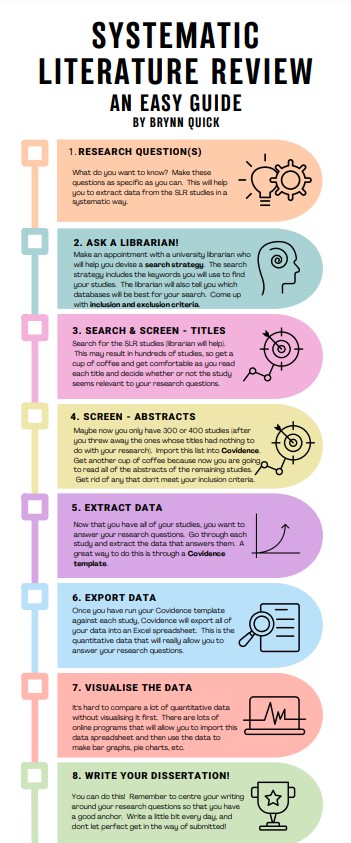 In early 2023, I was preparing to start my Master of Research programme at Macquarie University. I knew I wanted to investigate how language barriers are bridged in hospitals, but I didn’t know how to go about it. That was when my supervisor, Distinguished Professor Ingrid Piller, suggested that I conduct a systematic literature review (SLR). I had no idea what that was, but I love anything that is systematic and orderly, so I enthusiastically agreed to the idea. After all, how hard could it be to figure out how to do an SLR? Surely a Google search would tell me all I would need to know, right?
WRONG. It turns out that typing “what is a systematic literature review” into Google will only overwhelm a new researcher! I came across plenty of journal articles that claimed to be explaining what an SLR was (and how that somehow differed from another term I was learning – a scoping review), but for the life of me I could not find a clear-cut set of instructions. All of the information seemed to be pitched at a level far above the one I was operating at, and I began to feel frustrated that I could not find a source that was putting this methodology into terms that the average person could understand. But I knew I needed to figure it out, so over the course of the next few weeks I read what felt like dozens of explainers and guides.
Eventually, my reading and furious note-taking paid off, because by the end of 2023 I had successfully completed my research, entitled “How are language barriers bridged in hospitals?: a systematic review”. But in the process, I had spoken to so many academics who also voiced their frustration that they couldn’t find explanations on how to conduct an SLR in clear lay terms, and so I knew I hadn’t been alone.
Something I feel VERY passionate about is that, as academics, we must be able to talk to people outside of academia, and that means that we need to be able to communicate complex ideas in easily digestible ways. Higher knowledge shouldn’t be reserved for people who have weeks to teach themselves a new research methodology, and I wanted to be able to explain an SLR to everyone, not just other researchers.
And so, I created this “SLR: Easy Guide” explainer for anyone and everyone who would like to conduct an SLR but has no idea where to start. If that’s you, please feel free to use this resource – and know that you aren’t alone as an early researcher who is learning things for the first time. We’ve all got to start somewhere, and we can make it easier on others by sharing what we’ve figured out the hard way!
FAQs
What exactly is a systematic literature review (SLR)?
Ok, so you know how you need to do a literature review before you write a research paper? In that literature review, you are basically summarising what other researchers have said about your research topic so that you can show how your research is building on prior knowledge.
An SLR is different to that. An SLR is your research (your “experiment”, if you will). In an SLR, you read and analyse lots of different published journal articles in order to see patterns in already-published data. There’s an actual methodology that you have to use (which I detail in SLR: An Easy Guide) in order to select these journal articles.
I haven’t heard of an SLR, but I’ve heard of a meta-analysis. What’s the difference?
Literally nothing. They mean the same thing! Surprise! Academia is fun and not at all confusing.
I’ve also heard of a scoping review. Is that the same as a systematic literature review?
In this case, there actually is a difference, albeit a relatively small one. The methodology for both types of reviews will be the same (whew!), but the reason for conducting one versus the other will be a bit different. Let me give you an example based on my own research. When I began looking into how hospitals manage linguistic diversity between patients and staff, I knew that there was already a lot of literature out there about the subject (generally having to do with the work of professional interpreters). I had four very specific research questions that I wanted to answer based on that literature. This is why I conducted a systematic review – because I already knew that I would be able to find existing research that could answer my questions.
HOWEVER, you might not know how much literature already exists on a given topic. Maybe your topic is fairly niche, so you haven’t seen much about it in publications. This is where a scoping review comes in. In conducting a scoping review, you’ll find out exactly how much literature on the topic already exists. In doing so, you’ll be able to make an argument for why a particular area of research should be looked into more.
If this still sounds confusing (totally understandable!), be sure to talk to a fabulous university librarian. They are really good at knowing the difference between the two!
Is there any kind of SLR “authority” that I should know about?
There sure is! There is an organisation called PRISMA (which stands for Preferred Reporting Items for Systematic Reviews and Meta-Analyses). You can go to their website for two very crucial items that you will need for your SLR: a checklist and a flow chart.
The PRISMA checklist is great because it tells you exactly what you need to include in your SLR. The PRISMA flow chart is what you include in your SLR to show why/how you included and excluded studies during your screening process (which you can see in steps 3 and 4 of my SLR: An Easy Guide resource). But don’t worry, you don’t need to create the flow chart from scratch. If you use Covidence, the platform will create it for you. And speaking of Covidence…
This feels overwhelming! Is there one place I can go to manage all my SLR data easily?
Absolutely. I used Covidence, an online platform that essentially walks you through the SLR process. I would HIGHLY recommend using Covidence or a similar service to help you manage all your data in one place. Covidence will also automatically create your flow chart for you as you go through your screening process. What I especially liked about Covidence was that I was able to custom-create my data collection template based on my specific research questions. This made my data analysis much easier than it would have been without it!
What do I do if I’m still confused or feel like I don’t know how to do this?
Remember that every single one of us who goes on to do higher degree research feels like this. We don’t know what we don’t know! I’ve now completed two Masters degrees and am currently working on my PhD, and let me tell you, the learning curve is steep! But you know what? You can do it. Don’t be afraid to ask questions. Tell your supervisors and colleagues when you feel lost. Remind yourself that learning these research skills is just as important as the research itself. And when you get super stressed, grab a cup of coffee, stand in the sunshine and take a 10-minute break. You’ve got this!
Download and cite my free “SLR: An Easy Guide” resource
“SLR: An Easy Guide” is a free cheat sheet for your systematic literature review. You can download it here.
If you find it useful, please cite as:
Quick, B. (2024). Systematic Literature Review: An Easy Guide. Language on the Move. Retrieved from https://languageonthemove.com/systematic-literature-review-easy-guide
]]>The interview explores the Alliance’s origins, research themes, and future directions. The episode not only highlights the significant contributions of this dynamic research group but also provides a glimpse into the personal and professional journeys that have shaped this academic endeavor.
Enjoy the show!
This is early days for the Language on the Move Podcast, so please support us by subscribing to our channel on your podcast app of choice, leaving a 5-star review, and recommending the Language on the Move Podcast and our partner the New Books Network to your students, colleagues, and friends.
Further reading
Li, C., Shen, Q., Zhao, K., & Zheng, Y. (2022). The Shanghai alliance of multilingual researchers: Fudan University, Tongji University, Shanghai University of Finance and Economics, and Shanghai International Studies University, China. Language Teaching, 55(4), 583-587. https://doi.org/10.1017/S0261444821000379
Transcript
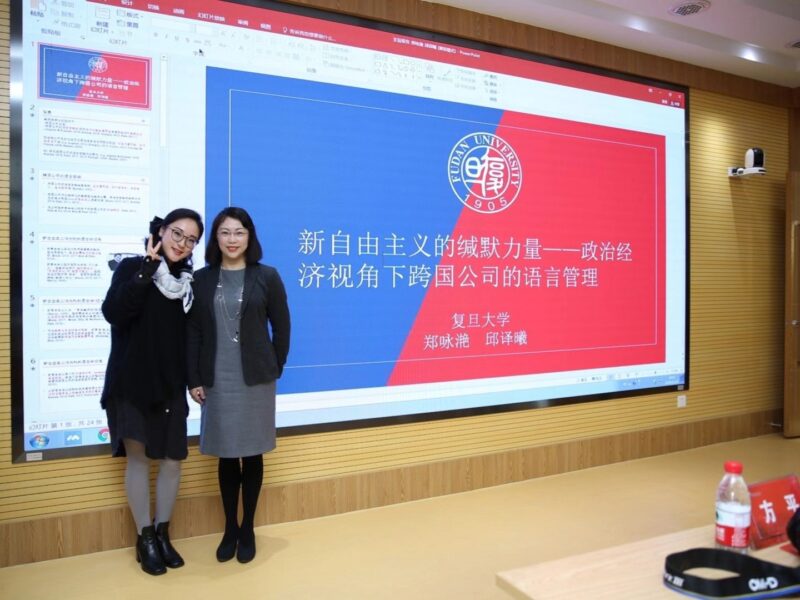
Yixi (Isabella) and Yongyan present about language management in global corporations
Welcome to the Language on the Move podcast, a channel on the New Books Network. My name is Yixi Qiu. You can call me Isabella.
I’m a PhD candidate in Applied Linguistics in Fudan University, Shanghai, China. I’m also a member of the Language on the Move team. My guest today is Professor Yongyan Zheng, a full professor at the College of Foreign Languages and Literature, Fudan University, Shanghai, China, where she teaches English academic writing and applied linguistics.
Her research interests include second language development, bilingual and multilingual education, and academic literacy practices. She is the editor-in-chief of Language, Culture, and Curriculum, and also the co-editor-in-chief of System. She is a leading scholar in the Shanghai Alliance of Multilingual Researchers. In today’s interview, we will focus on this Shanghai Alliance of Multilingual Researchers, talking about the motivations behind the Alliance, its key research themes, and some of the methodological innovations that the Alliance has pioneered. Welcome to the show, Professor Zheng.
Zheng: Thank you, Isabella, for having me today.
Bella: Could you please start us off by telling us a little bit about this Shanghai Alliance, its members, and its main focus?
Zheng: Yes. We are a group of scholars from four leading universities in Shanghai, especially the northeast part of Shanghai, including Fudan University, Tongji University, Shanghai University of Finance and Economics, and Shanghai International Studies University. We’ve been working together for over 15 years already, and our focus is on the role of multilingualism in China’s unique cultural and educational landscape. Now, our team includes about 10 core researchers, and we are also currently guiding around 30 master’s students, doctoral and postdoctoral researchers. Our work covers three main areas, multilingualism in language education, its influence in Chinese society, and the research methods we use to explore these topics.
Bella: Well, thank you very much for the introduction, Professor Zheng. Now, I’m quite curious about the origins of this Shanghai Alliance. What motivated you and other members to establish this group?
Zheng: The idea for the Alliance actually started from personal connections and shared interests among leading scholars. We are, me, of course, and then Professor Qi Shen from Tongji University, Professor Ziting Li from Shanghai International Studies University, and Professor Ke Zhao at Shanghai University of Finance and Economics. We actually are friends in our life, and Professor Li and Professor Zhao and I, we went to the same PhD program, and so our friendship goes way back. But then we work together, and especially our universities are quite close to each other, so we believe in knowledge construction, we share common interests in exploring multilingualism.
Then we say, why don’t we just start our own alliance? Well, there is a little story here. When we first started, we didn’t call ourselves Shanghai Alliance, but gradually, through our practice, we realized that we were doing something really significant. Originally, we wanted to call ourselves Wujiaochang Alliance, because Wujiaochang, namely the Pentagon Square, is where the four universities are located. But then we thought probably Shanghai Alliance, this name is easier to remember, and here we go.
Bella: Okay, thank you very much, and especially thank you very much for telling us the story behind this group. Could you please share the core philosophy behind Shanghai Alliance? How do you personally view its role and impact of this alliance?
Zheng: Yes, so as I mentioned before, we believe in collaboration, we believe in sharing our research, and particularly because we are doing multilingualism, we believe in the concept of researching multilingually.
So this approach was actually proposed by Professor Prue Holmes and her colleagues at Durham University UK, but then we believe that this approach is also suitable for our own research agenda. This approach encourages the use of multiple languages in the entire process of doing research, from idea generation, data analysis, interpretation, knowledge dissemination. So this approach enables us to orchestrate diverse linguistic and intellectual as well as cultural resources to cover a broader range of topics and break free from the constraints of single language research traditions.
Personally, I think this alliance is especially driven by the philosophy of researching multilingually as a transformative force in the field of applied linguistics, because it allows us to pull our resources together, our ideas, expertise, methodological repertoires together, not only to enhance our collective understanding of multilingualism, but more importantly, to impact how multilingualism is studied and understood in Chinese society.
Bella: Thank you very much for sharing the philosophy behind this group, and researching multilingually is indeed impressive, as it emphasizes the process rather than just the outcome, and emphasizing the cooperation and the growth that can be the most rewarding aspects of studying multilingualism. I have the personal experience in that aspect as well.
And as we discuss how multilingualism is studied and understood in society, you mentioned earlier three main areas of focus within the alliance, and could you please introduce about the multilingualism in education, how do you approach multilingualism in language education in your alliance? Y
Zheng: Yes, of course. The main concern or the very first impetus for me to put my emphasis on multilingualism in language education was the realization that there was too much emphasis on English, despite the fact that I was an English professor. So, our work in this area wants to look at language in education planning at a macro as well as the meso level, and we also want to explore the lived experiences of multilingual teachers and learners at different levels.
For instance, I had the opportunity to collaborate with Professor Andy Gao from the University of New South Wales, and we together co-guest edited a special issue entitled Multilingualism and Higher Education in Greater China, for the Journal of Multilingual and Multicultural Development back in 2019. This special issue was very well received by the readers, and some of the articles were still highly cited even until today. So, then our interest actually expanded to not only the lived experiences of students, but also to the meso level language planning.
Researchers such as Dr Xiuwen Chen, Professor Ke Zhao, and Dr Jian Tao from the Shanghai University of Finance and Economics have conducted a series of studies in the context of China’s national initiative to diversify foreign language education. Me, myself, and also my PhD students have also explored how an elective Arabic program was successfully implemented at Fudan University. So, these initiatives have some social impact on the learning experiences of our students as well.
Another focus is teacher development, because we believe that teacher development or teacher in-service training is also a critical component of our multilingual education planning. So, researchers in our alliance have launched various projects aimed at supporting multilingual teachers’ development, particularly in response to the huge pressure of the university research assessment system.
Bella: Thank you so much for the detailed introduction to the first theme. Let’s move forward then. I think we are particularly curious about the next focus area. I think it’s the multilingualism in Chinese society. How does this alliance explore the complexities of multilingualism in China?
Zheng: The second theme is related to another strand, language policy and planning and the sociolinguistics or let’s say the sociology of language that we have been focusing on. This strand is particularly featured by Professor Qi Shen and his team at Tongji University. They have been very productive in this area, particularly through their work over the past five years.
Back in 2019, Professor Shen and Professor Andy Gao also guest-edited a special issue entitled Multilingualism and Policymaking in Greater China, Ideological and Implementation Spaces for the Journal Language Policy. This special issue was also highly cited. So, they explored the notion of resource orientation and then they want to see how this notion allows various stakeholders to negotiate language policies which could help preserve linguistic diversity within China’s tradition of linguistic unity.
Bella: Yes, that sounds like a critical exploration of policy that could actually shape the future language policy and planning in significant ways.
Zheng: Yes, right. We hope so. And at the micro level, our research explores family language planning. We’ve looked at ethnic male families in southwest China, ethnic Korean migrant families in Shanghai, urban families of varying socioeconomic statuses. So, our studies highlight the intricate interplay of family dynamics, socioeconomic factors, language practices and identity against the backdrop of China’s modernization, urbanization and globalization.
And currently, we’re also examining Chinese transnational families in the USA, in Latin America as well as Arabic families doing business in China. We want to explore topics including heritage language maintenance, adolescence bilingual identity construction, parental agency as well as language ideologies. We believe that these topics are highly insignificant for us to understand the linguistic diversity and how people from different linguistic and cultural backgrounds can equally participate in social affairs.
Bella: Yeah, indeed. And it’s really fascinating to see such a wide range of research areas that you mentioned. And then how about the third strand? The third strand is about multilingualism in the workplace.
Zheng: We are studying how multinational corporations in China manage language policies and practices. For instance, Professor Ke Zhao and her team at the Shanghai University of Finance and Economics have analyzed a Spanish bank’s language management in Shanghai, the complex language dynamics in foreign banks against the changing context of foreign direct investment. And they also explored corporate language capacity at a German IT multinational company in Shanghai.
So, they emphasized the crucial role of middle-level management in designing and implementing language-related activities to support the goal of developing corporate language competence. I believe this strand is also related to the focus, the economic and financial focus of Shanghai University of Finance and Economics. And nowadays, Professor Ke Zhao and her team are also focusing on the language or the corporate language capacity building of Chinese corporations which want to go overseas. So, I believe that this is an interesting, under-explored area in social linguistics.
Bella: Wow, thank you for outlining how the second theme is approached in the alliance, with each member bringing their unique focus. Given the innovative approaches you’ve mentioned, our audience might be eager to learn more about the research methodologies utilized by the alliance. Could you elaborate on some of these methodological innovations used in this alliance?
Zheng: Yes, we believe that methodological innovations are indispensable for pushing the boundaries of theoretical development. So, guided by this kind of spirit, our group places a strong emphasis on pioneering qualitative research methods. For instance, my colleagues and I are the first batch of Chinese researchers who use the Q methodology in applied linguistics.
This method has proven useful in offering a systematic and a comprehensive exploration of subjectivity. So, we have already published a lot on Q methodology. For example, on a modern language journal, language teaching research, and also a journal of multilingual and multicultural development.
If you’re interested, you’re very welcome to check our publications on those journals. Additionally, we explore the use of social network analysis. For example, Professor Ziting Li from Shanghai International Studies University combines this social network analysis with ethnographic methods to study the pragmatic choices of international students in China.
Currently, Li and her team are applying different social network analysis techniques in their projects. One focuses on how multilingual STEM doctoral students from Africa and South America construct their personal networks to support their academic endeavors in China. And the other project examines the interaction between various types of support and personal network development in enhancing Chinese language teachers’ professional capacities.
Bella: I’m truly impressed by the theoretical and especially methodological advancements achieved by the alliance. And building on this, could you please explain how this alliance, this Shanghai alliance, promotes and shares its research and findings both within the academic community and with the wider public?
Zheng: The alliance is committed to advancing research methods on multilingualism among Chinese researchers. And equally important, we are committed to training early career researchers who are interested in doing multilingual research in Chinese contexts.
So we have already hosted eight language studies forums for emerging scholars since 2015. The most recent forum focused on English medium instruction in emerging contexts and attracted around 2,000 participants online. We have also invited distinguished scholars like Professor Li Wei from UCL, Professor Zhu Hua from UCL to conduct workshops on multilingualism and academic writing.
These events were offered mostly free to Chinese researchers. And we have also three social media accounts that share research insights and they have already gathered more than 20,000 subscribers. The upcoming forum, we call it the language studies forum for emerging scholars, the upcoming one will be held in early July.
That will be the ninth forum in a row. We hold this kind of forum every year. So this year’s topic is linguistic landscape and multilingual education. We believe that this would also be a very interesting topic to explore in the Chinese higher education as well as basic education contexts.
Bella: Thank you very much and thank you for sharing the information on the upcoming event, especially the July activity. And I’m very much looking forward to participating in this productive event. And before we wrap up, could you please tell us what’s next for the Alliance? Where is this amazing community headed?
Zheng: Yes, absolutely. We will continue to focus on three main research themes and further innovate our methodological approaches. For example, we are currently enhancing our use of social networks as both a theoretical framework and an analytical tool to investigate the various aspects of multilingualism.
Our team is also advancing the use of other innovative methods like qualitative comparative analysis, QCA, and more data-driven natural language processing techniques to study language policy and planning. These techniques are crucial as we explore patterns in language and education planning and language management across educational institutions and transnational families.
Bella: Thank you. I love those ideas. It’s absolutely amazing to see the techniques expanding and developing. Thank you very much, Professor Yongyan Zheng, for speaking with us today. We really appreciate it. And thanks for listening, everyone. If you enjoyed the show, please subscribe to our channel, leave a five-star review on your podcast app of choice, and recommend the Language on the Move podcast and our partner, the New Books Network, to your students, colleagues, and friends.
Till next time.
]]>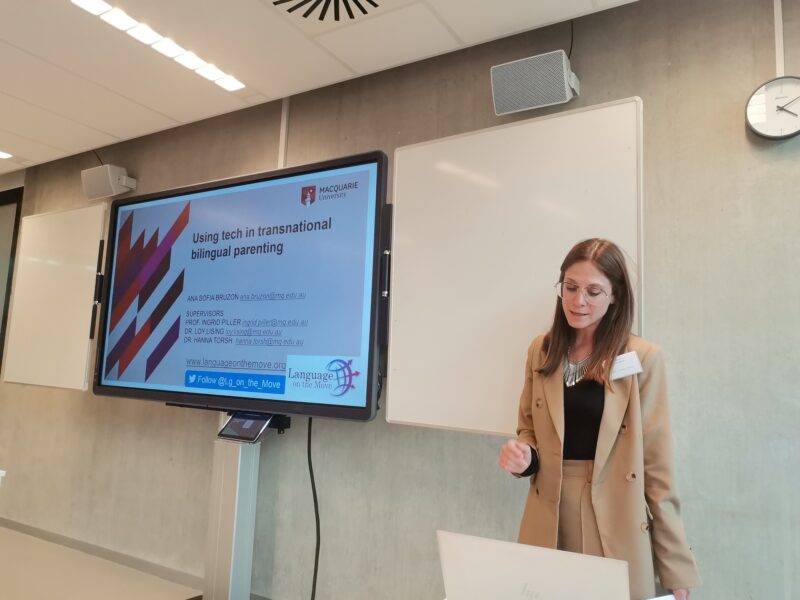
Ana Bruzon presenting her PhD research at ECREA conference in Rotterdam
As a third-year PhD candidate in the Linguistics Department at Macquarie University, Sydney, Australia, I recently had the awe-inspiring opportunity to travel to Europe as a visiting researcher at Hamburg University. I presented my research at two international conferences and delivered a seminar. Here, I reflect on a fantastic professional development experience that has enriched my PhD studies and will undoubtedly shape me as an early career researcher.
The Postgraduate Research Fund opportunity at Macquarie University
Higher Degree Research (HDR) students at Macquarie University can apply for an internal grant, the Postgraduate Research Fund (PGRF). PGRF is a generous and competitive award aimed at teaching HDR students grant writing skills whilst allowing us to build an international platform to disseminate our research and promote academic collaboration.
In my application, I had to explain how my planned research visit would enhance my doctoral thesis and align with the University’s strategic objectives. One of Macquarie’s objectives is “to prepare world-ready HDR candidates”. The concept of being ‘world-ready’ deeply resonates with me, and I believe that the best way to embody a world-ready HDR candidate is through connection and collaboration.
Therefore, my goal was to become an internationalised researcher, as Macquarie University envisions for its graduate students, by learning from and with colleagues in Europe. When my grant application was successful, I sought every opportunity to provide an international platform for my research and make new connections for future collaborations. My journey offered me a wealth of opportunities to achiveve that goal.
Conference attendance
The first stop on my journey was Rotterdam in the Netherlands, where I attended the conference of the European Communication Research and Education Association (ECREA). The conference topic was ‘Transnational families and media practices: methods, ethics and critical approaches’. At this interdisciplinary conference with attendees from around the globe, I presented the results of my study about ‘Using technology in transnational bilingual parenting’ in a dedicated PhD workshop and during the main conference. In Rotterdam, I connected with fellow PhD students from different corners of the world and met senior academics who contributed to my critical thinking about ethnographic work.
One of the conference highlights was the opportunity to learn from Dr Tanya Ahlin, a lecturer at the Amsterdam Institute of Social Science, who shared her vision as an anthropologist about ethical challenges when studying transnational families and presented her new book, ‘Calling Family: Digital Technologies and the Making of Transnational Care Collectives’.
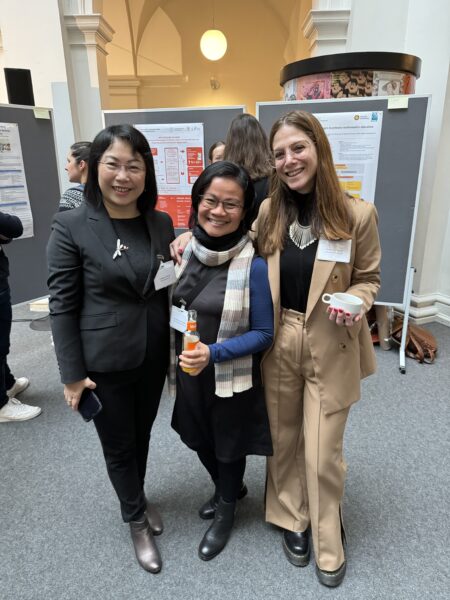
Ana Bruzon (r) with Next Generation Literacies colleagues Professor Yongyan Zheng (Fudan U, Shanghai) and Dr Pia Tenedero (U of Santo Tomas, Manila) in Hamburg
Visiting network partners
From Rotterdam I travelled to Hamburg in Germany, where I had the privilege to be a visiting researcher at Hamburg University as a guest of world-renowned Professor Dr. Dr. h.c. mult. Ingrid Gogolin. During my stay in Hamburg, I also had the pleasure of representing Macquarie at the Next Generation Literacies (NGL) Network Conference. The NGL network promotes international collaboration in the field of literacy and multilingualism and is a program jointly organised by Fudan, Macquarie, and Hamburg universities.
As Language on the Move readers will know, the theme of the NGL network conference was ‘Social Participation in Linguistically Diverse Societies.’ The exciting program showcased global research on multilingualism and social participation in diverse settings. For me, one of the highlights of the conference was the keynote speech by Professor Piller, where she beautifully explained the legacies of the NGL network.
Also, I had the honour of presenting my study on the same panel as my associate supervisor, Dr Hanna Torsh, who shared her study ‘Ten years on Revisiting family language policy’. Another high point was Associate Professor Tenedero’s reflections on being a network member and how the mentorship program shaped her as an early career researcher. In her reflections at the end of the two-day conference, she proposed the metaphor of research-water. Tenedero clearly explained that ‘water, like research, can look and taste different depending on where I am, who I do it with, and what my purpose is. But, the purpose is always to serve life’. Personally, I also parted this conference and closed my time in Hamburg full of renewed life and new refreshing ideas for the last stretch of my PhD journey.
Seminar presentation
The last stop on my itinerary was London, where I had the privilege of conducting a seminar at the Centre for Applied Linguistics in UCL hosted by Associate Professor Perez-Milans. In this seminar, I had another opportunity to share my findings with an engaged audience and to receive valuable feedback. In London, I also continued to make connections as a Macquarie representative and think about the next steps of my career as a novice researcher.
Building lasting academic connections
For me, the PGRF experience meant building academic relationships that will surely last a lifetime. Being part of Macquarie University, the Language on the Move team, and the Next Generation Literacies network opened the doors to travel to Europe, connect, and build bridges for prospective international collaborations, that is to be ‘world-ready’ and better prepared for the future. As I reflect on how to be successful in academia, one needs to acknowledge that it is always part of something larger and that collaboration forms the foundation for a solid academic career. My PGRF journey has filled me with incredible memories and lessons about connection and collaboration that will accompany me for the remainder of my journey as a PhD student and into my postdoctoral career beyond.
]]>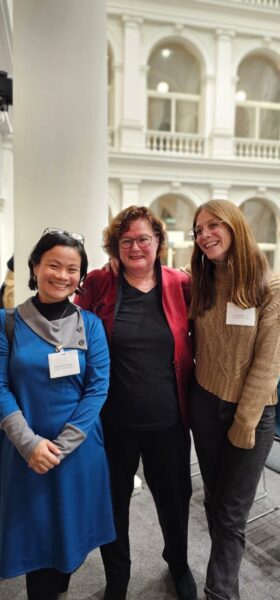
Dr Pia Tenedero, Prof Ingrid Gogolin, and Ana Bruzon (ltr.) during the NGL network conference
“Do not ask for free drinking water in Germany!”
This was a travel tip I received from a friend who had recently returned to Manila from Europe. As a first-time traveler to this continent, I was easily impressed by lessons learned by those who had been there before. So, where and how to get enough water to drink was part of my anxiety coming to Hamburg to attend the Next Generation Literacies Network Conference on January 11 to 12, 2024.
Held at the University of Hamburg, the Next Generation Literacies Network Conference was attended by network members from the three partner institutions – Universität Hamburg, Macquarie University, and Fudan University, as well as scholars from other places.
Representing the University of Santo Tomas, Manila, I was one of three delegates from the Philippines. Aimee Joy Bautista (an offshore accountant who participated in my research about language practice and ideology in this work world of numbers) posted about her unique NGL conference experience here. I was also happy to meet another kababayan (co-national), Dan Henry Gonzales from Ateneo de Manila University, who spoke about practices of monolingual English bias in Laguna-based schools.
The nearly 100 attendees in the 2-day conference shared their research related to linguistic diversity, multilingualism, and multiliteracies in diverse settings across the continents of America, Asia, Australia, and Europe. The sharing of discoveries and dreams concluded with a reflection session starting with Ingrid Piller’s reflections about the legacies of Next Generation Literacies Network, which she accurately described as a network of networks.
“Loud” and “quiet” water
In my reflection as a network member, I told the story of how my views of research have evolved over the years since I joined Next Generation Literacies Network. Revisiting the metaphors I mentioned in my presentations during Next Generation Literacies Network events from 2021 to 2023, I recognized with gratitude how the Next Generation Literacies Network research seminars, the mentoring program, and the generously collaborative spirit of the members have helped me grow as an early career researcher.
I pondered on how my views of research have evolved from a journey and a game, to a resource and a voice, to open doors—images of access.
To conclude, I proposed a final metaphor for research—water.
Like the research we dedicate our lives to, water should be accessible.
Thankfully, this was my experience of water in Hamburg, despite my early worries about not having easy access to das Trinkwasser in Europe. Not only was I relieved to find that water was, in fact, abundantly available during the Conference, but I was also impressed to even have the option to have water that is leise (still) or laut (sparkling).
Amazed and happy to have my anxieties proved false and unnecessary, I was reminded in this life-giving conference that water, like research, can look and taste different depending on where I am, who I do it with, and what my purpose is. But, the purpose is always to serve life.
]]>Brynn’s research examines what happens when people go to a hospital but don’t speak the dominant language (well). How do these linguistic minority patients communicate their health concerns, and how do hospital staff help them if a language barrier exists? What kinds of multilingual communication strategies and tools exist in hospitals? How do hospital staff even know if a patient needs a multilingual communication strategy?
Watch the award-winning entry here and find the script below.
Curing Confusion: How do hospitals communicate multilingually? Brynn Quick’s 3MT script
Have you ever been a patient in a hospital? If you have, do you remember feeling confused or scared? Imagine having to navigate that process……. in another language. What if you were hospitalised and you couldn’t understand what your healthcare providers were saying to you? What would you want the hospital to do to make sure that you received the same quality of care as the patients who could understand the language?
My research looks at the ways in which hospitals facilitate communication when there is a language barrier between linguistic minority patients and the hospital’s healthcare providers. Since I can’t call every hospital and ask how they manage linguistic diversity, I’ve done the next best thing – a systematic literature review. This means that I developed a very specific search strategy to find academic papers from the last 5 years that would answer my questions about this topic. First, I wanted to know what communication tools and strategies are currently in use in hospitals. And second, I wanted to find out how a hospitalised patient is identified as needing a multilingual communication strategy. After a rigorous screening process, I landed on 50 studies that would help me find the answers to these questions. So, I got to reading, and found an answer that I wasn’t expecting.
Here’s what I found. Human interpreters are really important to bridging language barriers between hospitals and linguistic minority patients. Professional medical interpreters are considered the gold standard, and even though it’s 2023, translation apps and AI are not yet reliable methods of conveying the complexities of medical concepts and emotions that interpreters can. But here’s the catch – healthcare providers are hesitant to actually use an interpreter if they feel that the process of organising for one will take a long time, OR if they feel that the interpretation itself will be time-consuming.
But how do these healthcare providers even know that a patient needs an interpreter? The answer to that question is what surprised me most – in almost half of the studies I looked at, this wasn’t even addressed. But! Of the studies that did, the majority pointed to hospital admission staff as the people who were responsible for finding out if a patient needed an interpreter. In most of the studies, this is where the responsibility seemed to end, though. Admission staff noted the need for an interpreter in the linguistic minority patient’s record, but then whose responsibility was it to actually organise the language service? The answer to that question was much less clear.
So what does my study tell us? Hospital admission staff with language needs training may be an untapped resource when trying to ensure that all hospital patients have equal access to information and care. Healthcare providers may be more inclined to utilise interpreters if they know that there is a dedicated team of people who are trained to identify a patient’s language need, book a language service, and follow up to make sure the patient is receiving that service. My research is important because it is identifying areas for health communication improvement – and ensuring equal communication access means ensuring a healthier community for us all.
]]>