
Last year, I wrote here on Language on the Move about Members of Parliament (MPs) across Australia making linguistic diversity visible. My research amplifies the increasing numbers of elected representatives who are Indigenous, as well as those who are not, who have been using their parliamentary platform to speak various Aboriginal and Torres Strait Islander languages.
I’ve just published a peer-reviewed ‘sequel’ to that research in the UNSW Law Journal. It’s an open access article all about the permission regimes that apply to the use of Aboriginal and Torres Strait Islander languages in parliaments across Australia.
There are six State parliaments, two Territory parliaments and a Commonwealth (national) Parliament in Australia. None of them ban languages other than English, and none of them explicitly require that parliamentary debates (or ceremonies) be in English. There are general rules against inappropriate or ‘unparliamentary’ language use in most of them, but the way those rules are applied to Aboriginal and Torres Strait Islander language use actually varies by jurisdiction.
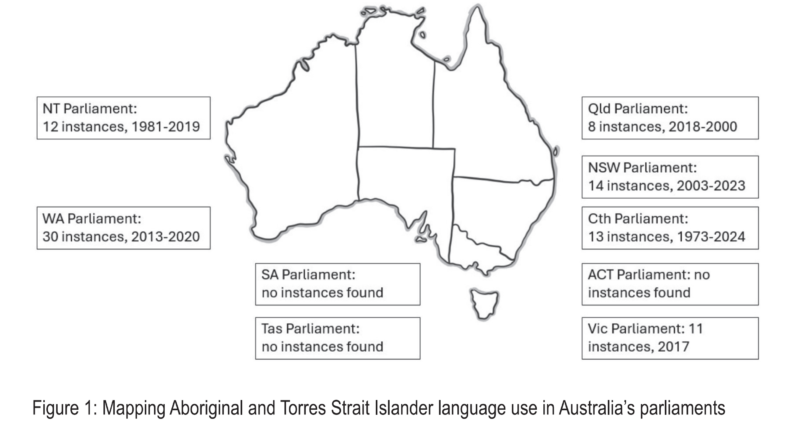
Summary of language use (Source: Grey, 2026, p. 501)
For instance, the West Australian Parliament uses procedural rules (called Standing Orders) about unparliamentary language to require MPs seek leave before using Aboriginal languages. By contrast, many other jurisdictions including the Commonwealth, New South Wales, Victoria and Queensland, never use their similar rules to impose a permission regime onto Aboriginal or Torres Strait Islander language use. New South Wales now even goes so far as the have rules that proactively allow Aboriginal language use in a ceremonial ‘language stick ceremony’ (although not in parliamentary debate).
A close up – the Northern Territory
Overall, bigger numbers of First Nations (Aboriginal and Torres Strait Islander) people are found in the more populated States of Australia, like New South Wales and Queensland, but the Northern Territory is the place with the highest proportion of First Nations residents: about 30% of the Territory population. And the Northern Territory Parliament is a microcosm of the regulatory variability. That Parliament has taken unregulated, restrictive, permissive and proactive approaches at different times over the last few decades.
When the Hon. Mr Neil Bell spoke in Pitjantjatjarra in his first speech in the Northern Territory Parliament in 1981, no leave was required, nor was it required when the Hon. Ms Alison Anderson spoke Western Desert Language in 2008. But when The Hon. Mrs Bess Nangarryi Price tried to use Warlpiri in 2015, she was stopped by the Speaker of the House (the MP who regulates debate) and warned she would be ruled disorderly if she continued. Mrs Price demanded that the Speaker name the rule she was breaking, and like her, I can’t find one. The absence of a rule is why Order 23A was then introduced in 2016 to provide the Speaker with clear authority: an Aboriginal language could now be used only with notice and only if the MP provided an English translation in advance. This new Order 23A is the most likely basis for the Speaker cutting off the Hon. Mr Yiŋiya Mark Guyula’s first speech when he began talking in Yolŋu Matha in 2016, but the record doesn’t give the reason.
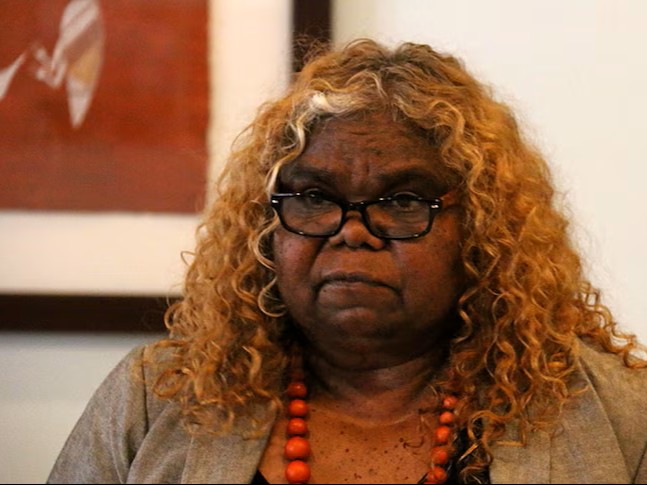
Minister Bess Nungarrayi Price was stopped from interjecting in Walpiri in the NT parliament in 2016 (Image credit: ABC News, Steven Schubert)
And even in the NT, the demand has softened since 2016. Advocates against the rule pointed out that Order 23A ‘restrains rather than accommodates linguistic inclusion’. In 2019, Order23A was replaced by a rule that ‘[M]embers seeking leave to speak in languages other than English must provide the Speaker with adequate notice for the Speaker to make any arrangements to provide assistance so that the member may be understood and that the Parliamentary Record may accurately report the contribution if leave of the Assembly to speak in the other language is granted.’
This rule is kind of proactive because the assistance mentioned is publicly-funded interpreting, which is not provided in any other parliament, but it’s also still a barrier to ad hoc language use in debate. According to my research, the MPs using Aboriginal languages in the Northern Territory Parliament can (and do) generally provide their own English interpretation off-the-cuff. It’s not clear that this rule requiring advanced notice is needed to enhance anyone’s understanding.
In fact, across Australia, whenever more than a few words of an Aboriginal or Torres Strait Islander language are used in a parliament, I have found that the person talking generally provides an interpretation or explanation within their own speech. In some cases, they also provide a written English translation to the Hansard transcription staff. This common practice is clear in the Hansard data. It’s only in the Northern Territory that this has come to be a regulatory demand.
Permission from language custodians
The other permission regime that appears very occasionally in the Hansard records, and sometimes in contemporaneous media reports of Aboriginal language use in a parliament, is the permission of language custodians. I am certainly not the first person to mention that a custodial relationship to language may be embedded in both Indigenous traditions and the power imbalance at the core of Australia’s colonisation. In this sense, I’m not inventing anything or proposing a new language right. What I suggest in the article, however, is that MPs should find out whether seeking permission from language custodians would be appropriate for their use of an Aboriginal or Torres Strait Islander language and, if it is, to mention that on the parliamentary record.
This would make the specific epistemology of each language more obvious, in addition to the parliamentary speech drawing attention to the words of a language. In making this suggestion, I’m drawing on Ingrid Piller’s point that in Australia we have a ‘moral imperative to acknowledge the linguistic and cultural relativity of our views’ (Intercultural Communication, 2025). Not all cultures treat access to a language in the same way that mainstream users of Australian English treat access to English, and nor should they.
Recognizing and valuing Indigenous languages
In 2012, the Commonwealth Parliament received a recommendation in one of its own committees’ report, Our Land Our Languages, that it ‘demonstrate leadership in the recognition and valuing of Indigenous languages by: considering how to incorporate Indigenous languages in the Parliament House building and in the operations of the Parliament’.
In a talk I recently delivered as part of the University of Sydney’s Linguistic Seminar Series, I summed up my own suggestions on how to incorporate these languages not only in the Commonwealth Parliament but across Australia’s parliaments:
- The NT Parliament remove the Continuing Order requirements to give advanced notice before using Aboriginal languages.
- Parliaments formally clarify that using Aboriginal and Torres Strait Islander languages is not contrary to Standing Orders against unparliamentary language, especially in WA.
- Hansard recording staff transcribe Aboriginal and Torres Strait Islander languages whenever they are used (as is increasingly being done).
- MPs inquire into and talk about any relevant sociocultural permissions on the parliamentary record when they use Aboriginal and Torres Strait Islander languages (especially non-Indigenous MPs).
- Parliaments adopt NSW’s message stick protocol or similar in order to proactively invite language use.
Contribute to my ongoing research on multilingualism in Australia’s parliaments
I am still conducting research interviews about peoples’ experiences practicing multilingualism in Australia’s parliaments. If you have used an Aboriginal or Torres Strait Islander language in a parliament, please get in touch to share your story.
References
Grey, A. (2026). Permission to speak: Who controls Aboriginal and Torres Strait Islander language use in Australia’s Parliaments? The University of New South Wales Law Journal, 49(2), 489–523.
Piller, I. (2025). Intercultural Communication: A Critical Introduction (3rd ed.). Edinburgh University Press.



 This work is licensed under a