
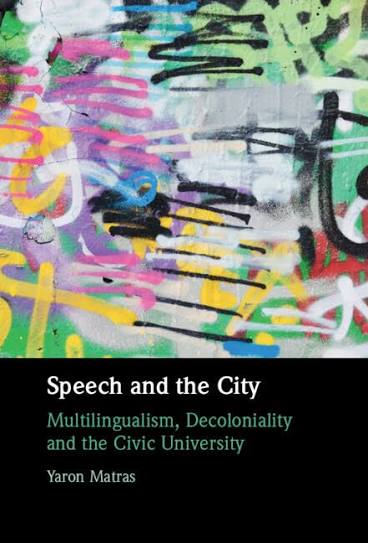
In this episode of the Language on the Move Podcast, Ingrid Piller speaks with Yaron Matras about his new book Speech and the City.
In this timely book, Yaron shows that cities can provide an important counter-weight to political polarisation by forging civic identities that embrace diversity. The book traces the emergence of a city language narrative that embraces and celebrates multilingualism and helps forge a civic identity. He critiques linguaphobic discourses at a national level that regard multilingualism as deficient citizenship. Drawing on his research in Manchester, he examines the ‘multilingual utopia’, looking at multilingual spaces across sectors in the city that support access, heritage, skills and celebration. The book explores the tensions between decolonial approaches that inspire activism for social justice and equality, and the neoliberal enterprise that appropriates diversity for reputational and profitability purposes, prompting critical reflection on calls for civic university engagement.
Beyond telling the story of the Multilingual Manchester project, the book also offers an intriguing glimpse into the author’s distinguished career as a linguist, scholar, and activist.
If you enjoy the show, support us by subscribing to the Language on the Move Podcast on your podcast app of choice, leaving a 5-star review, and recommending the Language on the Move Podcast and our partner the New Books Network to your students, colleagues, and friends.
Reference
Matras, Y. (2024). Speech and the City: Multilingualism, Decoloniality and the Civic University. Cambridge University Press.
Transcript
INGRID: Welcome to the Language on the Move podcast, a channel on the New Books Network. My name is Ingrid Piller and my guest today is Professor Yaron Matras. Yaron was Professor of Linguistics at the University of Manchester until 2020 and now holds visiting and honorary positions at the Aston Institute for Forensic Linguistics in Birmingham in the UK, at the University of Haifa in Israel and the University of Hamburg in Germany. Yaron is an expert in contact linguistics and bilingualism, language documentation, Romani linguistics, Arabic dialectology, discourse pragmatics, language policy, urban multilingualism and the linguistics of Kurdish, Hebrew, and Turkish. He’s probably best known for initiating the Multilingual Manchester Project and being the driving force behind LinguaSnapp, the world’s first app designed to crowdsource linguistic landscape data. Today, we want to talk about Yaron’s new book, Speech and the City, Multilingualism, Decoloniality and the Civic University, published by Cambridge University Press in 2024.
Welcome to the show, Yaron!
YARON: Thank you for having me.
INGRID: Speech and the City is a hopeful, almost utopian book that contrasts urban multilingualism with national monolingualism. In the process, the book explores the tensions between decolonial approaches that inspire activism for social justice and equality and, on the other hand, the neoliberal enterprise that appropriates diversity for reputational and profitability purposes. The book is an important intervention in the debate how to protect cultural pluralism in contemporary society. It focuses on the UK, but is obviously relevant around the world. So, Yaron, you start the book with the multilingual biography of your family, starting with your own great-grandmother who arrived in Manchester in 1899 from Skalat, a town that I discovered is today located in Ukraine, but back then in Austrian Galicia. Can you maybe start us off by telling us about your own multilingual story?
YARON: Yes. Well, the fact that my great-grandparents met and married and had their first children in Manchester and that I ended up working in Manchester at the university and researching the city’s multilingualism and then writing about that research in this book, that’s a coincidence. There was no direct continuity. We lost our great-grandparents in the Holocaust. They didn’t survive. Some of their children survived, and that’s how I’m here. But I grew up in Israel, in Jerusalem, which is a multilingual city, and with support and encouragement of my family, my parents, close friends, we always embraced the multicultural aspects of Jerusalem.
And as everybody knows, Jerusalem can be a very tense and contradictory place, but it can also be a place where people celebrate the diversity. That does exist, even if it doesn’t reach the headlines every day.
And we were such a family. My parents had links with different communities and families. It was even just obvious in the neighborhoods. Our teachers, every teacher, had a different home language. They all spoke Hebrew with an accent. So we grew up in a creolization kind of situation. The language was a formal language, obviously, for a century, for millennia, it had been a written language. And yet, most of our teachers spoke it as a second language, and we made fun of their accents, which means that we didn’t have any kind of guiding norms, or some we did, but not on the everyday vernacular side of the language.
INGRID: So you were the first native generation?
YARON: No, my mother was really the first native speaker. My mother grew up sort of monolingually, actively, but obviously everybody had languages. So between my four grandparents, and I was lucky to know all of them, all four, they had three different home languages between them, and that was not the exception. And those languages influenced, of course, the way we spoke Hebrew, because we had all sorts of phrases and words and terminology for domestic things and emotional things embedded into our language. And that meant that every family spoke a sort of family dialect, because every family had a different combination of grandparents and words and phrases that they incorporated. So already there were several, several languages in the family. And I grew up with English and Hebrew, just even with my parents, but then, like I said, with the other grandparents’ languages, there was Yiddish, there was German, there was Russian, and many languages in the environment.
As a teenager, I was very strongly involved in Israeli, Jewish, and Palestinian Arabic, Arab peace and dialogue initiatives. And I picked up Arabic. We had Arabic as a school subject. Everybody had Arabic at school, so we learned to read and write Arabic. But because of the social distance and de facto social segregation, very few people had contact. And so people across the divide, as it were, the cultural divide, national, ethnic divide. And so none of my classmates could speak Arabic. I ventured and through these initiatives had Palestinian friends at the age of 15, 16. And at that age, I was already fluent in Palestinian Arabic. And I still pass as native or native-like sometimes. And I very much believed that I was the only, the first person of my generation.
In the meantime, the next generation, my nieces and nephews also grew up in a similar environment and also speak Arabic, like near-native. But in my generation, it’s very much the exception. There are, of course, people of my generation who learned Arabic later on in life, professionally or for various reasons, but not as a teenager. And that’s, I mean, at the time, I knew that it was an exception, but it still seemed natural to me. So there was the interest of building bridges tightly embedded with the interest in language and figuring out language and immersing myself.
I spent part of my childhood in Canada. So we were there for a couple of years. And that was the time in the 1970s where there was in Quebec going on what they refer to as la Révolution Tranquille in Canadian French and this whole kind of French language movement. And we were right across the border. We were in Ottawa on the border between Ontario and Quebec. And I used to kind of ride my bicycle across the bridges and and spent time trying to pick up Canadian French. And I was also unique. I was in an Anglophone school, but one of the only ones who could speak actually Canadian French at the time. But I was also very much inspired by this French language movement. It had many flaws on the political side, but just on the language policy side, I very much identified with it.
And sort of there was a repeat of that when I then came to to Europe to study in Germany first. And I learned other languages through immersion. I developed an interest in Turkish and Kurdish. And then I met Romani people when I moved to Hamburg for my MA and PhD, and became probably the first or only person, a non-Romani person in Western Europe at the time to learn Romani fluently at the age of around 25 or so, which later became one of my main subjects of research interests. And that was, you know, later on, around the time of the political transition in Eastern Europe. And of course, the whole world, the Romani world opened up to us. And that was a fascinating time. That was in the context of Romani civil rights movement that I kind of accompanied and supported and engaged with a little bit. So I think there’s a motive there on the one hand of, you know, absorbing the multilingualism as a day-to-day reality from the family and the neighborhood and everything, but also taking the initiative to learn languages with a very, very conscious vision of using language to build bridges and inspire others to do that. And I think that remained with me for the whole of my academic career.
INGRID: Yeah, it’s such an amazing and inspiring multilingual story. So for sure, no one could accuse you of linguaphobia, the fear of languages, yet that’s exactly the title of the first chapter in your book. And you identify Brexit as simultaneously a product and a starting point of linguaphobia. So maybe could you start off getting into the book by telling us a bit how Brexit became the launching pad for your research that’s covered in the book, in Speech and the City?
YARON: Well, it wasn’t really the launching pad of the research. It’s the step into the story in the book itself. And it’s the story that is situated around Brexit. I became interested in urban multilingualism almost a decade earlier in Manchester after doing other things and research but starting to discover the city. And I already had contacts with communities and was using languages in those contexts. But the Brexit referendum in 2016 and the public debates that accompanied it put a spotlight on issues that I’d been interested in all my life because the debates around Brexit were questioning multiculturalism and by implication and sometimes head-on multilingualism as well.
And that’s why I see linguaphobia as inherently connected to the Brexit debate.
Not everybody sees that. People see other things but the evidence is there and I presented in the book. There are many, many statements by leading Brexiteers – the politicians who promoted leaving the EU – saying, well, at the end of the day it’s not really about money; it’s not really about resources; it’s about people feeling uncomfortable when there are people living next door who speak English with an accent.
There were attacks, you know. People were during that time attacked on the streets, violently, for speaking in another language or speaking even with an accent.
Now, at the time it also struck me how academic institutions were acting in almost complete compliance with the expectations of policy makers at national level. The pro-Brexit campaign was all around fear of foreigners. Language was presented as a key tangible feature of the impact of immigration. But those who favored remaining in the EU, I think, failed to challenge that head-on. Universities were not, as you might have expected, hotspots to promote multiculturalism. Instead they by and large remained passive during the debates and once the decision was taken to leave the EU, we saw many academics – and I have a big j’accuse here. So I really you know was very unhappy and still am very frustrated with the way the modern languages community as a whole in Britain really tried to appease policy makers. Of course, the study of languages had been in crisis for quite some time, declining numbers and in the neoliberal system, of course, when numbers of enrollment decline resources decline, because they’re linked. And they really tried to revive the study of languages by appealing to the policy makers; and to the policy narrative of the day, which was the Brexit narrative. Saying, “Well, now we need languages. Now that we’re out of the EU, we need languages for security and diplomacy and trade.” In other words adjusted to the Brexit narrative the argument for studying languages became “we need languages to help protect us from others and we need languages to successfully compete with our competitors.”
The narrative of the day and the narrative that won and that’s still the dominant narrative in UK higher education is “languages are justifiable as a subject as a foreign policy instrument” and ultimately it was those debates that prompted me to leave my university position. And so the book focuses on that because I guess it was a turning point in many ways and you might even say that, you know, writing the book I guess was making use of the distance after I’d left the university for critical reflection. Perhaps also having a kind of an intellectual therapy function for me personally.
INGRID: It does feel cathartic at times and I think not only for you but for your reader as well. And then that’s really quite powerful about the book. And so maybe let’s move on. You’ve already mentioned that languages in the UK are now treated as being for international diplomacy, and the UK is not unique there ,but that the internal multilingualism of the country is largely overlooked, like that’s sort of a different area altogether. So maybe you could lead us away from the nation-level monolingual ideologies towards, as the book does, urban multilingualism, particularly in Manchester. So what’s special about linguistic diversity in Manchester?
YARON: Well, actually, I think Manchester is representative of larger cities all across Western Europe. Maybe if it was very special, it would be less worth writing about it. It’s interesting to write about it and communicate about it because it’s not exceptional at all. It’s unique in its particular history, particularly of industrialization. Manchester, as everybody knows, has a very early industrialization and that meant a very early arrival of communities of migrant background so there are many, many historical layers of immigration, and therefore layers of languages from different regions.
Manchester was also a very strong center of social movements, social political movements for many centuries: the suffrage, the universal voting rights movement, the abolitionist movement against slavery, workers rights, gay rights, you name it, all sorts of movements over the centuries. And that in turn creates a social political climate where minority communities can flourish. There’s a spirit of tolerance, and acceptance of difference. And that particular history combines immigration movements initially from Eastern Europe in the 18th 19th century; then from former British colonies, South Asia and the Caribbean; then the move from industrialization to a service economy that attracted an international workforce; and then the EU expansion, and immigration from the EU, refugee movements, and others from the Middle East from Africa. So you’ve got all of these different layers and again that’s not exceptional. It’s not unique but it’s typical in terms of the size of the city, for a city with a population of about half a million.
One of my great successes in the public engagement side of the research was to persuade the city to embrace its multilingualism and language diversity as an identity badge, and it declared itself Britain’s city of languages in the press, and the city continues to brag about that.
So I think that’s a unique experience but that was something that I initiated, you know. The research and my collaborators and the public engagement that we did.
On the other hand one of my great frustrations is that we have not been successful, in fact, in getting the city to put forward any substantial structural changes to accommodate multilingualism.
Now the identity badge is not insignificant because that was acquired and flagged precisely at a time when the national discourse was all about English first. However, in terms of accommodating long term to take language diversity into a deeper level, our approaches have not been successful, despite the fact that they were very carefully crafted. We learned how the city functions very closely, we had a lot of support from within the administration and the political side of the city council, and put forward proposals that we thought were very realistic and comfortable to achieve. And yet there was no interest. Language diversity, as you pointed out in the introduction, became really a marketing instrument to promote an image, not a deep conviction or commitment, and this is where the neoliberal aspect overrides the commitment to social justice
INGRID: For sure, and I want to come back to language activism a bit later in the conversation, but first let’s maybe shine a spotlight on one language community. I mean you have all these really fascinating stories and descriptions and it’s a real kaleidoscope of languages and communities; but I thought maybe we can chat a bit about Romani given that you’re obviously one of the world’s leading experts on Romani, and that there is a sizable speaker community in Manchester, too. So can you just tell us a bit more about Romani in the UK and in Manchester in particular?
YARON: Well, I love to talk about Romani, of course, but just before I go to that, I just want to mention that I mean the urban setting is interesting from the point of view of a dialectologist of any language because it’s a setting where dialects come together and form a new speech community – if you want to sustain the concept for a moment at least, uncritically – which don’t normally meet in their original areas where they’re spoken. That applies to Arabic dialects to Kurdish dialects to Romani dialects so you get kind of the emergence of a local urban speech community where people have ties with one another who otherwise speak differently in their countries of origin that applies across the board and that’s quite fascinating for Romani, in particular.
Well, Romani has been spoken in Britain since probably around the 16th century. It’s attested since the 17th century and it was a dialect that was related to the Romani dialects of northwestern Europe as are still spoken in Germany and adjoining areas, probably also in Scandinavia but the language hasn’t survived there either. And it was spoken for a while, and there’s quite a few attestations. We know quite a lot about it because beginning with word lists and phrases but even texts that were written down by non-Roma but who were investigating a language until the mid-19th century. And then a language shift gradually took place most likely because of intermarriage of groups of indigenous travelers with people of Romani backgrounds. So that the social position that they had in society brought them together and most likely because Romani people were bilingual anyway if somebody married into the family who didn’t know Romani then everybody switched to English. So English Gypsies, as they call themselves, English and Welsh Gypsies, today speak English. However they do have a vocabulary of several hundred words of Romani origin that is used in conversation and often so densely that outsiders cannot understand. So somebody would say something, “oh kushti dordi dordi; dik at the luvva we’ve lelled today; how kushti, I’ll never sutti torati with excitement.”
INGRID: You’ll have to translate that for me and for our listeners.
YARON: Original thing that I’ve memorized basically because I’ve lectured it and talked about it so many times but this was a speaker from the north-east of England telling us “oh kushti dordi dordi,” “it’s very good”; “dik at the luvva we’ve lelled today“, “look how much money we’ve made today;” “I’ll never sutti torati with excitement“, “I won’t be able to sleep tonight with excitement.”
There’s such a density of words, they’re always at the discretion of the speaker. It’s never words that have to be in Romani but this is the form of speech. So you know while we as linguists might say well it’s just vocabulary, it’s not a different language in that sense; to the speakers it’s a different language because others can’t understand them. And that’s the test of what are language boundaries.
So Romani as we know it from Central Europe – what we call inflected Romani with its grammatical inflection and everything – is spoken in Britain now by immigrants from Central and Eastern Europe – so part of the EU migration with the EU accession of Central and Eastern European countries, for example people from Poland, Slovakia, Hungary, Romania, in particular. And they speak Romani. And I think what stands out in particular and is worth mentioning in the context of the research that led to the book is:
Romani stands out through the lack of awareness about it.
And the lack of information about it in the public domain and public institutions; in particular education, where it’s of particular importance but also all the other accompanying facilities like social services and regeneration and housing and so on and so forth. And that is also not helped let’s say, or complemented perhaps even, by the lack of experience of most of the Roma community to identify and to explain about themselves in aspects of their community. This is changing because there’s a growing kind of activism within the Romani community but we were part of that. Me and my team we worked with Romani communities to actually train that activism and this has to do, of course, with the fact that Romani is not a state language; it’s not even a regional minority language. So there’s no region where Romani is the authentic, native, whatever you want to talk to, this language where you can say it’s part of the landscape.
So unlike languages like even Frisian or Basque, it doesn’t enjoy that status so it’s not part of the marketing or the authentication or anything. And can’t be showcased as part of the regional character of any region.
So in that sense it’s sort of orphaned and that gives rise to ignorance, and when Romani pupils come to school then teachers either don’t know and don’t realize at all that they have another language.
They just put them on the records, and in England there’s statistics of- first, it’s called first language and there’s only one that you’re allowed to have; but nevertheless there is a record of languages unlike other countries, like Germany or France, but they don’t know so they put down the language of their country of origin, and then they get confused because many come from Romania. So they don’t realize that Romani and Romanian- and, of course, many of these Romani immigrants don’t know enough English and have never had a conversation about their identity. So they don’t even know what to call their language in English which adds to the confusion.
And that has given rise to where there were attempts where people did realize okay they have another language and they started to read about it to all sorts of fantastic essentializing generalizations, and we’ve come across claims made in brochures sponsored by Manchester City Council even for the education sector asking “whether the language is mystical, whether it’s linked to magic, or even whether the absence of literacy in Romani means that Romani children have a unique ability to navigate the world without needing to read and write. And so if they don’t read and write don’t be bothered because that’s their natural culture.”
So we’ve had to work very, very hard to counter misconception; and that of course triggers- there’s a chain reaction because when you’re an academic and you come to teachers and you try to enlighten, and there’s people going in the other direction, then you become a rival so you know while some people come to you and want the expertise- and actually in my experience it’s ironically- it’s in particular the police and the healthcare sector and the emergency service are the ones who really appreciate the expertise – and the education sector for some reason or other, that they see you as a rival actually because they think they have their own refugees and then instead of being able to enlighten using the tools that we have- you know you get into these clashes of almost territoriality. Who’s going to get a school on their side to give training to teachers and that you know that was a big, big challenge that is particular to the Romani community, and doesn’t occur- or I haven’t observed in relation to other immigrant communities.
INGRID: Yeah, I mean, amazing story; and if you want to know more, read the book! So maybe going back to the clash between national ideologies of monolingualism and the de facto urban multilingualism that you describe these are not just linguistic questions, right? There are real life consequences, and you focus on a range of areas of social participation. I mean there is a strong social justice focus and one of these areas is, of course, language service provision in healthcare. That’s something that listeners to this show will have a long standing interest in, so can you maybe tell us what you found out about linguistic diversity in the national health system? And what the consequences are for the health of people who do not speak English or do not speak it well?
YARON: Yes. Well, first of all, you’re right in suggesting that the UK has a national health care system. There is a national level health care system. However, the implementation of policy in regard to language does not occur at the national level within the health care system, it’s not even regional. It’s local. And it is so local that it differs from hospital to hospital. The general legal orientation is the Equality Act: everybody should have access to health care, and any barriers that they might have, we need to overcome. And on that basis it’s applied to language but only some trusts, so some hospital trusts in Manchester, in Greater Manchester:
Actually, there is huge differences between different hospitals in how they approach the issue of language.
Now we worked with the university, NHS – so National Health System – Health Care System Trust for Central Manchester, and I think that’s a hospital trust- a hospital set up that has probably the world’s best or unique system provision for languages, for interpreting. And I say that not because I’ve traveled the whole world but, you know, we read and we reached out, and we’ve published, and had reactions and I haven’t heard of anything comparable but again it’s only in one hospital set up hospital trust, not replicated even in neighboring trusts within the city they have a kind of a multi-tier approach.
So there’s an in-house group of interpreters, around 10 or 12, each of whom knows three or four languages. So that’s very economical as well and then they contract external agencies to supplement that for other languages, so altogether for years now they’ve been catering for about 100 different languages with a huge budget. I mean last time I was informed the budget was about 1.7 million pounds sterling, so something like around 2 million euros a year for a hospital; for one hospital trust so it’s a group of hospitals but to give you an idea of the size it’s a hospital trust that has approximately a million patient appointments a year, so not a million different people because, unfortunately, some people keep coming back.
A million clinical appointments a year and about 10% of those are mediated through interpreting services so something like 100,000 appointments a year are facilitated by interpreters.
And so and there’s a system, and we’ve worked closely with, them trying to study, it evaluate it, we also ran a student volunteer scheme that supported it for a while, as part of the multilingual Manchester project. So we had a very close connection and that was very exciting and since then when I do travel the world or have exchanges with people I kind of ask what provisions are there and like I said I haven’t come across anything comparable.
INGRID: It sounds really impressive in terms of just the funding.
YARON: Well, yes, and the thing is that clinical appointments that are arranged in advance usually have face-to-face interpreters. Spontaneous things or accident or emergency resort to telephone; it is not risk-free because when you’re working with contracted agencies you have little control over the training and vetting and qualifications so there are risks. On the other hand there are statistics because even just for accounting purposes, they have to know, you know, even which hospital department needs, you know asks for certain languages. Again that’s not completely accurate.
We’ve made the observation often that people ask for an interpreter in Urdu because Urdu is the official language of Pakistan. When the interpreter arrives after a couple of sentences they shift to Punjabi. That’s very common. You have other things, you know, Mandarin-Cantonese, and so on and so forth. And so the statistics are not always, you know, they’re for particular named languages, and they don’t always represent what the interaction is. Nevertheless they give some indication and we studied among other things the distribution among different hospital departments which gives you insights potentially also into age groups and gender groups. You know, you’ve got maternity ward, you’ve got the cataract unit, you’ve got sexual health, you know, that gives you some indications of different demographics that are using, you know, different languages to communicate. And so there’s a lot of material for research, as well.
One of the things we did was pilot- attaching to the smart city concept. The smart city is a city where everything’s digital and so on. Manchester is very advanced in that, and it’s usually about climate and air pollution and public transportation. It’s basically about physical movement from place to place, and we said, “well, okay, but once you get from A to B, what do you do? You have to communicate. So we want language in the picture.” Not everybody was interested but we piloted a system where we triangulated different data sets so the census in England asks about language. It’s also a question that’s it’s not a very good question but it gives us something. Schools ask about first language – also not accurate but gives us something. Interpreter requests. Put all of those together, we can triangulate. We can get some kind of picture of the vitality of languages and the need for languages and plan ahead.
The Linguasnapp app was about taking pictures of multilingual signs and adding indicators, descriptors, and then putting it all on a map which is interactive. And then you can filter the map and you can look for languages, you can look for alphabets, you can look for mixtures, you can look by sector, and so on. The other was the data mapping tool. Unfortunately, both were deleted by the University of Manchester and this is something unforgivable. And, you know, I don’t like to kind of use this forum to complain but this is really- this is 15 years of work, not just mine but, you know, with dozens of collaborators which was very much pioneering and innovative, and a technology that really doesn’t cost a penny to maintain. And if it did, then they could have asked, and I would have found a donation or made one myself. But after I left the University both resources were deleted, with all the data on them. It’s very difficult to go back and reconstruct. However, the idea is still there and if somebody else is interested I would gladly share.
INGRID: Is anyone sort of using that kind of approach? Because Linguasnapp has come to Hamburg and is maintained here.
YARON: Went to different places. Manchester maintained control over the servers for Melbourne, Jerusalem, and Manchester. And deleted them all. And the other one that was deleted was St. Petersburg. So Manchester is in good company in that regard, in terms of the intolerance towards the data. But, fortunately, Hamburg remains. Hamburg is thriving. Hamburg has also added additional features to the original concept, and so Hamburg is great. And if you want to see how Linguasnapp works, then go to Linguasnapp Hamburg, and you see the full concept and all the data that are still there.
INGRID: Yeah, and we’ll put the link to that in the show notes, but just going back to the other app that sort of looks at what communication needs do we have when people get to a particular spot. That really hasn’t been sort of operationalized?
YARON: Well, what we tried to do with that map was: it was a kind of a heat map based on wards – wards are municipal districts within Greater Manchester – it took quite a lot of doing and adjustment. Because different data sets- I mean they all have some indication of named languages but they’re spelt in different ways or sometimes divided in different ways. So you need to somehow unify. They all have some indication of place but some have a named school, some have a ward, some have a location, a particular one. And they all have some indication of time but sometimes it’s the date, sometimes it’s an accumulation of a whole year, of a finance year or a school year, so you get sort of different ways of- you know different metadata basically. Which we then worked hard and that’s explained in the book, exactly how we did that, and the thing was still there. It was still online when the book was published but I was already kind of suspicious, and I said, well, we managed to create a proof of concept. And now that the university that managed the server- just showed us that’s as far as the proof of concept goes.
So it’s all gone and the data are gone.
But basically what you could do with it is you could search several different data sets trying to parallel place and time, based on the same language name. With some adjustment and get a rough idea of what demand was in the different sectors, it included, for example- library. I mean that’s another thing that one could say in terms of the multilingual structure Manchester, again is not unique but had quite a bit of library stock, including neighborhood libraries, not just the central library in different languages, and was very responsive to demand for resources in different languages, and records were kept of stock acquired but also of loans. Anonymous, of course. But, you know, the book was scanned and we knew that a book was borrowed in Bengali, so you could compare how many books were borrowed in Bengali, how many interpreters in doctor surgeries were asked for in Bengali, and so on and so forth.
And for a while I was talking to the Office of National Statistics, which runs the census in England and Wales. And they were saying – this was ahead of the 2021 census – the position was this is going to be the last census. We’re going to draw on other data sources in the future to replace the census. I don’t know what the latest is on that now.
INGRID: Well, it’s a cautionary tale, also, about digital data just being deleted, and the whole thing being gone. But let’s maybe return to the question of language activism. You’ve already pointed out that you’ve worked with so many different communities, with so many different institutions. You’ve compared your experience in working with education to the experience working with the police and the healthcare system. And there is this really strong practical current of language activism that runs through your book. So I thought maybe we can focus on one particular aspect of language activism related to heritage language maintenance? And maybe you can tell us a bit how, what your experience has been with supporting heritage language maintenance, and how we can better support heritage language maintenance as a society?
YARON: Sure. This connects to a couple of earlier points that we made. One is the linguaphobic English monolingual narrative that doesn’t acknowledge Britain as a multilingual society, except for the regionally devolved governments, as they’re referred to in England, like Scotland and Wales and Northern Ireland, on one hand. And, on the other hand, to the what I see as the self-serving narrative of the modern languages departments. They only want to keep their departments, which is French, sometimes German, Spanish, and don’t really care about Punjabi and Polish and so on. So, there’s very few people to talk to.
There is, for those reasons and others, no government support whatsoever for heritage language.
Now, one interesting example that I talk about in the book was that in the early 1980s there was a public inquiry in Manchester following a racially motivated murder of a school child in a secondary school in the city. And the inquiry was published as a very long book of something like four or five hundred pages but one of the conclusions and recommendations that it made was that all schools in the city should offer Urdu as heritage language. The Pakistani people of Pakistani heritage being then and still are the largest minority group. That was some 40 years ago, and still now there are only three schools in the city that offer Urdu, and a similar number Arabic. In fact, the same schools also offer Arabic, and otherwise there’s nothing.
And heritage languages are taught exclusively by community initiatives. Sometimes they come under surveillance from the local authority under either safeguarding, which is a legal requirement: they have to have fire exit and police checks or whatever checks on the staff and so on. But partly it’s politicized: so anti-radicalization campaigns especially in Muslim schools, and all sorts of things that make the staff also feel very uncomfortable but they have to cooperate. But there’s no support. They often struggle with the logistics; you know, even just renting a room is- on a yearly basis, every year they have to renegotiate, being able to meet the requirements to be what’s called an exam center, so to be able to administer exams, which obviously means they can offer qualifications and not just a good past time for their pupils. And so on.
And they’re also dependent because there’s no resources to support them, unlike countries like Sweden, for example. They’re dependent on importing curriculum materials from the origin countries and with those materials come the language ideologies of those nation states. Now if you think of languages like especially Arabic nobody speaks standard literary Arabic. Everybody speaks a regional dialect. Or then there’s some languages that are typically regional languages like Cypriot Greek or Cantonese or Western Armenian, and so on. So for many pupils and for many families, the home language is a regional variety or vernacular. For everybody who speaks Arabic – and Arabic is in Manchester fastest growing now, it’s now become the second biggest language – so kids come to those schools, they want to learn the language that their family speaks. The family wants them to be able to speak. However, the schools only have- they’re only equipped with material and the ideology to justify it for the literary language. And then the kids go on holiday and they use the literary language that they learned in the heritage language school in Manchester with their family in Jordan. And everybody makes fun of them because they sound as if they’ve just stepped out of the evening news and not as if they’re members of the family. And then they become frustrated. They go back. They don’t want to go to school because that’s not what we want, and so on and so forth.
So we need a structural change. We need recognition but we also need a concept that is equipped to address the specific requirements of heritage language teaching that is tailored to the diaspora situation.
Now on the research side there’s been especially in England a lot of research on that. People have acknowledged the translanguaging approach in the classroom, the multilinguality, the post-national or deconstruction of national ideologies that teachers do in practice, and I’ve contributed to that as well. There’s a little bit or quite a lot about that actually in the book as a whole chapter on that but that’s not translating into administrative change and structural change yet. So we have the research expertise but we haven’t yet succeeded in instigating any change but that’s the direction of change that we need.
INGRID: Yeah, look, it’s such a rich book, and so much to discover. I recommend it to everyone. Before we go what’s next for you in your research?
YARON: Well a whole bunch of things. I’m waiting first of all for the appearance in print in the coming months of a recent book on an endangered language, which is the Domari or Dom language of Aleppo in northern Syria. This is an Indic language, remotely related to Romani, and through the civil war everybody’s become refugees. They’ve all moved and, you know, very unlikely that they will ever reassemble again. I’ve had the privilege and the joy to work with a native speaker from the community who is co-author of the book. It’s a descriptive grammar of Aleppo Domari that will appear with Brill publishers hopefully later this year.
I’m also co-authoring a book now with Gertrud Reershemius, which will appear with Cambridge University Press, on linguistic landscapes. And our ambition there is, to put it somewhat immodestly, I guess reintroduce theory into the study of linguistic landscapes. We think that we’ve gone off- you know there was a big start, very encouraging- we’ve gone off track in terms of what we would like to see. So we’re going to come back with a theory of discourse pragmatics and multilingualism and combine that and apply it to the study of linguistic landscapes.
And then I’ve got, well, two more projects at least. Big ones. I’m running a project sponsored by the Hanse-Wissenschaftskolleg in Delmenhorst. In the city of Delmenhorst. Delmenhorst is a middle-sized city that not many people have heard of. Has a population of about 80,000. That is close to Bremen in northwest Germany. Has a history that is remarkably similar to Manchester. It also started with a textile industry in the 19th century. Drew a lot of immigrants and has a population of at least 50% of people who are multilingual.
INGRID: I was so amazed when you first told me that. I had no idea that Delmenhorst was in any way on the multilingualism-
YARON: Also very interesting languages. Minority languages languages that are of particular interest to me: Kurdish, Arabic, but also Romani. Very large Romani community from Bulgaria, and a very, very large, probably one of the country’s biggest, Aramaic speaking communities, originally from Anatolia and Turkey but also from other areas. And that’s been quite spectacular. Looking at what characterizes the running of multilingualism, so initiatives in response to multilingualism in a middle-sized city where the networks are tighter and everybody knows each other.
And finally I’m involved in an innovative language learning app for Romani as part of a project called the Dialect Atlas, and it’s an innovative approach. Very much AI-supported. And we’re starting with Romani, and the approach is not to learn a standard language but to learn various dialects and dialect variation. That’s the kind of the basic vision of the app. So we’re starting with Romani. Might launch even in a few weeks time perhaps if we’re optimistic. We’re quite advanced, and the plan is to expand then to other languages, including languages that interest me like Kurdish and others. And that’s of course an applied kind of thing but it includes a lot of both my personal interests but also data sets that I’ve collected over the years, that the app is drawing on. But also this vision of vernacular language variation rather than the kind of standard named languages as the only exquisite kind of artifact that is the target of learning.
INGRID: Yeah and such important work. I mean we talk about low resources and you’re creating resources for those languages. So that’s amazing. Well, we’re looking forward to having you again on the show about all these other projects. So thank you so much, Yaron! It’s been a real pleasure. And thanks for listening, everyone! If you enjoyed the show please subscribe to our channel, leave a five-star review on your podcast app of choice, and recommend the Language on the Move Podcast, and our partner, the New Books Network, to your students, colleagues, and friends.



 This work is licensed under a