
“Eh, what?!” When a different melody causes confusion
It happened to me again. I said something, and my interlocutor’s reaction was: “I don’t know.” There is something in the melody of my “Czech” German that L1 German listeners interpret as a question, although I intended it as a statement.
We sing differently
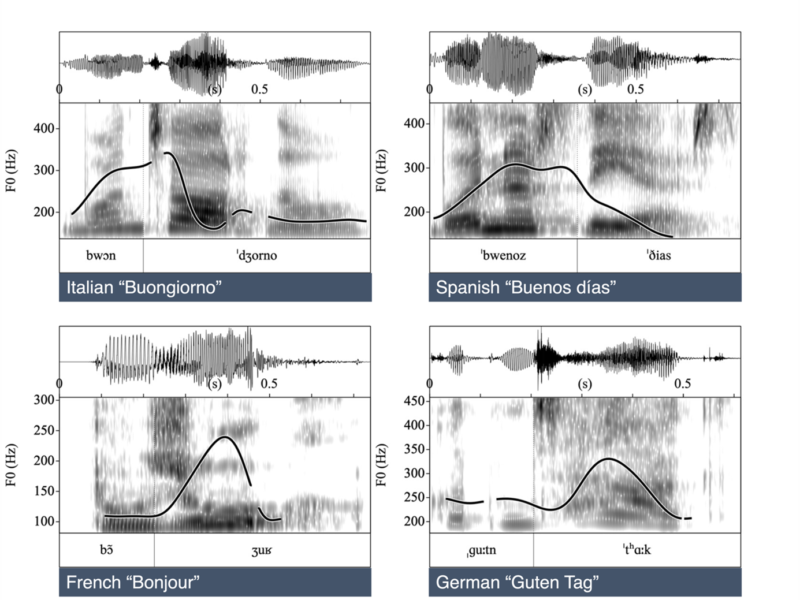
Image 1: Intonation of the greeting “good morning” in different languages. (The black line shows the fundamental frequency (F0) – an acoustic correlate of the intonation of the utterance).
Every language has its own melodic patterns. For example, in a simple greeting like good morning, some languages emphasize the first part (the adjective), whereas others put the emphasis on the second part (the noun) (see Image 1).
For learners of a foreign language, mastering its intonation is one of the trickiest parts of the learning process.
What is intonation?
Think of Severus Snape drawling, “Mr. Potter… our new celebrity,” the Terminator’s iconic “I’ll be back,” or Phoebe Buffay screaming, “My eyes! My eyes!” Without their distinctive intonation and rhythm, the lines would lose much of their meaning and attitude.
Prosody, after all, is what gives words their soul.
In this article, we will talk about one of the most fascinating prosodic phenomena: intonation.
Try a simple experiment: say the word “dragonfly” as a statement, as a calling chant, as a question, with anger, with surprise, and with sadness. Hear the difference? The word stays the same — dragonfly is dragonfly — but what it communicates changes entirely.
In simple terms, intonation is the melody of speech — the rise and fall of pitch that shapes the meaning of our sentences. It helps us distinguish a statement from a question, signal which word we want to emphasize, or express attitudes such as politeness, irony, enthusiasm, or doubt. Furthermore, intonation interacts closely with grammar and meaning, and can also convey socially relevant information — such as regional accent, age, and gender, among others.
It also helps us understand how a speaker groups words into phrases and where one phrase ends and another begins. Consider the example in Image 2: “Let’s eat, Sam” versus “Let’s eat Sam!” The words are identical, but the melody and phrasing are not — a tiny pause and a subtle pitch change completely alter the meaning. When we write, we use the comma to mark this difference.

Image 2: Intonation saves lives! (Image credit: Radim Peško)
In short, intonation does a lot of work. Without it, our speech would sound flat, ambiguous, or unnatural. It also plays an important role in acquiring our first language(s): together with other prosodic cues, it helps babies identify where one linguistic unit begins and another ends.
Intonation: The overlooked hero of language learning
When learning a new language such as English, learners tend to focus on the more visible parts of the system: grammar, vocabulary, and the pronunciation of individual sounds. And of course, that makes perfect sense — you can’t say much without words and correct sentence structure. But once you’ve memorized verb paradigms and filled your notebook with new vocabulary, something still feels missing.
That something is intonation: the element that makes your speech sound alive and natural.
You can say all the right words and use perfect grammar, but if the melody is off, listeners may still misunderstand your message — or interpret your tone as bored, abrupt, or even rude, even though you had no intention of sounding that way.
Despite how central prosody is to communication, it remains one of the most overlooked aspects of language teaching and learning. Language teaching has traditionally paid considerably less attention to prosody than to grammar, vocabulary, or individual sounds, and intonation is still often treated only briefly in teaching materials. Many teachers also feel unsure about how to teach it, as prosody has historically received limited attention in teacher training.
Take questions, for example. Many people assume that a question must end with rising intonation. But this is far from universal. In many languages, some types of questions can be realized with falling intonation, while in others the crucial pitch movement occurs earlier in the utterance rather than simply at its end. And the reverse can happen too: in several varieties of English, statements may end with a rise. This phenomenon, commonly known as uptalk, shows nicely why a rising melody does not automatically mean “question”.
How learners acquire intonation: What research shows
Learning the intonation of a foreign language is more complex than simply learning whether the voice should rise or fall. The linguist Dwight Bolinger famously called intonation a “half-tamed savage”: partly shaped by linguistic rules, and partly tied to expression and emotion. Mennen (2015) proposes that learners need to master several dimensions of intonation: which melodic patterns a language uses, how these patterns are phonetically realized, what they mean, and how frequently they are used. These dimensions can develop independently — a learner may produce the right melody but use it in the wrong context, or convey the intended meaning with a melody that still sounds foreign.
Like individual sounds, intonation is shaped by the learner’s first language, similarities between the languages, and exposure to the new language. Research shows that some melodies are easier to acquire than others: basic distinctions such as statements versus questions may be easier to master, while subtler meanings such as politeness, irony, or surprise can remain challenging.
Learners also do not simply replace the melody of their first language with that of the new one. Instead, they gradually build a new intonational system of their own, combining L1 patterns with newly acquired ones — and sometimes creating individual melodic contours.
In situations of intensive language contact, even the melody of a language can change. Buenos Aires is a fascinating example. Following massive Italian immigration in the late nineteenth and early twentieth centuries, local Spanish developed intonational features resembling Italian. It has been said that “Buenos Aires speaks with Italian intonation.” Argentina, after all, was once known as l’Australia italiana — “the Italian Australia.”
Bringing intonation into the language classroom
So how can we help learners acquire the melody of a new language? Even short prosodic training programs can lead to measurable improvements in pronunciation, and training that combines prosody with gestures can be particularly effective.
Several techniques can make a difference:
- Raise prosodic awareness by helping learners notice melodic differences between their own language and the target one. Simply showing or explaining these contrasts can sharpen perception and support production.
- Use visualizations and recordings. Seeing their own pitch movements on a screen makes the “invisible” melody of speech easier to recognize and imitate.
- Shadowing — repeating short phrases after or along with a target model — is a useful technique for practising rhythm and pitch.
- Embodied training, such as using gesture to “feel” pitch movement, can help learners internalize prosodic patterns.
- Technology and corpora provide authentic examples and allow learners to explore real intonation data.
Listening closely
In a multilingual world, listening to the melody of another language is more than a technical skill. It is a way of tuning in to other people — of understanding not only what they say, but how they mean it.
References
Baills, F., Alazard-Guiu, C., & Prieto, P. (2022). Embodied prosodic training helps improve accentedness and suprasegmental accuracy. Applied Linguistics, 43(4), 776–804.
Mennen, I. 2015. Beyond segments: Towards an L2 Intonation Learning theory. In E. Delais-Roussarie et al. (eds.), Prosody and language in contact: L2 acquisition, attrition and languages in multilingual situations, 171–188. Heidelberg: Springer.
Vidal de Battini, B. E. (1964): El español de la Argentina. Buenos Aires: Consejo Nacional de Educación.





 This work is licensed under a
One heroic Polish woman gassed in Treblinka (1942), whose Esperantizing of ‘QUO VADIS’ excels the English rendering of a classic that won for Sienkiewicz a Nobel in Literature, knew! Her devotion and talent provide in translation, in an ‘artificial’ idiom, a rendition to match the euphony of famous poems too. She attempted the impossible and did eclipse la bel-son-eco de originalaj poemoj archived here bilingually for your perusal by Googling ALMANAKO LORENZ in Brazil or ESPERANTO SUB LA SUDA KRUCO in Australia:
“Poeziece Esperanto venkas (parto 2)” : p 24-26. “Honore al Lidia Zamenhof” : p. 16 – 17. (Junio 2017) Illustrates Esperanto’s translation-gift of matching classical poems’ nuances & excelling their euphony! Almanako Lorenz 2018 devotes pages 77-88 tri-lingually to Pushkin & Tennyson (Ulysses).
Thanks, Paul! So interesting – I didn’t know any of this …