
Editor’s note: The 111th World Congress of Esperanto is currently taking place in the Austrian city of Graz. According to Austrian National TV, more than 1,100 attendees from 62 countries are attending the event to practice and celebrate the language, which was added to the list of Austria’s intangible cultural heritage only a few months ago.
After Poland and Croatia, Austria is only the third country in the world to recognize Esperanto as part of its intangible cultural heritage but the language is actually spoken worldwide, including by a thriving Esperanto community in Australia. They are proud to host the 112th World Congress in Melbourne next year.
So, from Austria to Australia, this is a good opportunity to learn more about Esperanto. In this post, the Secretary of Esperanto NSW, Nicole Else, demystifies the language and promises a cool incentive: if you start learning Esperanto now, you’ll be ready to attend the 112th World Congress in Melbourne next year.
***
There is one language that is not often mentioned, but is used much more widely than most people assume. It is Esperanto. Even though its name sounds Spanish it has nothing to do with Spanish.
What are the origins of Esperanto?
Esperanto was developed over 100 years ago by Dr L. L. Zamenhof, an eye doctor from the multi-ethnic and multilingual city of Białystok, which was then part of the Russian Empire and is today in Poland. Confronted with inter-ethnic tensions, the young Zamenhof thought that a common language was needed to enhance intercultural understanding. He therefore intended Esperanto to be the language of world peace, and Esperanto literally means “the one who hopes”.
What makes Esperanto so easy to learn?
Zamenhof wanted his language to be easily learned, so he took out all the unnecessary difficulties that can be found in most other languages. The words come mainly from European languages like Latin, French, German, but interestingly the grammar is more similar to Chinese than to the inflectional European languages. The numbers in Esperanto work exactly in the same logical way as in Chinese and Japanese. For example in English it is not obvious what “twelve” means, but in Esperanto “12” is “dekdu”, that is “ten-two” – and that’s exactly how you say “12” in Chinese, too: you just use the word for the number 10 and then add the word for 2.
Another advantage is that the number of words that need to be memorized is much smaller than in other languages. Many people consider that a limitation and believe that you cannot fully express yourself in Esperanto or that it is suitable only for basic conversation. That’s not true at all. You can express yourself in Esperanto as well as in any other language.
Esperanto is a bit like Lego.

4th Esperanto World Congress, 1908 Dresden, including Klara und Ludwik Zamenhof (Image Credit: Wikipedia)
With a limited number of elements, you can make an infinity of words. Esperanto uses many prefixes and suffixes to build words. For instance, how do you say “hospital” in Esperanto? “sana” is an adjective that means “in good health”, “mal” is a prefix that means the opposite, therefore “sick” is “malsana”. “ulo” is a suffix that means a person, therefore “malsanulo” is a sick person, “ejo” is a suffix that means “the place where”. Therefore “hospital” is “malsanulejo”. So you can see that where in English you have to memorize several different words, in Esperanto you just need to memorize one word and the prefixes and suffixes which you will be able to use in a wide range of words.
The spelling is phonetic, so you don’t have to worry about how to spell words.
And the grammar has rules that don’t have any exceptions at all! For example, if I take verbs: to make the present tense you replace the “i” of the base verb with “as”, for past tense you put “is”, and for future tense “os”. Therefore “I close” will be “mi fermas”, “I closed” is “mi fermis” and I suppose you can already guess what “mi fermos” means. There is not a single irregular verb. Just by reading this, you have already learned how to conjugate every single verb in Esperanto in those three tenses.
Is Esperanto artificial?
Esperanto is sometimes referred to as an “artificial” language, but for me it doesn’t feel artificial at all. Let me share a bit of my story: I grew up in France in a family where my parents and grandparents were all Esperanto speakers. Therefore, I learnt Esperanto as a young child. Through engaging with the Esperanto community and attending gatherings in various countries, I met my husband who is British, and gained many friends from all around the world, particularly Chile, Croatia, Japan, Hungary, and others.
You can learn more about people who learned Esperanto as their first language in this video.
And there is another way to look at the artificial-natural debate: one could say that Esperanto is more natural than English. If you listen to young children speak, they will naturally want to generalize rules and say “one mouse, two mouses”. In English they are not allowed to speak in that natural way, but in Esperanto they can.
Do we need Esperanto when everyone speaks English?
First, it is of course a myth that everyone speaks English. Millions do speak it, but the majority of the world’s population (about 80%) do not speak it or have only a very basic knowledge of English. Many people struggle a lot with English, and even many native speakers can’t spell it!
It is extremely time-consuming to learn English. This means that native English speakers have a ginormous advantage as they can express themselves with ease and don’t have to spend hundreds or even thousands of hours of their lives studying a language to be able to communicate internationally.
Is Esperanto too European?
.JPG)
Esperanto Place, Graz (Image credit: Wikipedia)
It is true that many Esperanto words come from European languages. At first glance it would seem fairer if at least one word would come from each of the 6,000 or so languages in the world, but that would be very impractical. This is a problem to which there is no perfectly fair solution. But why should Esperanto be held to an impossible standard? Some people seem to reject Esperanto precisely because it doesn’t meet this impossible standard of total fairness. It is true that a French person will learn Esperanto a bit faster than a Chinese person. But the important thing is that Asian people will learn Esperanto much faster than English. So, the use of Esperanto would be a big improvement even for people who don’t speak Romance, Germanic or Slavic languages.
Esperanto is a nice idea, but does anyone actually speak it?
While Esperanto is not yet used as a universal second language, there are enough Esperanto speakers to make its study worthwhile. I have met so many interesting people through Esperanto – for instance, my friends include an astronomy professor from Israel and a Croatian poet, neither of who I would have met without Esperanto.
Even though it seems to me that the world would be much fairer and it would save hundreds of hours to millions of people if Esperanto would be used as a neutral, easy-to-learn common language, it is not going to happen in the near feature. That doesn’t mean that it is useless to learn Esperanto now. I think speaking Esperanto has enriched my life, not financially, but by meeting people from many different cultures, countries, walks of life.
When you travel, you don’t have to rely on chance to find Esperanto speakers, because there are lists of people who are willing to meet you, show you around, or even let you stay at their place for free.
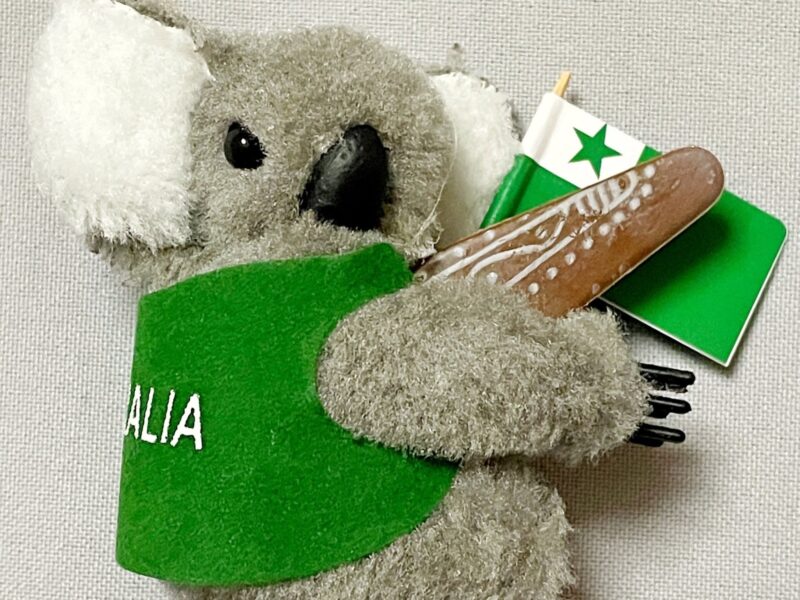
Koala souvenir with Esperanto flag (Image credit: Melburna Esperanto-Asocio)
There are lots of Esperanto gatherings, the biggest is the World Esperanto congress which is held once a year.
Start learning Esperanto now to attend the 112th World Esperanto Congress in Melbourne
One way to learn Esperanto is to do a free online course at www.lernu.net or on the Duolingo website. If you are in Sydney, you can attend classes on Saturdays in Redfern. The teacher is originally from Korea, btw.
If you start learning Esperanto this year, you will be ready to fully enjoy the congress next year. There will be scientific talks, concerts, discussion groups, theatre, and much more. There might not be quite as many attendees as in Graz but hundreds of Esperanto speakers from around 50 different countries are expected to attend.
I am looking forward to the event very much. Will you be there too?
It will be a unique experience with no interpreters and people communicating on an equal (or nearly equal) footing.



 This work is licensed under a
I am going to participate the congress in Melbourne.
Very good article.
I m from Brazil and also my mum and my brother are Esperanto speakers. My wife is polish and i met her in 2001 in a youth Esperanto festival in Italy. This language has opened literally so many door for me on trip and personal contacts. It is very easy to leanr and so many practical uses of it.
Lovely to read a little more about Esperanto, Nicole! And I do love consistent grammar rules 😉
We often talk about how languages grow and are maintained by communities, but your experience also reminds us that communities can be built and flourish around a language. All the best with next year’s Congress!