
Editor’s note: The 2026 Hamburg International Summer School “Literacies for Social Participation” has come and gone. For those of us fortunate enough to attend, it was an epic learning opportunity with over 30 participants from Australia, Canada, China, Germany, the Netherlands, Norway, Portugal, and Taiwan.
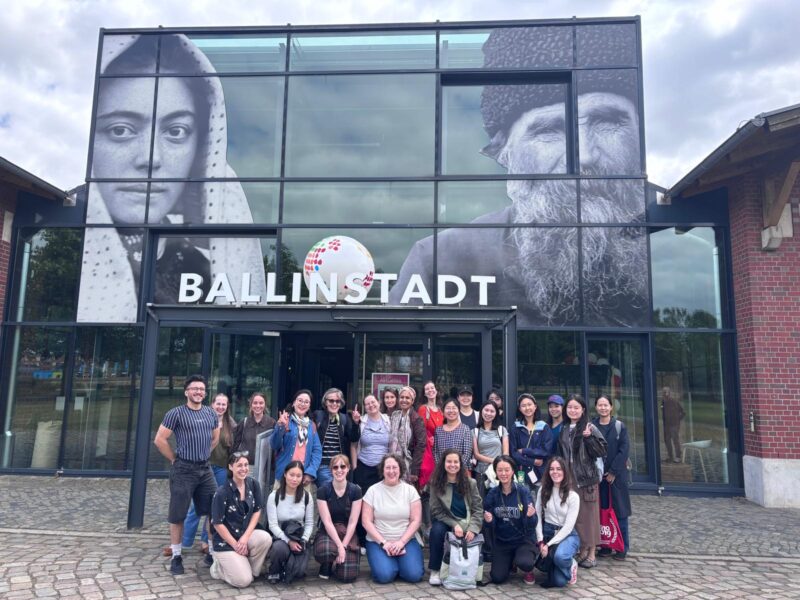
Attendees of HISS2026 “Literacies for Social Participation” pose for a group photo in front of the Emigration Museum (Image credit: Language on the Move)
In this composite post, three of our international participants – Dr Yixi (Isabella) Qiu from Tongji University, and Tazin Abdullah and Brynn Quick from Macquarie University – reflect on their experiences during their time at the University of Hamburg.
***
From Student to Speaker: Finding Epistemic Belonging in HISS
Dr Yixi (Isabella) Qiu, Tongji University
Language is always on the move, and so are we.
This July, I arrived in Hamburg for the first time. Yet the city did not feel entirely unfamiliar. I had already participated in the Hamburg International Summer School (HISS) twice, first as an online student participant and later as an online teaching assistant. This summer, I finally crossed the screen and entered the classroom as an invited speaker, leading a workshop on academic literacy and artificial intelligence.
Throughout my stay in Hamburg, one question stayed with me:
What makes someone feel that they belong in a multilingual community of knowledge?
Looking back, I do not think the answer lies in one defining moment. It emerged gradually through small encounters, conversations, and quiet acts of intellectual generosity that made me feel my questions mattered and my voice had a place.
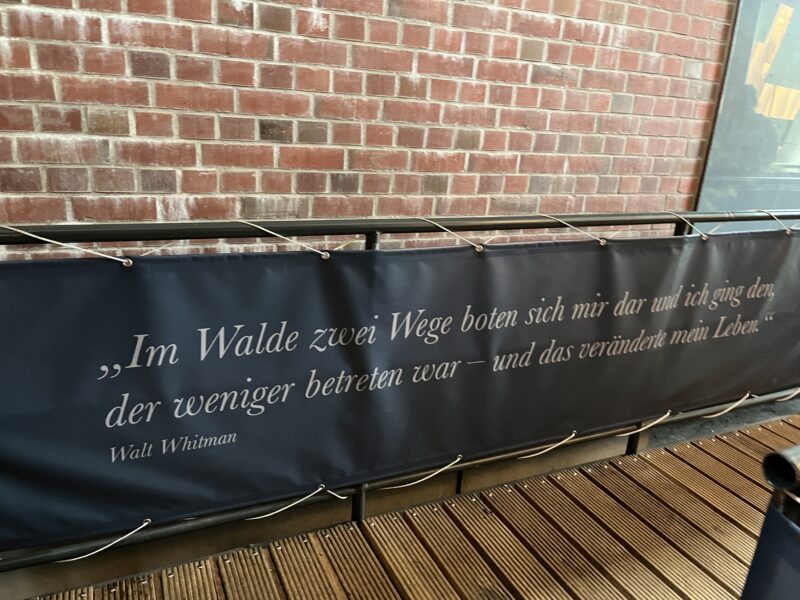
Lines from the Robert Frost poem “The Road Not Taken” misattributed to Walt Whitman in Emigration Museum display (Image credit: Language on the Move)
One of these moments took place during our visit to Hamburg’s Emigration Museum. As we walked through exhibitions on migration, ethnography, and colonial history, our conversations moved naturally between languages, histories, and perspectives. At one point, Professor Ingrid Piller noticed a citation error on one of the exhibition panels. What followed was not simply a discussion about an incorrect reference. It became a conversation about evidence and authority. What could easily have been ignored became an opportunity for collective inquiry: Who produces knowledge? Who is represented? What responsibilities do researchers have when knowledge enters the public sphere?
Perhaps this was what epistemic belonging felt like, not being given answers, but being invited to question how that knowledge had been produced, represented, and authorized.
The museums became spaces for dialogue rather than places to simply receive information. At the Museum am Rothenbaum – originally founded as a colonial museum of cultural history – conversations with fellow Language on the Move team members, including Vera Williams Tetteh, Tazin Abdullah, and Brynn Quick, invited us to reflect on colonial histories from different perspectives. Concepts such as epistemic justice and multilingual participation, which I had long encountered in my own research, became tangible through these shared conversations. They were more than analytical concepts for understanding others’ experiences. They became ways of interpreting my own participation in the multilingual encounters unfolding around me.
Answers to my question also emerged beyond lecture rooms and museums.
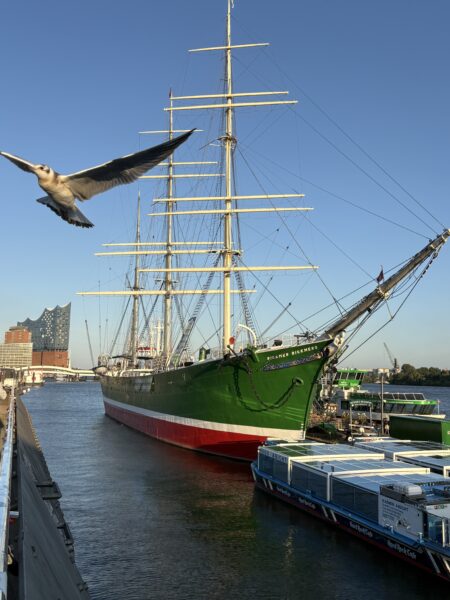
The museum ship Rickmer Rickmers, moored in Hamburg Harbor, with the Elbphilharmonie in the background. Hamburg has long been a place where people, languages, and ideas are on the move. (Image credit: Yixi Qiu)
Like many visitors, I quickly developed a habit of turning to generative AI in everyday life. AI helped me translate supermarket labels, understand product instructions, navigate public transport, and occasionally explore the history behind places that caught my attention. As I found myself reaching for AI almost automatically, I began to wonder whether this habit echoed what Professor Ingrid Gogolin has conceptualized as a monolingual habitus, shaping how I engaged with unfamiliar languages and places.
AI made Hamburg more accessible to me. I could understand the words and find my way around the city, yet feeling part of it depended on something more relational.
During our city walks, student organizers turned streets, buildings, and bridges into stories, introducing us to Hamburg’s Hanseatic history, multilingual heritage, and connections with the wider world. Gradually, my understanding of the city no longer depended only on translation. It grew through conversations, shared experiences, and the generosity of people who invited me into their ways of seeing the city. For example, learning to call the Elbphilharmonie “Elphi”, the local nickname Olga Vlasova, one of the student organizers, taught me, felt like a small act of participation rather than simply learning another name.
AI helped me gain access. People helped me participate.
Perhaps what stayed with me most throughout my stay in Hamburg was something I would describe as hidden hospitality. It appeared in ordinary moments: when several passersby stopped to ask whether I needed help with my luggage; when a stranger, seeing my confusion after a platform change, told me to follow her because she was also going to Lübeck; when a hotel staff member, instead of simply selling me a bottle of water, suggested that I could get one much cheaper at the nearby train station if I was not in a hurry; when someone switched into English to keep me in a conversation; or when a discussion continued long after class had ended. These moments were different. Some were practical, others linguistic or intellectual. Yet they shared something important: someone was making room for another person to participate. I began to think of this as a kind of everyday hospitality, often quiet and easily overlooked. But such gestures were not only about kindness. They also shaped who could access information, navigate unfamiliar spaces, make themselves understood, and participate on more equal terms. In this sense, everyday hospitality also had an epistemic dimension. It could soften, even if only momentarily, the inequalities of knowledge, language, and power that structure participation.
When such hospitality entered more explicitly into spaces of knowledge-making, through translation, explanation, listening, questioning, or simply taking another person’s perspective seriously, it created the conditions for epistemic belonging to grow. Through these repeated acts of hospitality and participation, knowledge began to feel less like an individual achievement and more like a collective journey.
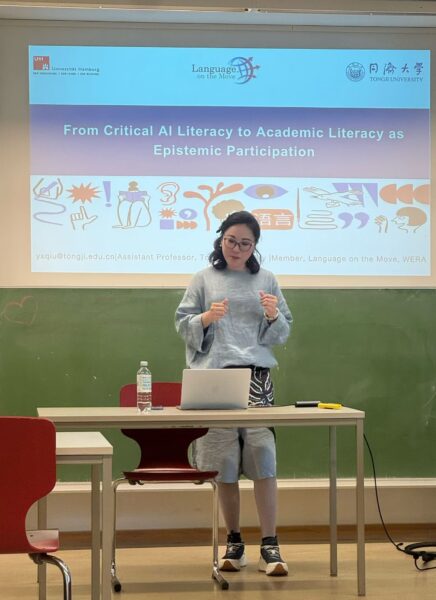
Dr Yixi Qiu teaching a session on critical AI literacy at HISS2026 (Image credit: Language on the Move)
These reflections followed me into my workshop on academic literacy and AI, which built on Dr. Yevgeniya Yudytska’s introduction to critical AI literacy earlier that day. The workshop grew out of my ongoing research on AI-mediated academic writing, supported by the Shanghai Magnolia Pujiang Talent Program and the National Social Science Fund of China. Yet my journey in Hamburg encouraged me to take this work further by exploring it within a multilingual and multicultural space. The question, I came to realize, was not only how AI changes the ways we think and write across languages, but also how it reshapes who can participate in knowledge-making, how they participate, and whose voices are heard. Standing in front of the classroom brought this question into sharper focus. Our conversations moved beyond AI itself. Together, we explored questions of academic literacy, responsibility, multilingual trajectories, and knowledge construction, as well as what it means to write academically in collaboration with both humans and technologies.
I left Hamburg with more questions than answers, questions about multilingualism, AI, and social participation. Yet perhaps that uncertainty was, itself, part of the journey.
Epistemic belonging, I began to understand, is not about arriving at certainty, but about continuing to participate in a community where knowledge remains open to questioning and negotiation, and where new voices can enter and contribute.
My sincere thanks go to Distinguished Professor Ingrid Piller for creating a space where epistemic belonging could grow, and to the organizing team, my fellow participants, and everyone who made this journey possible, a journey of growing confidence across languages, roles, and communities of knowledge.
HISS2026 reminded me that language is always on the move. And so is knowledge. And so are we.
***
HISS Highlights
Tazin Abdullah and Brynn Quick, Macquarie University
How are African literacies hidden in broad daylight? How did people in early modern Europe learn languages before these were standardized? How does AI actually work to produce plausible-sounding texts?
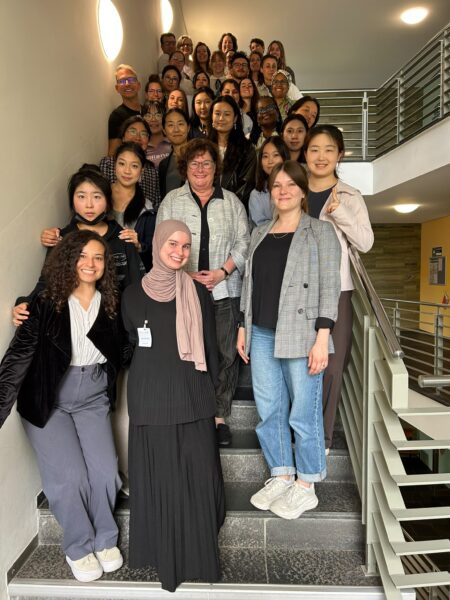
Participants of the doctoral symposium “Literacies for Social Participation” pose for a group photo (Image credit: Language on the Move)
These are some of the many fascinating questions explored during the Hamburg International Summer School (HISS) “Literacies for Social Participation”, which took place at the University of Hamburg over two weeks in July.
For the two of us, HISS provided an excellent opportunity to deepen our research and develop our networks as we head towards the final leg of our PhD journeys.
Thanks to the generous Postgraduate Research Funding (PGRF) from Macquarie University, we were able to travel to Hamburg and attend HISS along with a doctoral conference, also devoted to “Literacies for Social Participation.”
This very rewarding academic and personal experience was organized by the superb Alexander-von-Humboldt Professorship team and hosted by the Literacy in Diversity Settings (LiDS) Research Center.
Now back in Sydney, we are very pleased to say that we achieved far beyond what we thought we would and have returned richer in knowledge and friendships. Here are the seven highlights from our time at the Hamburg International Summer School:
- Purposeful human interactions. Summer School allowed us to meet, in person, colleagues whose work we had read or had previously only interacted with online. The great benefit of face-to-face settings stretched generously over two weeks is the space to spend quality time with our fellow researchers and learn from one another. In these settings, academic conversations are not restricted to one workshop or lecture but extend to multiple opportunities for exchanges that develop concepts and ideas. For example, our Humboldt Professorship team colleagues led us on a tour of Hamburg to places such as the Chilehaus and Speicherstadt, teaching us about the factors that have historically made it a city of both immigration and emigration. During the tour, we not only learned from these colleagues but got to know them better as well, and chats about all of our exciting research projects featured prominently along our walk.
- Insight into diverse research contexts. We attended daily workshops and a series of presentations on cutting-edge research from around the world and from researchers at various stages in their academic journeys. The diversity of research contexts, data sources and methodologies in sociolinguistics laid out for us the possibilities to make our work relevant internationally. On full show was the truly multifaceted and inter-disciplinary nature of sociolinguistic inquiry – from teaching and learning in multilingual contexts in Canada, family language policy in Norway, linguistic landscape in the Croatian seaside to literacy challenges in Taiwan and much, much more.
- Mentoring and feedback from senior academics. Currently at the final stages of our PhD journeys, we received priceless input from mentors who dedicated time to guide us on our data analyses and thesis writing. We were able to have multiple meetings with our mentors to discuss the work we have in common, and we set up future podcast recording dates with these mentors and other academics at HISS. Brynn even recorded one podcast episode with her mentor, so watch our Podcast space for that future episode!
- Presentations. In addition, we had the opportunity to present our research at a doctoral symposium. During these presentations, we received feedback from professors from several universities around the world and we returned with copious notes. Imagine getting this level of attention in one place!
- Brynn’s research highlight. Brynn really enjoyed hearing Dr. Nicole Marinaro’s lecture entitled Linguistic diversity and social participation in healthcare: overcoming communication barriers in the medical field. This lecture directly tied in to Brynn’s PhD research context where she has been investigating how Australian healthcare policies and organisations facilitate language support for patients with limited English proficiency. Dr. Marinaro offered a fascinating discussion on the European conventions regarding professional interpreters in healthcare, and Brynn was able to compare and contrast these conventions to those in Australia.
- Tazin’s research highlight. Tazin was very inspired by the real-world impact of Dr. Martin Serif Derince’s research on the language use of the Kurdish community in Germany. Dr. Derince’s mentorship proved highly significant to Tazin’s research on the practical barriers faced by women from linguistically diverse communities when they try to access domestic violence information. Their discussions provided an excellent guide on how to present Tazin’s academic research in academic, policy, and community contexts, so that the results of the research reach appropriate audiences in a meaningful way and be of real benefit to women who may be subject to domestic violence.
-

Fun at HISS2026: participants diving into the children’s exhibit at the Emigration Museum (Image credit: Yixi Qiu)
Last but not least, networking over tours, coffees, lunches, dinners and dessert. It may sound like we were researching the culinary scene of Hamburg, but what the Summer School provided was a unique opportunity to socialize in a highly intellectual atmosphere. In the company of our colleagues, we were able to experience Hamburg through museums, exhibitions, and historical sites such as the The Emigration Museum – BallinStadt Hamburg and Museum am Rothenbaum Cultures and Arts of the World. On their own, these experiences are enriching. However, in the company of our fellow researchers and teachers, we engaged in discussions about sociolinguistics and literacy – we could see how our research connects to language in society from history to present. Of course, these were also copious opportunities to discuss future research collaborations.
Overall, the Hamburg International Summer School “Literacies for Social Participation” allowed us to make meaningful connections. It reminded us of the value of true academic friendships. We leave convinced, more than ever, that academia is not just about the formalities of exchanging information and knowledge. Our two weeks of academic companionship underlined the importance of professional and personal support to growing as academics and individuals. Our many exchanges reminded us that meaningful friendships are a combination of listening to the needs of others, applauding achievements, and guiding when necessary. We finished with a renewed and shared commitment for our research to contribute to society and to earnestly search for ways to have real-life impact in the world.



 This work is licensed under a
Thank you for this beautiful reflection! As a student educated in China,I notice that English is always taught as a subject to be tested instead of a language to live with, and we actually seldom delve deep into the epistimic logic behind the new knowledege we required .Sometimes I wonder even when I can choose the correct answer,how can I confirm a theory is reliable or how to apply it into real encounters.It also puzzles me whether the hidden hospitality not only depends on individual kindness, but also is called forth by the multilingual backgrounds. Where monolingual habitus is the norm,does the apparent lack of hospitality perhaps caused less by people’s willingness than by the linguistic literacy limit and the scarcity of occasions to practice it?
Thank you so much for this beautiful recap! It was so lovely to read and brought back so many memories from our time in Hamburg. It was such a rich experience in every way: academically, through the connections we made, the food, the culture, and all the new people we met.
Thank you for sharing this insightful reflection! I learned so much from this summer school, especially about how epistemic belonging is fostered through everyday interactions and how different perspectives can be brought into dialogue to create more inclusive learning spaces. I could really relate to Bella’s experience when I first came to study in Europe. Everyone here seemed so multilingual, and I was constantly surrounded by languages that were unfamiliar to me. Fortunately, I was welcomed by a kind and supportive academic community that helped me navigate all the unfamiliarity. The inspiring lectures and engaging discussions gave me many new ideas that I will continue to reflect on in my own research. Thank you to everyone involved for creating such a welcoming and intellectually enriching experience!